






Rick Mills, Editor/ Publisher, Ahead of the Herd:
Last year, about this time, we started talking about gold, silver and copper and the junior resource companies focused on them. And it turned out we had a fantastic year. Our readers reaped the rewards of being ahead of the herd on where gold, silver and copper prices were going. Our predictions for many juniors to participate in our anticipated junior market revival after years of stagnation proved prescient.
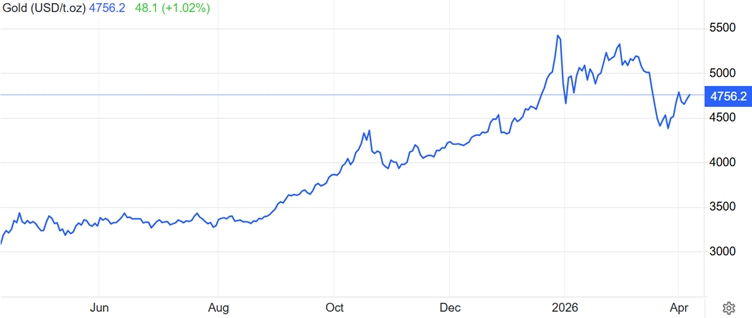
Gold’s come off, but that was not unexpected by you, given the current geopolitical situation.
Trading Economics
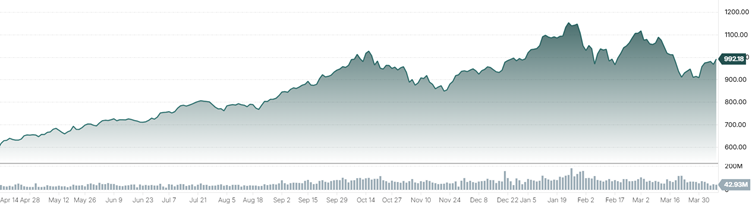
TSXV volume
Quinton Hennigh, CEO, San Cristobal Mining:
I think gold is prescient. It tends to front-run a lot of things. Look at gold since 2024. Were we in the current situation we are in the latter half of 2024? No.
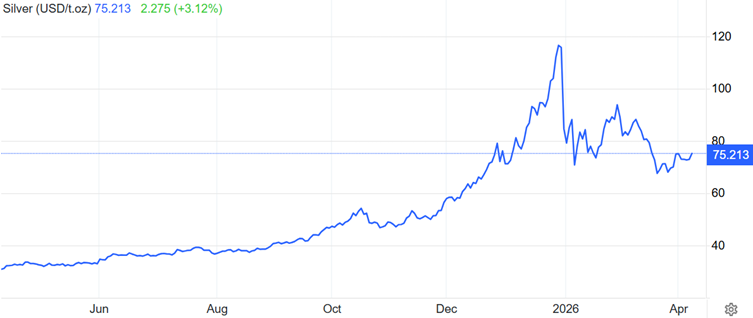
The elections were coming up in the US and yeah, there was uncertainty, but there wasn’t this global chaos that we’re seeing right now. Yet gold went on a tear, basically. It went from $1,800, I think, what was it, March of 2024. It was over $2,000 by the end of 2024. And it went all the way up, peaked at $5,500 just a little while ago.
Yeah, it’s pulled back, but it’s a new regime. It’s price discovery, gold’s finding its place where it’s going to be comfortable.
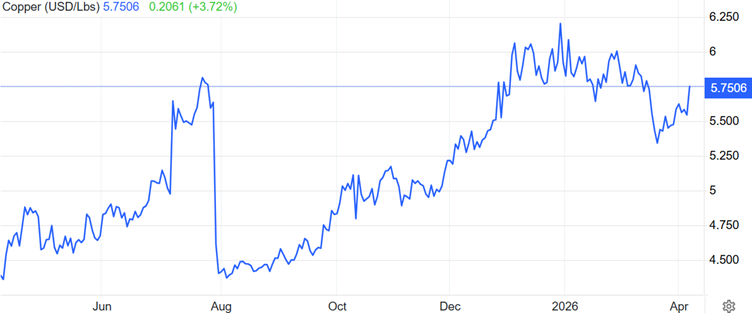
Other metals follow, okay? Silver followed, and copper is following.
Trading Economics
Trading Economics
And yeah, you’re going to see a cascade. Agriculture is going to follow, and then ultimately wage inflation is going to come. Wage inflation tends to be the last.
RM: I’m seeing a bit of a sector focus switch into critical metals, citing security of supply issues.
QH: Yes we are, there’s definitely been a pivot. Is it all about the supply side of these? Going out and finding new deposits? No, absolutely not. It’s about refining capacity. We in the United States blew it years ago.
China’s got all the refining capacity. What we should be doing right now is instead of pouring billions of dollars into chasing deposits we need to be building refineries here in the United States.
RM: Well, if you haven’t got the smelting and refining for any metals, I mean, the US has, for instance, three copper smelters. They’re all so old. They’re using technology with dinosaur dust on it. One of them doesn’t work very well. It’s down half the time.
The US could mine all its own copper. They do. As a matter of fact, they could easily mine 140% of their copper needs.
The problem is they can only refine 40% of their copper needs. The rest is shipped to China. When you look at Canada, we have one small copper smelter in Quebec.
All the copper produced in British Columbia is shipped to Asia. We want to be a metal superpower. How do you get to be a metal superpower? Certainly not by throwing money at mines to get them to produce more copper to ship to China.
You want to talk about idiocy. How about some of these companies with stranded metal? And they’re telling everybody they’re the next great thing. Why find all that metal when you can’t move it? You’ve got no railway. Are you going to truck the concentrates many hundreds of kilometers?
QH: There’s so much wasted capital, wasted effort right now. I hate to see money coming into this industry that really isn’t smart. It’s dumb money. And it gets misallocated.
It’s no better than the Green Deal crap that we saw a few years ago under Biden. I love the philosophy that we need to rebuild the mining industry. But for crying out loud, let’s do it right.
And let’s not screw it up by pissing away all this money and using these endeavors that just aren’t going to generate a pound of copper, an ounce of gold or anything. This is just a waste of time.
RM: You’re right. Why not put the money into training people, enticing them into school to become geologists, mining engineers, the people we need, business types to run these things. And why don’t we build some smelters? Why don’t we build some refineries? Why don’t we put in some railways so when we fund the finding of the metals, we can actually ship them to the smelters? Everything is just ass backwards the way we’re looking at it.
We need to do this right, but we need to do it. And we can’t just rush at it because then it becomes another government boondoggle and a waste of time for all of us.
The last time we talked was two months ago, and I mentioned Au Gold (TSX-V:AUGC), Mark Blythe’s Havelock Project in the Victoria goldfields, Australia. You said you really liked it and you wanted to get involved in it a little bit. Did you ever manage to?
Under the Spotlight – Marc Blythe Founder, President, CEO & Director Au Gold Corp
QH: I did. I put some money into the last private placement. I think the project does look like it’s a true epizonal gold system. The structural controls look pretty intriguing. It’s got that structural sauce that I like to see, they call it a complex structural system that can host a lot of ounces.
Au Gold Corp Identifies High-Grade Gold Targets at its Havelock Project, Victoria, Australia
It reminds me of Southern Cross Gold’s (TSX-V:SCGC) Sunday Creek project down there.
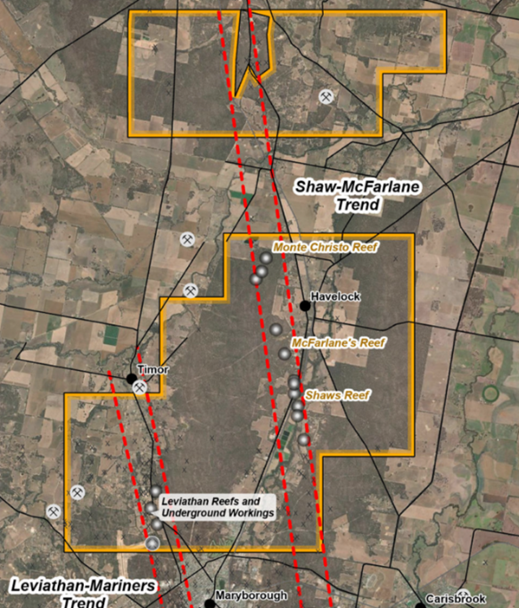
The Project is located in the heart of the Victorian goldfields near
Maryborough, roughly halfway between Bendigo and Ballarat
RM: There are several epizonal deposits in the area, Sunday Creek, Fosterville and Costerville These deposits formed roughly 60 million years later than the deeper, classic mesozonal system like Ballarat and Bendigo.
QH: Yes, they’re of the same ilk. They’re kind of sprinkled into the Victorian gold fields. There’s several of these epizonal systems, meaning shallow, high-grade gold systems, probably associated with late-stage granites that are part of the orogenic systems down there. They tend to have an antimony component, that’s a signature of these epizonal systems. You certainly see that with Au Gold’s project.
RM: We’ve talked about David Hoffman’s Orestone Mining (TSX-V:ORS) before. They’ve done the mapping and they’ve outlined an oxide gold stockwork mineralized trend that’s a strike length of 1,100m and it’s on a moderate relief hill.
Orestone initiates exploration on Francisca Gold Project with mapping and sampling program
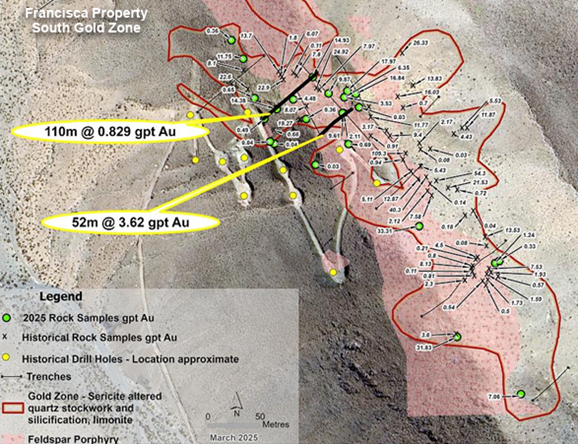
Last January they put out a news release that they were going to be working on it, and we haven’t heard much since. Are you still favorable towards this project and the work they’re doing?
QH: Absolutely, I like to see good science and from what I see that’s what they’re doing, so yes absolutely. I’m a strong supporter.
RM: We were both excited about Rackla Metals (TSX-V:RAK) prospects last year. Unfortunately, the drill program didn’t work out the way anybody wanted or expected. I wasn’t against the drill program. If we did it this year and we found the same thing, we’d just be one year later. More work would not have changed the results, imo. If I can get your thoughts on that.
Rackla plans 10,000m drill program at Lentung tungsten property
And then what are you thinking about the jump to the Lened tungsten property to the (renamed) Lentung? It seems like United Carbon had quite a database there, a very impressive amount and apparently of quality. What are you thinking about the switch to tungsten here?
QH: Rackla was the heartbreaker of 2025. That one was a shocker. I really thought that would generate a new gold discovery. Yes, they hit some gold. They certainly hit the bismuth and the tellurium in the system as well from the data they presented.
But it did not hit the gold like we see at Snowline Gold’s (TSXV:SGD) Valley deposit or something like that. Now they’re pivoting to tungsten. You’re going to do a bit of mental readjustment.
This part of the intrusive belt, the Tintina/Tombstone-type belt is better known for tungsten, especially at the east end. There are some very big reduced intrusive systems here with appreciable tungsten.
What does it take to make a tungsten deposit work? One of the keys with tungsten is metallurgy. You’ve got to see metallurgy that says you can actually recover the tungsten.
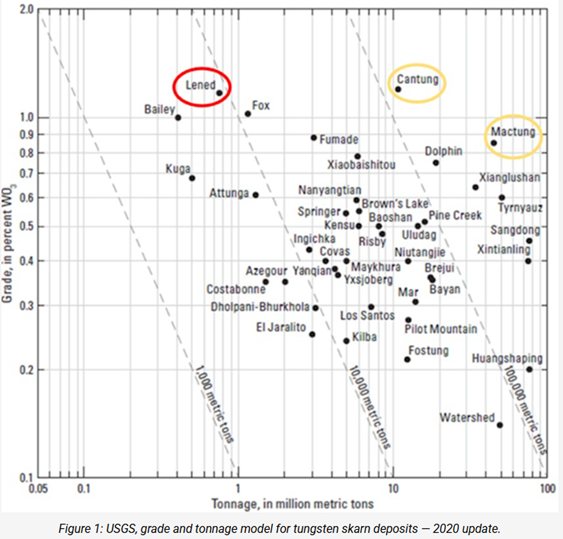
In this case, in almost all reduced intrusive systems, the tungsten occurs as a mineral called scheelite. Scheelite is basically calcium tungstate, which is a white brittle mineral. It has very good cleavage, meaning when you smack it, it tends to disintegrate along cleavage planes. It breaks down fairly easily and is soft. To make scheelite work, the key is this:
You’ve got to have a rock that when you mill it, it doesn’t break the scheelite down preferentially over the rock that you’re milling. There’s a lot of tungsten deposits where the host rock is very hard. The problem there is that you go after that kind of tungsten and you’re milling the hard rock to break it down so you can release these particles of scheelite.
In turn, the scheelite gets absolutely grounded into bug dust and you can’t recover the darn stuff. Fortunately, it sounds like these guys have a more reduced intrusive-type system where the scheelite is distributed in the intrusion itself. That’s a big plus for the system.
Can they define a large volume of intrusive, with sheeted veining and stuff? They seem to be on the right path. And they’ve got a smart team. I think if they can demonstrate to the world by the end of this season that they can pull that off, I think this could be a very good opportunity.
RM: I was talking to Brian Savage the other day. Electric Metals (TSX-V:EML) is a new sponsor of Ahead of the Herd, and I’m very happy about it. We’ve talked for over a year now, and when I first started talking to you, you were technical advisor to Crescat Capital, your hat right now is CEO of San Cristobal Mining.
Are we going to have to start introducing you now as chairman of Electric Metals along with chairman of San Cristobal?
You’ve put your name on Electric Metals, it’s a fascinating company, and it is critical metals, manganese.
QH: First of all, you’ve got to understand that I’ve known Brian (Brian Savage CEO – Rick) for quite some time. I like Brian a lot. He’s a very smart individual. He’s probably one of the most knowledgeable people I’ve ever met in the manganese space.
He has a very good sense of every single level of the manganese space from the geology to the engineering and production, and all the way up through the actual refining and usage, and more importantly, the supply chain of manganese.
He knows manganese inside and out. When Brian came to me in 2024, I think it was mid-2024 and asked if I could join as director and then chairman, I said, Brian, manganese is in the dumps right now.
Yep, it’s in the dumps. What’s the case here? And he laid it out. He showed me everything from basic supply chain – we talked about the reorganization of the world, the global supply chains.
He explained it to me in a very simple picture that was extremely compelling. Basically, the West needs to secure its own manganese supply chains. There’s a lot of new uses coming up for manganese that are going to mean additional refining capacity, other particular refining products that are going to be needed, things like this.
I said, okay, so what do you want to do about it? I can’t go into the details about what the company is working on, but I would say in the next six to 12 months, I think you’ll see a fundamental change where Electric Metals becomes a significant producer of manganese products for the global supply chain. And between Brian and Tyson and a few others on the team there, Rick and so forth, we’ve got an excellent team.
These guys know what they’re doing. And that’s what I need to see in the company. So, I’m very happy to be part of the story.
Am I a manganese guy? No, not at all. I have public company experience and I’m happy to help make some connections, which I did for the financing. We got Eric Sprott in there, by the way.
It’s funny because Eric found out about Electric Metals, independent of my introduction, he called me up one morning. He said, okay, you’ve got to tell me more about this. And I explained the concept of what we’re going to work on.
And he jumped in. He put in $2 or $3 million on the back of one of the raises we did. So, Eric’s actually a big believer in manganese, which kind of caught me off guard, but he’s got the right view.
Buy low, sell high. These are the stories you want to put money into while the commodity is soft.
RM: It’s an interesting story because you’re mating up a high grade manganese district and the Emily deposit to a future processing plant.
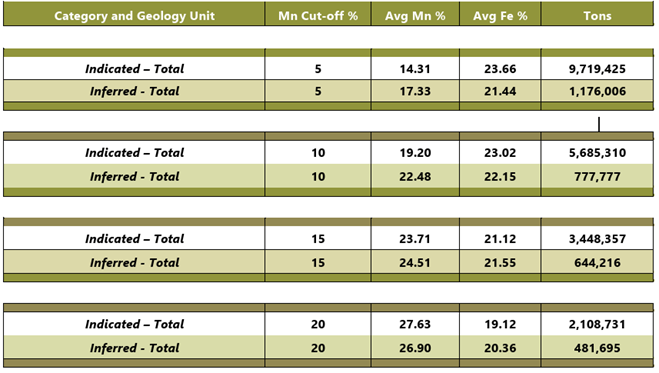
While a significant manganese resource exists at the Emily deposit, the resource defined by Barr Engineering represents only a small portion of a much larger area of manganese-iron deposition along strike and down-dip that was previously drilled by Pickands Mather and U.S. Steel in the 1940s and 1950s,
The Emily’s the highest-grade manganese deposit, according to USGS, in the northern hemisphere. You’re going to mate it with exclusive exploration, mining and processing rights of manganese ore in the Cuyuna Iron Range, Crow Wing County, Minnesota. You’re going to incorporate the construction of a 100,000-tonne per year high-purity manganese sulfur monohydrate (HPMSM) plant.
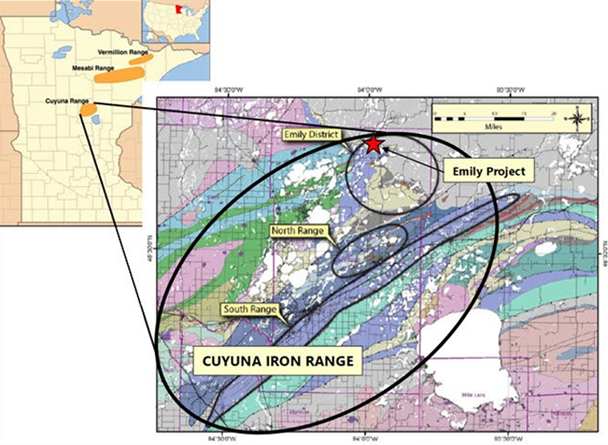
So, you’re marrying this high-grade manganese, the highest in the northern hemisphere, with production of the high-purity manganese sulfide monohydrate. Now, that sounds like a winning combination.
It seems to me that it’s not only the potential opportunity to go mining, but also potentially kicking in some manufacturing as well, and capture not just the upstream or downstream, you’re capturing the whole damn stream.
QH: That’s precisely the business model here. It is about everything from the mining side of it all the way to producing very specialty products in the manganese space, correct.
RM: Which just isn’t happening a lot in the US if there’s any, is there?
QH: No, it’s not. It’s almost a lost art. There’s a very precious handful, a few plants out there that produce these products. And here we are about to embark into some high tech uses, modern uses of manganese that aren’t even on most people’s radar yet.
So, we’ve got to ramp up our ability to produce quality manganese products in the United States, absolutely.
RM: Okay, we’ve got three left.
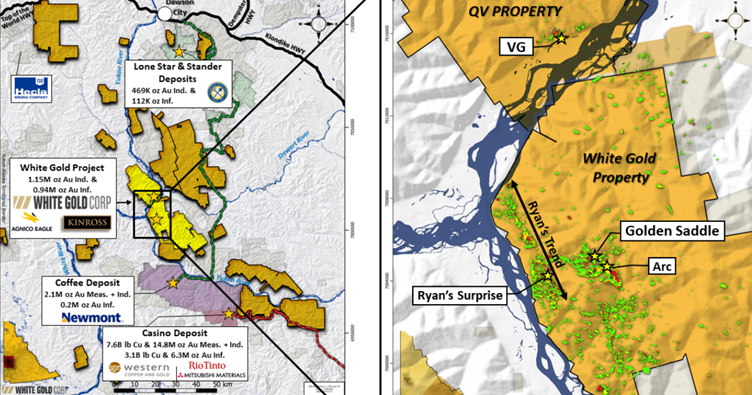
White Gold (TSX-V:WGO). We talked about White Gold early last year. You went up and you visited David D’Onofrio. You talked to Dylan Langille. You talked to Sean Ryan several times. These guys put together one hell of a program, and it really paid off for investors.
What do you think about WGO going forward now?
QH: The White Gold story, I did talk to the team about a week and a half ago. I really like the team, like Dylan, all the rest of the folks. What impresses me is that they really do have a concrete understanding of the controls on the gold deposits now, that I think by and large was lacking previously.
So, I think these guys, as they take this understanding, they start showing some of these targets again or testing new targets even, I think they’re going to have a very strong success rate. I think that this particular style of deposit is orogenic gold, okay, and there’s no question these are orogenic deposits.
But the particular style of deposit here reminds me of some of the great orogenic systems that we have in the southwest United States and into northern Mexico. So, I see a strong similarity between the White Gold area, we’ll call it this area south of Dawson, and places like La Herradura in Mexico, where you can get 10-plus million-ounce deposits sprinkled over the terrain. I think these guys are onto it.
I think they’ll do the good work to find these. And the best part is the grades are there. I mean, they’re finding some very handsome grades, 2-3 grams per tonne. It’s not, point X gram per tonne or 1 g/t. This is 2.5, 3.5 grams per tonne-type grades.
RM: I don’t think there’s anything quite like it for an open pit, and it’s shaping up to have a starter pit, in North America, is there? The grades seem to be exceptionally high.
QH: It is. These things will go down to the bowels of the earth, too. But as an open-pit target, these is one of the highest-grade things I’ve seen in recent history.
RM: We were very high on Harvest Gold (TSX-V:HVG).
We went into the drill program, I’ll say, with some high expectations. We talked about the northern part of the Mosseau and we got smoke.
Under the Spotlight Rick Mark CEO Harvest Gold & Louis Martin Technical Adviser Harvest Gold
We got some good solid sniffs of copper and gold smoke. We came down, we drilled some holes into the central, the Kiask River Fault, which a lot of the length seems to be a mirror image of the rocks over where Gold Fields’ (NYSE:GFI) Windfall deposit is. We talked to Louis and Rick, and we’re talking structures, we’re talking layers, we’re talking just exceptional exploration potential.
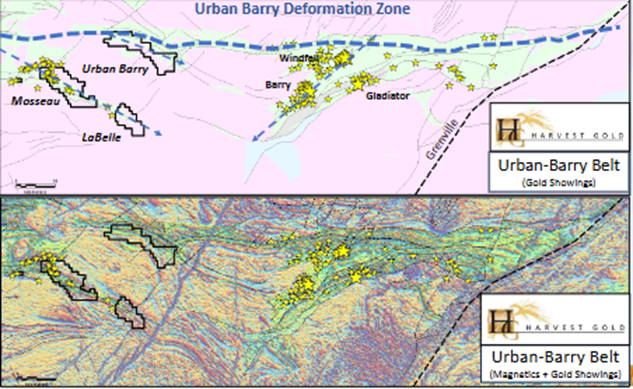
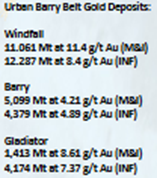
We did hit 100-and-some grams per tonne over 1.15 meters. And it wasn’t just one chunk. Apparently, the visible gold was spread over the entire 1.15 meters. Where are you on HVG right now?
QH: They’re going to have to raise some more money. But as a first pass drill program goes, any time you manage to hit a 100-gram meter hole, I don’t care if it’s, like you said, just 1.15 meters of 100 and something grams. That’s fine.
Okay, that works. You don’t have to hit 100 meters of a gram or something like this. I actually like the high-grade nature of this particular hit, because this camp is known for high grades, okay? You don’t hit stuff like this at random in a hole out in the middle of miles and miles of nothing.
To manage to find a geophysical target, the structural target, go in there, poke a hole and hit high grade, that’s a good omen. Yeah, they could have got lucky. Sure, that’s a possibility.
I’d love to think that all geologists are just inherently lucky. But the corollary is it’s telling us something about the geology. There is gold here.
And it is high grade. And I think everybody should pay attention.
Now, the company has thought about picking up a few scraps of additional land, which I think is good. And they’re collecting other data. But yeah, they’re going to have to get some money in the bank and go out there and give this thing another go.
I bought shares, would I participate in another placement? Yeah, I’d probably participate in a placement. I think it’s a discovery. It’s not like super flash in front of everybody’s face — 100 grams over a meter.
Yeah, it goes kind of quick in many people’s views; everybody’s got ADHD. But in my view, it didn’t slip by me. I’m a believer.
RM: It’s so easy for a deposit like Windfall to be hiding in those rocks that we’ve got to go back. We’ve got to do another drill program. It’s just that simple.
QH: I agree. I’m right with you.
RM: Tell us about BCM Resources (TSX-V:B).
QH: BCM is drilling currently for a porphyry copper skarn target in Utah. The fellow who runs the company, Sergei Diakov, is one of the best-known copper geologists in the geologic world.
He found Oyu Tolgoi in Mongolia. He’s an absolute rock star. Sergei and his team developed this target, which is underneath a gravel flat out in the middle of nowhere in southwest Utah a few years ago. They went in and tested it. We were big supporters.
Crescat put some money in alongside a lot of other fairly savvy investors. And they went out and tested, and it was hole 8 where they hit 155 meters of about 0.85% copper equivalent. It was mainly copper with a bit of gold, bit of silver and a little bit of moly, I think.
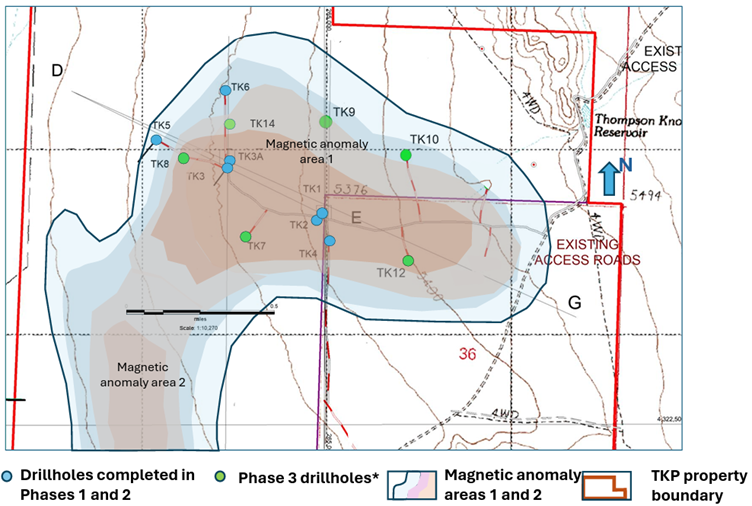
Anyway, it was a significant intercept, 155 meters. Now, a lot of people said, oh, it’s kind of deep. It’s underneath this gravel.
That doesn’t bother me so much because the target here is what you’ve got to understand. We’re looking for a Bingham Canyon-scale target or a Robinson porphyry target or something like that. Both world-class deposits that are within the neighborhood of this system.
So, they hit that drill hole in May of 2023. The market was going pear-shaped at that point; everything was turning soft. They had very little chance to raise additional money and get back to work. So, what I did with Sergei is I funded a student at Colorado School of Mines who studied the discovery hole.
And he also studied some of the other holes that had been drilled across the property. They basically came up with a vector for future drilling. And that’s what we chased.
I worked with Sergei once all of this technical work was done and we could see what the vector was, which is to the southwest. We got some money into Sergei’s hands recently and now we’re drilling.
We’ve completed our first pre-collar hole and now they’re core drilling. They’ll be down at target depth over the next week or two.
We’re going to find out if there’s something really super-big here. This is a swing-for-the-fence-type story. I think the science behind it is absolutely compelling. It’s already got a discovery hole in it. And I think this next hole, hopefully, will show that the vectoring that we did is accurate and that we’re going to actually home in on the prize here. I think we’re going to hit something big.
RM: Okay. Thank you for your insights, Quinton.
QH: Thanks Rick.
Subscribe to AOTH’s free newsletter
Richard does not own shares of Electric Metals (TSX-V:EML) and BCM Resources (TSX-V:B).
Richard owns shares of Au Gold (TSX-V:AUGC), Orestone Mining (TSX-V:ORS), Rackla Metals (TSX-V:RAK), Electric Metals (TSX-V:EML), White Gold (TSX-V:WGO), Harvest Gold (TSX-V:HVG)
Au Gold (TSX-V:AUGC), Orestone Mining (TSX-V:ORS), Rackla Metals (TSX-V:RAK), White Gold (TSX-V:WGO), Harvest Gold (TSX-V:HVG) and Electric Metals (TSX-V:EML) are paid advertisers on his site aheadoftheherd.com
This article is issued on behalf of Au Gold (TSX-V:AUGC), Orestone Mining (TSX-V:ORS), Rackla Metals (TSX-V:RAK), White Gold (TSX-V:WGO), Harvest Gold (TSX-V:HVG) and Electric Metals (TSX-V:EML)
Quinton owns shares of Au Gold (TSX-V:AUGC), Orestone Mining (TSX-V:ORS), Rackla Metals (TSX-V:RAK), Electric Metals (TSX-V:EML), White Gold (TSX-V:WGO), Harvest Gold (TSX-V:HVG) and BCM Resources (TSX-V:B).
Legal Notice / Disclaimer
Ahead of the Herd newsletter, aheadoftheherd.com, hereafter known as AOTH.
Please read the entire Disclaimer carefully before you use this website or read the newsletter. If you do not agree to all the AOTH/Richard Mills Disclaimer, do not access/read this website/newsletter/article, or any of its pages. By reading/using this AOTH/Richard Mills website/newsletter/article, and whether you actually read this Disclaimer, you are deemed to have accepted it.
Divests US$13.5M McEwen Copper Debt to Further Enhance Liquidity ... READ MORE
Aura Minerals Inc. (NASDAQ: AUGO) (B3: AURA33) is pleased to anno... READ MORE
Montero Mining and Exploration Ltd. (TSX-V: MON) (OTC Pink: MXTRF... READ MORE
Barksdale Resources Corp. (TSX-V: BRO) (OTCQB: BRKCF) (FSE: 2NZ) ... READ MORE
Getty Copper Inc. (TSX-V: GTC) (OTCQX: GTCDF) is pleased to an... READ MORE