






Volta Metals Ltd. (CSE: VLTA) (OTCQB: VOLMF) (FSE: D0W) announces assay results from drill holes SL26-29, SL26-30 and SL26-38, completing the 13-hole 2026 winter drill program at its Springer Rare Earth Element deposit, near Sturgeon Falls, Ontario, Canada.
Drill holes SL26-29 and SL26-30 tested the core of the deposit, averaging about 1% TREO over 351.0 metres and 286.5m, respectively, with gallium mineralization present throughout the full assayed lengths. SL26-29 also returned the highest-grade rare earth and gallium intercept of the 2026 program, while SL26-30 intersected a zone enriched in the high-value heavy rare earth elements dysprosium and terbium. See Tables 1 to 3 for details.
“SL26-29 has raised the bar again in the heart of Springer, returning 7.54% rare earth oxides and 283 g/t gallium oxide over 2.95m within a 165.3-metre interval grading 1.36% TREO. Importantly, the drill hole remained strongly mineralized at depth, with a sample near the bottom of the hole returning nearly 2% TREO more than 400m below surface. SL26-30 highlights another important dimension of the Springer system – intersecting enrichment in dysprosium and terbium, two critical heavy rare earths used in high-performance permanent magnets. Both drill holes average approximately 1% rare earth oxides over roughly 290m to 350m, with more than 30 g/t gallium oxide in every sample,” said Kerem Usenmez, President and CEO of Volta.
WHY THESE RESULTS MATTER
Table 1: Selected assay highlights from drill holes SL26-29, SL26-30 and SL26-38, Springer Rare Earth Deposit.
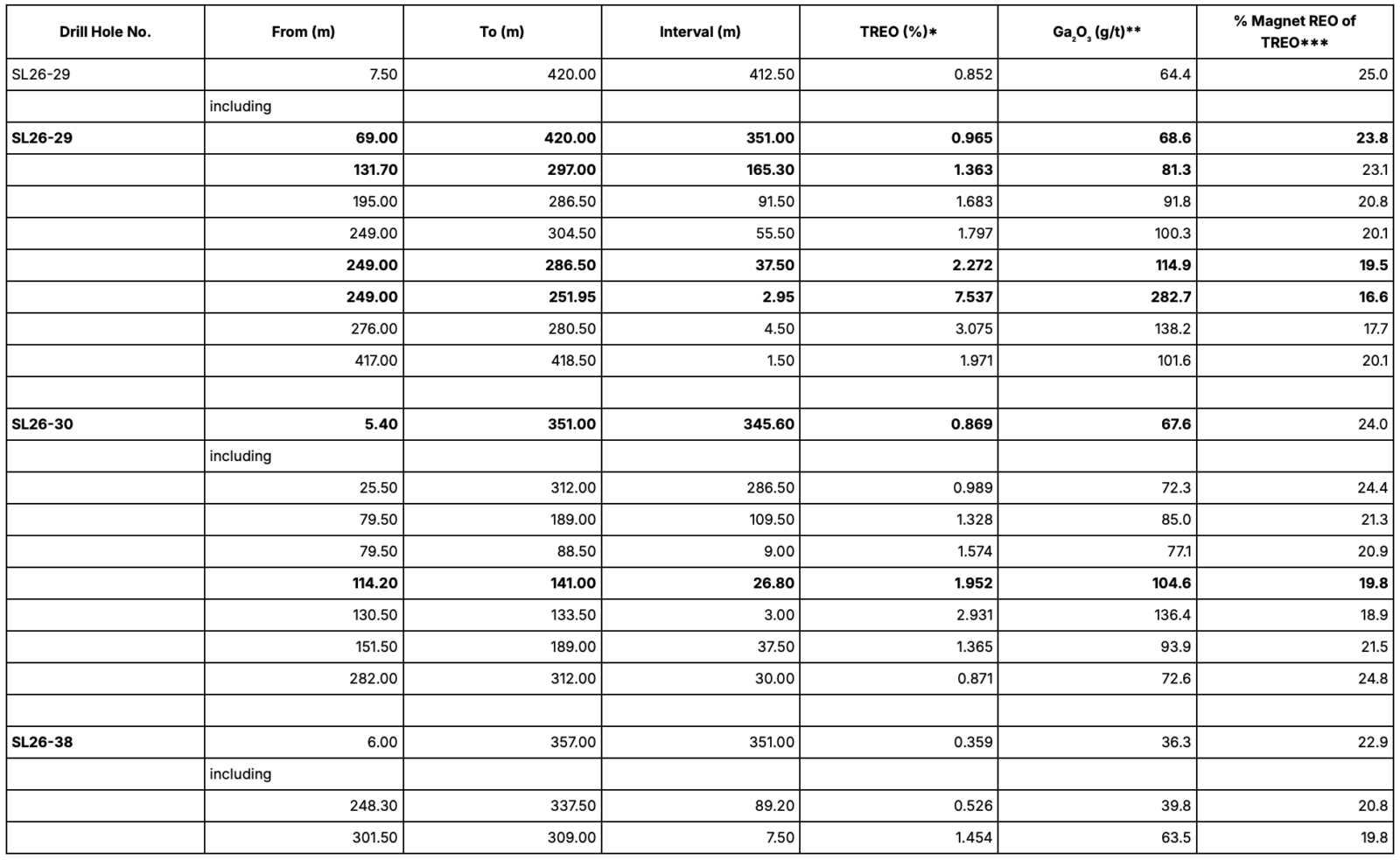
Rows marked “including” are higher-grade sections within the interval above them.
True thickness/width of mineralization is unknown; intervals are reported as downhole core lengths.
*TREO (%) = La2O3 + CeO2 + Pr6O11 + Nd2O3 + Sm2O3 + Eu2O3 + Gd2O3 + Tb4O7 + Dy2O3 + Ho2O3 + Er2O3 + Tm2O3 + Yb2O3 + Lu2O3 + Y2O3 (%).
**Ga2O3 (g/t) is calculated from assayed gallium (Ga) ppm using the stoichiometric factor 1.3442.
***% Magnet REO = (Pr2O3 + Nd2O3 + Tb2O3 + Dy2O3) / TREO x 100. Pr2O3 and Tb2O3 are derived from assayed Pr (ppm) and Tb (ppm) using stoichiometric conversion factors of 1.2082 and 1.1762, respectively.
DETAILS
The following sections summarize results from each hole, with assay highlights presented in Table 1. At Springer, rare earth and gallium mineralization is consistently associated with white dolomite-carbonatite veins.
SL26-29: Highest Grade intercept of the 2026 Program and Mineralization Remains Open at Depth
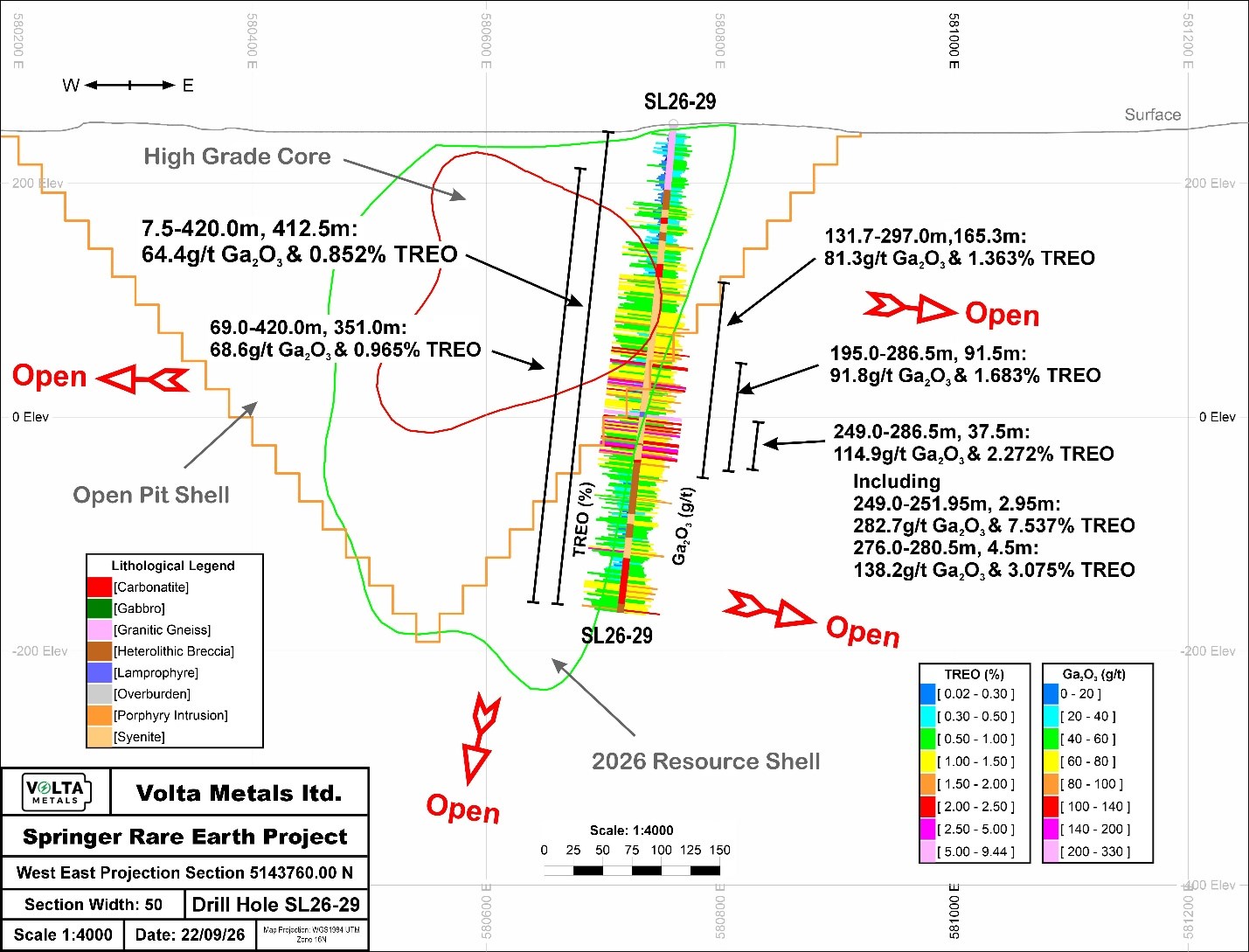
SL26-29 was drilled through the centre of the Springer deposit and the high-grade resource shell (Figure 2). The hole indicates good to excellent mineral continuity within the core of the deposit and extends rare earth and gallium mineralization approximately 190m beyond the eastern limit of the current conceptual resource open pit.
SL26-29 was continuously assayed from 7.5m to 420.0m, returning an average of 0.85% TREO and 64.4 g/t Ga2O3 over 412.5m – see Table 1 for details. Higher-grade intervals include 91.5m grading 1.68% TREO and 91.8 g/t Ga2O3 (from 195.0m – 286.5m), 55.5m grading 1.80% TREO and 100.3 g/t Ga2O3 (from 249.0m – 304.5m) and 7.54% TREO and 282.7 g/t Ga2O3 over 2.95m (249.0m – 251.95m), including 7.67% TREO and 297.1 g/t Ga2O3 over 1.45m (250.5m – 251.95m). The 2.95m interval also contains 3.90% CeO2, 2.18% La2O3 and 1.25% Magnet 4 (Pr2O3 + Nd2O3 + Tb2O3 + Dy2O3), the four rare earth oxides principally used in high-performance permanent magnets. In the highest-grade intervals, cerium and lanthanum make up most of the rare earth content, so magnet rare earths form a lower share of TREO (Table 1) even though their absolute grade is higher.
Within the centre of the deposit, rare earth and gallium mineralization is associated with two principal textures:
A sample near the bottom of the hole (417.0m – 418.5m) returned 1.97% TREO and 101.6 g/t Ga2O3 in red syenite with carbonatite veins. Because SL26-29 was drilled at a dip of -85°, this sample lies more than 400m below surface. The result is consistent with a vertically extensive carbonatite-hosted system that remains open at depth.
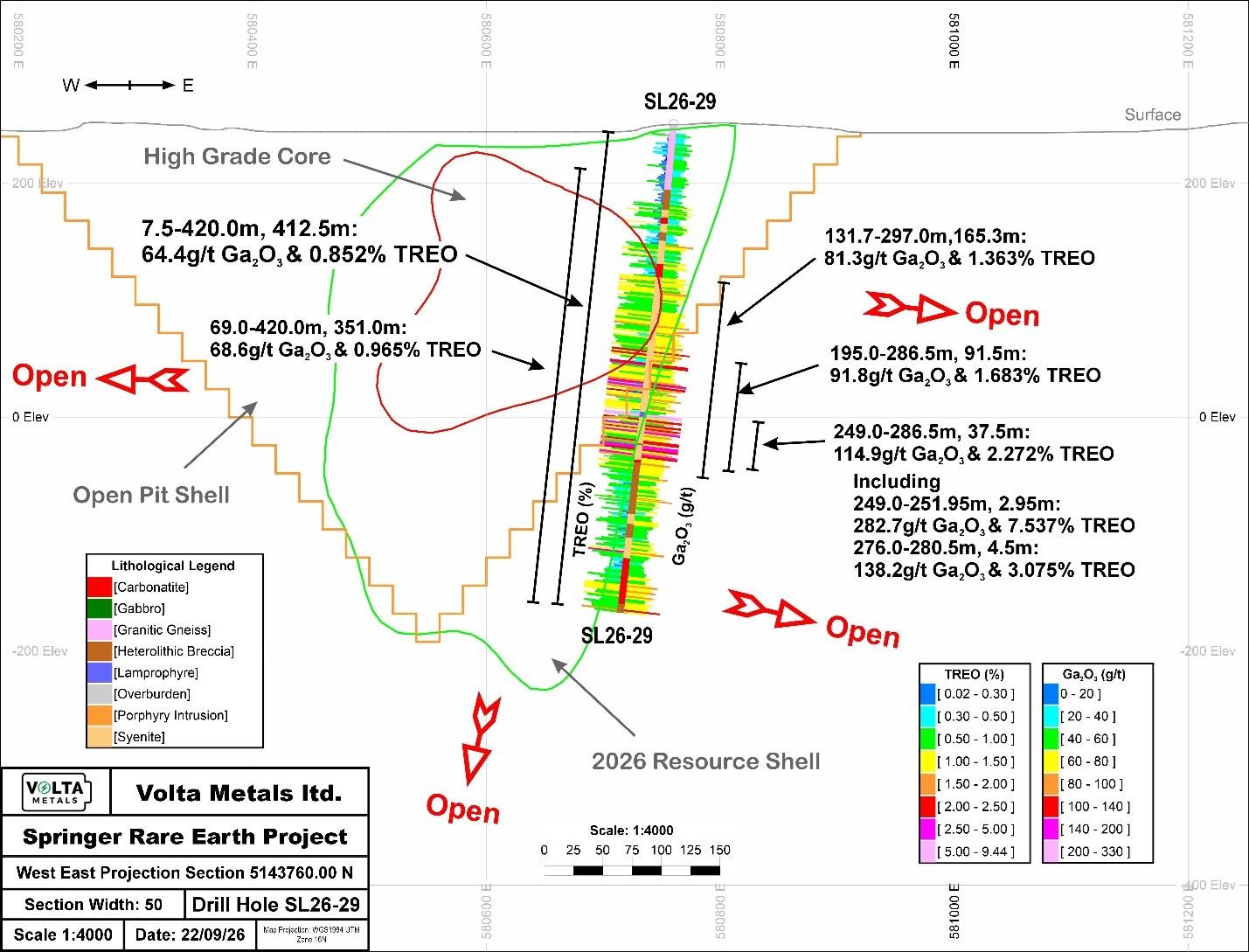
Figure 2. Cross section for drill hole SL26-29.
To view an enhanced version of this graphic, please visit:
https://images.newsfilecorp.com/files/9598/316790_740e40b934c48bf5_001full.jpg
SL26-30: averages 0.87% TREO and 67.6 g/t Ga2O3 over 345.6m, including 26.8m of 1.95% TREO and a Heavy Rare Earth Enriched Zone
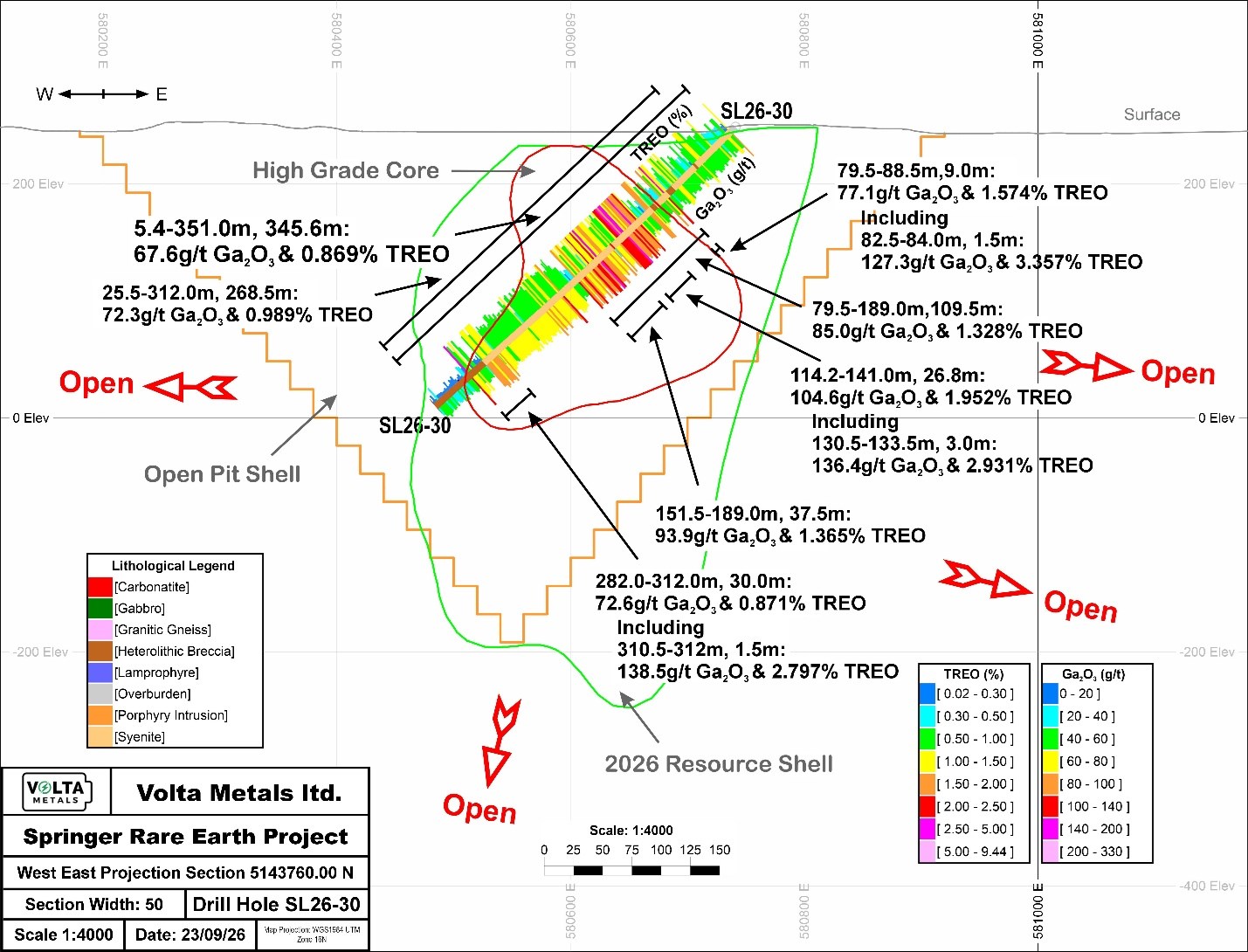
Similar to SL26-29, SL26-30 passes through the centre of the Springer deposit and infills between drill holes SL11-02, SL11-04 and SL12-08 (Figure 4).
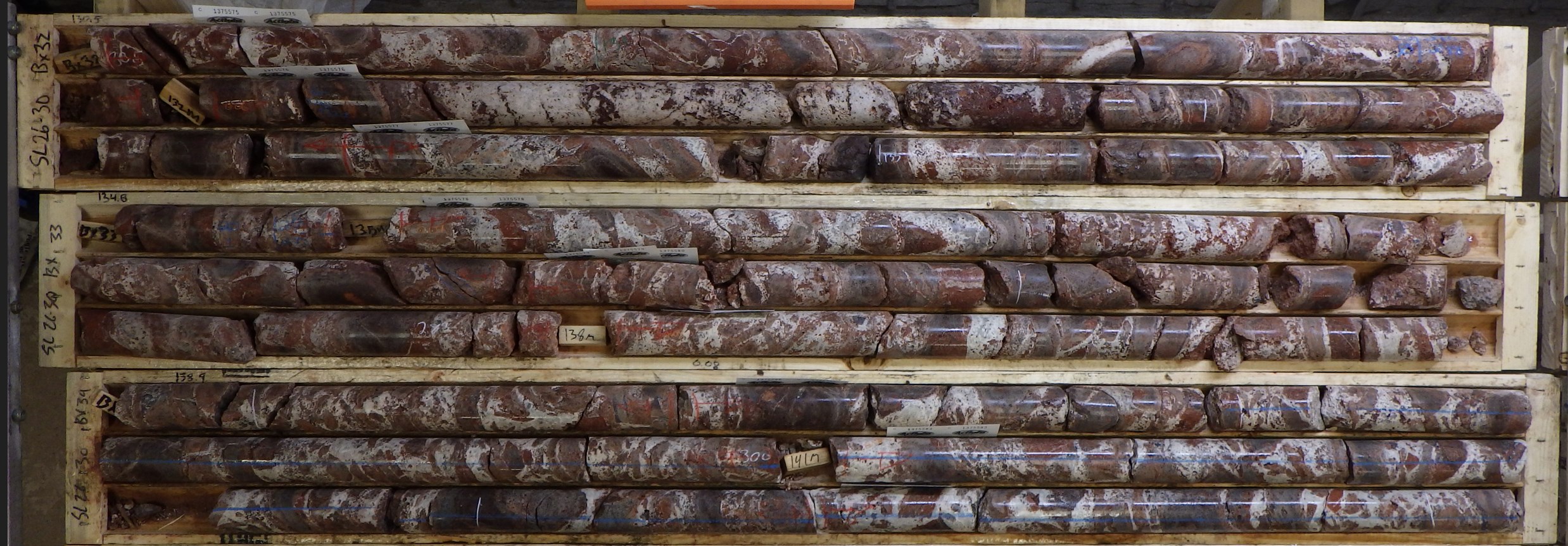
SL26-30 was continuously assayed from 5.4m to 351.0m and averages 0.87% TREO and 67.6 g/t Ga2O3 over 345.6m. The highest-grade zone is 26.8m grading 1.95% TREO and 104.6 g/t Ga2O3 (114.2m – 141.0m, Figure 3).
Heavy rare earths. From 127.5m to 130.5m, heavy rare earth oxides make up 18.2% of TREO, with 278 g/t Dy2O3 and 44 g/t Tb4O7 over 3.0m grading 1.50% TREO (Table 2). A wider 9.0m interval (121.5m – 130.5m) grades 238 g/t Dy2O3, 1.78% TREO and 97.95 g/t Ga2O3. Dysprosium is valued principally for its use in high-performance permanent magnets.
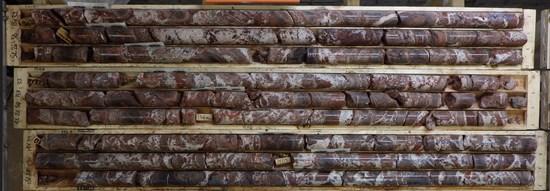
Figure 3. SL26-30 high-grade TREO and Ga mineralization in red syenite and white carbonatite, 130.5m – 144.1m, boxes 32–34.
To view an enhanced version of this graphic, please visit:
https://images.newsfilecorp.com/files/9598/316790_740e40b934c48bf5_002full.jpg
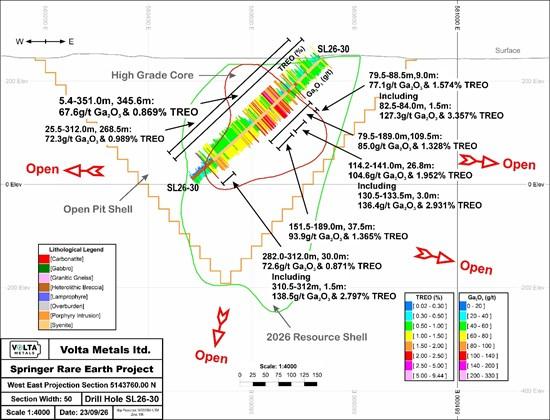
Figure 4. Cross section for drill hole SL26-30.
To view an enhanced version of this graphic, please visit:
https://images.newsfilecorp.com/files/9598/316790_740e40b934c48bf5_003full.jpg
SL26-38: Infill Drilling in the South Part of the Deposit
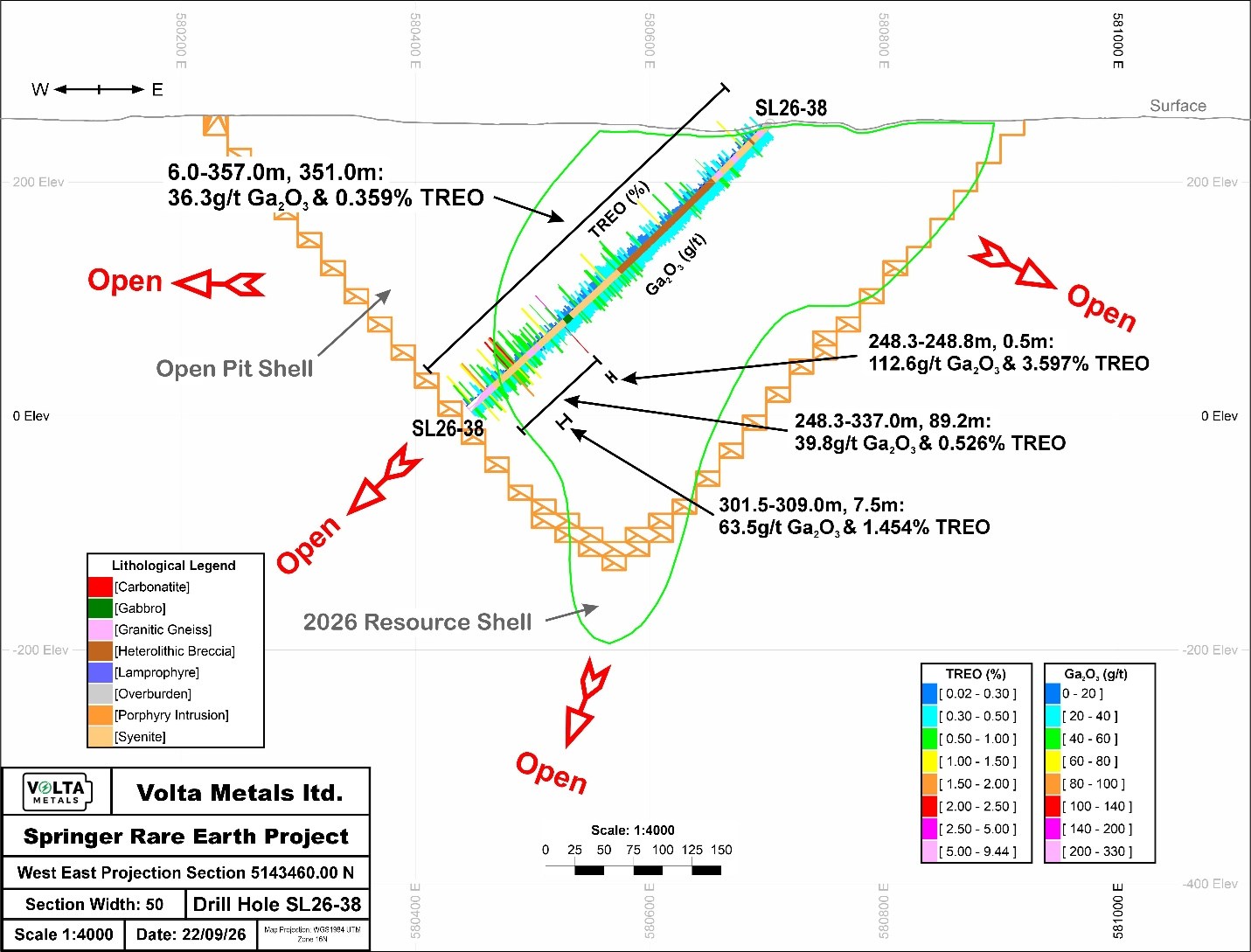
SL26-38 intersects the southern portion of the Springer deposit (Figure 5). It infills between drill holes SL12-20 and SL12-17, passing through syenite and ending in granitic gneiss. The drill hole averages 0.36% TREO and 36.3 g/t Ga2O3 over 351.0m (6.0m – 357.0m), including 89.2m grading 0.53% TREO and 39.8 g/t Ga2O3 (248.3m – 337.5m).
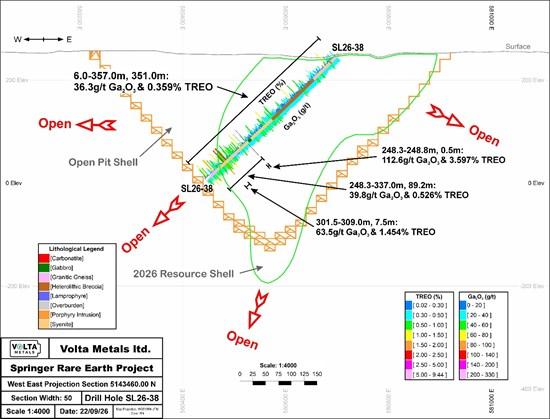
Figure 5. Cross section for drill hole SL26-38.
To view an enhanced version of this graphic, please visit:
https://images.newsfilecorp.com/files/9598/316790_740e40b934c48bf5_004full.jpg
Table 2: Heavy rare earth highlight intervals, SL26-29, SL26-30 and SL26-38, Springer.

*HREO (%) = Gd2O3 + Tb4O7 + Dy2O3 + Ho2O3 + Er2O3 + Tm2O3 + Yb2O3 + Lu2O3 + Y2O3 (%). % HREO of TREO = HREO / TREO x 100. Dysprosium (Dy2O3) and terbium (Tb4O7) are highlighted separately as the two rare earth oxides most valued for high-performance magnet applications.
Table 3: Springer drill hole collar locations. UTM NAD 83, Zone 17.

Azimuth and dip are collar orientations. No downhole directional survey was completed.
NEXT STEPS AND UPCOMING MILESTONES
With these latest results, assays for all 13 drill holes of the 2026 winter drill program at Springer have been received and released.
Volta is targeting completion of two mineral resource estimates for Springer in the fourth quarter of 2026:
Both estimates would be prepared in accordance with National Instrument 43-101 and CIM Definition Standards.
The Company cautions that the timing of both mineral resource estimates depends on the completion of supporting metallurgical and analytical work and on the availability of the Company’s independent consultants. There is no assurance that either estimate will be completed within the anticipated timeframe, that a gallium mineral resource will be defined at all, or that any updated rare earth mineral resource estimate will be larger or higher grade than the current MRE. Mineral resources are not mineral reserves and do not have demonstrated economic viability.
RESOURCE ESTIMATE
On February 23, 2026, Volta reported an updated Mineral Resource Estimate (“MRE”) for the Springer deposit, effective December 31, 2025, prepared by SLR Consulting (Canada) Ltd. The MRE comprises 56.6 Mt Indicated at 0.70% TREO (including a near-surface high-grade core of 11.5 Mt at 1.10% TREO) and 119.5 Mt Inferred at 0.58% TREO (including a near-surface high-grade core of 3.0 Mt at 1.16% TREO). Resources are reported within an optimized open pit shell above a C$43/t net metal revenue cut-off. Revenue is driven primarily by praseodymium and neodymium, which together account for approximately 90% of total net metal value. The MRE placed Springer among the top 10 largest REE deposits in North America based on the S&P Global Market Intelligence database (2025). The Company cautions that mineral resources are not mineral reserves and do not have demonstrated economic viability.
Mineralization remains open in all directions. Gallium is not included in the current MRE and will be reported separately. An NI 43-101 Technical Report supporting the MRE was filed on SEDAR+ on April 9, 2026.
QA/QC PROTOCOL
All drilling was completed by a diamond drill rig producing NQ-size core. Volta implemented a strict QA/QC protocol in processing all rock samples collected from the diamond core obtained from the Springer property. The protocol included inserting reference materials, in this case high-concentration and low-concentration certified rare earth element and gallium standards, blanks, and drill core duplicates, to validate the accuracy and precision of the assay results. All collected rock core samples were cut in half by a rock saw, placed in sturdy plastic bags and zip-tied shut while under the supervision of a professional geologist. The remaining half core was returned to the core box, which is stored on the Property. The samples were shipped from Volta’s core shack in Sturgeon Falls to the Saskatchewan Research Council’s facility in Saskatoon, Saskatchewan, using the Manitoulin Transport freight shipping company.
The drill core samples were analyzed at SRC using lithium metaborate fusion with subsequent analysis by ICP-MS. SRC holds ISO/IEC 17025:2017 accreditation from the Standards Council of Canada. Syenite standard SY-5 from Natural Resources Canada was inserted by SRC in the sample stream for every 20 drill core samples. Standard SY-5 passed within two standard deviations for rare earth elements (La to Lu) and Ga. All internal standards and duplicates, and all external blanks, standards and core duplicates, passed a Quality Control review by the Qualified Person.
QUALIFIED PERSON
The technical content of this press release has been reviewed and approved by Dr. Julie Selway, P.Geo., VP, Exploration, and Qualified Person as defined in National Instrument 43-101, Standards of Disclosure for Mineral Projects.
ABOUT VOLTA METALS LTD.
Volta Metals Ltd. (CSE: VLTA) (FSE: D0W) (OTCQB: VOLMF) is a critical mineral exploration company focused on rare earths, gallium, lithium, cesium, and tantalum. Volta owns, has optioned, and is currently exploring a critical minerals portfolio of rare earth, gallium, lithium, cesium, and tantalum projects in Ontario, one of the world’s most prolific and emerging hard-rock critical mineral districts.
Volta is advancing its 4,750-hectare Springer REE Deposit, located on the traditional territory of the Nipissing First Nation in Sturgeon Falls. The Springer Rare Earth Element deposit sits approximately 70 km east of Sudbury, Ontario, with direct access via the Trans-Canada Highway and Highway 64. The project benefits from well-developed infrastructure, including paved road access, on-site power lines fed from the Crystal Falls hydroelectric dam, a natural gas pipeline, and Canadian National Railway service, all within 8 km of the deposit.
To learn more about Volta and its Springer and Aki Projects, please visit www.voltametals.ca.
ON BEHALF OF THE BOARD
For further information, contact:
Kerem Usenmez, President & CEO
Tel: 416.919.9060 | Email: info@voltametals.ca | Website: www.voltametals.ca
New assays support higher grades and substantially greater minera... READ MORE
Antimony Resources Corp. (CSE: ATMY) (OTCQB: ATMYF) (FSE: K8J0) i... READ MORE
Adyton Resources Corporation (TSX-V: ADY) (OTCQB: ADYRF) (FSE: 70... READ MORE
Scottie Resources Corp. (TSX-V: SCOT) (OTCQB: SCTSF) (FSE: SR80)... READ MORE
Silver Pony Resources Corp. (CSE: PONY) (FSE: BJ40) (OTCID: PONIF... READ MORE