








Adyton Resources Corporation (TSX-V: ADY) (OTCQB: ADYRF) (FSE: 701) (PNGX: ADY) provides an exploration update on its 100%-owned Feni Island Gold-Copper Project on the productive Lihir Trend, Papua New Guinea, ahead of an analyst and investor site visit on 24 October 2026. Kabang hosts an Inferred Mineral Resource of 60.4 Mt at 0.75 g/t Au for 1.46 Moz Au (NI 43-101, effective 14 October 2021).
KEY HIGHLIGHTS
“With our analyst site visit scheduled for 24 October 2026, we believe it is important to provide investors with a broader update on the scale and growing potential of the Feni Project,” said Adyton’s COO & Chief Geologist, Dr. Chris Bowden. “We are particularly encouraged by step-out holes, FDD048 to FDD053, which have intersected the interpreted Kabang structures and the hydrothermal breccias at both ends of the 2.2 km mineralized corridor, which now extends to more than three times the strike length drilled for the 2021 Mineral Resource Estimate. In addition, FDD033 confirms copper mineralization strengthening at depth beneath the Kabang gold system, adding to the evidence supporting the potential for a larger porphyry copper-gold system. With corridor extensions now drilled, the IP survey advancing and multiple untested targets across Anir Island, we look forward to showing the geology and broader exploration potential to analysts and investors on 24 October.”
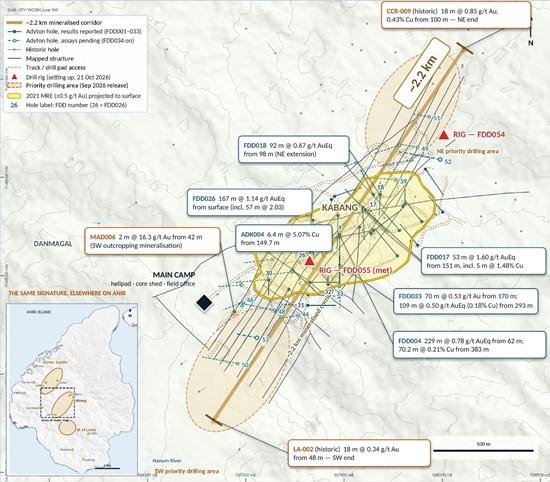
Figure 1: Kabang Plan – the ~2.2 km corridor from LA-002 to CCR-009, results reported to FDD033, holes with assays pending (FDD034 onward), the 2021 Mineral Resource outline (0.5 g/t Au cut-off) projected to surface, rigs setting up on FDD054 and FDD055, and the NE and SW priority drilling areas.
NEW ASSAY RESULTS FROM DRILLING – DRILLHOLES FDD030 to FDD033
Assays have been received for four more holes (Table 1). Hole FDD033 was drilled towards the north on the same north-south section as FDD004, which was drilled towards the south. Gold dominates the upper part of the hole, and copper increases below about 290 m where the two holes converge (Figure 2). FDD033 intersected 70 m @ 0.53 g/t Au from 170 m, then 109 m @ 0.50 g/t AuEq (0.18% Cu) from 293 m. Copper is strongest from 326 m to 346 m (20 m @ 0.42% Cu), and a potassic-altered quartz diorite (K-feldspar-magnetite alteration), chalcopyrite and bornite from 392 m to 400 m lies within 13 m @ 0.23% Cu from 389 m. Holes FDD030-FDD032 tested peripheral zones of the central Kabang resource and returned no significant intercepts, helping to define the limits of mineralisation (Table 1).
Table 1: Significant gold and copper intercepts from this news release (top) along with previously reported intercepts (bottom) – Feni Island Au-Cu Project (Kabang)
| Hole ID | From (m) | Interval (m) | Au (g/t) | Cu (%) | AuEq (g/t) | ||||||||||||||||||||||||||||||||||||||||||||||||||
| New this release (to FDD033): | |||||||||||||||||||||||||||||||||||||||||||||||||||||||
| FDD033 | 170 | 70 | 0.53 | 0.03 | 0.53 | ||||||||||||||||||||||||||||||||||||||||||||||||||
| incl. | 170 | 21 | 0.70 | 0.03 | 0.70 | ||||||||||||||||||||||||||||||||||||||||||||||||||
| incl. | 198 | 42 | 0.50 | 0.02 | 0.51 | ||||||||||||||||||||||||||||||||||||||||||||||||||
| and | 293 | 109 | 0.25 | 0.18 | 0.50 | ||||||||||||||||||||||||||||||||||||||||||||||||||
| incl. | 293 | 53 | 0.26 | 0.23 | 0.60 | ||||||||||||||||||||||||||||||||||||||||||||||||||
| incl. | 313 | 3 | 1.90 | 0.33 | 2.27 | ||||||||||||||||||||||||||||||||||||||||||||||||||
| incl. | 326 | 20 | 0.22 | 0.42 | 0.84 | ||||||||||||||||||||||||||||||||||||||||||||||||||
| incl. | 389 | 13 | 0.41 | 0.23 | 0.73 | ||||||||||||||||||||||||||||||||||||||||||||||||||
| Previously released: | |||||||||||||||||||||||||||||||||||||||||||||||||||||||
| FDD026 | 0 | 167 | 1.03 | 0.12 | 1.14 | ||||||||||||||||||||||||||||||||||||||||||||||||||
| incl. | 57 | 57 | 1.91 | 0.17 | 2.03 | ||||||||||||||||||||||||||||||||||||||||||||||||||
| FDD004 | 62 | 229 | 0.71 | 0.08 | 0.78 | ||||||||||||||||||||||||||||||||||||||||||||||||||
| and | 383 | 70.2 | 0.33 | 0.21 | 0.63 | ||||||||||||||||||||||||||||||||||||||||||||||||||
| FDD002 | 45 | 142.2 | 1.18 | 0.05 | 1.17 | ||||||||||||||||||||||||||||||||||||||||||||||||||
| ADK004 | 70.7 | 85.4 | 0.94 | 0.57 | 1.75 | ||||||||||||||||||||||||||||||||||||||||||||||||||
| incl. | 149. | .4 | 1.59 | 5.07 | 9.28 | ||||||||||||||||||||||||||||||||||||||||||||||||||
| FDD005 | 69 | 158 | 0.54 | 0.14 | 0.72 | ||||||||||||||||||||||||||||||||||||||||||||||||||
| FDD003 | 70 | 81 | 1.12 | 0.21 | 1.36 | ||||||||||||||||||||||||||||||||||||||||||||||||||
| FDD001 | 95 | 76 | 1.43 | 0.03 | 1.38 | ||||||||||||||||||||||||||||||||||||||||||||||||||
| FDD017 | 151 | 53 | 1.29 | 0.26 | 1.60 | ||||||||||||||||||||||||||||||||||||||||||||||||||
| incl. | 198 | 5 | 3.60 | 1.48 | 5.63 | ||||||||||||||||||||||||||||||||||||||||||||||||||
| FDD027 | 94 | 162 | 0.43 | 0.06 | 0.48 | ||||||||||||||||||||||||||||||||||||||||||||||||||
| incl. | 149 | 9 | 1.03 | 0.17 | 1.14 | ||||||||||||||||||||||||||||||||||||||||||||||||||
| FDD012 | 61 | 105 | 0.60 | 0.12 | 0.73 | ||||||||||||||||||||||||||||||||||||||||||||||||||
| FDD018 | 98 | 92 | 0.61 | 0.07 | 0.67 | ||||||||||||||||||||||||||||||||||||||||||||||||||
| FDD025 | 114 | 130 | 0.38 | 0.03 | 0.40 | ||||||||||||||||||||||||||||||||||||||||||||||||||
| incl. | 209 | 10 | 1.05 | 0.03 | 1.03 | ||||||||||||||||||||||||||||||||||||||||||||||||||
| FDD020 | 234 | 71 | 0.62 | 0.03 | 0.63 | ||||||||||||||||||||||||||||||||||||||||||||||||||
| FDD014 | 253 | 51 | 0.86 | 0.02 | 0.83 | ||||||||||||||||||||||||||||||||||||||||||||||||||
| FDD029 | 24 | 34 | 0.82 | 0.04 | 0.83 | ||||||||||||||||||||||||||||||||||||||||||||||||||
| and | 186 | 42 | 0.81 | 0.02 | 0.80 | ||||||||||||||||||||||||||||||||||||||||||||||||||
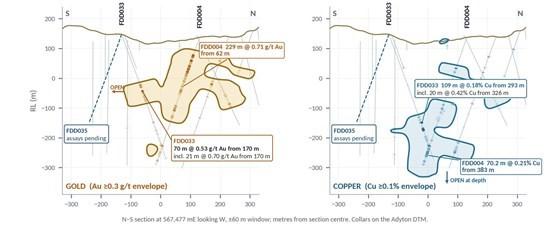
Figure 2: North-south section at 567,477 mE, looking west – gold (left) and copper (right) envelopes with FDD004, FDD033 and FDD035 (assays pending). Copper remains open at depth: FDD004 ended in copper mineralisation.
EXPANSIONARY STEP-OUT DRILLING EXTENDS BOTH ENDS OF THE CORRIDOR
Since February 2025, 20,460 m have been drilled at Kabang in holes FDD001 to FDD053. The two rigs are now setting up on the final two drillholes of the current Phase 1 program, FDD054 (in the north-east between FDD051 and FDD052) and FDD055 (a metallurgical hole twinning FDD026). Assays are now reported to FDD033. Results for later holes will be released as they are received; Adyton is working with the laboratory to prioritise assays for all Phase 1 holes.
Step-out holes FDD048 to FDD053 test both ends of the ~2.2 km LA-002 to CCR-009 corridor (Figures 1 and 3). FDD050, near the south-west end, and FDD051, near the north-east end, are about 1.6 km apart. The completed step-out holes all intersect the interpreted NE-SW trending Kabang structures, with hydrothermal breccias and alteration in the same style as Kabang (Table 2), including both epithermal and porphyry signatures. FDD052 (north-east) and FDD053 (south-west) were completed at 622.1 m and 312.3 m respectively, both ending in hydrothermal breccia: FDD052 logged hydrothermal breccia with potassic alteration overprinted by phyllic alteration, magnetite and chalcopyrite over the last 230.5 m of the hole, from 391.6 m, and FDD053 logged hydrothermal breccia over the last 181.3 m, from 131 m (Figures 12 and 13). Assays are pending; see the note on visual observations below.
Table 2: Expansionary step-out holes at both ends of the Kabang corridor – visual observations (assays pending)
| Hole | End | Logged zone (m) | Visual observations |
| FDD048 | SW | 132.6-393.6 | Brecciated monzonite on two interpreted structures; disseminated and fracture-fill sulphides |
| FDD049 | NE | 278-553.6 | Hydrothermal breccia and monzonite on an interpreted structure; disseminated and fracture-fill sulphides |
| FDD050 | SW | 0-123.4; 151.7-220 | Two interpreted structures, oxidised near surface; sericite-chlorite alteration; silica-cemented breccia from 152 m to 202 m; K-feldspar ± biotite-magnetite alteration below 202 m; fracture-fill and disseminated sulphides |
| FDD051 | NE | 3-68; 172-334 | Monzonite with fracture-fill and disseminated sulphides; hydrothermal breccia on an interpreted structure; silica-sericite alteration; quartz stockwork from 202 m to 264 m |
| FDD052 | NE | 248-391.6; 391.6-622.1 | Hydrothermal breccia on interpreted Structure 2, with pyrite and arsenopyrite; from 391.6 m to the end of the hole, hydrothermal breccia with monzonite, monzodiorite and quartz diorite intrusives; phyllic alteration overprinting potassic alteration, with patchy magnetite; quartz-magnetite-pyrite-chalcopyrite stockwork veinlets; disseminated and fracture-fill pyrite, chalcopyrite and arsenopyrite |
| FDD053 | SW | 0-131; 131-312.3 | Hydrothermal breccia, strongly oxidised to 131 m; from 131 m, intensely fractured monzonite and hydrothermal breccia with strong silica-clay and sericite alteration and sulphides, including minor chalcopyrite; brecciated monzodiorite from about 288 m to the end of the hole |
Pyrite, arsenopyrite and chalcopyrite were logged in FDD050, FDD051 and FDD052, with minor chalcopyrite in FDD053. Visual observations only; see “Visual observations” below.
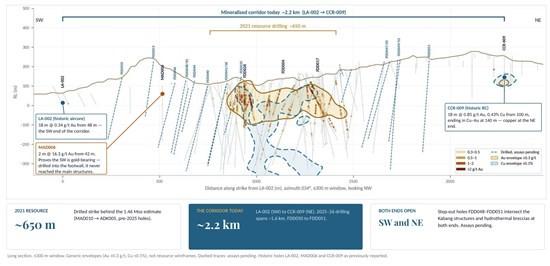
Figure 3: Long section along the ~2.2 km Kabang corridor, LA-002 (SW) to CCR-009 (NE), looking north-west – the corridor is more than three times the ~650 m of strike drilled for the 2021 Mineral Resource, with step-out drilling at both ends. Generic gold and copper envelopes, not resource wireframes.
EMERGING COPPER PICTURE VECTORING TO THE PORPHYRY SOURCE
Drilling has documented gold in the upper parts of the Kabang system and copper strengthening with depth. Examples of the increased Cu to depth include: i) Hole FDD004 (70.2 m @ 0.21% Cu from 383 m to the end of the hole, leaving copper open at depth); ii) FDD033 (above); iii) ADK004 (including 6.4 m @ 5.07% Cu from 149.7 m), and; iv) FDD017 (including 5 m @ 1.48% Cu from 198 m). At the north-east end of the corridor, historic RC hole CCR-009 yielded 18 m @ 0.85 g/t Au, 0.43% Cu from 100 m.
Elevated molybdenum on the southern flank (up to 1,205 ppm Mo in holes FDD019 and FDD021), together with potassic alteration and intrusive rocks logged at depth, points to a porphyry system beneath the epithermal gold mineralization. Adyton interprets Kabang as a low- to intermediate-sulphidation epithermal gold-(silver-copper) system overprinting an earlier porphyry copper-(gold)-molybdenum system, with the best gold grades where the two overlap. Downhole spectral data (illite crystallinity) and multi-element porphyry indices increase toward the south and south-west.
Gold falls away with depth while copper holds: across all Adyton holes released to FDD033, the ratio of mean copper to mean gold rises about six-fold from surface to 400-500 m vertical depth (Figure 4). In FDD033, a potassic quartz diorite with chalcopyrite and bornite from 392 m to 400 m is the strongest porphyry-style feature logged to date.
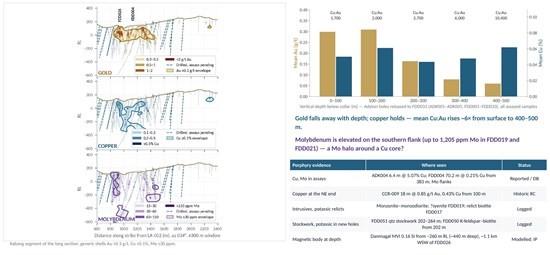
Figure 4: Porphyry evidence at Kabang – gold above, copper below, molybdenum on the flanks. Kabang segment of the long section with generic Au, Cu and Mo shells (left); length-weighted mean Au and Cu by vertical depth below collar for all Adyton holes released to FDD033 (ADK001-ADK005, FDD001-FDD033), with Cu (ppm) : Au (g/t) ratio of the means (top right); summary of porphyry evidence (bottom right).
At Danmagal, 1.1 km west-south-west of FDD026, 3D magnetic vector inversion (MVI) of the 2024 drone magnetic survey models a magnetic body from about 440 m below surface (−260 m RL), open below the base of the model (Figure 5). Mapping in 2024 recorded porphyry-style intrusives with magnetite-biotite alteration, and diatreme breccia, at surface above it. The porphyry source has not been drill-tested; the IP survey covers Danmagal.
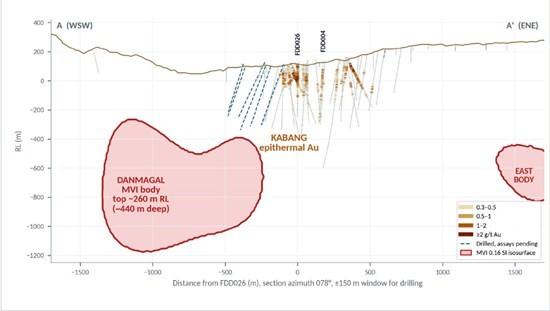
Figure 5: Section A-A′ (azimuth 078°) through FDD026 – Kabang drilling and the Danmagal and East magnetic bodies (MVI 0.16 SI isosurface).
The evidence for both systems is summarised in Figure 6, ordered from direct observation (core logging and mapping) down to derived indices.
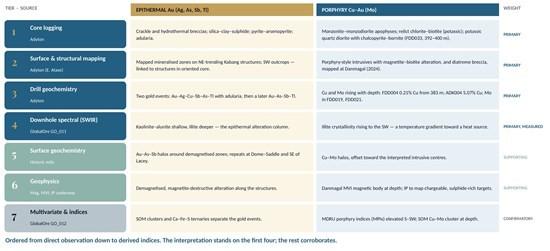
Figure 6: The evidence stack – epithermal gold and porphyry copper-gold indicators at Feni, by source and weight.
ISLAND-SCALE TARGETS AND IP SURVEY PROGRESS
Zones where hydrothermal fluids have destroyed magnetite (demagnetised zones) mark pathways where those fluids moved through Anir Island. At Dome-Saddle and SE of Lacey, these zones coincide with gold-arsenic-antimony anomalies in historic soils, the same signature as at Kabang (Figure 7). These overlapping anomalies have not been comprehensively drill-tested in either area, and mapping of both is planned through 3Q 2027. The detailed IP survey results will be key to highlight and rank targets.
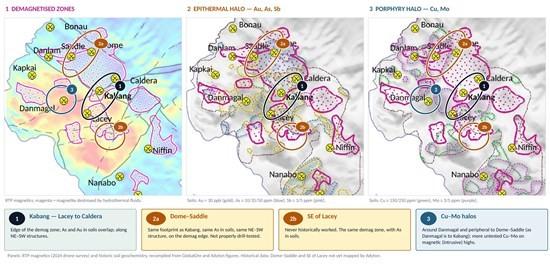
Figure 7: Kabang’s signature in historical data – demagnetised zones (RTP magnetics), the gold-arsenic-antimony halo and the copper-molybdenum halo in historic soils, repeated at Dome-Saddle (2a) and SE of Lacey (2b).
Adyton’s target pipeline at Feni comprises four advanced drill targets around Kabang (Kabang, Kabang NE to CCR-009, Kabang SW to LA-002 and deep Kabang copper), 12 known targets including Dome-Saddle, SE of Lacey and Danmagal, and 26 geophysical targets from drone and historic magnetic data (nine high, 11 medium and six low priority) (Figures 8 and 9). The IP survey is expected to refine these targets and generate new ones.
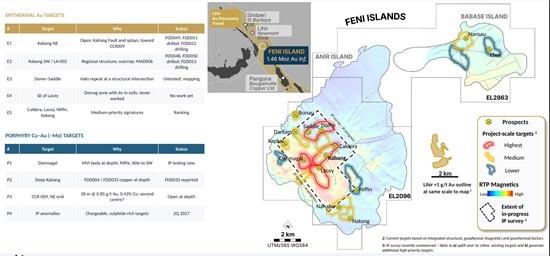
Figure 8: Where the datasets align – epithermal gold and porphyry copper-gold (-molybdenum) targets on Anir Island, with project-scale target priority, RTP magnetics and the extent of the IP survey. The Lihir outline is shown at the same scale for reference only.
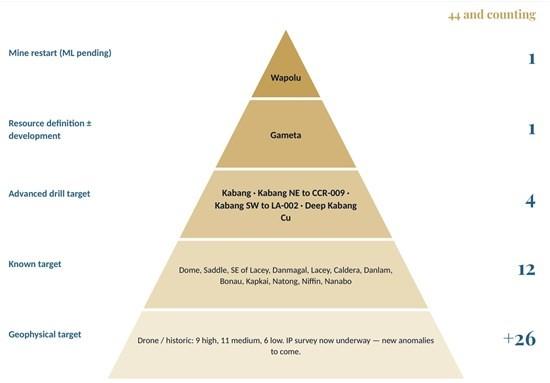
Figure 9: Adyton’s project and target pipeline across Feni and Fergusson islands – one mine restart (Wapolu, Mining Licence pending), one resource (Gameta), four advanced drill targets, 12 known targets and 26 geophysical targets.
The 5 km × 5 km ground IP survey (combined 2D in-line and offset 3D pole-dipole) had acquired arrays 01 to 08, about 30% of the survey area, by 11 October. Northern arrays are scheduled to finish by the end of November, and southern arrays from December to about the end of January 2027. No IP results are available yet. IP will be combined with mapping, geochemistry, spectral, magnetic and drill data to rank a combination of Kabang extensional targets, Kabang repeat targets and porphyry targets in 2Q 2027 (Figure 10).
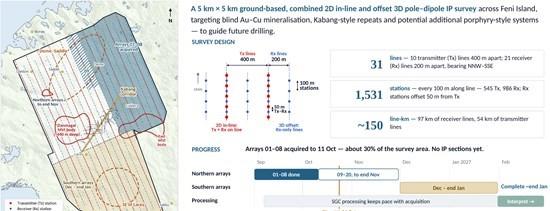
Figure 10: IP survey layout and progress at 11 October 2026.
NEXT STEPS
| Workstream | Timing |
| Assays FDD034-FDD055 | Released as received; laboratory asked to prioritise all Phase 1 holes |
| IP survey | Complete about end of January 2027; ranked targets 2Q 2027 |
| Metallurgical hole (FDD055, twinning FDD026) | Drilling November 2026; results to follow |
| Oriented-core structural data | 4Q 2026 |
| Updated Kabang Mineral Resource Estimate | A priority; as soon as practicable after Phase 1 assays |
ANALYST SITE VISIT ON 24 OCTOBER 2026
Adyton will host analysts and investors at Feni on 24 October 2026 as part of a joint PNG site tour. The site visit includes operating drill rigs, newly discovered mineralised outcrops in the south-west zone, drill core and a technical session.
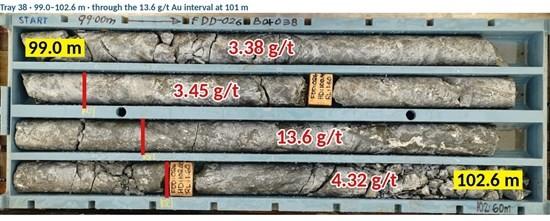
Figure 11: FDD026 drill core – tray 38 (99.0-102.6 m), through the 13.6 g/t Au interval at 101 m within 57 m @ 2.03 g/t AuEq (mineralised from surface). Red lines are the metre marks; labels are 1 m sample assays (g/t Au).
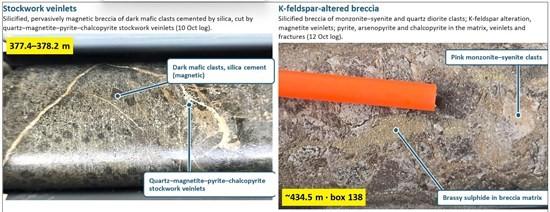
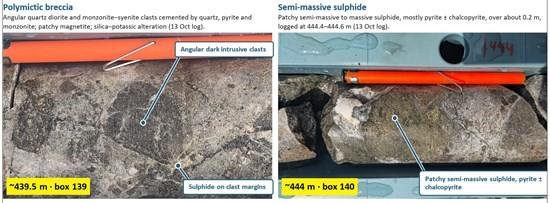
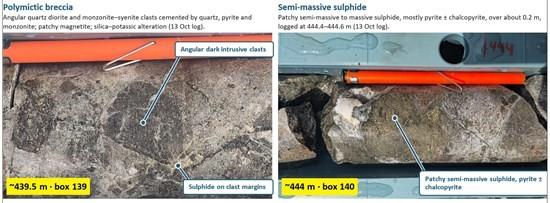
Visual log envelope: 248-391.6 m, hydrothermal breccia on interpreted Structure 2 with pyrite and arsenopyrite (377.4 m panel); 391.6-622.1 m (end of hole), hydrothermal breccia with monzonite, monzodiorite and quartz diorite intrusives, phyllic alteration overprinting potassic alteration, and disseminated and fracture-fill pyrite, chalcopyrite and arsenopyrite.
Field photographs. Visual observations only; assays pending. Visual descriptions of mineralisation are not a substitute for laboratory analysis and do not indicate grade.
Figure 12: FDD052 drill core – silicified, magnetic breccia with quartz-magnetite-pyrite-chalcopyrite stockwork veinlets (377.4-378.2 m); and, within the hydrothermal breccia logged from 391.6 m to the end of the hole, K-feldspar-altered breccia with pink monzonite-syenite clasts and brassy sulphide in the matrix (about 434.5 m), angular intrusive clasts with sulphide on their margins (about 439.5 m), patchy semi-massive sulphide (about 444 m), a discrete pyrite-chalcopyrite vein with quartz (about 446 m) and disseminated chalcopyrite near the end of the hole (619.6 m), where chalcopyrite increases relative to pyrite. Visual observations only; assays pending.
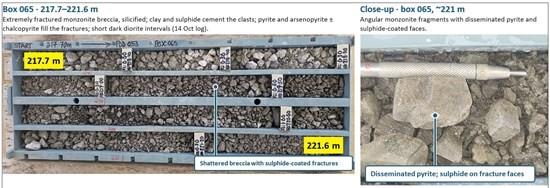
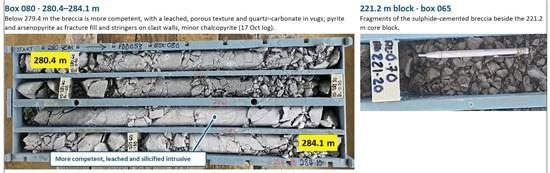
Visual log envelope: 0-131 m, hydrothermal breccia, strongly oxidised; 131-312.3 m (end of hole), intensely fractured hydrothermal breccia with strong silica-clay alteration and sulphides.
Field photographs. Visual observations only; assays pending. Visual descriptions of mineralisation are not a substitute for laboratory analysis and do not indicate grade.
Figure 13: FDD053 drill core – box 065 (217.7-221.6 m), shattered monzonite hydrothermal breccia with clay and sulphide cement, with close-ups near the 221.2 m block showing disseminated pyrite and sulphide-coated fracture faces; and box 080 (280.4-284.1 m), more competent, leached and silicified breccia with sulphide on fracture walls. Visual observations only; assays pending.
QUALITY ASSURANCE / QUALITY CONTROL
Adyton adheres to industry-recognised standards of best practice and Quality Assurance/Quality Control. Drill core samples were submitted in batches to Intertek Laboratory in Lae, which include field blanks, certified reference materials (CRMs) and staged duplicates. Samples were sealed ensuring chain of custody. To date, all batches passed QA/QC. All drill holes were drilled and sampled predominantly from PQ and HQ diameter drill core, and to a lesser extent NQ core. Core recovery is considered to be appropriate.
Visual observations
Mineral and alteration descriptions for holes without assays are from visual logging. Visual observations are not a substitute for laboratory analysis, do not indicate grade and should not be relied on until assays are reported.
Nearby deposits
References to Lihir and Simberi are for geological context only. Mineralisation at those deposits is not necessarily indicative of mineralisation at Feni.
Qualified Person
The scientific and technical information contained in this press release has been prepared, reviewed, and approved by Dr Chris Bowden, PhD, GCMEE, FAusIMM(CP), FSEG, the Chief Operating Officer and Chief Geologist of Adyton, who is a “Qualified Person” as defined by National Instrument 43-101 – Standards of Disclosure for Mineral Projects.
ABOUT THE FENI GOLD-COPPER PROJECT
The Feni Au-Cu Project is 100% owned by Adyton and is a key asset in Adyton’s portfolio, located in a highly prospective region of Papua New Guinea on the Lihir Island chain known for world-class gold-copper deposits, including Lihir (owned and operated by Newmont). The Company has confirmed significant gold-copper mineralisation at Feni, has a 1.46 Moz Au Inferred Mineral Resource and is focussed on expanding the resource base and identifying new high-grade targets.
Table 3: Drillhole collar details – new holes this release (FDD030-FDD033), holes described in this release with assays pending, and FDD054 and FDD055 (rigs setting up). Coordinates UTM Zone 56S, WGS84.
| Hole ID | Easting (m) | Northing (m) | Depth (m) | Dip (°) | Azimuth (° grid) |
Status | Prospect |
| New this release: | |||||||
| FDD030 | 567,116 | 9,547,977 | 234.1 | -70 | 180.5 | Completed | Kabang |
| FDD031 | 567,316 | 9,547,850 | 407.9 | -70 | 90.5 | Completed | Kabang |
| FDD032 | 567,418 | 9,547,956 | 117.8 | -70 | 0.5 | Abandoned | Kabang |
| FDD033 | 567,477 | 9,547,946 | 443.4 | -70 | 0.5 | Completed | Kabang |
| Described in this release, assays pending: | |||||||
| FDD048 | 567,146 | 9,547,824 | 425.6 | -70 | 280.5 | Completed | Kabang |
| FDD049 | 567,874 | 9,548,652 | 573.1 | -80 | 280.5 | Completed | Kabang |
| FDD050 | 566,959 | 9,547,553 | 365.8 | -60 | 280.5 | Completed | Kabang |
| FDD051 | 567,934 | 9,548,807 | 481.9 | -80 | 280.5 | Completed | Kabang |
| FDD052 | 567,988 | 9,548,590 | 622.1 | -70 | 280.5 | Completed | Kabang |
| FDD053 | 567,056 | 9,547,684 | 312.3 | -70 | 280.5 | Completed | Kabang |
| FDD054 | 568,006 | 9,548,712 | 0.0 | -70 | 280.0 | Setting up | Kabang |
| FDD055 | 567,324 | 9,548,072 | 0.0 | -90 | 360.0 | Setting up (metallurgical) | Kabang |
ABOUT ADYTON RESOURCES CORPORATION
Adyton Resources Corporation is focused on the development of gold and copper resources in world class mineral jurisdictions. It currently has a portfolio of highly prospective mineral exploration projects in Papua New Guinea on which it is exploring to expand its identified gold Inferred and Indicated Mineral Resources and expand on its recent significant copper drill intercepts on the 100% owned Feni Island project. The Company’s mineral exploration projects are located on the Pacific Ring of Fire on easy to access island locations which hosts several globally significant copper and gold deposits including the Lihir gold mine and Panguna copper/gold mine on Bougainville Island, both neighboring projects to the Company’s Feni Island project.
Adyton has a total Mineral Resource Estimate inventory within its PNG portfolio of projects comprising Indicated resources of 441,000 ounces gold and Inferred resources of 2,086,000 ounces gold.
The Feni Island Project currently has a mineral resource prepared in accordance with NI 43-101 dated October 14, 2021, which has outlined an initial Inferred mineral resource of 60.4 million tonnes at an average grade of 0.75 g/t Au, for contained gold of 1,460,000 ounces, assuming a cut-off grade of 0.5 g/t Au. See the NI 43-101 technical report entitled “NI 43-101 Technical Report on the Feni Gold-Copper Property, New Ireland Province, Papua New Guinea” prepared for Adyton Resources by Mark Berry (MAIG), Simon Tear (MIGI PGeo), Matthew White (MAIG) and Andy Thomas (MAIG), each an independent mining consultant and “qualified person” as defined in NI 43-101, available under Adyton’s profile on SEDAR+ at www.sedarplus.ca. Mineral resources are not mineral reserves and have not demonstrated economic viability.
The Fergusson Island Project currently has a mineral resource prepared in accordance with NI 43-101, which outlined an Indicated mineral resource of 10.19 million tonnes at an average grade of 1.35 g/t Au for contained gold of 441,000 ounces and an Inferred mineral resource of 21.2 million tonnes at an average grade of 0.92 g/t Au for contained gold of 626,000 ounces; both Inferred and Indicated resources used a 0.4 g/t Au cut-off grade.
See the technical report dated July 12, 2026, entitled “NI 43-101 Technical Report on Gameta Au Project Fergusson Island, Papua New Guinea” prepared for Adyton Resources by Louis Cohalan (MAIG), an independent mining consultant and “Qualified Person” as defined in NI 43-101, available under the Company’s profile on SEDAR+ at www.sedarplus.ca. Mineral resources are not mineral reserves and have not demonstrated economic viability.
See the technical report dated January 7, 2026, entitled “NI 43-101 Technical Report on Wapolu Gold Project” prepared for Adyton Resources by Louis Cohalan (MAIG), an independent mining consultant and “Qualified Person” as defined in NI 43-101, available under the Company’s profile on SEDAR+ at www.sedarplus.ca. Mineral resources are not mineral reserves and have not demonstrated economic viability.
For more information about Adyton and its projects, visit www.adytonresources.com.
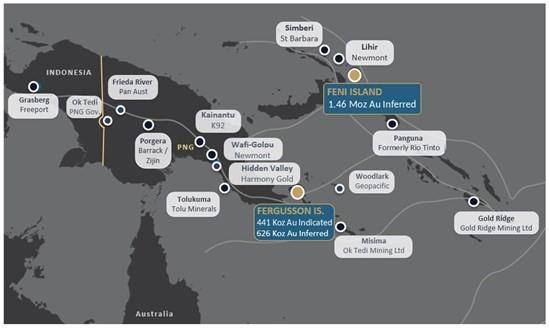
Adyton’s island-based projects, Papua New Guinea.
New assays support higher grades and substantially greater minera... READ MORE
Antimony Resources Corp. (CSE: ATMY) (OTCQB: ATMYF) (FSE: K8J0) i... READ MORE
Scottie Resources Corp. (TSX-V: SCOT) (OTCQB: SCTSF) (FSE: SR80)... READ MORE
Silver Pony Resources Corp. (CSE: PONY) (FSE: BJ40) (OTCID: PONIF... READ MORE