






Rick Mills, Editor/ Publisher, Ahead of the. Herd:
You recently cut a deal with Canadian Goldfields Discovery (TSXV:CGM), you’re selling Miminiska, the project that we were going to work on first. I’d like to know more about the deal and what you like about it.
Bruce Counts, CEO, Storm Exploration:
Broadly, it’s a $5.8 million transaction, that’s the total consideration. Those payments occur over a nine-month period.
On Feb. 17 Storm announced that it exercised its option to acquire a 100% interest in the Miminiska and Keezhik projects from Landore Resources, and immediately sold its interest in the Miminiska Project to Canadian Goldfields Discovery, formerly European Electric Metals.
These transactions place Storm in a strong position to take advantage of the bull market for precious metals and critical minerals. The company has relatively few shares outstanding, a robust balance sheet and 100% ownership of three demonstrably prospective, district-scale exploration projects in northwestern Ontario, two of which are slated for drilling in 2026.
Here’s a bit of history on the deal.
Storm exercised its option to acquire a 100% interest in the Miminiska and Keezhik projects from Landore by completing its remaining option payment of $1,312,500 under the 2021 option agreement.
Immediately following the option exercise, the company completed the sale of its interest in the Miminiska Project to CGM. The total consideration to be paid includes cash and share payments is equal to $5,812,500.
Prior to the closing of the transaction, CGM paid a $200,000 non-refundable cash deposit to Storm. On the closing date, CGM made a payment of $1,800,000, of which $1,312,500 was used by Storm for the option exercise. CGM will make additional cash payments of $1,525,000 on the 3-month and 9-month anniversaries of the closing date.
Storm also received 7,500,000 common shares of CGM on closing as consideration under the transaction, which represents approximately 7.59% of CGM’s issued and outstanding shares. Storm will receive $787,500 in CGM shares on the 9-month anniversary of the closing date, subject to certain limits to the total number of shares that may be issued. If these limits result in less than $787,500 in CGM shares being issued, the balance shall be paid by CGM in cash.
Landore has retained a 2% Net Smelter Royalty (NSR) on the Keezhik Project. Under the NSR agreement, Storm may buy back 1% of the NSR by paying Landore $1,000,000 at any time.
The company obtained exchange approval for the transaction on February 13th.
RM: Canadian Goldfields Discovery, who are the principals behind it?
BC: They are a well-respected team in mineral exploration circles. It’s the same people that put together K92 Mining (TSX:KNT), which is a very successful gold explorer-turned-producer in Papua New Guinea.
They have a lot of street cred. They’ve got a great technical group to work with, and they have excellent access to capital.
The CEO is a gentleman named John Booth, who currently is the chair of the board at Laramide Resources (TSX:LAM). John is a lawyer by training but has been involved in the mineral exploration business for many years.
On the corporate development side, Bryan Slusarchuk, who was instrumental in putting together K92. I know that their senior technical consultant will be a gentleman named Dr. Mick Carew. He’s involved in Great Pacific Gold (TSXV:GPAC), which is looking to put a mine into production on New Britain Island.
RM: Let’s get into the plans for this year. I understand that you plan to drill Gold Standard in the second quarter, Keezhik in Q3, and Attwood in 2027. Let’s start with Keezhik.
Keezhik
BC: Sure. Keezhik’s a big project. It’s a little over 12,000 hectares in size and it is located about 25 km north of and in the same belt of rocks as Miminiska.
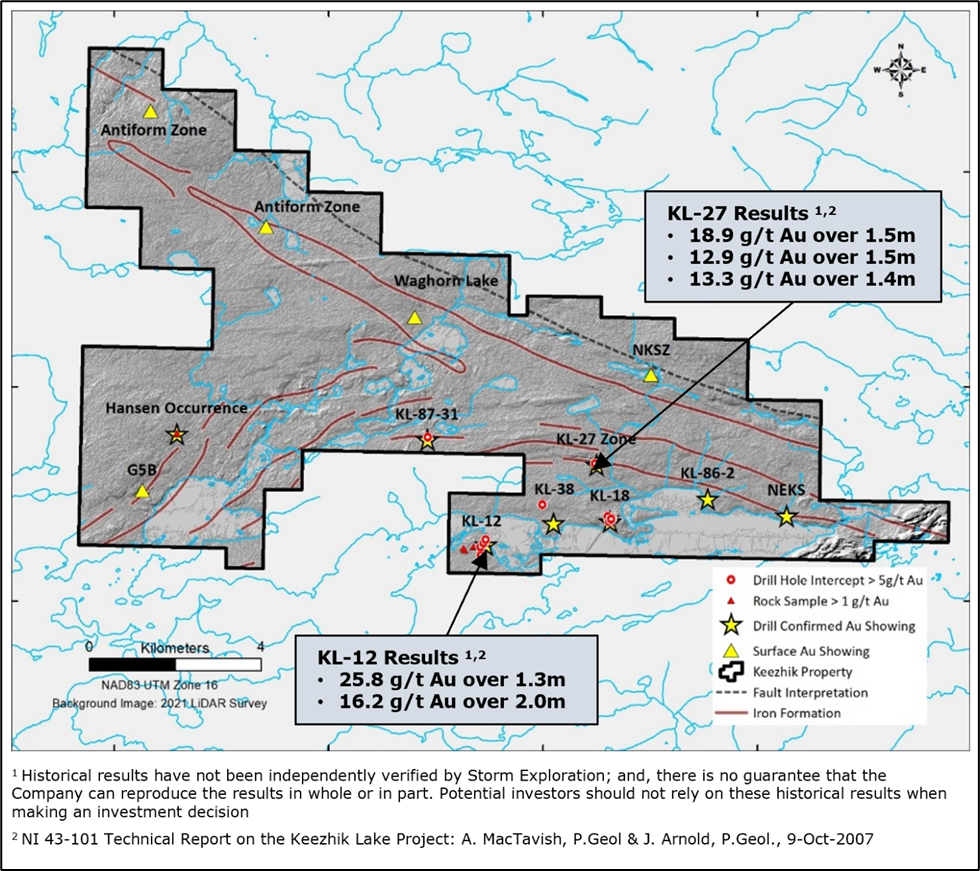
Looking at the big picture at Keezhik, we can see that there’s been a lot of faulting and folding in the regional geology which important in the development of a good mineral district. And historical exploration demonstrates that Keezhik is highly prospective.
But it is under-explored. There hasn’t been any significant exploration work since the 1980s and what has been done is very limited. There has only been about 14,000 meters of drilling across the whole project but that resulted in eight separate drill-confirmed high-grade gold discoveries.
Just to give you some of the more interesting numbers from a couple of the targets, KL-27 returned 18.9 grams per tonne gold over 1.5 meters, and KL-12 returned 16.2 g/t over 2.0 meters.
This belt of rocks is clearly well endowed with gold but there is more work to do to make sure we are focused on the best targets. For example, there are numerous surface gold showings, including in banded iron formation, that have never been followed up.
So, what’s the plan? The goal is to develop targets for a drill program in Q3 of 2026. To accomplish that, we will conduct a two-component exploration program.
We’re going to put people on the ground doing focused exploration on the known targets, like KL-27 and KL-12, with the aim of expanding the footprint. Work will likely include detailed mapping, soil sampling and ground geophysics.
In parallel with the target-focused work, Storm will undertake project-wide reconnaissance exploration aimed at identifying new targets on this extensive and prospective portion of the Miminiska-Fort Hope Greenstone Belt. A comprehensive airborne magnetic and electromagnetic survey is planned for June 2026, to be followed by regional prospecting, sampling, and geological mapping.
Keezhik property
Gold can often be associated with sulfides like arsenopyrite. These are conductive minerals so, an airborne electromagnetic survey, which measures the electrical conductivity of the rocks, can help identify potential targets. It’s not a silver bullet by any stretch, but it’s a really important tool in your toolbox in terms of identifying places to explore on this big property.
Keezhik is an exciting project, and we’re quite eager to get to work on there. But Q3 is a long way away so we have Gold Standard in the meantime, and we can get to drilling at Gold Standard much more quickly.
Banded iron formations
RM: Bruce, why don’t you tell us about gold in banded iron formations.
BC: In addition to being an important source of iron, banded iron formations are also an important source of gold, accounting for approximately 25% of global production. Banded iron formations, or BIFs, were deposited early between 2.4 and 2.0 billion years ago and are an important component of greenstone belts.
It is important to understand that gold is not deposited when a banded iron formation is forming. That happens later, when the iron formation is being deformed by faulting and folding. Gold-rich fluids circulating through the rocks at the time of deformation react with the iron formation causing the precipitation of gold and sulfide minerals like arseno-pyrite.
Iron formations are a very hard and brittle rock. It fractures easily when under the stress of faulting and folding, creating the plumbing through which the gold-rich fluids flow. More fractures in the iron formation means there is more conduits and surface area available to react with the fluids, which, in turn means that there will be more gold.
So, that kind of sets up how you get the gold into the iron formation…it is a process generally associated with tectonic deformation.
RM: The folding is important.
BC: Absolutely. The nose of the fold can be particularly important since it is thicker and there tends to be a lot of fracturing. So, more plumbing for the fluids to exploit and more surface area to react with those gold-bearing fluids.
The nose of the fold is not always going to be rich with gold, but it often can be. It’s one of the first places you would look if you’ve got a folded iron formation.
RM: BIFs do have several attributes that make them stand out for both the junior that owns one, and a future potential miner.
BC: I can tell you what I like about them as an explorer.
First, they tend to be high-grade so, if you get into an area that’s really well-endowed with gold, you can have a lot of ounces. A good example of that would be Back River, owned by B2Gold (TSX:BTO). That’s around 9 million ounces, at around 6 grams per tonne. So fantastic grades and lots of ounces.
Second, banded iron formations can extend for kilometers. Thus, there can be several deposits strung out along its length like a string of pearls. For example, there are 6 deposits at the Back River mine that will be accessed from a central facility.
RM: And this is consistent mineralization. It’s not nuggety, spotty or patchy.
BC: That is the third thing I like about banded iron formation hosted gold deposits. The grades tend to be very consistent throughout the deposit. So, from a producer’s perspective, they love them because they know how many ounces they are going to produce today, tomorrow, next week and next month. BIFs tend to be very predictable. You don’t wind up with that nuggety effect. That consistency is very comforting to a producer.
A great example of that is the past-producing Lupin mine, which is located in Nunavut. Lupin produced gold at 9 grams per ton at surface and was still 9 grams material at 1,200m. So, very consistent grades.
RM: I’ve always heard that if you have a banded iron formation, you’ve got gold; there’s just no doubt there’s gold in it. It’s just if it’s economic or not, or if you’re going to find it, but if you’ve got a banded iron, you’ve got gold. I’ve heard that frequently.
BC: Any gold in the fluids that interact with the iron formation you’re going to wind up with some gold in the system, so I think there’s probably some truth in that. Obviously, it’s about how much gold was in the fluids when it came through at the end of the day.
RM: The iron seems to play a huge part in it as a reducing agent for the fluids, right?
BC: That’s exactly right. It is the mineral-rich fluids reacting with the iron formation that drops the gold out of solution. Sulphide minerals are often deposited at the same time. So, you’ll get often a very strong correlation, for example, with arsenopyrite and gold. People use arsenopyrite as a pathfinder to finding gold in banded iron formation.
I think the other thing that’s important to note about a banded iron formation is that it tends to be fairly, and this is a generalization, so keep that in mind, but they can be very consistent in terms of your ability to process and get the gold out. It doesn’t require a complicated processing circuit.
It’s fairly straightforward minerology so the metallurgy is relatively simple, and you get very good recoveries. Another thing that producers really like, so you’ve got very consistent grades, you’ve got good recoveries, and you’ve got large footprints in terms of the ounces.
Another great example of a banded iron formation hosted gold deposit recently in the news is Orla Mining (TSX:OLA), which recently bought the Musselwhite gold mine in northwestern Ontario from Newmont (NYSE:NEM). Orla paid $850 million for the 2 million ounces that was known to be in the ground.
RM: Just one thing on Keezhik. I noticed it says on your website that the property has the same regional shear zone that hosts Newmont’s 6-million-ounce Musselwhite mine. Could you expand on that a little bit? How close is it to Musselwhite?
BC: When I say regional, I mean big. This is a structure that goes for 150 kilometers, I think Musselwhite’s about 150 kilometers to the northwest along this massive structure. You can see that there’s a big structure that comes along there.
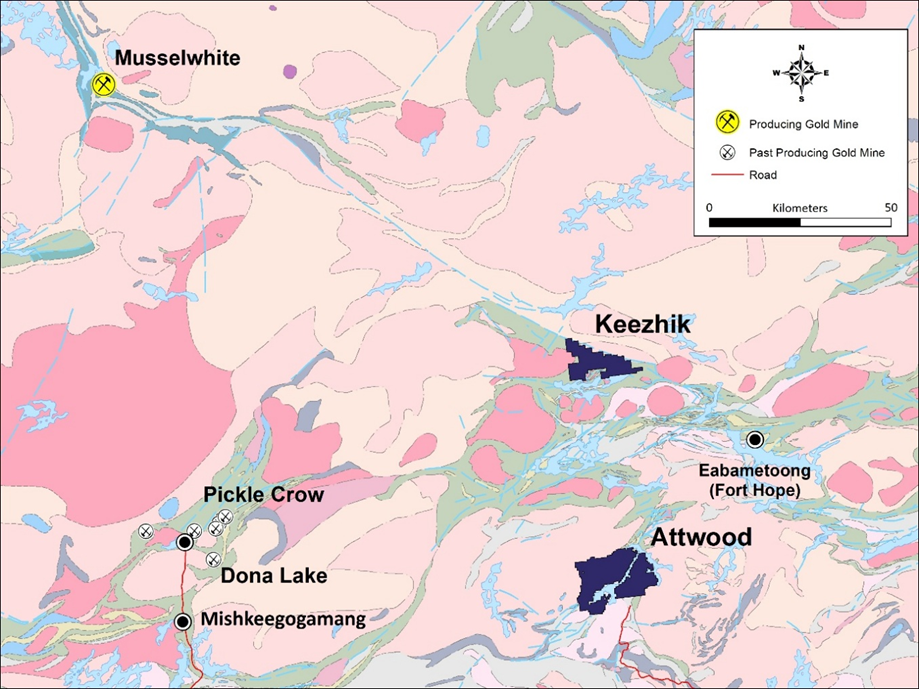
You can see where we’ve drawn in the iron formation and that long structure trends northwest southeast along the northeast edge of the property there.
So, it’s a massive structure and obviously a big terrain change. That just means there’s been a lot of movement.
And again, that’s all about that disruption and moving of rocks and getting fluids flowing into those rocks.
RM: You have to have structure.
BC: Yes, absolutely. Again, there’s a lot of gold that’s been found through drilling and through prospecting on this property and really almost no work since the 1980s. It’s wide-open country.
It’s very exciting. I love this stage of exploration where you’re out effectively treasure hunting. We’re looking for that big discovery and we’re going to use all the tools in the toolbox to make it happen.
Gold Standard
RM: I’m looking at Gold Standard right now on your company presentation. It has had historical gold mining, and the mine grades are quite high. It’s located about 60 km north of Fort Frances and encompasses 6,018 hectare of road-accessible mineral claims.
Of course, none of us mind working around where the old guys worked, because they didn’t get everything. And if they were there, there was a reason and it was high grade.
Kenorland (TSX:KLD), is now the largest land owner in the area. They had previously staked around Keezhik and Miminiska and have now staked an immense area to the east of Gold Standard. KLD is a well respected project generator and have optioned a lot of projects to majors and juniors. This is good news as the more companies working in the area means better chance of discovery and news flow.
BC: That’s right. I believe they have made an interesting story perhaps more interesting.
We acquired Gold Standard because of the presence of three old gold mines. They’re down in the southeast part of the property, and they were mined between 1901 and 1903. Their records are old, but what you gather is that they were mining gold at very high grades, above 50 grams per tonne. They went down about 30 meters, and then they would drift maybe 25 meters before losing the gold-bearing quartz vein.
There had been very little follow-up on any of this gold mining that had been done more than 120 years ago. And no drilling. So, that’s what drew us to the area.
We were looking around at what else has been done in this part of the world and saw that there were four holes that had been drilled in 1969 and 1970 by Inco. As I’m sure you and many of your readers know, Inco was a big Canadian base-metal producer back in the day, quite a famous company.
Inco was there for a reason. We didn’t know why they were there, but they drilled four holes. Now, these were drilled using a Winky drill. The core from a Winky is about the size of your thumb. And all the holes were less than 50 meters in length.
It was a very exploratory, small test. But what was interesting was that three of those four holes encountered zinc and copper mineralization. They didn’t assay the holes.
Basically, it’s handwritten notes that have been filed with the government for assessment. They talk about the fact that they see these copper and zinc sulfides in the core, and that’s it. So, we thought, well, look, for a couple of thousand dollars, let’s expand the property out of this gold zone and let’s just capture those holes.
So that’s what we did. And then in 2022, we flew the area with an EM survey. And so, again, that’s measuring the conductivity of the rocks. The initial purpose of the EM survey was to give us an idea of what was going on with the shear zone that hosts the gold. The primary goal was to extend those gold horizons.
To our surprise there was a very large electromagnetic anomaly that is directly associated with the four holes that Inco drilled. We believe that conductivity anomaly could represent a Volcanogenic Massive Sulphide deposit and it will be the focus of near-term exploration efforts at Gold Standard.
That said, the gold potential at Gold Standard remains high. Surface samples that Storm collected in 2022 near one of the historic gold mines returned grades up to 166 g/t Au.
RM: Okay, so how do you attack a property like this?
BC: Well, the first thing that we did was we just went to where those old gold mines were, and we started taking samples of the rocks right around there. We found grab samples that were very close that ran up to 166 grams per tonne gold.
That was our way of confirming that these are very high-grade gold-bearing rocks. Other than that, there was nothing to really confirm that historical record.
Those airborne systems really help you understand what’s going on with the rocks in terms of the faulting and the folding and the different kinds of lithologies or rock types that you have.
What really jumped out was that big electromagnetic anomaly in the north. It follows a fold in the rocks with one limb that is north-south and the other points to the east-northeast.
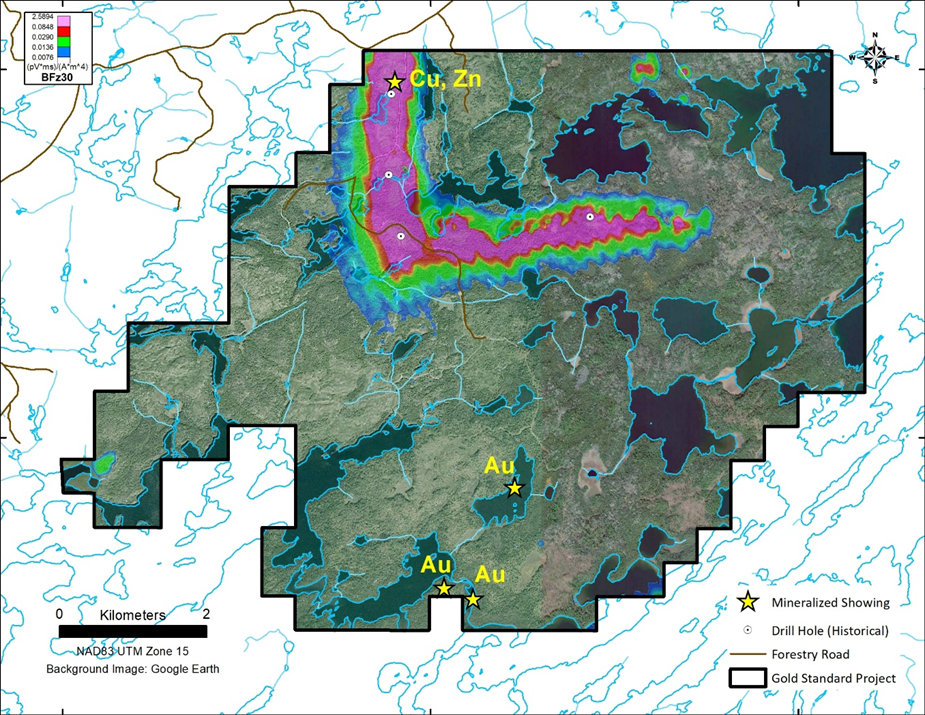
Gold Standard conductivity anomaly — 2022 VTEM survey
That EM anomaly is a big conductivity zone that extends for about 5 kilometers. And its coincident with those old holes from Inco. So, when you look at that from a geological perspective, what we think is it may very well represent a VMS system. So that’s a potential volcanogenic massive sulfide deposit.
They often carry copper and zinc sulfide mineralization, which is what Inco found. Now, Inco probably knew about this EM anomaly, that’s what they were testing, but it was the ‘60s and ‘70s. Technology was a lot different back then.
They may not have known the extent or where to drill properly. We don’t know. There’s no information about why they drilled where they drilled.
So, this anomaly is located along an all-weather forestry road. It won’t cost a lot to get out there, do a little bit of prospecting, walk along that EM anomaly and then poke 5 to 10 holes to see what it is.
The anomaly is 50 meters across and goes for 5 kilometers. If it is a VMS system with grade, it could be a very important discovery.
It is fairly high risk, but we can get to drilling on this very quickly. Again, because there’s road access, it won’t be expensive to drill. Certainly, for under $500,000, you can get in here and drill the five to 10 holes required to test this thing.
You want to do a little bit of work ahead of time just to make sure you know where you’re drilling on this 5-kilometer strike length. But that’s easy to do. Before the end of Q2, we should be able to pop a few holes in it.
RM: Storm has agreements with the two First Nations in whose traditional territory Gold Standard is located.
BC: Yes, the Nigigoonsiminikaaning and the Naicatchewenin First Nations.
The Naicatchewenin had been working with Detour Gold, acquired by Kirkland Lake Gold in 2020, which was in turn acquired by Agnico Eagle Mines (NYSE:AEM), and they have agreements with drill companies. So, they can competitively bid on putting a drill on this project.
Again, access to equipment, to the project, and to getting the work done is fantastic here. So that’s a near-term drill play. If that EM anomaly turns out to be a volcanogenic massive sulfide deposit, and it’s got grade, we’re off to the races with that on its own.
RM: It sure is interesting. It looks like an arm bent at the elbow. VMS are interesting deposits because where you find one VMS pod, you’re going to find another. It almost always comes in bunches.
BC: Yes, that’s right. Mineral exploration has been conducted all around this part of Ontario, but in this specific area, really very little has been done. If this thing turns out to be something that’s of interest, it could lead to a lot more exploration in the area. That’s for certain.
Attwood
RM: Did you want to talk about Attwood? It’s pretty much a grassroots project, situated within the Miminiska-Fort Hope Greenstone Belt, about 380 kilometers north of Thunder Bay, Ontario. The property is located within the traditional territory of the Eabametoong First Nation, with whom the company has entered into an exploration agreement.
BC: It is very much grassroots and won’t get an enormous amount of attention. We really want to focus on where we can put drills into the ground because that’s the catalyst that moves the value needle.
But Attwood is very prospective. There’s an old copper showing from the 1960s on the project, but we acquired the property because there was a report written by a government geologist in 1981 who mapped in the area, and he noted that the banded iron formation included arsenopyrite.
When there is arsenopyrite in banded iron formation there almost always some gold around.
But the other thing is, as a government geologist, he’s mapping regionally. That means that if it’s just a little bit of arsenopyrite in one place, he might make a note of it but it’s not going to really make it into a report. It has to be significant enough to be included in the report that he’s written about the area.
There’s copper around there and there’s banded iron formation with arsenopyrite in it. And again, there’s a lot of disruption in the geology at the district scale. The rocks have been folded and faulted which is good for fluid flow and there’s clearly mineralization around.
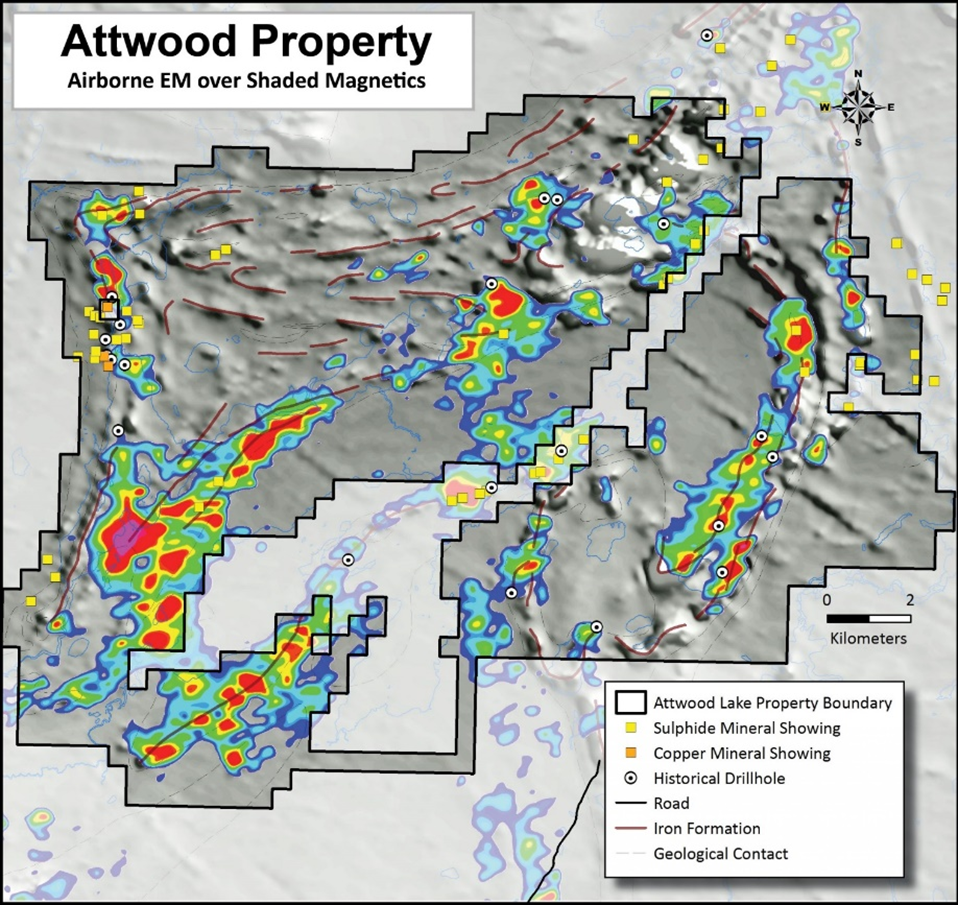
At 22,230 hectares, Attwood is a massive project but there are just 19 drill holes on the whole property. So, again, an underexplored part of the world.
The other great part about Attwood is that it is right at the terminus of an all-weather road called the Ogoki Forestry Road. It comes within about 5 kilometers of the property. So, our access to this project is fantastic.
For a couple of hundred thousand dollars, we can put some boots on the ground, do a little bit of prospecting and some sampling, and develop targets for 2027.
Again, the focus is going to be on Keezhik and Gold Standard. Those are more advanced, that’s where we can put drills on the ground in 2026.
But Attwood is also a really interesting project and deserves a look.
Not a big chunk of our budget, but enough to keep the interest going and figure out where it is we would want to look in the future.
RM: Will we have the money in the treasury to do all three properties, after the deal, as you’ve laid out, without having to finance?
BC: I wouldn’t say we have enough to do all three; drilling isn’t cheap. We certainly have enough to do the work at Gold Standard and start the work at Keezhik.
There’s certainly enough money that’s coming into the treasury in the short term to cover our needs and move exploration forward. Of course, the best time to be looking for money is when you don’t need money.
The market is more receptive to financing when your back’s not against the wall. And when there’s interest in what you’re doing.
I’m currently on the road making sure the market understands the value proposition in Storm. We have a $5 million market cap, 20.7 million shares outstanding, 100% ownership of three fantastic properties and a significant position in the company acquiring Miminiska.
We have a lot of shareholders that are based in Europe and the US. They’re very receptive to being the back end of a charity flow-through raise. And charity flow-through doesn’t come back at you in the same way than it can if it’s a regular flow-through fund here in Canada. That’s not to disparage flow-through funds, but charity flow-through just tends to go into longer-term-view hands, if you will.
RM: We’ve got a problem though, one that’s good to have. We’ve got an awful lot of shares of a company that could very well be worth a lot of money down the road. What do you eventually do with those shares?
BC: Let me preface my answer by saying that the shares that we’re getting in Canadian Goldfields Discovery will be held in escrow over a period of 16 months. So, every four months, 25% will be released to us.
Obviously, we’re not in the business of owning stock, we’re explorers, hopefully discoverers, and property developers, to a certain point. And so, at some point, if there’s a lot of success, we’ll look to cross them, but of course we’ll work with CGM if that’s the case.
I have every confidence that the management of Canadian Goldfields Discovery are going to have great success at Miminiska. And so, there’s a great opportunity for us to participate in that and have the company rewarded and use it as a non-dilutive financing.
Those are all things that will be decided in the future, and they won’t be decided in a vacuum, Rick. Certainly, the board will be very involved. And I always talk to my big shareholders about what their opinion is. At the end of the day, the decision is the board’s and mine, but I like to hear from shareholders. I want to know what they think.
RM: The more we can explore and drill, go for discovery, that’s where the big money’s made. Discoveries are the best reward you can get in this business with juniors and at the end of the day, that is the business we’re in.
Bruce we’re chasing the rainbow looking for a discovery.
BC: Absolutely, and it’s the end of the business I like the most. The discovery is where you get the big lift in the share price. And it’s obviously very exciting. The risks that go along with early-stage exploration are apparent, but if you make the discovery, the winnings eclipse any losses that might have occurred elsewhere in this space.
RM: Exactly. The team put Miminiska into seems very strong.
BC: They’re also operating in the same neck of the woods as us. So, there’s probably synergies in terms of operating together to save money on getting people on the ground and drills on the ground.
RM: What would you like to say in closing? You’re talking to shareholders and prospective shareholders, why do you think they should speculate on Storm, your projects and this management team?
BC: I think there’s a couple of straightforward points. People invest in these ventures ultimately to make money, right? So, what’s the value proposition that we’re bringing to the table? I think there’s a few. A lot of experience in the management and the advisors that we’re working with, we’re a very lean company, so the money that we do have, and raise, will go into the ground.
Storm is planning two drill programs on its own and has a very tight share structure. I mean, 20.7 million shares outstanding at this stage. And a low market cap of $5 million. Plus, we’re exposed to the drilling that will be done at Miminiska.
Storm stands out when compared with other early-stage explorers. At a $5 million market cap, there is a lot of upside with Storm’s assets and share structure.
RM: We do have a really nice metals market; discoveries are being rewarded as is news advancing good projects. Timing could not be better.
BC: We’ve been quiet for a couple of years dealing with First Nations issues, getting the company’s share structure fixed up and dealing with our treasury. So, it’s been a long time coming. And during that prolonged process, we haven’t been out marketing the company that much.
So not a lot of people know about us. That’s another thing that we’re going to focus on in 2026, getting out there and making sure people understand what we have and what we’re doing.
RM: Thank you, Bruce, STRM’s future looks bright.
BC: Thank you, Rick.
Subscribe to AOTH’s free newsletter
Richard owns shares of Storm Exploration(TSXV:STRM). STRM is a paid advertiser on his site aheadoftheherd.com This article is issued on behalf of STRM
Legal Notice / Disclaimer
Ahead of the Herd newsletter, aheadoftheherd.com, hereafter known as AOTH.
Please read the entire Disclaimer carefully before you use this website or read the newsletter. If you do not agree to all the AOTH/Richard Mills Disclaimer, do not access/read this website/newsletter/article, or any of its pages. By reading/using this AOTH/Richard Mills website/newsletter/article, and whether you actually read this Disclaimer, you are deemed to have accepted it.
Divests US$13.5M McEwen Copper Debt to Further Enhance Liquidity ... READ MORE
Aura Minerals Inc. (NASDAQ: AUGO) (B3: AURA33) is pleased to anno... READ MORE
Montero Mining and Exploration Ltd. (TSX-V: MON) (OTC Pink: MXTRF... READ MORE
Barksdale Resources Corp. (TSX-V: BRO) (OTCQB: BRKCF) (FSE: 2NZ) ... READ MORE
Getty Copper Inc. (TSX-V: GTC) (OTCQX: GTCDF) is pleased to an... READ MORE