







Stallion Uranium Corp. (TSX-V: STUD) (OTCQB: STLNF) (FSE: B76) is pleased to announce results from its 2026 ground gravity survey at the Stone Island target, located on claims owned 100% by Stallion within the Moonlite Project in the southwestern Athabasca Basin, Saskatchewan. Integration of the gravity results with the Company’s 2026 VTEM Plus survey has identified three new priority target areas – A, B and C – expanding Stallion’s exploration pipeline of high-priority targets beyond the Coyote target.
“Stone Island is developing into an important second priority area within the Moonlite Project,” said Matthew Schwab, President and Chief Executive Officer of Stallion Uranium. “The combination of gravity and VTEM data has identified three distinct areas for follow-up, led by Target Area A where multiple conductors coincide with the strongest gravity low. Advancing targets outside Coyote strengthens our project pipeline and gives us multiple opportunities for future discovery.”
Target Area A is the strongest integrated target and contains multiple VTEM conductor picks within the principal gravity low. Target Areas B and C provide additional follow-up opportunities where conductive trends are spatially associated with distinct gravity gradients. In Athabasca Basin exploration, these combined responses are important because gravity lows or gradients can reflect structural disruption, alteration, lithological contrasts or combinations of these features associated with prospective uranium-bearing systems.
Highlights:
“The key result is the geometry of the combined responses,” commented Darren Slugoski, P.Geo., Vice President Exploration. “Target Area A shows the strongest overlap between a north-trending conductor and the principal gravity low. Areas B and C provide additional, distinct targets that will now be advanced through detailed conductor modelling and structural interpretation.”
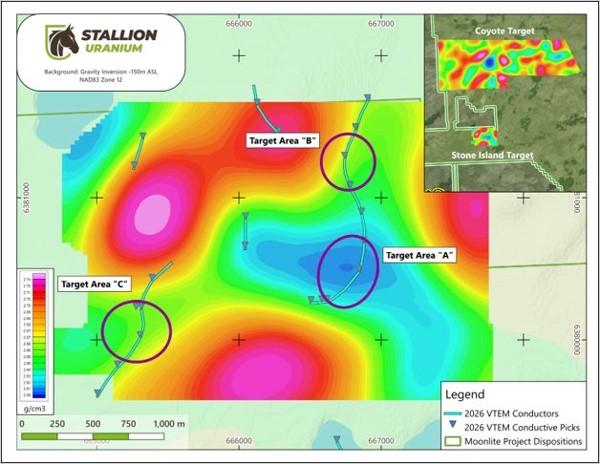
Figure 1: Target Areas A, B and C shown over the Stone Island target area
*background; Horizontal slice through Stone Island physical-property-constrained 3D gravity inversion at -150 m ASL
*blue triangles identify conductor picks from the 2026 VTEM Plus survey
Stone Island Target Development:
The 2026 ground gravity survey comprised 519 stations and was completed to refine targets identified by Stallion’s approximately 690 line-kilometre VTEM Plus survey over Stone Island. The integrated interpretation has identified three priority areas where conductive trends coincide with gravity lows or gradients.
Target Area A is the highest-priority target, where multiple VTEM responses overlap the strongest portion of the principal gravity low. Target Area B extends north along the same general conductor trend near a separate gravity gradient. Target Area C is a distinct southwest target where a conductive trend follows the margin of a localized gravity feature.
Gravity lows are not direct indicators of uranium mineralization, but when integrated with conductive trends and structural information they can help identify areas of alteration, structural disruption or lithological contrast that warrant further evaluation.
Next Steps:
About the Ground Gravity Survey and 3D Inversion:
MWH Geo-Surveys (Canada) Ltd. completed 519 unique ground gravity stations over Stone Island, together with repeat readings for quality control. The survey achieved a typical mean data accuracy of approximately 0.02 mGal.
Convolutions Geoscience Corporation subsequently completed a physical-property-constrained 3D inversion of the Stone Island gravity data. The inversion incorporated the gravity measurements, terrain information, and available geological, drillhole and petrophysical density data to produce a 3D model of the subsurface density distribution.
Additional News:
The Company also announces that it has terminated its investor engagement services agreement with Straight Edge Marketing Inc., d/b/a InvestorHyve (to update the disclosure in its May 27/26 and July 7/26 news releases). As a result of the termination, InvestorHyve will no longer provide investor engagement or related services to the Company.
Qualifying Statement:
The foregoing scientific and technical disclosures for Stallion Uranium have been reviewed and approved by Darren Slugoski, P.Geo., VP Exploration, a registered member of the Professional Engineers and Geoscientists of Saskatchewan. Mr. Slugoski is a Qualified Person as defined by National Instrument 43-101.
About Stallion Uranium Corp.:
Stallion Uranium is working to ‘Fuel the Future with Uranium’ through the exploration of roughly 1,700 sq/km in the Athabasca Basin, home to the largest high-grade uranium deposits in the world. The company, with JV partner Atha Energy holds the largest contiguous project in the Western Athabasca Basin adjacent to multiple high-grade discovery zones. With a commitment to responsible exploration and cutting-edge technology such as the use of the proprietary Haystack TI technology, Stallion is positioned to play a key role in the future of clean energy.
Our leadership and advisory teams are comprised of uranium and precious metals exploration experts with the capital markets experience and the technical talent for acquiring and exploring early-stage properties. For more information visit stallionuranium.com.
Brutus Mining Inc. (CSE: BRU) (FSE: ZI3) is pleased to announce that it has closed its non-brokered ... READ MORE
Jaguar Uranium Corp. (NYSE American: JAGU) is pleased to announce an independent Mineral Resource E... READ MORE
Auro Metals Inc. (TSX-V: AURO) (OTCQB: AURFF), is pleased to announce the assay results of the fina... READ MORE
Endeavour Silver Corp. (NYSE: EXK) (TSX: EDR) is pleased to announce that repairs to the primary bal... READ MORE
Scorpio Gold Corp. (NASDAQ: SGLD) (TSX-V: SGLD) (OTCQB: SRCRF) (FSE: RY9) is pleased to announce re... READ MORE