







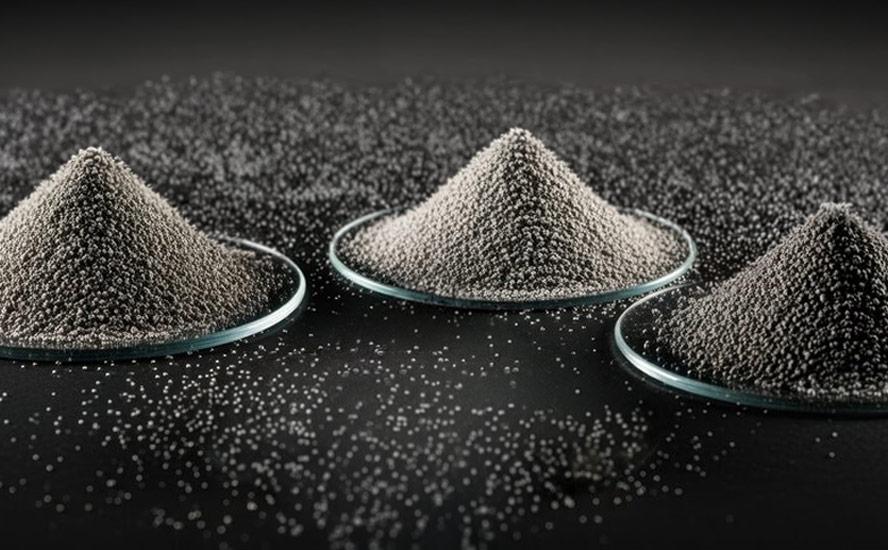
Certain metals are essential for maintaining a country’s warfighting capabilities. Three are tungsten, graphite and rare earths.
Tungsten
Tungsten (W) is one of the world’s hardest and hardest-to-source materials. It tolerates the most extreme-temperature environments, making it useful for lights, transistors, construction equipment, and parts for cars and aircraft. Tungsten-based alloys are used in a variety of industries, including defense, aerospace, energy and electronics.
Because tungsten is extremely hard, it is essential for armor-piercing munitions and high-end tooling. This has turned tungsten into a frontline strategic material. No wonder that several countries, including Canada and the US, have classified it as a critical mineral.
According to Investor News, “without tungsten, the modern military-industrial machine quite literally grinds to a halt.”
Even mining depends on tungsten, as diamond drill bits rely on tungsten components.
Just over half of the globe’s tungsten reserves are in China. Other reserve holders include Canada, Russia, the US, Vietnam and Bolivia, in descending order. Vietnam is boosting its output to overtake Russia. The United States hasn’t produced any tungsten since 2015.
Tungsten supply isn’t keeping up with demand. Last February, the Chinese government slapped export controls on tungsten, in response to the US-instigated trade war. Chinese shipments were down about 40% last year, not only due to export restrictions, but because of diminished ore quality.
The end result of skyrocketing demand for tungsten, due to militaries rearming and the war in Iran, combined with limited supply, is the metal has jumped 557% in a little over a year.
Clearly, there needs to be more tungsten mines put into production.
Outside of China, which accounts for 83% of global supply, there are only a few tungsten mines, making exploration imperative.
Tungsten and antimony: mission critical exploration — Richard Mills
While conducting regional exploration, Rackla Metals (TSXV:RAK), evaluated three Cretaceous intrusions at the historical Lened tungsten deposit in the Northwest Territories. Lened is located about 50 km north of the past-producing Cantung tungsten mine, which has a non-NI 43-101-compliant resource of 3.84 million tons in the Indicated category @ 0.97% WO3, and 1.37Mt Inferred @ 0.8% WO3 (not to be relied upon for investment purposes).
One of the stream sediment samples from Lened Creek returned a strong gold anomaly of 6.5 g/t Au. Rackla crews found much of the historical core was on the property and recoverable. The company became aware that the deposit was much more advanced that it had previously recognized, thus immediately staked it.
Discovered in 1960, in 1976 Union Carbide purchased the Lened tungsten deposit, extensively exploring the site from 1977 to 1982. The project was advanced to the prefeasibility stage.
Their work included geological mapping, geochemical and geophysical surveys, metallurgical testing, drilling 26,900 meters in 178 holes, and economic and environmental studies. Another 15 tungsten occurrences were discovered over a 15-km strike along the northeastern bank of Lened Creek.
Rackla has acquired the original Union Carbide documents, which are currently being scanned and catalogued. Once received Rackla will bring the dataset into 3D visualization software and design an exploration program to bring the resource up to an NI 43-101 standard.
Plans for 2026 include recovering, re-logging and re-sampling of the historical core to test for copper, gold and any other metals that might be associated with the tungsten, and testing of the other high-grade showings tungsten showings on the property.
Graphite
In 2023, China imposed export restrictions on gallium, germanium and graphite, disrupting supplies to the United States.Graphite is an important component of helicopters, submarines, artillery and missiles, but 70% of graphite production comes from China (and 100% of processed graphite).Virtually every US military system requires mineral components, from steel and titanium to graphite composites and cadmium alloys. Global defense spending shows that military demand is increasing for these platforms, munitions, and thus minerals. (Modern War Institute)
Graphite’s warfighting capabilities — Richard Mills
Video: Both graphite and rare earths have military and civilian applications
Graphite is the ideal material for defense purposes thanks to its unique properties, i.e., it is able to withstand very high temperatures with a high melting point; it is stable at these high temperatures; it is lightweight and easy to machine; and it is corrosion-resistant.
Four ways graphite has transformed aerospace engineering to make it more efficient, are increasing the service life of airplanes; improving fuel economy; having the ability to run hotter engines; and reducing the weight of airplanes.
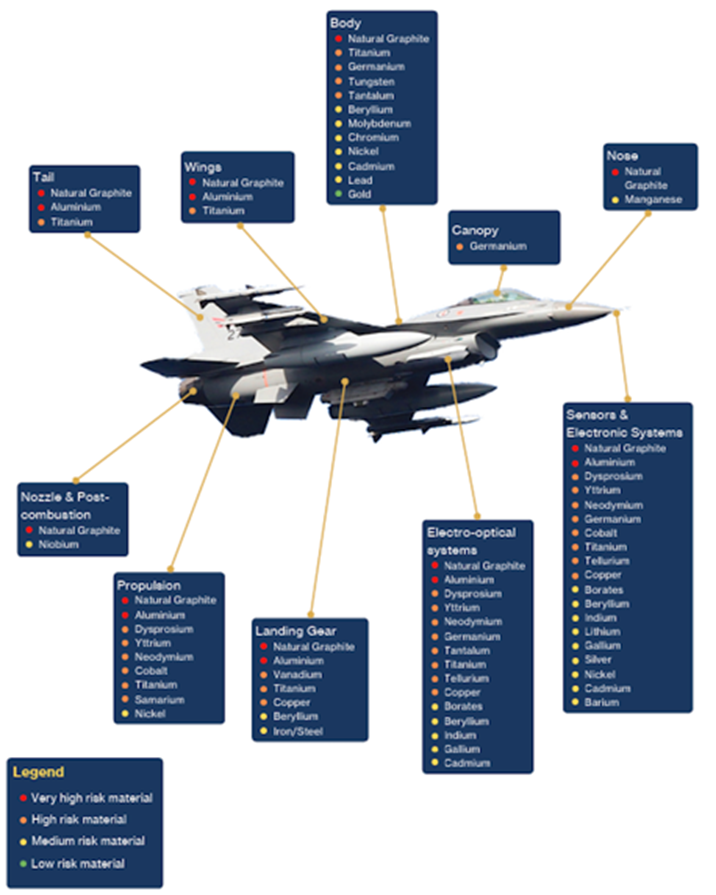
In the fighter plane graphic below, notice the use of natural graphite (red dots) in almost every part of the plane, including the body, wings, tail, nose, nozzle, propulsion system, landing gear, electro-optical systems, and sensors and electronic systems.
A second graphic of a tank shows natural graphite in the inertial navigation system, combat identification equipment, and coaxial machine gun.
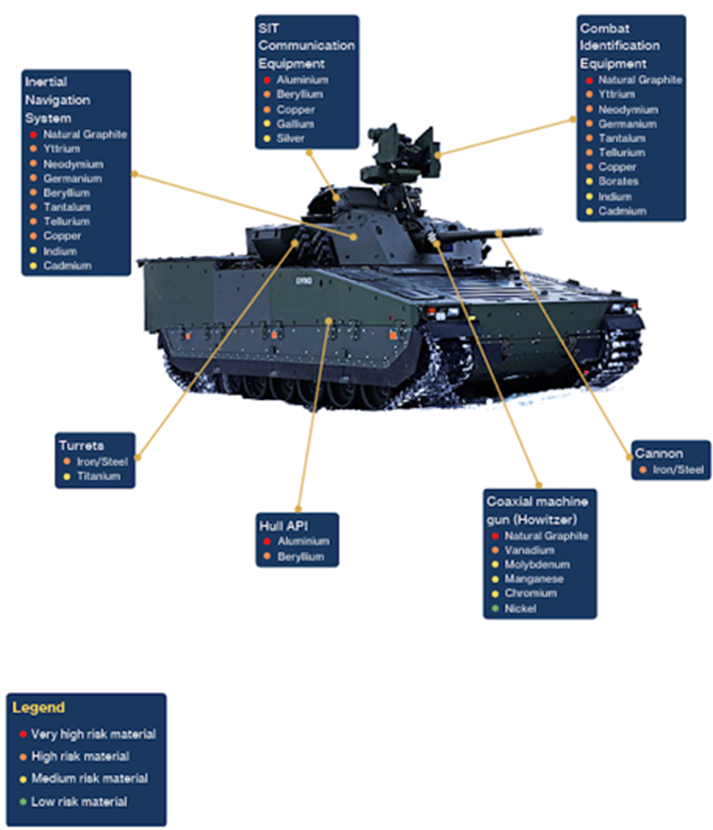
Source: Hague Centre for Strategic Studies
The amount of equipment used by the US military alone demonstrates a captive market for natural graphite. One source reported in 2018, the US government had roughly 440,000 vehicles, 780 strategic missiles, 278 combat ships and 14,000 aircraft.
A primary use of graphite is in the anode of lithium-ion batteries. There are no substitutes. An AI Overview states the US military is actively electrifying its equipment, focusing on transitioning non-tactical vehicles to electric, testing electric light tactical vehicles (LTVs), and developing hybrid-electric powertrain combat vehicles to reduce fuel dependence, boost agility, and meet net-zero emission goals by 2050. The Department of Defense is also investing in on-site renewable energy and microgrids at installations.
Junior mining companies are on the hunt for graphite deposits that will reduce their reliance on Chinese imports.
Graphite One (TSX-V:GPH) (OTCQX:GPHOF) plans to build a graphite anode manufacturing plant in Trumbull County, Ohio, and is raising funds to put towards the project.
Graphite One raising CAD$35M for Active Anode Materials plant — Richard Mills
On Feb. 18 the Vancouver-based company announced that it closed a public offering involving the sale of 20,002,000 units for aggregate gross proceeds of CAD$35 million.
Graphite One plans to become the first vertically integrated producer to serve the US EV battery market. Its supply chain strategy involves mining, manufacturing and recycling, all done domestically.
Graphite One’s Graphite Creek mine in Alaska completed a bankable feasibility study in Q2 2025, mostly funded by a $37.5 million grant from the Department of Defense.
G1’s Voltage Valley AAM manufacturing facility will initially produce synthetic Active Anode Materials from purchased materials and in the future add natural graphite AAM as graphite becomes available from the company’s Graphite Creek mine, located near Nome, Alaska, according to the March 20, 2024 news release.
The company can make other graphite products. Two possibilities are silicon-blend graphite, where silicon is embedded within a graphite matrix in the anode; and hard carbon, which improves ionic flow and provides higher power densities in batteries.
The plan also includes a recycling facility to reclaim graphite and other battery materials, to be co-located at the Ohio site, which is the third link in Graphite One’s circular economy strategy.
Rare earths
In late November 2025, Graphite One said it has found rare earth elements at its Graphite Creek graphite deposit in Alaska, potentially making the mine, once it’s advanced to production, even more valuable than when graphite was the only mineral present.
The company reports that Geochemical analyses completed by Activation Laboratories Ltd (“ActLabs”) found rare earths in drill core samples of garnet-bearing ore rock within the anticipated pit outlined in G1’s Feasibility Study (“FS”), completed in February 2025.
Garnet has a strong affinity for REEs and can concentrate them to levels exceeding those found in many existing REE ore sources, therefore garnet-bearing rocks are considered a potentially important source for rare earth elements (REEs), yttrium (Y) and Scandium (Sc), which makes them significant in the search for new REE deposits.
Scandium is often grouped with rare earth elements because it shares similar properties and is found in the same deposits. Garnet and scandium are closely linked, with garnet being the primary host for scandium in the deep lithospheric mantle, accounting for about 75% of the element’s budget there.
Yttrium (Y) and Scandium (Sc) are chemically similar to the lanthanides (REEs) and occur in the same ore deposits, so they are classified as rare earths for geological and commercial purposes.
Initial test work identified all five of the principal permanent magnet REEs at Graphite Creek: neodymium, praseodymium, dysprosium, terbium and samarium.
G1’s rare earths recovery plan will include independent testing and process development with a Department of Energy national lab.
Rare earth elements are vital to 21st century technology, with neodymium, praseodymium, dysprosium, terbium and samarium forming essential building blocks of powerful permanent magnets used in wind turbines, electric vehicles and advanced defense systems such as precision-guided munitions and radar.
Neodymium-iron-boron (NdFeB) magnets, or just neodymium magnets, are critical for electric vehicles, robots and wind turbines. They are also used in defense applications.
Terbium and dysprosium are sometimes added to NdFeB magnets to allow them to tolerate even higher temperatures.
Samarium-cobalt (SmCo) magnets have the highest known resistance to demagnetization. This capability, meaning the magnet has higher coercivity, allows them to function in high-temperature environments without losing magnetic strength — an essential attribute for most military applications.
Precision-guided munitions depend on SmCo magnets as part of the motors that manipulate their flight control surfaces. The generators that produce power for aircraft electrical systems also rely on samarium-cobalt magnets, as does the stealth technology used to mask the sound of helicopter rotor blades by generating white-noise concealment.
Other permanent magnet applications include “jet engines and other aircraft components, electronic countermeasures, underwater mine detection, antimissile defense, range finding, and space-based satellite power and communications systems,” according to the USGS.
The Army relies on REE magnets for the navigation systems in its M1A2 Abrams battle tank, and the Navy is developing a similarly dependent electric drive to conserve fuel for its Arleigh Burke-class destroyers. The Air Force’s F-22 fighter uses miniaturized permanent magnet motors to run its tail fins and rudder.
Visualizing How Rare Earths Power U.S. Defense
The infographic below explores the quantities of REEs used in major US defense platforms and highlights their specific applications in modern warfare.
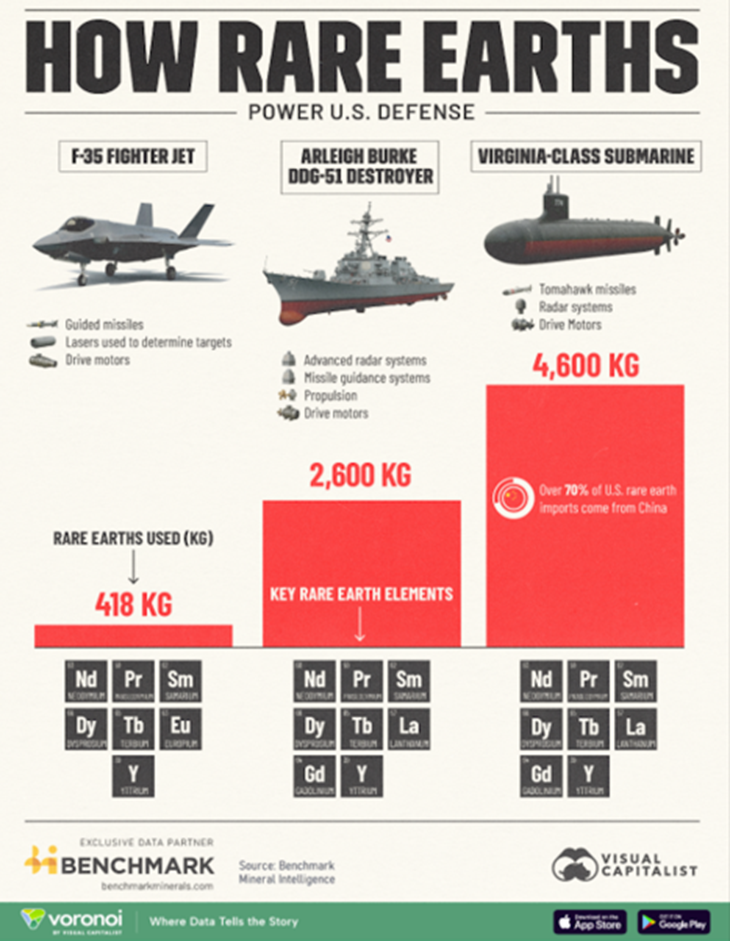
Source: Visual Capitalist
No scandium is currently mined in the United States. The US gets most of its scandium and scandium components from China. Scandium is mainly found in aluminum-scandium alloys and solid oxide fuel cells (SOFCs).
Aerospace is a key application for scandium, which is primarily used to create high-performance aluminum-scandium alloys. Even a small addition of scandium (typically 0.1% to 0.5%) significantly enhances the properties of aluminum, making it ideal for the demanding requirements of aircraft and spacecraft manufacturing.
Graphite One’s news indicates the presence of the five principle rare earths magnet elements at the Graphite Creek deposit — light rare earths neodymium, praseodymium and samarium, and heavy rare earths dysprosium and terbium. Also present is yttrium and scandium.
Graphite Creek will help the United States to break its dependence on China for rare earths and rare earth magnets, as it builds domestic refining capacity.
Conclusion
The energy transition and digitalization have made critical minerals top of mind for policymakers and investors alike. Some of these minerals play an essential role in the defense sector; shortages can easily cause supply chain disruptions to the world’s militaries.
Three weeks into the war with Iran, the US is running out of missiles, and it doesn’t have the domestic rare earths capacity to quickly replace them.
US risks running out of missiles in war with Iran — Richard Mills
The danger of depleting minerals needed to build weapons and defend territories is at a heightened risk now. With wars raging in the Middle East and Ukraine, and numerous trouble spots on the back burner, nations are girding for war and re-arming their militaries, pushing up demand for critical minerals including tungsten, graphite and rare earths.
President Trump has committed his administration to the Iran war, and I don’t see an end to it anytime soon. Trump has asked for NATO’s help without much success. According to Forbes, the only NATO members that have come out in support of the US-Israel strikes on Iran are Canada, the Czech Republic, Albania, North Macedonia, Lithuania and Latvia. The other 26 of 32 NATO members have said they’re staying out of the conflict.
On the other hand, Trump has said he doesn’t need other countries’ help in re-opening the Strait of Hormuz.
Trump at first rejected a troop deployment but is now reportedly open to it.
According to Reuters, his administration is considering deploying thousands of U.S. troops to reinforce its operation in the Middle East, as the U.S. military prepares for possible next steps in its campaign against Iran, said a U.S. official and three people familiar with the matter.
Satellite images show the USS Tripoli, an amphibious assault ship, taking Marines to Iran. Two escort ships were traveling southwest across the South China Sea on March 15, according to USA Today.
The news site adds the Tripoli will join the USS Gerald R. Ford and USS Abraham Lincoln carrier strike groups that have been part of the US attacks on Iran.
NBC News recently ran an article on potential exit strategies the United States has in what has already become a Middle East quagmire. The article doesn’t offer much hope of a quick retreat, making the availability of minerals for weapons manufacturing even more important.
As the conflict widens in the Middle East and the Iranian regime maintains its chokehold on the critical Strait of Hormuz, the stated terms and timeline for ending the war remain in flux. Aides and allies have sought to pull Trump in different directions: Those in favor of an exit strategy have been concerned about global economic instability since the war began, two of the people said, while other aides have focused on the opportunity to erode the regime’s influence in the region.
The timeline for the duration of the war “could change every day,” according to one of the people…
But exit strategies have taken on a new significance as the administration wrestles with surging oil prices and questions grow on whether Iran will willingly lay down arms and agree to U.S. terms.
Last week, the president told Axios the war will “end soon” while his defense secretary told CBS it was “only just the beginning.” Asked Friday, March 13 when he would know when the conflict was done, Trump told Fox News: “When I feel it in my bones.
Subscribe to AOTH’s free newsletter
Richard owns shares of Rackla Metals (TSXV:RAK) and Graphite One (TSXV:GPH). RAK & GPH are paid advertisers on his site aheadoftheherd.com This article is issued on behalf of RAK and GPH.
Legal Notice / Disclaimer
Ahead of the Herd newsletter, aheadoftheherd.com, hereafter known as AOTH.
Please read the entire Disclaimer carefully before you use this website or read the newsletter. If you do not agree to all the AOTH/Richard Mills Disclaimer, do not access/read this website/newsletter/article, or any of its pages. By reading/using this AOTH/Richard Mills website/newsletter/article, and whether you actually read this Disclaimer, you are deemed to have accepted it.
Divests US$13.5M McEwen Copper Debt to Further Enhance Liquidity ... READ MORE
Aura Minerals Inc. (NASDAQ: AUGO) (B3: AURA33) is pleased to anno... READ MORE
Montero Mining and Exploration Ltd. (TSX-V: MON) (OTC Pink: MXTRF... READ MORE
Barksdale Resources Corp. (TSX-V: BRO) (OTCQB: BRKCF) (FSE: 2NZ) ... READ MORE
Getty Copper Inc. (TSX-V: GTC) (OTCQX: GTCDF) is pleased to an... READ MORE