







Purepoint Uranium Group Inc. (TSX-V: PTU) (OTCQB: PTUUF) today reported radiometric results from the completed 2026 summer drill program at the 50/50 Dorado Joint Venture with IsoEnergy Ltd. (NYSE American: ISOU) (TSX: ISO), located in Saskatchewan’s Athabasca Basin. Drill hole PG26-11, the first hole completed at the Q24 target, intersected 7.4 metres averaging 8,760 counts per second across the unconformity, including 0.5 metres averaging 38,710 cps. The Q24 radioactive interval occurs primarily within strongly altered and structurally disrupted basement rocks, at a separate target area from both Nova and Q23.
“The first hole at Q24 delivered exactly what we look for in this part of the Athabasca Basin; strong radioactivity at the unconformity, significant alteration, structural disruption and graphitic basement rocks,” said Chris Frostad, President & CEO of Purepoint. “These geological features have guided uranium exploration in this district for decades and seeing them come together in the first hole at a new target area is really encouraging. Q24 is separate from both Nova and Q23, giving us an important new area for follow-up drilling at Dorado.”
Highlights
Q24 Target — First-Pass Drilling
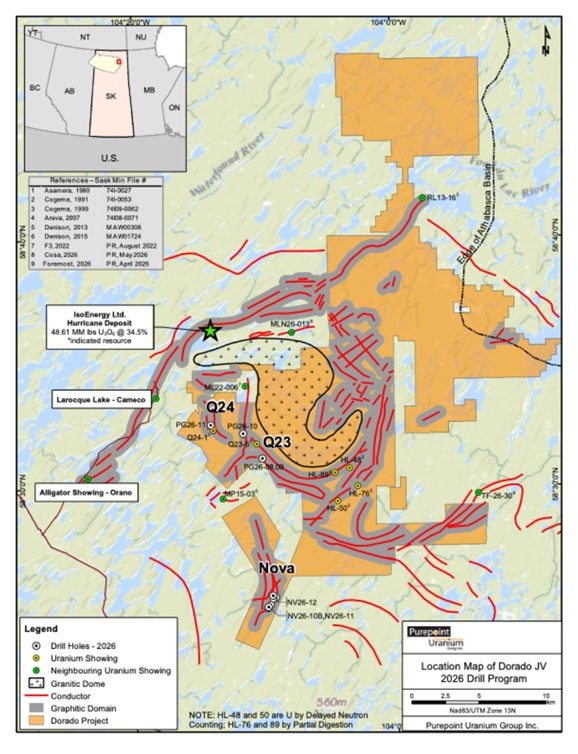
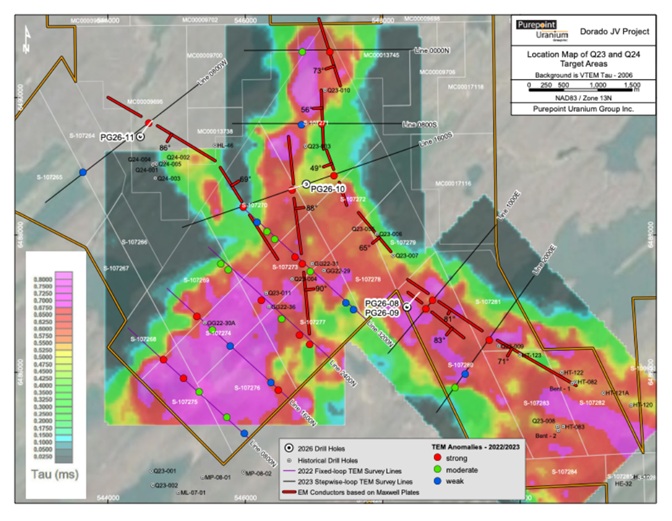
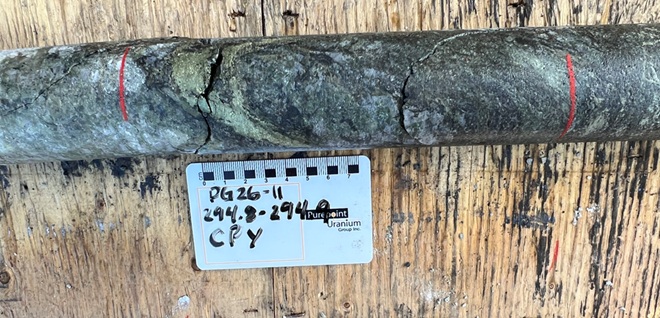
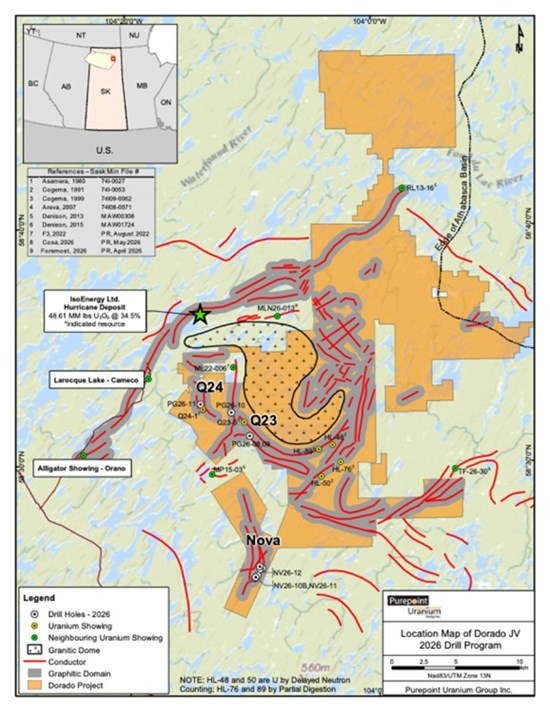
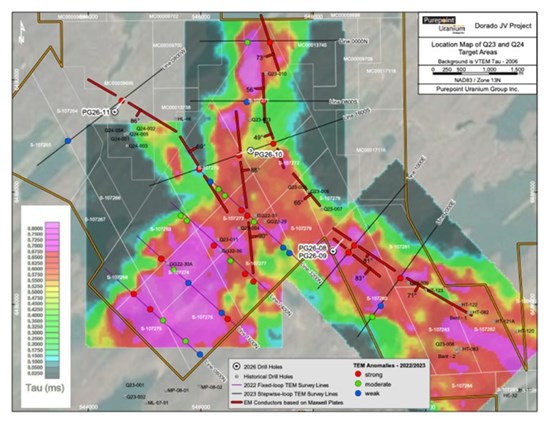
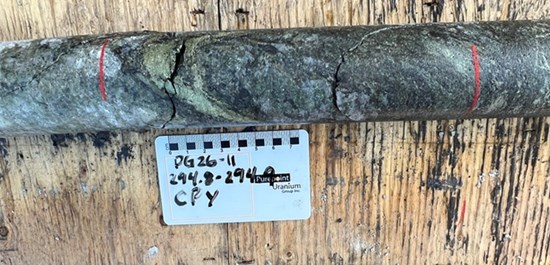
PG26-11, the first drill hole completed at Q24, tested a strong ground electromagnetic (EM) conductor (Figures 1 and 2) and encountered strongly altered and broken sandstone before reaching the unconformity at approximately 285 metres. The principal radioactive interval extended from 284.1 to 291.5 metres and averaged 8,760 cps over 7.4 metres, including 0.5 metres averaging 38,710 cps. Core recovery was incomplete within this higher-radioactivity interval; assays from the recoverable portion are pending. Chalcopyrite (copper-bearing) veining was observed 3.3 metres farther downhole at 294.8 metres (Figure 3).
The hole encountered sericite, clay and chlorite altered pelitic gneiss from the unconformity to a depth of 318 metres. A second radioactive interval, just below the chalcopyrite veining, averaged 1,010 cps over 6.2 metres from 297.2 to 303.4 metres. Pyritic graphitic pelitic gneiss, with chlorite alteration and local fault breccia, was drilled from 318 to 343 metres then unaltered pelitic gneiss to a final depth of 551 metres.
Additional Results from Q23 Target
Summer drilling also tested the Q23 target area located east of Q24. PG26-10 returned several intervals of elevated radioactivity, including 0.8 metres averaging 1,000 cps from 292.0 to 292.8 metres, 1.2 metres averaging 1,030 cps from 339.5 to 340.7 metres and 1.7 metres averaging 660 cps from 349.4 to 350.8 metres.
The hole also encountered significant desilicification and broken core in the lower sandstone, together with altered basement rocks. The Q23 results provide an additional priority target area for evaluation as the Joint Venture integrates the summer program into its 2027 exploration priorities.
2026 Summer Program
The 2026 summer drill program completed 3,669 metres of drilling across the Nova, Q23 and Q24 target areas. The program tested multiple geological and geophysical settings across Dorado, with radioactivity encountered at more than one target, reinforcing the Joint Venture’s strategy of systematically evaluating multiple prospective corridors across the Project. The first-pass Q24 result, together with the Q23 results and the broader geological information collected during the program, will be integrated with the final MobileMT structural interpretations to establish priorities for the 2027 exploration program.
Demobilization was completed in September. Laboratory assays from the summer drilling remain pending and will be reported when they become available, together with their incorporation into the Joint Venture’s 2027 exploration planning.
TABLE 1 – 2026 SUMMER DOWNHOLE GAMMA PROBE RESULTS
| Target Area | Hole ID | From (m) | To (m) | Length | Avg. CPS. | Max. CPS |
| Q24 | PG26-11 | 281.2 | 282.8 | 1.6 | 1,380 | 3,210 |
| 284.1 | 291.5 | 7.4 | 8,760 | 50,110 | ||
| includes | 284.6 | 285.1 | 0.5 | 38,710 | ||
| 291.9 | 292.6 | 0.7 | 880 | 1,280 | ||
| 297.2 | 303.4 | 6.2 | 1,010 | 3,200 | ||
| Q23 | PG26-08* | 248.1 | 250.1 | 3 | 850 | 1,610 |
| PG26-09* | 221.2 | 222.5 | 1.3 | 710 | 1,170 | |
| 235.1 | 237.0 | 1.9 | 780 | 1,190 | ||
| PG26-10 | 292.0 | 292.8 | 0.8 | 1,000 | 1,360 | |
| 339.5 | 340.7 | 1.2 | 1,030 | 1,870 | ||
| 349.4 | 350.8 | 1.7 | 660 | 900 | ||
| Nova | NV26-10B* | 389.7 | 390.5 | 0.8 | 700 | 830 |
| 399.4 | 399.8 | 0.4 | 1,100 | 1,670 | ||
| 453.1 | 453.6 | 0.5 | 1,650 | 3,010 | ||
| NV26-11* | 305.7 | 307.1 | 1.4 | 730 | 1,070 | |
| 337.8 | 343.4 | 5.6 | 11,730 | 53,300 | ||
| includes | 339.0 | 339.4 | 0.4 | 50,650 | – | |
| NV26-12 | 304.4 | 304.9 | 0.5 | 700 | 810 | |
| *previously released | ||||||
TABLE 2 – Drill Hole Statistics
| Target Area | Hole ID | NAD 83 UTM Zone 13 | Elev’n | Azimuth | Dip | Depth | |
| Easting | Northing | (masl) | (degrees) | (degrees) | (m) | ||
| Q24 | PG26-11 | 544475 | 6489438 | 420 | 032 | -60 | 551 |
| Q23 | PG26-08 | 548357 | 6486962 | 422 | 039 | -60 | 515 |
| PG26-09 | 548357 | 6486962 | 422 | 039 | -75 | 401 | |
| PG26-10 | 546891 | 6488745 | 420 | 250 | -60 | 524 | |
| Nova | NV26-10B | 548818 | 6475894 | 475 | 334 | -64 | 524 |
| NV26-11 | 548818 | 6475894 | 475 | 321 | -64 | 487 | |
| NV26-12 | 549146 | 6476743 | 466 | 288 | -60 | 579 | |
FIGURE 1 – DORADO PROJECT MAP SHOWING NOVA, Q23 & Q24 TARGETS
To view an enhanced version of this graphic, please visit:
https://images.newsfilecorp.com/files/3218/314667_purepoint1.jpg
FIGURE 2 – Q23/Q24 TARGET AREAS – COMPILATION MAP
To view an enhanced version of this graphic, please visit:
https://images.newsfilecorp.com/files/3218/314667_purepoint2.jpg
FIGURE 3 – HOLE PG26-11 CORE PHOTO SHOWING CHLORITE ALTERED PELITIC GNEISS WITH CHALCOPYRITE VEINING
To view an enhanced version of this graphic, please visit:
https://images.newsfilecorp.com/files/3218/314667_purepoint3.jpg
About the Dorado Project
The Dorado Project is located along the eastern margin of Saskatchewan’s Athabasca Basin in Canada. The property covers prospective structural corridors considered favourable for unconformity-related uranium mineralization and is operated by Purepoint under a 50/50 joint venture with IsoEnergy Ltd.
Dorado hosts the Nova Discovery, where previous drilling returned assays of up to 8.1% U3O8 over 0.4 metres within 1.62% U3O8 over 2.1 metres. Uranium mineralization has been identified along a prospective structural corridor extending approximately one kilometre and is associated with intense alteration, structural disruption and graphitic basement rocks.
Exploration at Dorado is focused on advancing the Nova Discovery while systematically evaluating additional priority targets across the Project’s prospective structural and conductive corridors, including Q23 and Q24.
Gamma Logging
A Mount Sopris 2PGA-1000 downhole total gamma probe was utilized for radiometric surveying and counts per second reported in this press release.
A handheld RS-125 Gamma-Ray Spectrometer is used during core sampling and provides a readout of equivalent % K, ppm of U and Th. All drill intercepts are core width, and true thickness is yet to be determined.
Qualified Person
The technical information contained in this news release has been reviewed and approved by Scott Frostad, P.Geo., Vice President, Exploration of Purepoint Uranium Group Inc., who is a Qualified Person as defined by National Instrument 43-101.
About Purepoint
Purepoint Uranium Group Inc. (TSX-V: PTU) (OTCQB: PTUUF) is a uranium exploration company operating at the heart of the Athabasca Basin — the world’s premier high-grade uranium district. Purepoint actively operates exploration programs on behalf of joint venture partnerships with three of the world’s leading uranium companies: Cameco Corporation, Orano Canada Inc. and IsoEnergy Ltd. Purepoint’s strategy of advancing projects through partnerships with leading uranium companies allows the Company to leverage technical expertise and partner funding while maintaining meaningful exposure to discovery success.
Purepoint operates the Dorado Project under a 50/50 joint venture with IsoEnergy Ltd., where the Nova Discovery returned confirmed assays of up to 8.1% U₃O₈ and a mineralized corridor now extends to one kilometre. The Company also operates the Aurora and Celeste Blocks with IsoEnergy and the Hook Lake and Smart Lake projects under joint venture with Cameco Corporation and Orano Canada Inc. Purepoint’s wholly owned property portfolio includes additional exploration-stage uranium assets in the Athabasca Basin region. Additionally, Purepoint holds a promising VMS project optioned to and strategically positioned adjacent to Eldorado Gold’s McIlvenna Bay project.
For more information, please contact:
Purepoint Uranium Group Inc.
Chris Frostad, President & CEO
Phone: (416) 603-8368
Email: cfrostad@purepoint.ca
Neither the Exchange nor its Regulation Services Provider (as that term is defined in the policies of the Exchange) accepts responsibility for the adequacy or accuracy of this Press release.
Brutus Mining Inc. (CSE: BRU) (FSE: ZI3) is pleased to announce that it has closed its non-brokered ... READ MORE
Jaguar Uranium Corp. (NYSE American: JAGU) is pleased to announce an independent Mineral Resource E... READ MORE
Auro Metals Inc. (TSX-V: AURO) (OTCQB: AURFF), is pleased to announce the assay results of the fina... READ MORE
Endeavour Silver Corp. (NYSE: EXK) (TSX: EDR) is pleased to announce that repairs to the primary bal... READ MORE
Scorpio Gold Corp. (NASDAQ: SGLD) (TSX-V: SGLD) (OTCQB: SRCRF) (FSE: RY9) is pleased to announce re... READ MORE