








Lion One Metals Limited (TSX-V: LIO) (OTCQX: LOMLF) is pleased to report significant new high-grade gold results from 3,337.30 meters of underground infill and grade control drilling at its 100% owned Tuvatu Alkaline Gold Project in Fiji.
Top New Drill Results:
*Drill intersects are downhole lengths, 3.0 g/t cutoff. True width not known. See Table 1 for additional data.
The primary target of the drill program is the southern and down-dip extensions of the Ura and Murau lodes in Zone 2 below level 1061, which is the lowest level of underground development in Zone 2. Drilling was conducted from one near surface underground drill station on the 1103 level. The Company intersected high-grade mineralization in 14 out of 18 drillholes with three drill holes abandoned.
Drill results include multiple very high-grade assay results, including 325.75 g/t over 0.4 m, 237.58 g/t over 0.4 m, 162.75 g/t over 0.5 m, 126.93 g/t over 0.4 m, and 6,571.20 g/t over 0.45 m, which is the highest-grade assay result ever returned at Tuvatu. Most of the high-grade drill intersects are located within 15 m to 75 m of underground development (within 50 m vertical distance) and are anticipated to be incorporated into the mine plan within the next twelve months. These drill results are focused on an area of limited prior drilling and are outside the current resource. The Ura and Murau systems remain open at depth and along strike and represent a significant opportunity for resource expansion at Tuvatu. The drill program is ongoing.
The headline interval of 4.2 m of 715.15 g/t gold is located 55 m from the Western Decline and intersected a shallow-dipping roscoelite bearing vein that is part of the Murau lode system. Roscoelite mineralization is a defining characteristic of alkaline gold systems and is directly associated with high-grade gold. Similar mineralization is observed at analog alkaline gold deposits, including the nearby Vatukoula gold mine in Fiji and the Porgera gold mine in PNG, which has produced over 25 million ounces of gold.
Very high-grade gold results are not unexpected at Tuvatu. Previous results include 2,749.86 g/t over 0.3 m, 1,517.79 g/t over 0.3 m, 1,568.55 g/t over 0.3 m, and 1986.23 g/t over 0.6 m.
Lion One President and CEO, Ian Berzins, stated: “We’re extremely pleased with the new results from our Zone 2 drilling. The interval of 715.15 g/t gold over 4.2 m is the highest grade over width in the history of Tuvatu, and it’s located in close proximity to our underground workings in an area of limited drilling. The Ura and Murau systems are a developing target and this type of intersect is testament to the potential of the system as we continue to drill and expand the resource at Tuvatu, both in Zone 2 and in Zone 5.”
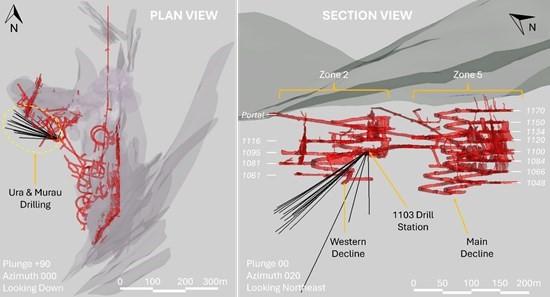
Figure 1. Location of the Zone 2 drilling reported in this news release. Left image: Plan view of the Zone 2 drilling in relation to the mineralized lodes shown in grey with Tuvatu underground development shown in red. Right image: Section view of the Zone 2 drilling looking Northeast with underground levels and declines in Zone 2 and Zone 5 identified. The primary target for the Zone 2 drilling is the down-dip and southern extension of the Ura and Murau lodes below level 1061, outside the current resource.
Zone 2 Ura and Murau Drilling
The Zone 2 area of Tuvatu is located on the west side of the deposit and includes the Ura, Murau, and AV (formerly URW1) mineralized lode systems. The Ura and AV lode systems consist primarily of steeply dipping mineralized veins, while the Murau lode system consists primarily of shallow to flat-dipping veins between the Ura and AV lode systems. Similar shallow to flat-dipping veins are observed at the Vatukoula gold mine 40 km northeast of Tuvatu and are referred to locally as “flatmakes”.
The primary target for the drill holes in this news release was the shallow-dipping Murau flatmakes below level 1061 of the mine, while a secondary target was the down-dip extension of the Ura lodes below level 1061. Mineralization in the Murau and Ura lode systems was poorly constrained below level 1061 due to limited drilling below current underground workings in Zone 2. The purpose of this drill program is to increase resource confidence in those areas and bring them into the mine plan in the near term. Both the Ura and Murau lode systems are largely untested at depth below level 1061. The systems remain open at depth and along strike and represent a significant opportunity for resource expansion.
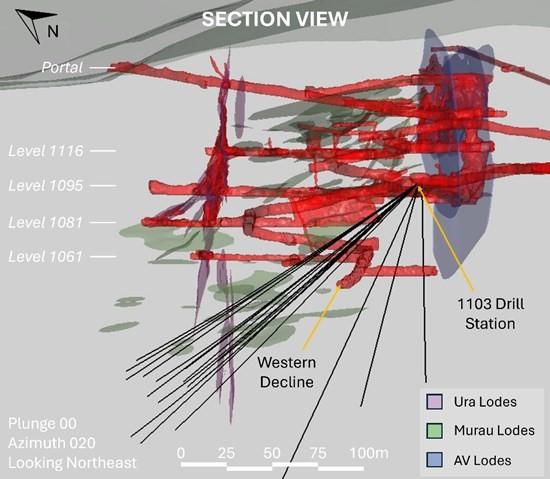
Figure 2. Ura, Murau and AV Lodes in Zone 2. Section view looking Northeast, showing the Ura and Murau drilling in relation to modeled high-grade mineralized structures of the Ura, Murau, and AV lode systems. The Murau lodes are shallow to flat-dipping structures between the steeply dipping Ura and AV lodes.
Drilling was conducted from the 1103 drill station underground and targeted a drill spacing of 12.5 m x 12.5 m in the Murau lodes and a drill spacing of 25 m x 25 m in the Ura lodes. 14 of the 18 completed drillholes intersected high grade mineralization, with most of the drill results located within 15 m to 75 m of underground development and within 50 m vertically. This represents approximately two additional levels of mining in Zone 2.
The Murau lodes, or “flatmakes”, are flat to shallow-dipping mineralized structures that typically strike E-W and dip at approximately -20° to the north or northwest. They have a vuggy texture and consist of grey chalcedonic silica, arsenian pyrite, quartz, roscoelite, and visible gold. The presence of roscoelite is significant as quartz-roscoelite veining is directly related to high-grade gold mineralization and is the most economically important mineral assemblage at large alkaline gold deposits similar to Tuvatu, such as Vatukoula and Porgera.
At Porgera, the most significant veins are the Stage II quartz-roscoelite-pyrite veins with native gold, found in Zone VII of the Roamane fault zone. Zone VII yielded 5.1 million ounces of gold at 27 g/t. Individual veins within Zone VII locally contained hundreds to thousands of grams per tonne gold, which is similar to assay results observed at Tuvatu. Within the 14 drillholes that intersected high-grade mineralization in this news release, there are five assays that returned over 100 g/t gold, including the highest-grade assay result ever returned at Tuvatu; 6,571.20 g/t over 0.45 m. The Ura shrinkage stope, which is located on Level 1116 approximately 100 m above these drill results, returned 5,704 tonnes at 10.6 g/t gold. The Ura and Murau lodes were first mined in 2025 and are a developing target at Tuvatu with limited drilling and strong discovery potential below current underground levels.
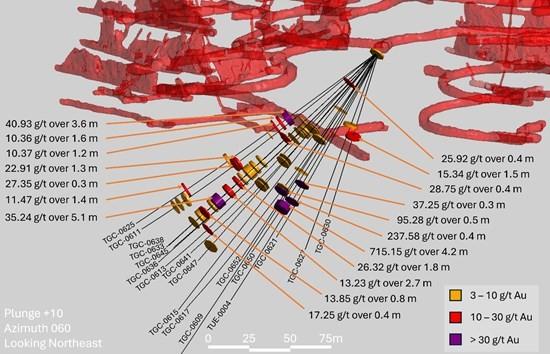
Figure 3. Ura and Murau drilling with high-grade intercepts highlighted, 3.0 g/t gold cutoff. Oblique view looking down to the Northeast with select high-grade intercepts highlighted. The drill holes shown here targeted the Ura and Murau lodes below Level 1061 of the mine in an area with limited prior drilling. Most of the drill intercepts shown are outside the current resource and mine plan but are located within 15 m to 75 m of underground development and are anticipated to be brought into the mine plan within the next twelve months.
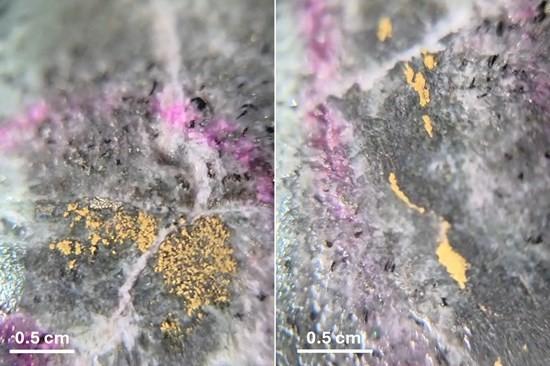
Figure 4. Example visible gold from TGC-0650 at 124 m depth. Assay results from this interval returned 6,571.20 g/t gold over 0.45 m.
Note on Composite Grades
The drill results reported in this news release are expressed in downhole intervals. Due to local variability in structural orientation true widths are unknown. Drill holes are oriented perpendicular to mineralization as much as possible. The minimum mining width at Tuvatu is approximately 1.5 m. In reporting drillhole intercepts Lion One uses a grade composite cut-off of 3 g/t gold with <1 m internal dilution at <3 g/t gold. Drill hole intervals that are <3 g/t gold are below cutoff and are not included in Figure nor in Table 2.
Competent Person’s Statement
In accordance with National Instrument 43-101 – Standards of Disclosure for Mineral Projects, Melvyn Levrel, MAIG, Chief Geologist for Lion One Metals, is the Qualified Person for the Company and has reviewed and approved the technical and scientific content of this news release.
Lion One Laboratories / QAQC
Lion One adheres to rigorous QAQC procedures above and beyond basic regulatory guidelines in conducting its drilling, sampling, testing, and analyses. The Company operates its own geochemical assay laboratory and its own fleet of diamond drill rigs using PQ, HQ and NQ sized drill rods. The Lion One geochemical laboratory is accredited under the IANZ ISO/IEC 17025:2017 Standard – the international standard for testing and calibration of laboratories.
Diamond drill core samples are logged by Lion One personnel on site. Exploration diamond drill core is split by Lion One personnel on site, with half core samples sent for analysis and the other half core remaining on site. Grade control diamond drill core is whole core assayed. Core samples are delivered to the Lion One Laboratory for preparation and analysis. All samples are pulverized at the Lion One lab to 85% passing through 75 microns and gold analysis is carried out using fire assay with an AA finish. Samples that return grades greater than 10.00 g/t Au are re-analyzed by gravimetric method, which is considered more accurate for very high-grade samples.
Duplicates of 5% of samples with grades above 0.5 g/t Au are delivered to ALS Global Laboratories in Australia for check assay determinations using the same methods (Au-AA26 and Au-GRA22 where applicable). ALS also analyses 33 pathfinder elements by HF-HNO3-HClO4 acid digestion, HCl leach and ICP-AES (method ME-ICP61). The Lion One lab can test a range of up to 71 elements through Inductively Coupled Plasma Optical Emission Spectrometry (ICP-OES), but currently focuses on a suite of 29 important pathfinder elements with an aqua regia digest and ICP-OES finish.
About Lion One Metals Limited
Lion One Metals is an emerging Canadian gold producer headquartered in North Vancouver BC, with new operations established in late 2023 at its 100% owned Tuvatu Alkaline Gold Project in Fiji. The Tuvatu project comprises the high-grade Tuvatu Alkaline Gold Deposit, the Underground Gold Mine, the Pilot Plant, and the Assay Lab. The Company also has an extensive exploration license covering the entire Navilawa Caldera, which is host to multiple mineralized zones and highly prospective exploration targets.
Broad Gold Mineralization Starts at Surface, Returning 1.86 g/t A... READ MORE
Lithium Africa Corp. (TSX-V: LAF) (FSE: 6MQ) (OTCQB: LTAFF) is pl... READ MORE
Drilling also returns 134.0 m of 0.65 g/t Au in the Lower Domain;... READ MORE
Copper Road Resources Inc. (TSX-V: CRD) is pleased to announce th... READ MORE
Brunswick Exploration Inc. (TSX-V: BRW) (OTCQB: BRWXF) (FRANKFUR... READ MORE