








2,090,000 MTS OF CONTAINED Cu (Indicated Resource)
and 1,385,000 MTS OF CONTAINED Cu (Inferred Resource)
2,338,000 MTS OF CONTAINED CuEq (Indicated Resource)
and 1,583,000 MTS OF CONTAINED CuEq (Inferred Resource)
Au RESOURCE OF 487,900 OZS (Indicated Resource)
and 380,200 OZS (Inferred Resource)
Mo RESOURCE OF 103,600,000 LBS (Indicated Resource)
and 84,500,000 LBS (Inferred Resource)
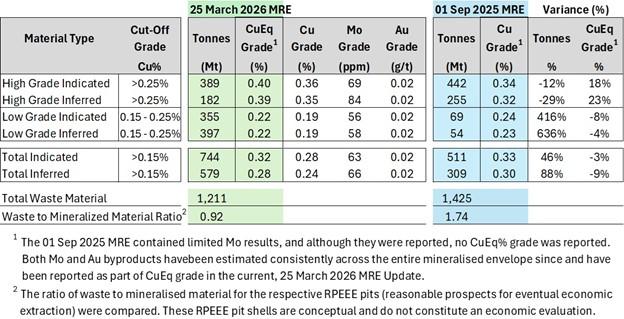
STRIPPING RATIO REDUCED TO 0.92x FROM 1.74x
Highlights
Koryx Copper S.A. (TSX:KRY.V) (NSX:KYX) (OTCQB:KRYXF) is pleased to announce an updated Mineral Resource Estimate for its wholly-owned Haib Project, in southern Namibia. This Mineral Resource Statement represents an update to the previous statement that had an effective date of 01 September 2025 and was reported in an NI 43-101 Technical Report titled “Preliminary Economic Assessment of the Haib Copper Project, Namibia”.
Haib is a large-scale, advanced open-pit sulphide copper, molybdenum, and gold porphyry project with a small oxide cap. It has an envisaged average production rate 92,000tpa in clean concentrate over a 24-year mine life via a simple and low-risk open pit crushing/milling/f lotation process. The Company’s Preliminary Economic Assessment, dated September 2025, demonstrated the project to be technically and economically feasible with attractive economics and a simple, scalable, long-life and low-cost development strategy undergoing rapid advancement.
Heye Daun, Koryx Copper’s President and CEO commented: “We are very pleased with the large improvement and refinement of the Haib MRE, particularly the grade increase of the high grade portion to 0.40% CuEq (from 0.34% CuEq) coupled with the conversion of a large volume of material previously modelled as waste into lower grade mineralised material, thereby increasing the total copper inventory from 2.6Mt to 3.5Mt of contained copper whilst also reducing the expected stripping ratio from 1.74x to 0.92x.
The high-grade zone CuEq grade improvement was achieved primarily through the inclusion of by products (Mo and Au), and refined modelling of the high-grade portions of the mineral resource. That high-grade portion in the Indicated and Inferred category now represents over 15 years of life-of-mine, and with the addition of the substantially larger lower grade halo, the life-of-mine of the Haib project is expected to grow very significantly from its current 24 years to likely more than 35 years.
We will soon have 14 drill rigs on site aiming to complete 50,000m of additional infill and growth drilling before the middle of 2026. The results will be incorporated into another MRE update, which will serve as the basis for the PFS.
The combination of the (i) improved Cu grade in the high grade zones, (ii) establishment of Au and Mo indicated and inferred resources, (iii) reduced expected strip ratio, (iv) increased life-of-mine and (v) potential additional grade increase from mineral ore sorting, are expected to de liver a step-change improvement in overall project economics (both capital intensity and AISC) to be published as part of the 4Q 2026 PFS. The Haib deposit continues to grow, and demonstrate the scale and consistency required for a future large-scale copper producer.”
Haib Geology
Haib is Paleoproterozoic in age and is considered one of the oldest known porphyry copper deposits in the world. Disseminated copper mineralisation is contained within the porphyritic granodiorite, porphyritic andesite and associated breccias and is concentrated along a north-westerly structural trend that dips steeply to the southwest. Broad zones of copper mineralisation occur over a strike length of approximately 2 km that are commonly several hundreds of metres wide. Like many South American porphyries, Haib has a small oxide cap.
Mineralisation has been intersected by diamond drilling to a depth of 790 m below th e topographic surface. Copper mineralisation is predominantly chalcopyrite, however small amounts of supergene copper mineralisation in various mineralogical states occurs near surface to shallow depths (generally less than 10 m).
The MRE update has been produced by re-logging and refining of the geological interpretation and mineralisation controls, together with the new drilling results received since the previous model update of October 2024. This has resulted in an updated Mineral Resource Statement, with an effective date of 16 March 2026, based on an updated Mineral Resource model and a revised optimised pit shell.
Gold has been included in this update following metallurgical test-work allowing for assumed recovery to be applied. Additional Molybdenum assay results have also generated a better estimate for the by-product resource. Furthermore, using parameters aligned with the latest metallurgical results and assumptions, payabil ities and metal prices, a copper equivalent grade has been included in the Mineral Resource statement.
Haib Resource Modelling
A three-dimensional geological model of the copper mineralisation was constructed using all the drillhole sample data, creating multiple mineralised zones using a grade shell approach at various copper grade thresholds (>0.25%, 0.20-0.25%, 0.15-0.20%, 0.10-0.15% and <0.10%). This produced a nested grade shell model that accounts for all mineralisation currently defined in the resource area.
The model incorporated interpreted structural trends and geological domains that influence the mineralisation (Figure 1). The copper grade was estimated using the accepted historical and all Koryx data. Estimation of the grade of a three-dimensional block model was performed by ordinary kriging of five metre composite sample copper grades using Leapfrog Edge software. An average in-situ dry bu lk density value of 2.78 t/m3 was assigned to all blocks.
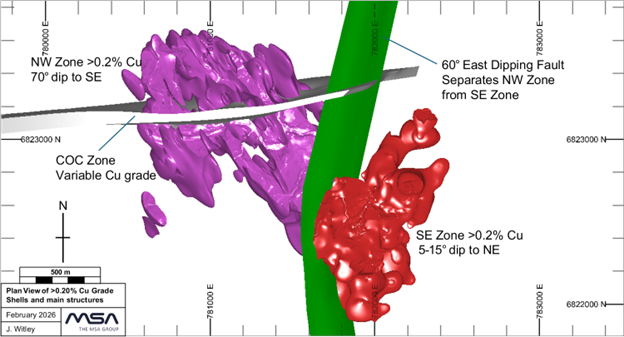
Figure 1. Plan view illustrating >0.2% Cu grade shells in the NW and SE zones and major structures
Haib Mineral Resource Statement
The Mineral Resource was estimated using the Canadian Institute of Mining, Metallurgy and Petroleum (CIM) Best Practice Guidelines and is reported in accordance with the 201 4 CIM Definition Standards, which have been incorporated by reference into National Instrument 43-101 – Standards of Disclosure for Mineral Projects.
The Mineral Resource was reported from within an optimised pit shell. The project envisages an open-pit mining operation with flotation of sulphide mineralisation, and heap leach with solvent extraction, electrowinning (SX-EW) of oxide and transitional mineralisation.
The optimised pit shell was informed by mineralisation contained within the modelled 0.20% Cu grade shell. Blocks that occur within the pit-shell with estimated grade above 0.15% Cu satisfy marginal cut-off grade criteria and, together with the optimised pit shell, reasonable prospects for eventual economic extraction (RPEEE) for the Mineral Resource has been demonstrated.
The assessment to satisfy the criteria of RPEEE is a high-level estimate and is not an attempt to estimate Mineral R eserves. A summary of the Mineral Resource estimate is presented in Table 1.
Table 1. Mineral Resource Estimate for Haib as at 16 March 2026 at a 0.15% Cu cut-off
| Category | Type | Tonnes (Mt) |
Cu Grade (%) |
Mo Grade (ppm) |
Au Grade (g/t) |
CuEq Grade (%) |
Cu Content (Mlbs) |
Mo Content (Mlbs) |
Cu Content (kt) |
Mo Content (kt) |
Au Content (koz) |
|
| Indicated | High Grade Oxide and Transitional (>0.25% Cu) | 28 | 0.35 | 51 | 0.021 | 0.38 | 215 | 3.1 | 98 | 1.4 | 18.7 | |
| Low Grade Oxide and Transitional (0.15-0.25% Cu) |
32 | 0.19 | 51 | 0.02 | 0.22 | 132 | 3.5 | 60 | 1.6 | 18.2 | ||
| High Grade Sulphide (>0.25% Cu) |
361 | 0.36 | 71 | 0.02 | 0.40 | 2,891 | 56.2 | 1,311 | 25.5 | 253.3 | ||
| Low Grade Sulphide (0.15-0.25% Cu) |
323 | 0.19 | 57 | 0.02 | 0.22 | 1,370 | 40.7 | 621 | 18.5 | 197.6 | ||
| Indicated | Total High Grade (>0.25% Cu) |
389 | 0.36 | 69 | 0.02 | 0.40 | 3,106 | 59.3 | 1,409 | 26.9 | 272.0 | |
| Total Low Grade (0.15-0.25% Cu) |
355 | 0.19 | 56 | 0.02 | 0.22 | 1,502 | 44.2 | 681 | 20.1 | 215.9 | ||
| Total | 744 | 0.28 | 63 | 0.02 | 0.32 | 4,608 | 103.6 | 2,090 | 47.0 | 487.9 | ||
| Inferred | High Grade Oxide and Transitional (>0.25% Cu) | 5 | 0.30 | 45 | 0.02 | 0.33 | 31 | 0.5 | 14 | 0.2 | 2.7 | |
| Low Grade Oxide and Transitional (0.15-0.25% Cu) |
30 | 0.19 | 51 | 0.02 | 0.22 | 124 | 3.4 | 56 | 1.5 | 21.4 | ||
| High Grade Sulphide (>0.25% Cu) |
177 | 0.35 | 85 | 0.02 | 0.39 | 1,371 | 33.4 | 622 | 15.1 | 121.6 | ||
| Low Grade Sulphide (0.15-0.25% Cu) |
367 | 0.19 | 58 | 0.02 | 0.22 | 1,527 | 47.3 | 693 | 21.5 | 234.5 | ||
| Inferred | Total High Grade (>0.25% Cu) |
182 | 0.35 | 84 | 0.02 | 0.39 | 1,402 | 33.9 | 636 | 15.4 | 124.3 | |
| Total Low Grade (0.15-0.25% Cu) |
397 | 0.19 | 58 | 0.02 | 0.22 | 1,651 | 50.7 | 749 | 23.0 | 255.9 | ||
| Total | 579 | 0.24 | 66 | 0.02 | 0.28 | 3,052 | 84.5 | 1,385 | 38.3 | 380.2 | ||
Notes:
Table 2. Indicated Resource Grade-Tonnage – 16 March 2026
| Cut-off Cu % |
Tonnes (Mt) |
Cu (%) |
Mo (ppm) |
Au (g/t) |
CuEq (%) |
Cu (kt) |
Mo (kt) |
Au (koz) |
| 0.100 | 888 | 0.26 | 61 | 0.020 | 0.29 | 2,267 | 53.9 | 569.2 |
| 0.150 | 744 | 0.28 | 63 | 0.020 | 0.31 | 2,090 | 47.0 | 487.9 |
| 0.200 | 535 | 0.32 | 67 | 0.021 | 0.36 | 1,730 | 35.6 | 362.2 |
| 0.225 | 433 | 0.35 | 69 | 0.021 | 0.38 | 1,512 | 29.9 | 298.4 |
| 0.250 | 389 | 0.36 | 69 | 0.022 | 0.40 | 1,409 | 26.9 | 272.0 |
| 0.275 | 370 | 0.37 | 70 | 0.022 | 0.40 | 1,360 | 25.7 | 261.3 |
| 0.300 | 326 | 0.38 | 69 | 0.022 | 0.41 | 1,232 | 22.5 | 234.0 |
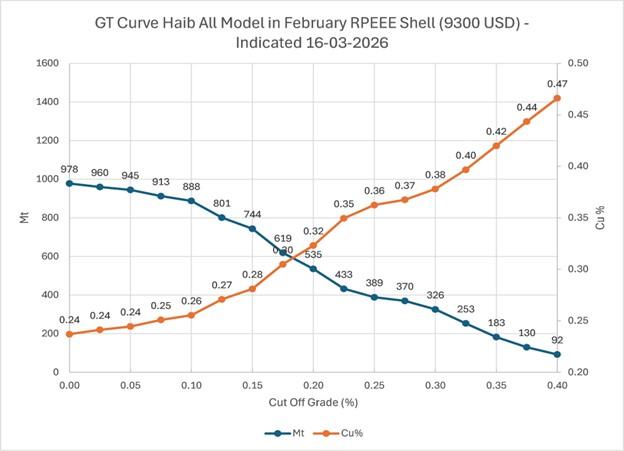
Figure 2. Grade-Tonnage Curve for Indicated Resources
Table 3. Inferred Resource Grade-Tonnage – 16 March 2026
| Cut-off Cu % |
Tonnes (Mt) |
Cu (%) |
Mo (ppm) |
Au (g/t) |
CuEq (%) |
Cu (kt) |
Mo (kt) |
Au (koz) |
| 0.100 | 899 | 0.20 | 58 | 0.021 | 0.23 | 1,769 | 52.1 | 595.4 |
| 0.150 | 579 | 0.24 | 66 | 0.020 | 0.27 | 1,385 | 38.3 | 380.2 |
| 0.200 | 307 | 0.30 | 74 | 0.021 | 0.33 | 910 | 22.6 | 205.6 |
| 0.225 | 218 | 0.33 | 79 | 0.021 | 0.37 | 720 | 17.3 | 149.3 |
| 0.250 | 182 | 0.35 | 84 | 0.021 | 0.39 | 636 | 15.4 | 124.3 |
| 0.275 | 166 | 0.36 | 86 | 0.021 | 0.40 | 594 | 14.3 | 114.4 |
| 0.300 | 137 | 0.37 | 84 | 0.022 | 0.41 | 509 | 11.4 | 95.7 |
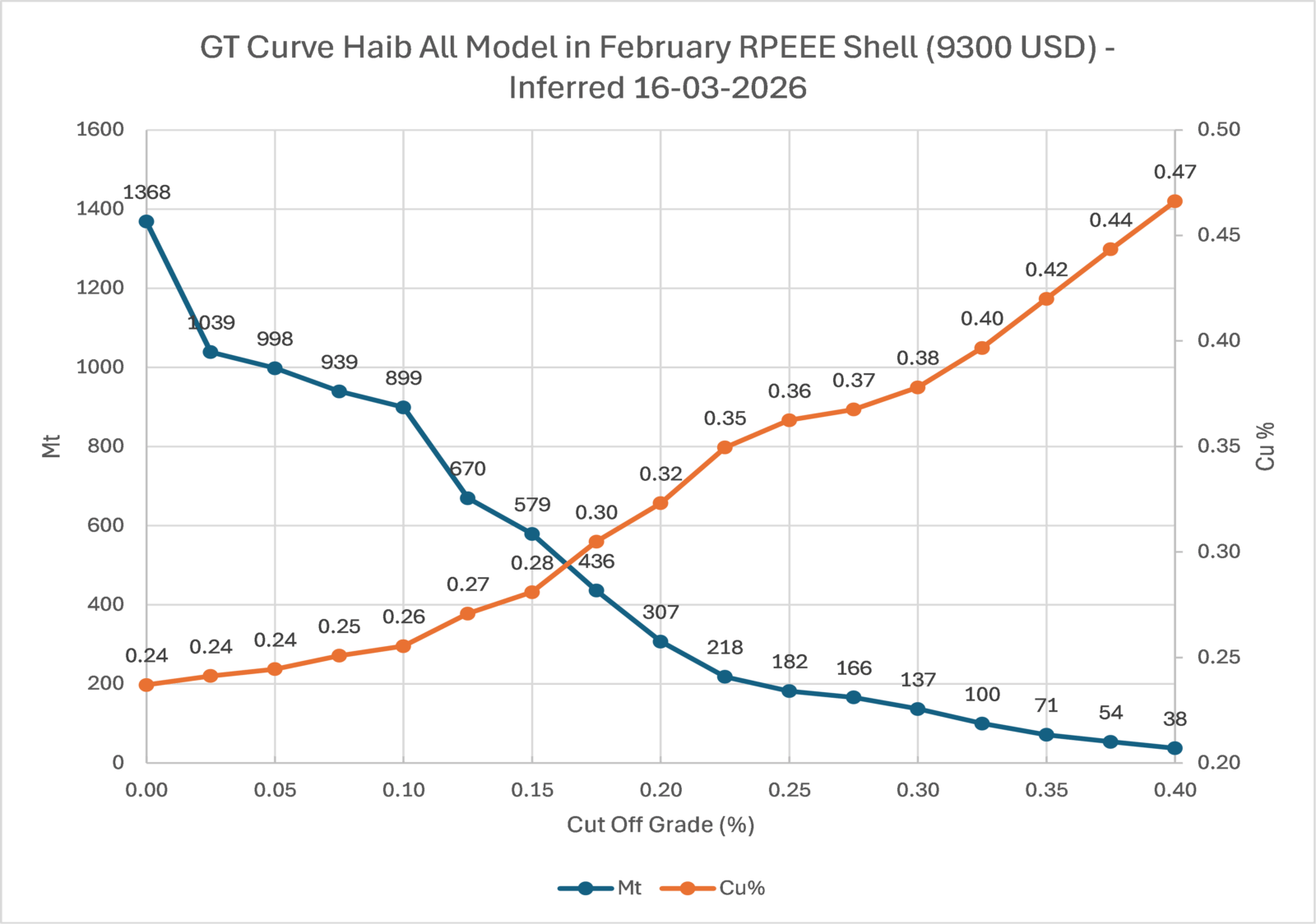
Figure 3. Grade-Tonnage Curve for Inferred Resources
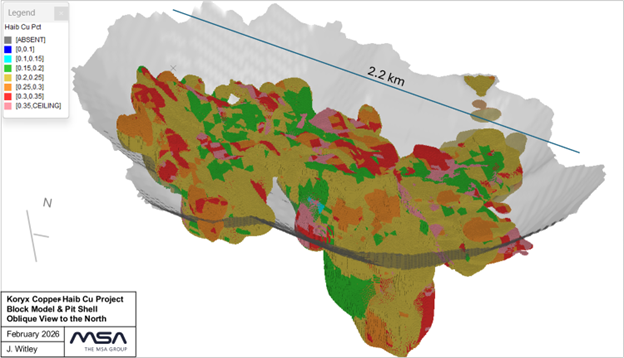
Figure 4. Haib resource pit shell and block model – oblique view to the north
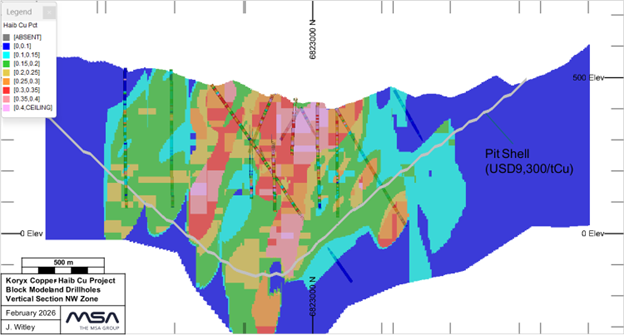
Figure 5. Section through Haib resource block model, drillholes and pit shell – NW Zone, view to the northwest
Quality Control
The Koryx drill core was logged, photographed and marked for sampling in nominal lengths of one metre. The core samples were cut in half longitudinally using a rotating diamond saw. The bagged core samples were given a unique sample reference number, bagged and despatched to ALS Laboratories Ltd. in Johannesburg, South Africa for analysis (SANAS Accredited Testing Laboratory, No. T0387), while the other half was quartered with one quarter archived and stored on site for verification and reference purposes while the other quarter is available for metallurgical test work. 33 elements were analysed by Induced Coupled Plasma (ICP) utilizing a 4-acid digestion, and gold was assayed using a 30g fire assay method. Duplicate samples, blanks, and certified standards were included with every batch and are actively used to ensure proper quality assurance and quality control. The QAQC frequency is 1 in 20 for each of blanks, duplicates and standards. The Qualified Person is satisfied that the assay results are of sufficient accuracy and precision for use in Mineral Resource estimation.
Qualified Person
Mr. J.C. Witley (BSc Hons, MSc (Eng.)) is a geologist with more than 35 years’ experience in base and precious metals exploration and mining as well as Mineral Resource evaluation and reporting. He is Head of Mineral Resources for The MSA Group (an independent consulting company), is registered with the South African Council for Natural Scientific Professions (SACNASP) and is a Fellow of the Geological Society of South Africa (GSSA). Mr. Witley has the appropriate relevant qualifications and experience to be considered a “Qualified Person” for the style and type of mineralisation and activity being undertaken as defined in NI 43-101 and is considered independent pursuant to NI 43-101. Mr. Witley has reviewed and approved the technical and scientific information within this news release.
TSX-V Approval of Continuation, New ISIN, New CUSIP and N ame Change
The Company is also pleased to announce that it has obtained approval from the TSX Venture Exchange for the continuation of the Company out of British Columbia, under section 308 of the Business Corporations Act (British Columbia), to the Grand Duchy of Luxembourg.
Additionally, and further to its news release dated November 12, 2025, the Company has also received approval from the TSX-V with regards to the previously announced name change from “Koryx Copper Inc.” to “Koryx Copper S.A.”. The TSX-V will publish a bulletin announcing the effective date of the Name Change, together with the Company’s new CUSIP and ISIN numbers.
It is anticipated that the Company’s common shares will begin trading under the new name on or about March 27, 2026. The Shares will continue to trade under the “KRY” ticker symbol on the TSX-V.
Effective on or about March 26, 2026, the new CUSIP and ISIN assigned to the Shares will be:
CUSIP: L5S2AP105, ISIN: LU3306723589.
No action is required to be taken by shareholders with respect to the Name Change, nor will this announcement have any effect on the Company’s business goals, strategy, or associated fees and expenses.
This announcement concludes the previously announced Continuation and Name Change. Please refer to the Company’s previous news releases dated September 5, 2025 and November 12, 2025 for further information.
About Koryx Copper S.A.
Koryx Copper S.A. is a Luxembourg domiciled copper development Company focused on advancing its 100% owned Haib Copper Project in Namibia whilst also building a portfolio of co pper exploration licenses in Zambia. Haib is a large, advanced (PEA-stage) copper/molybdenum/gold porphyry deposit in southern Namibia with a long history of exploration and project development by multiple operators.
More than 120,000m of drilling has been conducted at Haib since the 1970’s with significant exploration programs led by companies including Falconbridge (1964), Rio Tinto (1975) and Teck (2014). Extensive metallurgical testing and various technical studies have also been completed at Haib to date. Additional studies are underway aiming to demonstrate Haib as a future long-life, low-cost, low-risk open pit, sulphide flotation copper project with the potential for additional copper production from heap leaching.
Mineralisation at Haib is typical of a porphyry copper deposit and is dominantly chalcopyrite with minor bornite and chalcocite present and only minor secondary copper minerals at surface due to the arid envir onment. Haib is one of only a few examples of a Paleoproterozoic porphyry copper deposit in the world and one of only two in southern Africa (both in Namibia). Due to its age, the deposit has been subjected to multiple metamorphic and deformation events but still retains many of the classic mineralisation and alteration features typical of these deposits. The mineralisation is dominantly chalcopyrite with minor bornite and chalcocite present and only minor secondary copper minerals at surface due to the arid environment.
Brutus Mining Inc. (CSE: BRU) (FSE: ZI3) is pleased to announce that it has closed its non-brokered ... READ MORE
Jaguar Uranium Corp. (NYSE American: JAGU) is pleased to announce an independent Mineral Resource E... READ MORE
Auro Metals Inc. (TSX-V: AURO) (OTCQB: AURFF), is pleased to announce the assay results of the fina... READ MORE
Endeavour Silver Corp. (NYSE: EXK) (TSX: EDR) is pleased to announce that repairs to the primary bal... READ MORE
Scorpio Gold Corp. (NASDAQ: SGLD) (TSX-V: SGLD) (OTCQB: SRCRF) (FSE: RY9) is pleased to announce re... READ MORE