








Golden Cariboo Resources Ltd. (CSE:GCC) (OTC:GCCFF) (WKN:A402CQ) (FSE:3TZ) announces results from its Quesnelle Gold Quartz Mine property (‘the Property’, located 4 km northeast of Hixon British Columbia, south of Prince George. It has intersected 0.42 g/t gold over 47.01m (154.2 ft) from surface in diamond drill hole QGQ25-25 within a broader anomalous interval of 0.26 g/t Au over 190.2m and additional gold mineralization deeper in the hole, including 0.76 g/t gold over 20.45m from 324.88m. The drill hole ended in mineralization, yielding 1.00 g/t gold over 1.91m.
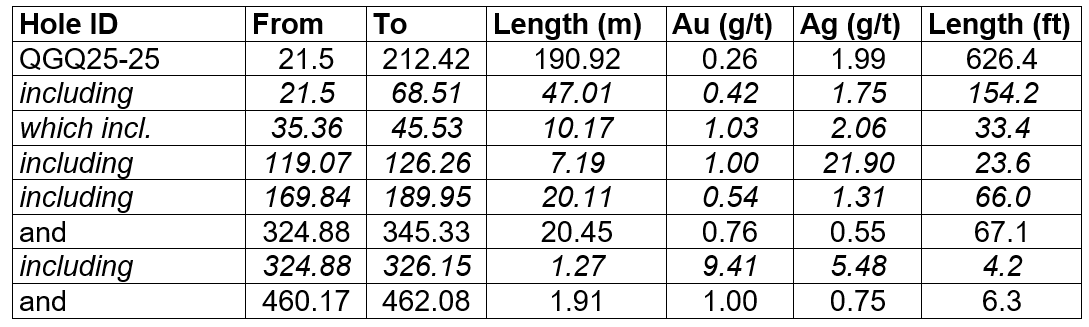
*Interval widths reported at this point have insufficient data to reliably estimate true width.

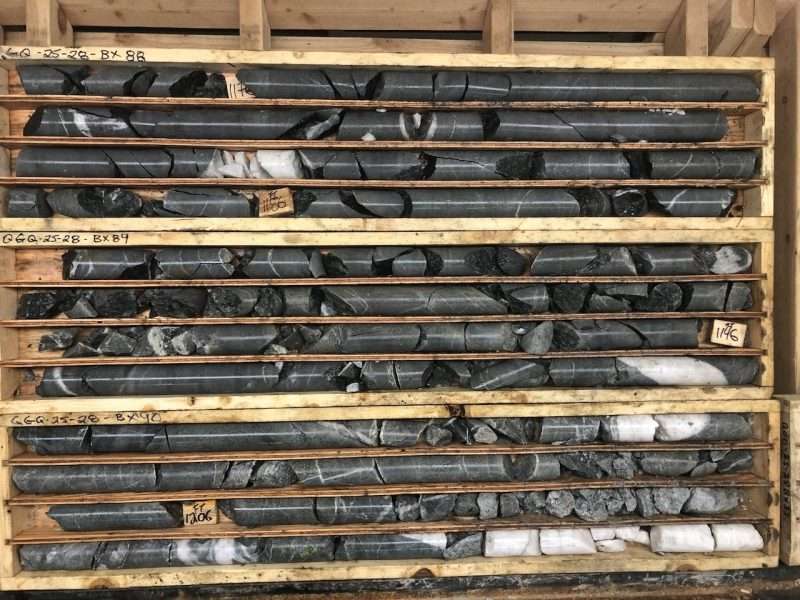
Diamond drill hole QGQ25-25 is a step out in the Halo zone, with the collar being 96m to the north-northeast of QGQ24-20, which returned 0.99 g/t Au and 9.77 g/t Ag over 236.88m (LINK). QGC25-28, an 80m step north of diamond drill hole QGQ25-25, is currently being extended to target depth, intersecting extensive quartz-carbonate veins as seen in Photo 1 on the following page.
Golden Cariboo Resources Ltd. President and CEO Frank Callaghan states: “We continue to drive forward with intersections of mineralization from surface, extending the deposit along strike at our Halo zone. Our excellent infrastructure and proximity to the community of Hixon in Central British Columbia allows our team to drill year around. We’re excited to be drilling in the winter and look forward to an active year in the Cariboo Gold Corridor.”
QA/QC samples, including blanks, standards and coarse reject duplicates, constitute 5% of the total number of samples. The reported drilling has all been NQ core, which has been logged then split in half before being sent to the laboratory.
The drill core samples were sent to the accredited MSALABS laboratory (“MSA”) in Prince George for analysis. Samples were crushed by MSA to >70% passing below 2 mm and split using a riffle splitter, and 250g splits were pulverized to >85% passing below 75 microns. An aqua regia digest with an inductively coupled plasma atomic emission spectroscopy (ICP-AES) finish was used for 35-element analysis on 0.5g aliquots. Additionally, PhotonAssay™ (photon) analysis was conducted for gold and silver. Photon analysis uses a larger size (250-500g), compared to 30 or 50g in a fire assay, providing a more thorough assessment of gold distribution in coarse gold settings, characteristic of the Halo zone, where nugget effects can impact conventional assay results. MSA is accredited for the procedures performed and entirely independent from the Company.
The technical information in this news release has been reviewed and approved by Jean Pautler, an independent consultant commissioned by the Company. Jean Pautler is a Professional Geoscientist (P.Geo.) registered with the Association of Professional Engineers and Geoscientists of the Province of BC (“APEGBC”) and licensed by Engineers and Geoscientists BC, and is a “Qualified Person” with respect to NI 43-101.
Photo 1: Example of diamond drill hole QGQ25-28 core which exhibits extensive quartz-carbonate veining.
About Golden Cariboo Resources Ltd.
Golden Cariboo Resources Ltd. is rediscovering the Cariboo Gold Rush by proceeding with highly targeted drilling and trenching programs on its Quesnelle Gold Quartz Mine property which is bordered by Osisko Development (NSE:ODV/TSXV:ODV), partly intertwined with them at the north end of the Cariboo Gold Project, and located along a favourable corridor adjacent to the Spanish and Eureka thrust faults over a 94,899 hectare (234,501 acre) area. Historically, over 101 placer gold creeks on the 90-kilometer (56 mile) trend, from the Cariboo Hudson mine north to the Quesnelle Gold Quartz Mine property, have recorded production with successful placer mining continuing to this day.
Golden Cariboo’s Quesnelle Gold Quartz Mine property is 4 kilometers (2.5 miles) northeast of, and road accessible from, Hixon in central British Columbia. The Property includes the Quesnelle Quartz gold-silver deposit, which was discovered in 1865 and developed over a footprint of about 150m x 150m (< 6 acres) at the Main zone straddling Hixon Creek. Overall, the geological setting of the gold mineralization at the Company’s Quesnelle Gold Quartz Mine property shows strong similarities with the Spanish Mountain gold deposit, situated 120 km (75 miles) towards the southeast along the same geological trend. As a sediment-hosted vein (SHV) deposit, the Spanish Mountain deposit is considered to belong to the epizonal orogenic subclass of gold deposits which include some of the world’s largest deposits such as Muruntau, Uzbekistan and Bendigo, Australia.
Broad Gold Mineralization Starts at Surface, Returning 1.86 g/t A... READ MORE
Lithium Africa Corp. (TSX-V: LAF) (FSE: 6MQ) (OTCQB: LTAFF) is pl... READ MORE
Drilling also returns 134.0 m of 0.65 g/t Au in the Lower Domain;... READ MORE
Copper Road Resources Inc. (TSX-V: CRD) is pleased to announce th... READ MORE
Brunswick Exploration Inc. (TSX-V: BRW) (OTCQB: BRWXF) (FRANKFUR... READ MORE