








Step-out drilling places SPMC on the upper margin of a potential large epithermal vein system; high-grade target drilling set to commence beneath ONED26-009
South Pacific Metals Corp. (TSX-V: SPMC) (OTCQB: SPMEF) (FSE: 6J00) is pleased to announce assay results from five drill holes, ONED26-010 to ONED26-014, at its 100%-owned Osena Project, located immediately southwest of K92 Mining’s Kainantu gold-copper mine in Papua New Guinea. The program involved step-out drilling along the Megabe structures, and a first test of an adjacent structure to the southwest. All five holes intersected mineralised structures. The four holes on Megabe mapping strike extension to more than 300 metres, and the structures remain open along strike in both directions and at depth; ONED26-010 confirmed that mineralisation extends beyond the Megabe corridor.
Highlights
CEO Timo Jauristo commented, “These four holes confirm the Megabe structures hold together along strike, are mineralised, and indicate the upper margins of an epithermal system. We think the high-grade zones in hole ONED26-009 have only clipped the upper edges of the main system, and we will drill a few deeper holes below ONED26-009 to test for continuity of high grade in that direction.
“It is important to note that we are currently drilling only one small section of Megabe and it is just one of eight currently known NW-trending mineralised zones that have been mapped at Ontenu, most of which have yet to be drilled. We have commenced planning for the next phase of exploration to test these other known structures. Much of the Ontenu area remains to be mapped. Our immediate focus is the deeper high-grade at Megabe, targeting veins showing the same character as Kora and Judd next door at K92 — and will start drilling the first of these holes shortly.”
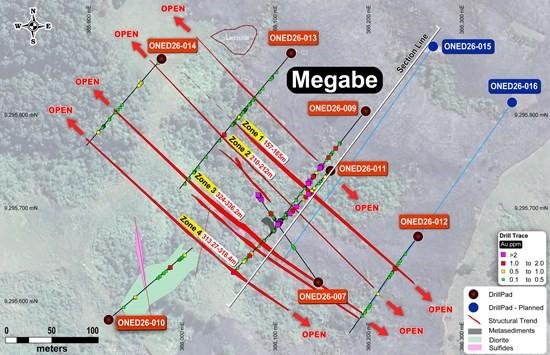
Figure 1: Map view of Megabe Drilling
Vectoring High-Grade
Four of the five holes in this program were designed to define the geometry and strike continuity of the Megabe NW trending structures. Every hole intersected the targeted structures, confirming that the Megabe trend is continuous over more than 300 metres of strike (see Table 1 for a summary of drill results). The structures remain open along strike in both directions and at depth: ONED26-012 and ONED26-014 support the interpreted geometry of the structures, marked by the current limits of drilling, not the limits of the structures (see Figure 1).
The step out drill program intercepted the top of the system, cutting the Megabe structures above the interpreted productive high-grade zone and within the leached horizon, an area that we now understand extends to at least 100 metres below surface.
Follow-up hole ONED26-011, drilled up-dip of previously released discovery hole ONED26-009, cut the Megabe structures within the window expected in the Company’s interpretation, returning 5.1 m at 1.79 g/t AuEq in a potential fourth mineralised zone (see Figure 2). The result of this drilling effectively supports vectoring towards stronger grades.
ONED26-010, tested a separate set of structures southwest of Megabe, intersected 18 m at 0.25 g/t AuEq — confirming that mineralised structures extend beyond the Megabe corridor.
Octavio Garcia, Exploration Manager of the Company, commented, “Following confirmation of the initial mineralised zone in drill holes ONED-007 and ONED-009, the objective of this step-out drilling program was to define the key geological parameters of the system, including its geometry, continuity, size, mineralisation controls and others required to validate the geological model.
“The results have confirmed several key parameters. Mineralised structures remain open in both directions, while geochemistry indicates strong potential for continuity over more than 300 metres of strike. We have also identified subparallel minor mineralised structures and a local leaching effect, similar to that observed in the Kora vein. The data provide clear evidence of an intermediate-sulfidation epithermal (ISE) system, comparable to neighbouring deposits. Recent drilling intersected the upper zone of this hydrothermal system, while also expanding the mineralised envelope. Further drilling is required to validate the geological model and determine the full extent of the system.
“The next phase will test vertical variability by drilling below the current mineralisation, helping establish the system’s position within the hydrothermal system and guide targeting of higher-grade mineralisation.”
Table 1: Summary of significant drill results, ONED26-010 to ONED26-014
| Hole ID | From (m) | To (m) | Length (m) | Intercept Grade (weighted average) | Maximum Individual Sample Assay | ||||||
| Au (g/t) | Cu (ppm) | Ag (g/t) | AuEq (g/t) | Au (g/t) | Cu (ppm) | Ag (g/t) | |||||
| ONED26-010 | 81 | 84 | 3 | 0.35 | 45 | 0.05 | 0.36 | 0.82 | 47 | 0.05 | |
| 183 | 188 | 5 | 0.29 | 73 | 3.36 | 0.35 | 1.07 | 128 | 10.1 | ||
| including | 187 | 188 | 1 | 1.07 | 128 | 6.5 | 1.18 | 1.07 | 128 | 6.5 | |
| 213 | 231 | 18 | 0.18 | 130 | 3.53 | 0.25 | 0.9 | 265 | 11.7 | ||
| ONED26-011 | 11 | 18 | 7 | 0.23 | 1486 | 14.24 | 0.59 | 0.52 | 2911 | 29 | |
| 51 | 53 | 2 | 0.51 | 176 | 7 | 0.63 | 0.76 | 234 | 7.8 | ||
| 56 | 71 | 15 | 0.32 | 117 | 2.42 | 0.37 | 2.09 | 154 | 5.6 | ||
| including | 69 | 70 | 1 | 2.09 | 137 | 2.8 | 2.15 | 2.09 | 137 | 2.8 | |
| 76 | 79.3 | 3.3 | 0.68 | 152 | 2.37 | 0.73 | 1.77 | 165 | 4.1 | ||
| including | 78.6 | 79.3 | 0.7 | 1.77 | 164 | 4.1 | 1.85 | 1.77 | 164 | 4.1 | |
| 85 | 86 | 1 | 0.56 | 65 | 3.3 | 0.62 | 0.56 | 65 | 3.3 | ||
| 108 | 109 | 1 | 4.53 | 85 | 0.4 | 4.54 | 4.53 | 85 | 0.4 | ||
| 120 | 124 | 4 | 0.6 | 77 | 1.8 | 0.63 | 1.27 | 102 | 2.1 | ||
| including | 120 | 121 | 1 | 1.27 | 51 | 1.9 | 1.3 | 1.27 | 51 | 1.9 | |
| including | 123 | 124 | 1 | 1.03 | 84 | 1.7 | 1.06 | 1.03 | 84 | 1.7 | |
| 129 | 131 | 2 | 1.76 | 132 | 1.4 | 1.79 | 3.24 | 149 | 1.9 | ||
| including | 130 | 131 | 1 | 3.24 | 114 | 0.9 | 3.26 | 3.24 | 114 | 0.9 | |
| 143 | 144 | 1 | 0.24 | 229 | 6.3 | 0.36 | 0.24 | 229 | 6.3 | ||
| 256.07 | 257.9 | 1.83 | 0.56 | 59 | 6.82 | 0.67 | 0.69 | 89 | 11 | ||
| 263.2 | 264 | 0.8 | 1.27 | 582 | 26.4 | 1.72 | 1.27 | 582 | 26.4 | ||
| 274.5 | 283.6 | 9.1 | 0.24 | 766 | 7.04 | 0.42 | 0.71 | 5374 | 41 | ||
| 313.27 | 318.4 | 5.13 | 1.66 | 140 | 7.6 | 1.79 | 5.65 | 294 | 9 | ||
| including | 314.52 | 317.53 | 3.01 | 2.52 | 155 | 8.2 | 2.66 | 5.65 | 294 | 9 | |
| ONED26-012 | 79.3 | 85 | 5.7 | 0.41 | 210 | 7.93 | 0.55 | 1.47 | 565 | 15.9 | |
| including | 82 | 83 | 1 | 1.47 | 175 | 8.2 | 1.61 | 1.47 | 175 | 8.2 | |
| 91.7 | 93.5 | 1.8 | 0.24 | 164 | 9.64 | 0.4 | 0.43 | 258 | 12 | ||
| ONED26-013 | 153.6 | 167 | 13.4 | 0.12 | 240 | 1.95 | 0.18 | 0.21 | 721 | 3.7 | |
| 177 | 186 | 9 | 0.2 | 564 | 0.84 | 0.27 | 0.53 | 1460 | 2.3 | ||
| 195 | 206 | 11 | 0.14 | 396 | 1.21 | 0.19 | 0.49 | 765 | 2.4 | ||
| 234 | 234.9 | 0.9 | 1.18 | 237 | 0.6 | 1.21 | 1.18 | 237 | 0.6 | ||
| ONED26-014 | 77 | 87.1 | 10.1 | 0.37 | 695 | 3.89 | 0.5 | 0.78 | 5815 | 24.6 | |
| 189.4 | 193 | 3.6 | 0.17 | 358 | 7.74 | 0.33 | 0.35 | 903 | 11.6 | ||
| 210 | 218 | 8 | 0.16 | 486 | 3.42 | 0.26 | 0.41 | 2072 | 7.2 | ||
| 231 | 232 | 1 | 0.68 | 123 | 3.2 | 0.73 | 0.68 | 123 | 3.2 | ||
*AuEq is based on 100% equal co-recoveries of Au, Ag and Cu using an Au price of US$4,180 per ounce, an Ag price of US$62 per ounce and a Cu price of US$6.20 per lb. Intervals are calculated using a 0.1 g/t Au lower cut with a maximum of 3 m of internal dilution; “including” intervals are calculated using a 1.0 g/t Au lower cut with a maximum of 2 m of internal dilution. Maximum individual sample assays are the highest single-sample values reported within the stated interval and do not necessarily occur in the same sample. All intervals are reported as downhole lengths. True widths have not yet been determined pending further structural interpretation.
Complete significant intercepts and drill hole collar details are provided in Appendix Tables A1 and A2 at the end of this release.
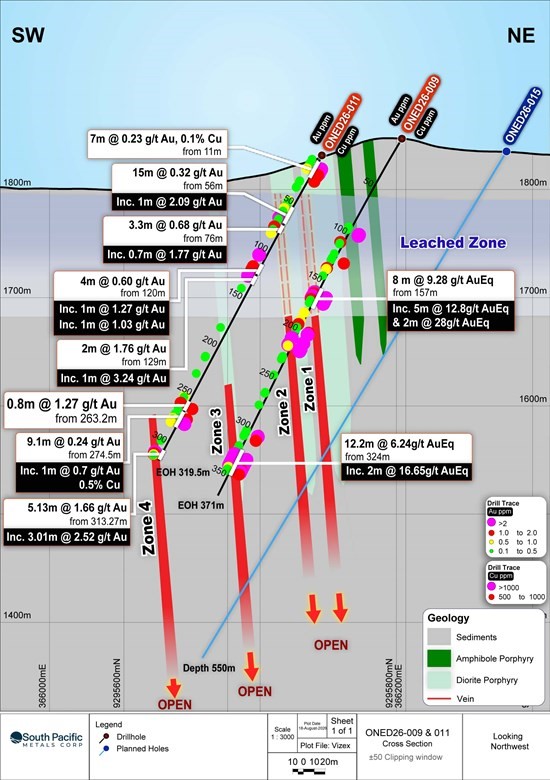
Figure 2: Cross-section (Looking Northwest) of ONED26-009 and ONED26-011 with planned follow-up hole.
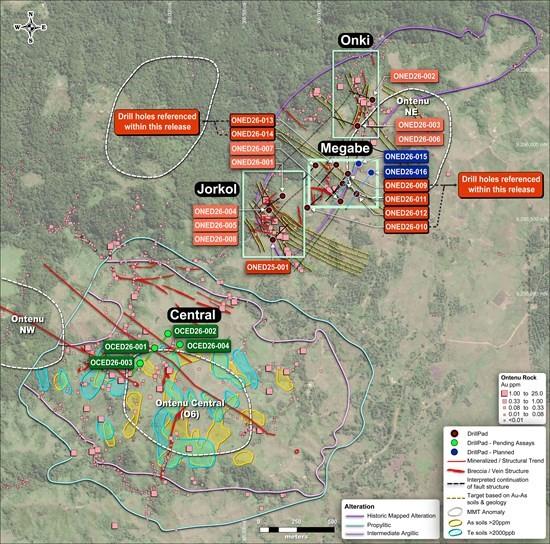
Figure 3: Map View of the broader Ontenu prospective area
Next Steps
Drilling has continued without pause. While assays from the Megabe step-outs were pending, both rigs advanced to Ontenu Central to test the newly mapped NW-SE mineralised trends (Figure 3); two of the four planned holes are complete and two are nearing completion. Assays from Ontenu Central will provide a first test of these trends while drilling advances at Megabe.
At Megabe, the next two holes are planned to test for further high-grade targets below and down-plunge to the southeast of the high-grade intercepts in ONED26-009, where the structures remain open. The first rig will move to Megabe, with the second to follow on completion of the final Ontenu Central hole.
The broader Ontenu prospective area spans five kilometres and hosts at least eight identified mineralised structures, of which only a small few have seen initial drill testing. As results from Megabe and Ontenu Central are integrated, geological mapping is advancing across all known target areas to build structural understanding of the mineralised trends ahead of systematic testing of the remainder, including strike extensions of Jorkol, Megabe and Onki, and the mineralised trends at Ontenu Central.
Megabe is the most advanced of the eight structures identified to date. Assays for holes in progress will be reported as they are received and validated.
Quality Assurance and Quality Control
All drill holes are logged on site by the Company’s geology team. Drill core (PQ or HQ) is half-cut, with samples secured and shipped to Intertek Laboratory in Lae, Papua New Guinea. Gold is assayed by 50 g fire assay with AAS finish (FA50/AA); copper and silver are assayed by 3-acid digest with AAS finish (PGGA03) at Intertek Lae. Sample pulps are subsequently sent to Intertek in Perth, Western Australia, for multi-element ICP-MS analysis using a 4-acid digest (4A/MS); the ICP-MS multi-element work is pending for all holes noted in this release. Two certified reference materials (standards), one blank and one duplicate are inserted within each batch of 100 samples to monitor laboratory performance.
Qualified Person
The technical and scientific information in this news release has been reviewed and approved by Dr. Darren Holden, B.Sc. (Hons), Ph.D., FAusIMM, a technical advisor and consultant to the Company and a “Qualified Person” as defined under National Instrument 43-101.
About South Pacific Metals Corp.
South Pacific Metals Corp. is an emerging gold-copper exploration company operating in the heart of Papua New Guinea’s proven gold and copper production corridors. SPMC has four exploration properties:
* Kili Teke resource information is drawn from the independent technical report dated November 18, 2022, prepared by Graeme J. Fleming, B.App.Sc., MAIG, and available under the Company’s profile on SEDAR+ at www.sedarplus.ca. Gold-equivalent contained ounces based on equal recoveries of Au and Cu only and prices of US$3,300/oz Au and US$4.45/lb. Cu. Preliminary metallurgical test work by Harmony Gold shows gold reporting to copper minerals, indicating the two can be co-recovered. Molybdenum is not included in the Au-equivalent figure.
Brutus Mining Inc. (CSE: BRU) (FSE: ZI3) is pleased to announce that it has closed its non-brokered ... READ MORE
Jaguar Uranium Corp. (NYSE American: JAGU) is pleased to announce an independent Mineral Resource E... READ MORE
Auro Metals Inc. (TSX-V: AURO) (OTCQB: AURFF), is pleased to announce the assay results of the fina... READ MORE
Endeavour Silver Corp. (NYSE: EXK) (TSX: EDR) is pleased to announce that repairs to the primary bal... READ MORE
Scorpio Gold Corp. (NASDAQ: SGLD) (TSX-V: SGLD) (OTCQB: SRCRF) (FSE: RY9) is pleased to announce re... READ MORE