






Eastport Critical Metals Corp. (TSX-V: EVI) (OTCQB: EVIIF) is pleased to announce the second batch of laboratory assay results for the reverse circulation drilling program at the Foley Uranium Project in Botswana. The second batch covers the results for the final five of 16 drill holes located on drill Fence 1, the first batch of assay results were announced 28 May 2026.
CEO, Burns Singh Tennent-Bhohi, commented:
“The latest batch of assays at Foley complete the results for drill Fence 1, which shows significant uranium mineralisation over a full 1.4 kilometres of strike length.
Very encouragingly, these results confirm we are in the right rocks with the desired >200ppm U₃O₈ grade profile, with mineralisation remaining open to the north, south and east.
Whilst we still await the assay results for drill Fence 2, the Fence 1 results already warrant the commencement of additional drill fences, step-out drilling, and targeted geophysics to extend coverage to the north and east and to vector towards the key geological controls. By systematically mapping where the mineralisation thickens, enriches, or pinches out, we aim to rapidly unlock the true size potential of this exciting new uranium discovery in Botswana.”
Highlight Drill Hole Intersections (depth stated downhole):
The Fence 1 assay results demonstrate potential for widespread uranium mineralisation (>200ppm U3O8), with significant, laterally continuous, uranium mineralisation intersected in 7 of the 16 drill holes (see the Figure 1 plan and cross section).
The uranium mineralisation which remains open both along strike and dip, is hosted in Karoo Supergroup sediments in an interpreted paleo-channel setting.
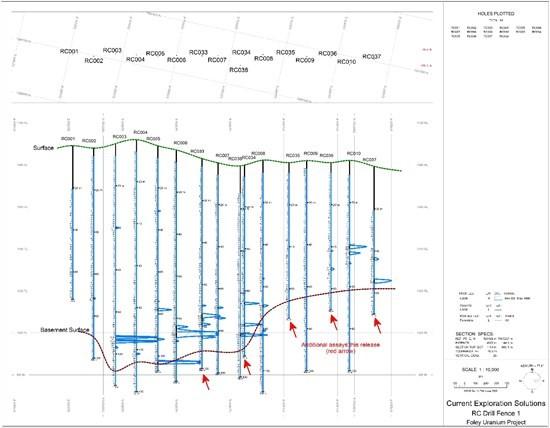
Figure note: blue trace pressed pellet assay, left number is U3O8 assay value ppm, red arrows indicate latest, batch 2, assay results.
Figure 1: Plan and Cross-Section of Fence 1 Down-hole Assay Results
The reported drill Fence 1 is located approximately 350 metres north of the Letlhakane deposit (Figure 2), a project owned by Lotus Resources Limited. According to publicly available disclosure by Lotus Resources Limited, the Letlhakane project hosts a reported Mineral Resource Estimate consisting of Indicated Mineral Resources of 71.6Mt grading 360 ppm U₃O₈ for 56.8 Mlb contained U3O8, and Inferred Mineral Resources of 70.6Mt at 366 ppm U₃O₈ for 56.9 Mlb contained U3O8, based on a 200ppm U3O8 cut-off grade.1
Furthermore, Lotus Resources concluded a Scoping Study for the Letlhakane Uranium deposit in 2025. The study outlined a 10-year open-pit mining operation producing approximately 3.0 million pounds of U₃O₈ annually, with estimated initial capital costs of US$465 million and all-in sustaining costs ranging from US$35 to US$41 per pound U₃O₈.2
The Company advises that mineralization hosted on adjacent, nearby or geologically similar properties, including the Letlhakane Project, is not necessarily indicative of mineralization on the Foley Project. The historical and technical information regarding the Letlhakane project has been sourced from publicly available disclosure by Lotus Resources Limited and has not been independently verified by the Company’s Qualified Person.
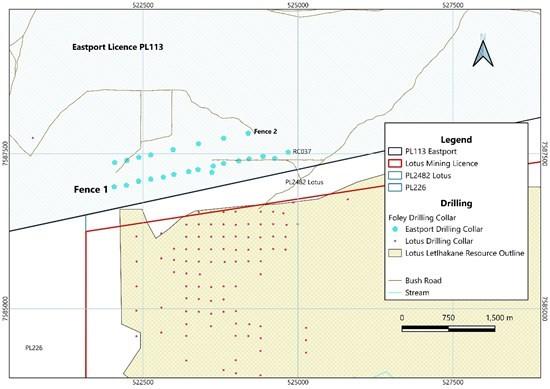
Figure note: Fence 1 contains the drill holes for which results are reported. See Figure 2 for Drill Hole Section and Assay Results.
Figure 2: Location of Eastport Phase 1 Reverse Circulation Drilling Program Fence 1 and Fence 2 in Relation to the Neighbouring Lotus Letlhakane Resource Area.
Pressed Pellet Assay Technique
Sample preparation and analytical work is conducted by SGS Group, an accredited laboratory based in Johannesburg, South Africa. Samples are weighted, dried, crushed, riffle split, and pulverized to a nominal pulp size suitable for pressed pellet analysis. Uranium and thorium are analyzed using a WD-X-ray fluorescence (“XRF”) Spectrometer technique.
For the pressed pellet method (SGS analytical method code GE_XRF71UTH), a representative portion of pulverized sample is blended with a binding agent and compressed under high pressure to produce a homogeneous pellet for instrumental analysis. The prepared pellets are analyzed by XRF spectrometry to determine uranium and thorium concentrations, with certificated results for U, Th, U3O8 and ThO2.
Eastport implements quality assurance and quality control (“QA/QC”) procedures including the routine insertion of blanks, and duplicate samples within the analytical stream. SGS also applies internal laboratory QA/QC protocols in accordance with their standard operating procedures.
Notes and References:
1 Lotus Resources Limited, ASX announcement titled: “Lotus increases Indicated Mineral Resources by 65% at Letlhakane Uranium Project”, 6 December 2024. (https://snowdenoptiro.com/wp-content/uploads/2025/01/loftus-resources.pdf)
2 Lotus Resources Limited, ASX announcement titled: “Updated Letlhakane Scoping Study” highlights Lotus’ potential to become a 5.5Mlbpa uranium producer“, corrected version dated 12 March 2025.
(https://wcsecure.weblink.com.au/pdf/LOT/02924086.pdf)
Qualified Person
The technical information in this news release has been reviewed and approved by Nicholas O’Reilly MIMMM (QMR) MAusIMM MSc DIC, an independent consultant and Qualified Person under National Instrument 43-101 – Standards of Disclosure for Mineral Projects.
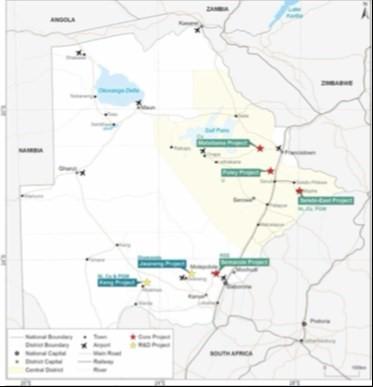
Eastport Critical Metals Corp: Project Location Map
About Eastport Critical Metals Corp.
Eastport is a critical minerals development company advancing five projects in Botswana, with cumulative historical and current expenditures approaching CAD$20 million. The Company’s most advanced asset is the Matsitama Copper Project, which hosts multiple sizeable targets across the Matsitama copper district.
The Company’s additional projects include Selebi East, a nickel-copper-cobalt project located seven kilometres east of the historic Selebi Mines; the Semarule Rare Earth Elements Project, positioned within the Gaborone-Molepolole corridor; the Foley Uranium Project, adjoining the Letlhakane uranium deposit; and the Keng Project, which targets nickel, copper and PGE’s on the northern margin of the Molopo Farms Complex.
Botswana is widely regarded as one of Africa’s strongest mining jurisdictions, combining the continent’s highest GDP per capita with a 50-year track record of large-scale mineral development since the Orapa diamond discovery in 1967. The country ranks among the top performers globally on the Fraser Institute’s Investment Attractiveness Index and is the highest-rated jurisdiction in Africa on the Policy Perception Index. These rankings reflect Botswana’s stable regulatory environment, consistent rule of law, and long-standing support for responsible mineral development – factors that have underpinned significant investment and major M&A activity in the natural resources sector in recent years.
Brutus Mining Inc. (CSE: BRU) (FSE: ZI3) is pleased to announce that it has closed its non-brokered ... READ MORE
Jaguar Uranium Corp. (NYSE American: JAGU) is pleased to announce an independent Mineral Resource E... READ MORE
Auro Metals Inc. (TSX-V: AURO) (OTCQB: AURFF), is pleased to announce the assay results of the fina... READ MORE
Endeavour Silver Corp. (NYSE: EXK) (TSX: EDR) is pleased to announce that repairs to the primary bal... READ MORE
Scorpio Gold Corp. (NASDAQ: SGLD) (TSX-V: SGLD) (OTCQB: SRCRF) (FSE: RY9) is pleased to announce re... READ MORE