








The Prospector News

Drilling Intersects Best Results to Date at the Marimaca Oxide Deposit: 308m at 0.94% CuT from 32m including 186m at 1.37% CuT from 154m; 26m at 4.83% CuT from 202m

You have opened a direct link to the current edition PDF

Open PDF Close
Uncategorized

Share this news article

Drilling Intersects Best Results to Date at the Marimaca Oxide Deposit: 308m at 0.94% CuT from 32m including 186m at 1.37% CuT from 154m; 26m at 4.83% CuT from 202m


Marimaca Copper Corp. (TSX: MARI) is pleased to announce the final reverse circulation drill results from the 2022 infill drilling campaign. Results reported in this release reflect 2,766m of drilling across 13 drill holes predominantly located in the northern portion of the Marimaca Oxide Deposit. The results include the best copper intersection drilled to date (LAR-109), on a grade-times-width basis, at the MOD, since it’s discovery in 2016. Drilling was focused in the northern and central zones of the MOD, following up on the higher-grade green oxide centres identified in the previously reported 2022 infill drilling in the northern MOD.


Highlights

  • Drilling focused on the northern and central zones of the MOD – following up on previous 2022 infill results which identified high-grade green oxide zones in the northern MOD (see press release dated December 5th, 2022 and November 21st, 2022)
    • The northern MOD was previously interpreted to be lower grade, dominantly WAD (black oxide) copper mineralization
    • Results expected to have positive implications for average grade in northern area of the deposit for the updated Mineral Resource Estimate planned for the first half of 2023, targeting conversion of Inferred Resources into Measured and Indicated categories
  • Highlights from reported results include
    • LAR-109 intersected 308m at 0.94% CuT from 32m, including 186m at 1.37% CuT from 154m, including 26m at 4.83% CuT from 202m
    • TAR-37 intersected 62m at 1.02% CuT from 2m, including 28m at 1.84% from 2m
    • ATR-167 intersected 46m at 1.23% CuT from 180m within a broader intersection of 76m at 0.79% CuT from 150m
    • TAR-40 intersected 68m at 0.30% CuT from 60m including 26m at 0.60% CuT from 90m
    • The northern MOD continues to demonstrate potential for growth beyond the northeast limits of the 2022 MRE pit
  • Results represent the final assays of the 2022 infill RC campaign
    • 2,762m of diamond drilling (geological and geotechnical drilling) remains outstanding from the 2022 program with final assays pending


2023 Exploration Planning

  • Marimaca is finalizing plans for the H1 2023 exploration program which will follow-up on drill hole MAD-22, which intersected primary sulphides (dominantly chalcopyrite) down-dip of the MOD (92m at 2.11% CuT from 140m including 22m at 5.27% CuT) – see press release dated December 15, 2022
  • The Company will provide an update to the market in due course


Sergio Rivera, VP Exploration of Marimaca Copper, commented:


“The final results of the 2022 infill RC program mark the completion of an exceptionally successful year at the MOD. Grades intersected in the northern MOD continue to surprise us to the upside, while results from LAR-109, the best hole we have drilled to date at the MOD, highlights the continuity of higher-grade copper mineralization in the central MOD.


Today’s results improve our confidence in the potential for upside in the planned 2023 MRE – as discussed previously, the higher-grade nature of mineralization identified in the northern MOD vs. the current interpolation of grades has positive implications for Marimaca’s mineral inventory.


Equally as exciting, we are in the final stages of planning for the H1 2023 exploration program where we intend to investigate the potential for extensions to the sulphide mineralization identified in MAD-22. We look forward to updating the market when plans have been finalized.”


Overview of Drilling Campaign Objectives


Marimaca’s 2022 drilling campaign consisted of over 41,500m of RC and diamond drilling between the MOD infill and the MAMIX zone, the depth extension of the MOD. The 2022 MRE, announced on October 13, 2022 incorporates 19,580m of the approximate 41,500m of drilling completed in 2022 for a total of over 110,000m of drilling completed since 2016. The balance of the 2022 infill drilling program will be included in a subsequent MRE planned for H1 2023 with the objective of converting Inferred Resources to the Measured and Indicated Categories to underpin a Definitive Feasibility Study.

Figure 1: Plan View of Infill Drilling Results
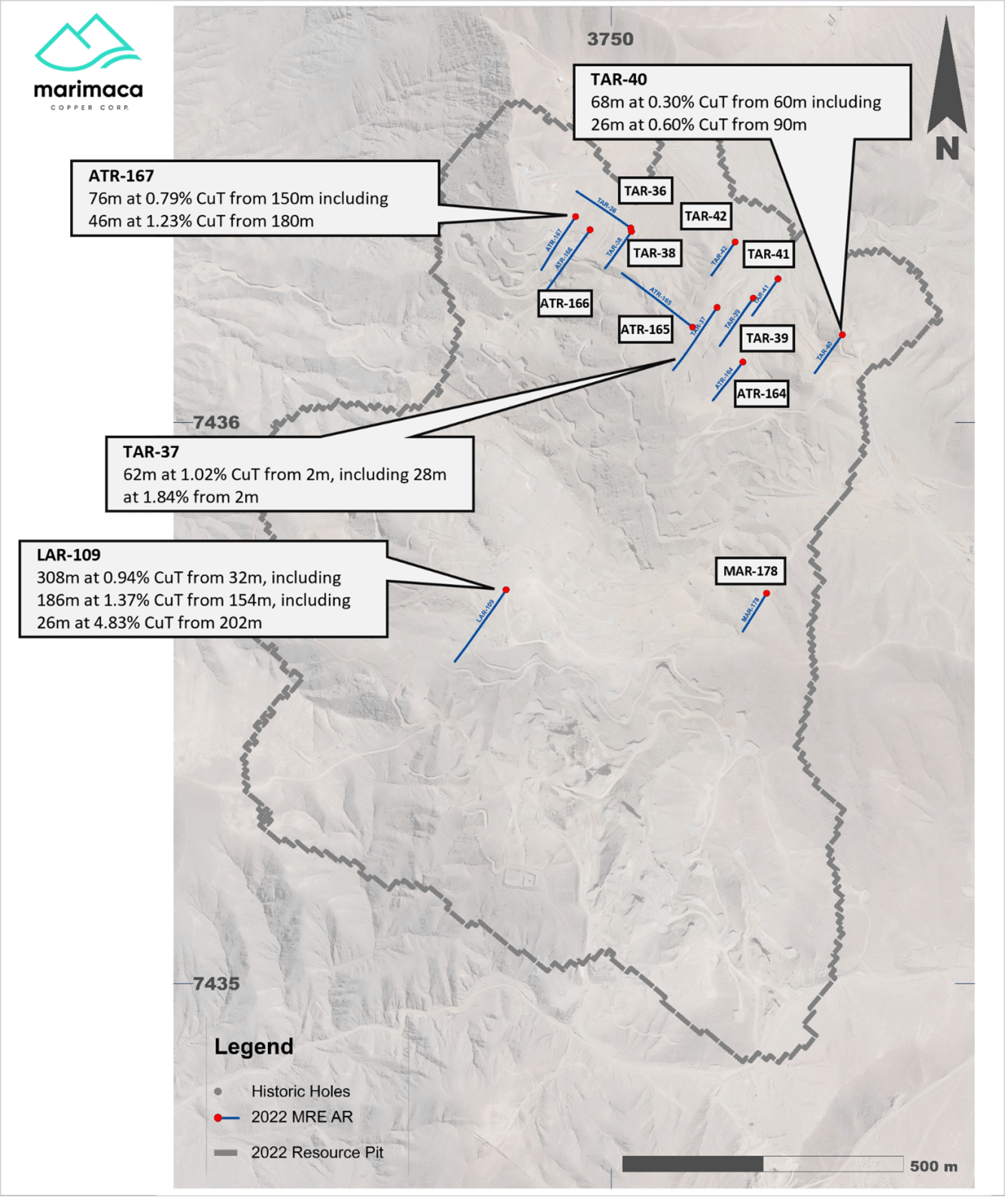
 

Table 1. Summary of Drill Results


Hole Depth (m)   From (m) To (m) Interval (m) CuT (%)
ATR-164 200   68 102 34 0.27
including 44 56 12 0.31
  170 196 26 0.26
ATR-165 300   18 80 62 0.20
ATR-166 250   84 96 12 0.28
  124 158 34 0.28
  192 214 22 0.23
ATR-167 226   150 226 76 0.79
including 180 226 46 1.23
MAR-178 150   72 118 46 0.29
LAR-109 350   32 340 308 0.94
  32 136 104 0.32
including 32 44 12 0.42
and 64 122 58 0.40
  154 340 186 1.37
including 160 198 38 0.41
and 202 228 26 4.83
  238 262 24 0.62
and 278 328 50 1.60
TAR-36 230 No significant intercepts
TAR-37 250   2 64 62 1.02
including 2 30 28 1.84
  172 218 46 0.37
including 182 216 34 0.42
TAR-38 150   90 104 14 0.28
  120 128 8 0.22
TAR-39 200   4 62 58 0.24
  86 92 6 0.35
TAR-40 160   60 128 68 0.30
including 90 116 26 0.60
TAR-41 150   24 72 48 0.27
including 24 42 18 0.51
TAR-42 150 No significant intercepts


Table 2. Drill Collars and Survey


Hole Easting Northing Elevation Azimuth Inclination Depth
ATR-164 375234.3 7436107.9 1111.5 220 -60 200
ATR-165 375144.9 7436169.9 1116.3 310 -60 300
ATR-166 374962.3 7436343.4 1065.1 220 -60 250
ATR-167 374936.5 7436366.9 1065.6 220 -60 226
LAR-109 374812.7 7435702.0 1123.7 220 -60 350
MAR-178 375276.7 7435695.8 1132.8 220 -60 150
TAR-36 375034.8 7436346.5 1069.2 310 -60 230
TAR-37 375188.5 7436205.0 1099.9 220 -60 250
TAR-38 375036.0 7436340.3 1069.4 220 -60 150
TAR-39 375252.9 7436221.5 1092.3 220 -60 200
TAR-40 375411.5 7436156.4 1130.4 220 -60 160
TAR-41 375297.0 7436256.0 1085.3 220 -60 150
TAR-42 375220.6 7436321.6 1082.2 220 -60 150


Sampling and Assay Protocol


True widths cannot be determined with the information available at this time. RC holes were sampled on a 2m continuous basis, with dry samples riffle split on site and one quarter sent to the Andes Analytical Assay preparation laboratory in Calama and the pulps then sent to the same company laboratory in Santiago for assaying. A second quarter was stored on site for reference. Samples were prepared using the following standard protocol: drying; crushing to better than 85% passing -10#; homogenizing; splitting; pulverizing a 500-700g subsample to 95% passing -150#; and a 125g split of this sent for assaying. All samples were assayed for %CuT (total copper) and %CuS (acid soluble copper) by AAS. A full QA/QC program, involving insertion of appropriate blanks, standards and duplicates was employed with acceptable results. Pulps and sample rejects are stored by Marimaca Copper for future reference.


Qualified Person


The technical information in this news release, including the information that relates to geology, drilling and mineralization was prepared under the supervision of, or has been reviewed by Sergio Rivera, VP of Exploration, Marimaca Copper Corp, a geologist with more than 35 years of experience and a member of the Colegio de Geólogos de Chile, Instituto de Ingenieros de Minas de Chile and of the Society of Economic Geologist USA, and who is the Qualified Person for the purposes of NI 43-101 responsible for the design and execution of the drilling program.


The QP confirms he has visited the project area, has reviewed relevant project information, is responsible for the information contained in this news release, and consents to its publication.


Posted January 23, 2023

Share this news article

MORE or "UNCATEGORIZED"


Critical Metals Corp Achieves Breakthrough Tanbreez Heavy Rare Earth Results: >99% Dissolution of Eudialyte Concentrate Into 19 Ultra-High-Purity Rare Earth Products; Refinery Study Projects US$1.8–2.2b in Annual Refinery Revenue

Critical Metals Corp. (Nasdaq: CRML) a leading critical minerals ... READ MORE

September 16, 2026

Metalsource Mining Extends High Grade Mineralization at Depth as Silver Hill Exploration Enters Major Expansion Phase

Holes SH26-22 and SH26-23 return up to 930 g/t AgEq within broade... READ MORE

September 16, 2026

Pasinex Completes Sale of High-Grade Zinc Sulphide Material and Provides Pinargozu Operations Update

Pasinex Resources Limited (CSE: PSE) (FSE: PNX) a growing zinc-fo... READ MORE

September 16, 2026

Aya Gold & Silver Reports High-Grade Silver Exploration Results Near Pit and at Depth at Zgounder

Aya Gold & Silver Inc. (TSX: AYA; NASDAQ: AYA) is pleased to... READ MORE

September 16, 2026

New Break Resources Ltd. (CSE: NBRK) (OTCQB: NBRKF) (FSE: O91) has received results from the last four holes of a ten-hole, 1,996 metre summer drilling program in the Zavitz gold zone at the Company's 100% owned Moray gold project. In total, New Break has completed 5,372 metres of drilling in 32 drillholes in 2026. Moray is located 49 km southeast of Timmins, Ontario and 32 km northwest of the Young-Davidson gold mine operated by Alamos Gold Inc. Select results from the final four of ten holes drilled in the summer drilling program are presented below in Table 1, while drillhole collar locations are detailed in Table 2 in Appendix A. Table 1 – Moray Summer 2026 Final Drill Results Hole ID Length (m) From (m) To (m) Width (1) (m) Au Grade (2) (g/t) NBR-26-29 322.0 77.3 78.8 1.5 0.42 and 138.0 139.1 1.1 0.38 and 162.5 173.3 10.8 (3) 1.61 and 227.4 229.0 1.6 1.21 and 231.5 232.1 0.6 1.72 NBR-26-30 250.0 37.0 38.0 1.0 0.30 and 102.8 103.5 0.7 0.60 and 121.5 122.5 1.0 0.36 and 124.5 125.5 1.0 0.33 and 128.5 129.0 0.5 0.90 and 131.0 132.0 1.0 0.36 and 169.8 174.0 4.2 2.65 and 178.0 179.5 1.5 0.77 and 183.5 186.6 3.1 1.22 and 190.0 190.5 0.5 1.06 and 191.5 192.5 1.0 1.48 and 196.0 200.5 4.5 2.53 and 203.5 204.0 0.5 2.15 and 206.5 212.0 5.5 1.57 NBR-26-31 274.0 169.0 170.5 1.5 0.37 and 184.5 186.0 1.5 0.51 and 197.0 200.0 3.0 0.94 and 201.5 202.0 0.5 0.50 and 203.5 210.0 6.5 (3) 3.12 NBR-26-32 352.0 73.5 74.0 0.5 0.44 and 174.0 174.6 0.6 0.52 and 194.0 195.0 1.0 0.66 and 199.8 203.3 3.5 2.29 and 227.3 228.0 0.7 0.97 (1) Intervals are drill intersections and do not necessarily represent true widths. (2) All intervals are presented using a cut-off grade of 0.3 g/t Au and internal dilution of no more than 1.0 metres at grades less than 0.3 g/t Au and assays are not capped (see QA/QC Procedures). (3) Drill core photos shown in Appendix B. Figure 1 – Newly Reported Drillholes NBR-26-29, 30 Figure 2 – Newly Reported Drillholes NBR-26-30, 31, 32 Note: The bottom of NBR-26-30 deviated southeast and is represented in both sections. Figure 1: Section B-B1 incorporates drillholes NBR-26-06, 07, 08, 25, 26, 27, 28, 29 and part of 30. Gold mineralization extends southeast into the syenite as exhibited in NBR-26-29. NBR-26-30 is identified in both sections A-A1 and B-B1 as the drillhole was collared along section A-A1 but deviated southeast, intersecting gold mineralization in the mafic volcanics in section B-B1. Figure 2: A-A1 incorporates drillholes NBR-26-03, 04, 05, 23, 24, 30, 31 and 32. NBR-26-31 exhibits gold mineralization both within the syenite (at the contact) and within a "flow breccia" within the hematite altered mafic volcanic at the contact. NBR-26-32 is typified by blocky faulted ground with lamprophyre dykes and gold mineralization in the hematite altered mafic volcanics in a brecciated quartz vein with angular syenitic fragments. William Love, Chief Executive Officer of New Break commented, "Ongoing drilling this summer in the Zavitz gold zone continues to deliver significant gold values, with gold mineralization intercepted in every drillhole. As depicted in Figures 1 and 2, gold mineralization has been encountered predominantly within the mafic volcanics. Importantly, drillholes NR-26-29 and NR-26-32, the deepest drilled to date, demonstrate that gold mineralization extends into the syenite to the southeast at the contact with the mafic volcanics." He further noted, "The intrusive-mafic volcanic contact in the Zavitz gold zone has a distinctive magnetic high. This could be reflective of the higher proportion of iron in these mafic volcanics, which is associated with the higher gold values. This same magnetic and IP signature has been identified elsewhere in areas also believed to be along the intrusive-mafic volcanic contact. Drilling these never before tested targets with the goal of identifying gold mineralization similar to that encountered in the Zavitz zone represents the potential for significantly expanding the Moray gold discovery. There is also the belief that the Zavitz zone could represent the first of a series of stacked mineralized gold zones, which would point to the potential for a much larger gold system at depth. We plan to test this through deeper drilling directly into the Zavitz zone." About the Moray Gold Project The Moray property is located in the heart of the Ontario Abitibi greenstone belt, 49 km southeast of Timmins surrounded by a number of significant gold producing companies and existing mills (see Figure 3). The Young-Davidson gold mine operated by Alamos Gold Inc., with its 8,000 tonne per day mill is the closest and within a short trucking distance of approximately 45 km by road from Moray. The understanding of gold mineralization at Moray continues to evolve with each round of drilling. The occurrence of gold mineralization extending into the syenite to the southeast of the Zavitz zone and in the deepest drillholes is noteworthy given the presence of syenite-hosted mineralization at Young-Davidison. More recent examination of the drill core also suggests that the gold mineralization discovered to date may resemble an intrusion related style of deposit like Agnico Eagle's Upper Beaver gold deposit east of Kirkland Lake, as opposed to a structurally hosted gold system. Both Young-Davidson and Upper Beaver host multi-million ounce gold deposits. Figure 3 – Moray Location Map: Surrounding Gold Producers and Upper Beaver Gold Project Technical Content and Qualified Person The scientific and technical information contained in this news release has been reviewed and approved by Peter C. Hubacheck, P. Geo, consulting geologist to New Break, and an independent Qualified Person as defined by National Instrument 43-101. Mr. Hubacheck certifies that this news release fairly and accurately reflects the technical information and data presented. New Break conducts its exploration activities in accordance with CIM Best Practices Guidelines. QA/QC Procedures QA/QC procedures were executed to ensure all work is conducted in accordance with best practices. All drill core was sawn in half with one half of the core prepared for shipment and the other half retained for future verification. All core is under watch from the drill site to the core processing facility. Drill core is BQTK size and sample intervals range from 0.5 metres to 1.0 metres in length. Commercially prepared certified reference material ("CRM") standards and blanks were inserted with each shipment at a rate of 1 QAQC sample in every 12 core samples. Samples from New Break's 2026 Moray drilling program were analyzed at Activation Laboratories in Timmins, Ontario, which is ISO 17025 certified, by 30-gram fire assay with atomic absorption finish. Any sample assaying greater than 10.0 g/t Au was re-assayed with fire assay gravimetric analysis. Grade composite intervals over core lengths are calculated using a weighted average grade with a cut-off grade of 0.3 g/t Au. Up to 1.0 m of internal dilution (consecutive interval below cut-off grade) are included within specific geologic domains and alteration assemblages, except as otherwise noted. The composites are constrained geologically by metasomatic alteration processes sourcing from the Fiset syenite intrusion and contact mafic volcanic rocks. Elevated gold values are coincident with hematite, silica, sericite and pyrite mineralization within structurally prepared brecciated corridors flanking the intrusion. Intervals are not true widths and no top cutting has been applied to the higher gold values. About New Break Resources Ltd. New Break is a Canadian mineral exploration company focused on its Moray gold project located 49 km southeast of Timmins, Ontario, in a well-established mining camp within proximity to existing infrastructure, and 32 km northwest of the Young-Davidson gold mine, operated by Alamos Gold Inc. Shareholders are also leveraged to exploration success in Nunavut, Canada, through New Break's 20% carried interest in the Sundog gold project and ownership of 6.0 million shares of Guardian Exploration Inc. (TSXV: GX). The Company is supported by a highly experienced team of mining professionals. Appendix A – Drillhole Data and Locations Table 2 – Moray Summer 2026 Drillhole Collar Locations Hole ID Length (m) UTM Easting UTM Northing UTM Elevation Azimuth (degrees) Dip (degrees) NBR-26-29 322.0 492703 5320285 363 220 -70 NBR-26-30 250.0 492708 5320329 363 220 -47 NBR-26-31 274.0 492708 5320329 363 220 -60 NBR-26-32 352.0 492708 5320329 363 220 -70 Total 1,198.0 Coordinates are reported in UTM Zone 17 North, with units in metres. Figure 4 – Zavitz Gold Zone – Surface Traces of 2025 and 2026 Drillholes. All of the drilling at Moray has been completed by Enviro North Exploration Inc. out of Sturgeon Falls, Ontario. Drilling in the Zavitz gold zone is shown in figure 4, with the 1,996 metres in 10 holes drilled this summer depicted in red, the 2,807 metres in 20 holes drilled from January to April 2026 shown in blue and the 1,817 metres in 8 holes drilled in 2025 shown in black. In total, 6,620 metres in 38 drillholes have been completed in the Zavitz gold zone, while New Break has completed a total of 5,372 metres in 32 drillholes of our planned 2026, 10,000 metre drilling program. Appendix B – Drill Core Photos From NBR-26-29 and NBR-26-31

New Break Resources Ltd. (CSE: NBRK) (OTCQB: NBRKF) (FSE: O91) ha... READ MORE

September 16, 2026

Copyright 2026 The Prospector News