







Dakota Gold Corp. (NYSE American: DC) is pleased to provide an update on its Richmond Hill Oxide Heap Leach Gold Project and Maitland Gold Project, both located on private land in the Homestake District of South Dakota. The Company has concluded key process and site-layout trade-off studies for the Richmond Hill Pre-Feasibility Study and received additional assay results that will be incorporated into the Feasibility Study resource update. These milestones provide greater definition for the resource model, process design and infrastructure configuration.
Highlights From This Update Include:
Jack Henris, Chief Executive Officer, President and Director of Dakota Gold, said, “Receipt of the final Richmond Hill assays is an important milestone as we complete the dataset for our upcoming PFS resource update expected to be released in conjunction with our PFS in the fourth quarter of this year. We have also concluded two significant trade-off studies by selecting a 0.5-inch design crush size and a single heap-leach facility in the area contemplated for Phase 1 of the IACF. Together, these decisions support a simpler operating configuration, reduce geotechnical complexity and provide greater definition for the overall PFS design.”
Richmond Hill Process and Site-Layout Trade-Off Studies
Dakota Gold has completed the PFS trade-off evaluation of the primary crushing options and selected a 0.5-inch (12.7-millimeter) design crush size. Recent metallurgical testing indicated modeled ultimate gold recovery for oxide material averaged 80.4% at a 0.5-inch crush size, compared with 75.9% at a 1-inch crush size. The PFS financials will capture this benefit when it is released later this year.
The updated resource informing the PFS will incorporate 333 drill holes completed in 2025 and 2026, representing 30% more drilling data from the prior resource, and will be entirely focused on oxide material. The metallurgical test program results defined oxide material as having a CN/FA ratio ≥0.82 and total sulfur content ≤0.5%. Therefore, the PFS will exclude transition material, which represented roughly 18% of the heap leach material in the prior resource.
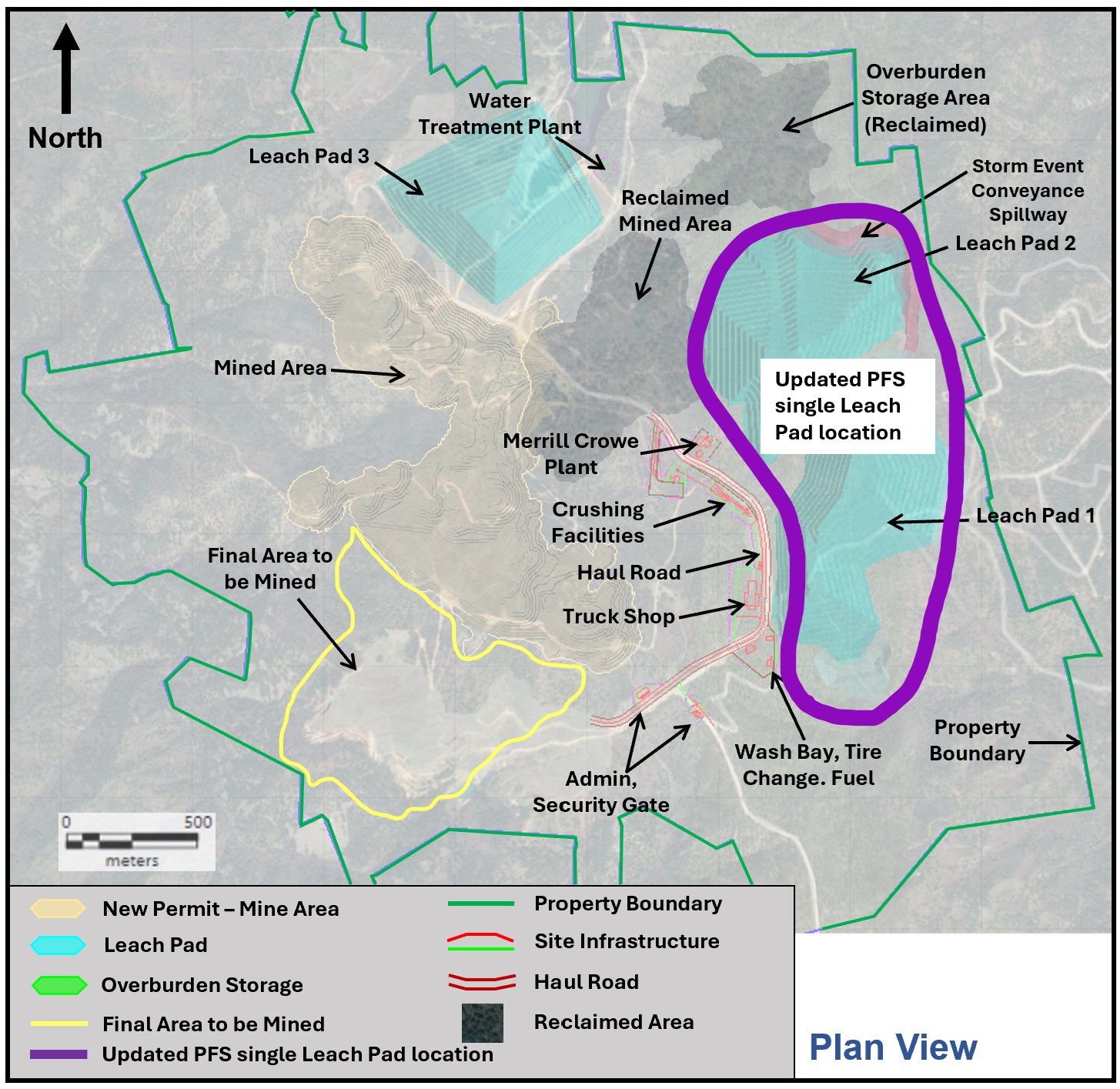
The Company has also selected a single heap-leach facility located generally within the area identified for Phase 1 in the IACF, rather than the multiple conceptual heap-leach areas previously considered. The consolidated configuration (see Figure 1) will simplify material handling and solution management, optimize operation and consolidate the geotechnical design and monitoring program within one operational area.
This selection will reduce operational complexity and provide a more integrated approach to heap leach facility construction, stacking, solution collection, and long-term facility management. From a geotechnical perspective, a single facility allows the Project team to focus design, liner system preparation, solution management and monitoring in one principal location. The combined crush-size and heap-location decisions provide important inputs to the PFS capital estimate, operating plan, permitting design and economic model.
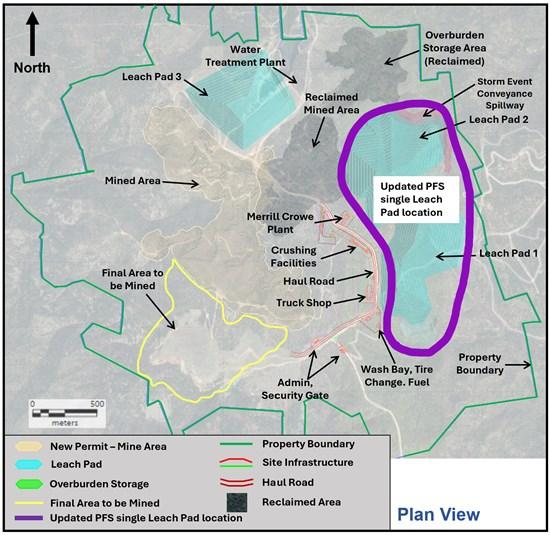
Figure 1. Richmond Hill IACF conceptual mine site layout with updated single leach pad location for PFS.
To view an enhanced version of this graphic, please visit:
https://images.newsfilecorp.com/files/8218/316209_c0d3c07074d53b72_002full.jpg
Richmond Hill Final Assays and PFS Integration:
Dakota Gold has received the final assay results from the Richmond Hill drilling datasets required to complete the resource-model update supporting the PFS. The results are being integrated with geological, metallurgical and geochemical information to finalize resource classification, mine sequencing and the production schedule. Completion of this assay dataset closes a key technical workstream for the PFS and provides the basis for the updated resource and reserve evaluation.
The Company is excited to include the completed assay dataset in the upcoming PFS. The updated model will also incorporate the results of the recent metallurgical program, including the strong recovery response from breccia-hosted oxide material, to support recovery assignment, ore routing and mine-sequencing decisions.
Additional assay results, which are reported here (see Table 1), represent 3,002 meters (9,847 ft) of geotechnical drilling conducted after the PFS drilling was completed, as well as Chism Gulch phase 2 definition drilling designed to convert remaining inferred blocks for the FS.
Progress on FS:
Along with the additional drilling in the central Richmond Hill area with oxide-breccia hosted material, the Company has planned additional metallurgical holes to complete the testing as part of the FS. The current planned variability testing scope includes:
This round of metallurgical variability testing is in direct support of the FS that complements the suite of testing completed during the PFS, and meets the requirements for adequate statistical representation of material types and quantities in the plan at the FS level. The FS test data will allow us to complete a more rigorous metal recovery model and metal plan which will assist in improved mine planning and sequencing. Expected outputs from this effort will include:
Maitland Drilling Update:
Initial drill results have been received representing 791 meters (2,594 feet) of drilling from the 5,578 meter (18,300 feet) campaign to produce a maiden resource for the Tertiary epithermal Unionville Zone (see Table 2). In response to the strong metallurgical results from breccia-hosted oxide material at Richmond Hill, Dakota Gold redirected drilling capacity to the central Richmond Hill area to prioritize definition and metallurgical drilling that can inform Feasibility Study mine sequencing and resource conversion opportunities.
The Company expects to resume drilling at Maitland and complete the planned program for the maiden resource in the first half of 2027. The revised schedule reflects disciplined allocation of drilling resources to near-term technical priorities at Richmond Hill and does not change Dakota Gold’s long-term view of Maitland’s high-grade exploration potential. Additional Maitland results will be reported as assays are received, reviewed and interpreted.
About Dakota Gold Corp.
Dakota Gold is a responsible exploration and development company advancing the Richmond Hill Gold Project toward production as soon as 2029, while continuing to define and expand the high-grade underground gold resource potential at the Maitland Gold Project. Both projects are located on private land within the historic Homestake District of South Dakota, one of the most prolific gold mining regions in the United States.
Subscribe to Dakota Gold’s e-mail list at www.dakotagoldcorp.com to receive the latest news and other Company updates.
Shareholder and Investor Inquiries
For more information, please contact:
Jack Henris
CEO, President and Director
Tel: +1 605-717-2540
Shawn Campbell
Chief Financial and Development Officer
Tel: +1 778-655-9638
Carling Gaze
Director of Investor Relations
Tel: +1 605-679-7429
Email: info@dakotagoldcorp.com
Qualified Person and S-K 1300 Disclosure
William Gehlen, a Certified Professional Geologist (CPG-10626) with the AIPG, American Institute of Professional Geologists, a Senior Fellow with the SEG, and Senior Manager – Geology of Dakota Gold Corp., is the Company’s designated qualified person (as defined in Subpart 1300 of Regulation S-K) for this news release and has reviewed and approved its scientific and technical content.
Quality Assurance/Quality Control consists of regular insertion of certified reference materials, duplicate samples, and blanks into the sample stream. Samples are submitted to the ALS Geochemistry sample preparation facility in Winnipeg, Manitoba. Gold and multi-element analyses are performed at the ALS Geochemistry laboratory in Vancouver, British Columbia. ALS Minerals is an ISO/IEC 17025:2017 accredited lab. Check samples are submitted to Bureau Veritas, Vancouver B.C. as an umpire laboratory. Assay results are reviewed, and discrepancies are investigated prior to incorporation into the Company database.
Appendix:
Richmond Hill Gold Project Assay Results:
Table 1. Richmond Hill drill results (Metric / Imperial)1,2,3,4,5
| Hole # | From (m) | To (m) | Interval (m) | Grade Au (g/t) | g x m Au | Grade Ag (g/t) | g x m Ag | From (ft) | To (ft) | Interval (ft) | Grade Au (oz/ton) |
| RH26C-454 | 45.1 | 69.5 | 24.4 | 0.93 | 23 | 3.59 | 88 | 148.0 | 228.1 | 80.1 | 0.027 |
| 109.1 | 118.7 | 9.5 | 0.52 | 5 | 2.07 | 20 | 358.0 | 389.3 | 31.3 | 0.015 | |
| RH26C-455 | 11.6 | 23.8 | 12.2 | 0.79 | 10 | 73.70 | 896 | 38.1 | 78.0 | 39.9 | 0.023 |
| RH26C-457 | 0.0 | 24.8 | 24.8 | 1.08 | 27 | 14.07 | 349 | 0.0 | 81.4 | 81.4 | 0.032 |
| RH26C-459 | 30.1 | 54.5 | 24.4 | 0.99 | 24 | 8.44 | 206 | 98.7 | 178.7 | 80.0 | 0.029 |
| 67.4 | 72.5 | 5.2 | 0.64 | 3 | 10.65 | 55 | 221.0 | 238.0 | 17.0 | 0.019 | |
| RH26C-460 | 13.9 | 27.3 | 13.5 | 0.64 | 9 | 3.64 | 49 | 45.5 | 89.7 | 44.2 | 0.019 |
| 39.0 | 43.3 | 4.3 | 0.63 | 3 | 0.49 | 2 | 128.0 | 142.1 | 14.1 | 0.018 | |
| 72.4 | 75.6 | 3.2 | 1.02 | 3 | 4.86 | 15 | 237.6 | 248.0 | 10.4 | 0.030 | |
| 80.0 | 86.2 | 6.2 | 0.60 | 4 | 5.32 | 33 | 262.5 | 282.8 | 20.3 | 0.018 | |
| 116.9 | 128.8 | 12.0 | 1.25 | 15 | 5.00 | 60 | 383.4 | 422.7 | 39.3 | 0.037 | |
| 198.2 | 206.9 | 8.7 | 0.81 | 7 | 7.37 | 64 | 650.3 | 678.7 | 28.4 | 0.024 | |
| RH26C-462 | 37.1 | 41.6 | 4.6 | 0.86 | 4 | 0.55 | 3 | 121.6 | 136.6 | 15.0 | 0.025 |
| 57.2 | 61.2 | 4.0 | 1.84 | 7 | 4.60 | 18 | 187.8 | 200.9 | 13.1 | 0.054 | |
| 105.8 | 133.2 | 27.4 | 0.75 | 21 | 2.80 | 77 | 347.0 | 437.0 | 90.0 | 0.022 | |
| RH26C-463 | 22.2 | 31.7 | 9.5 | 1.39 | 13 | 7.79 | 74 | 72.8 | 104.0 | 31.2 | 0.040 |
| 38.3 | 71.8 | 33.6 | 0.85 | 28 | 4.13 | 138 | 125.5 | 235.6 | 110.1 | 0.025 | |
| 84.4 | 102.7 | 18.3 | 1.81 | 33 | 8.23 | 151 | 277.0 | 337.0 | 60.0 | 0.053 | |
| 134.8 | 144.2 | 9.4 | 0.80 | 8 | 3.53 | 33 | 442.2 | 473.2 | 31.0 | 0.023 | |
| RH26C-464 | 12.9 | 18.7 | 5.9 | 0.66 | 4 | 3.52 | 21 | 42.2 | 61.4 | 19.2 | 0.019 |
| 97.2 | 102.1 | 4.9 | 0.74 | 4 | 4.90 | 24 | 319.0 | 335.0 | 16.0 | 0.022 | |
| 106.1 | 118.3 | 12.2 | 1.19 | 14 | 5.80 | 71 | 348.0 | 388.0 | 40.0 | 0.035 | |
| RH26C-465 | 160.0 | 172.2 | 12.3 | 0.53 | 7 | 4.11 | 50 | 524.8 | 565.0 | 40.2 | 0.016 |
| 175.9 | 183.8 | 7.9 | 0.75 | 6 | 36.08 | 286 | 577.0 | 603.0 | 26.0 | 0.022 | |
| RH26C-466 | 32.1 | 36.6 | 4.5 | 0.61 | 3 | 12.31 | 56 | 105.2 | 120.1 | 14.9 | 0.018 |
| 117.0 | 131.4 | 14.4 | 0.75 | 11 | 9.17 | 132 | 383.8 | 431.2 | 47.4 | 0.022 | |
| RH26C-467 | 0.0 | 3.6 | 3.6 | 0.57 | 2 | 2.11 | 8 | 0.0 | 11.7 | 11.7 | 0.017 |
| 14.3 | 17.4 | 3.0 | 2.26 | 7 | 13.02 | 40 | 47.0 | 57.0 | 10.0 | 0.066 | |
| 29.6 | 35.1 | 5.5 | 0.65 | 4 | 2.93 | 16 | 97.0 | 115.0 | 18.0 | 0.019 | |
| RH26C-468 | 2.1 | 8.2 | 6.1 | 1.46 | 9 | 1.97 | 12 | 7.0 | 27.0 | 20.0 | 0.043 |
| 41.3 | 44.3 | 3.1 | 2.29 | 7 | 16.69 | 51 | 135.4 | 145.5 | 10.1 | 0.067 | |
| 48.2 | 60.0 | 11.9 | 0.81 | 10 | 3.79 | 45 | 158.1 | 197.0 | 38.9 | 0.024 | |
| RH26C-469 | 3.4 | 14.7 | 11.2 | 0.69 | 8 | 4.63 | 52 | 11.3 | 48.2 | 36.9 | 0.020 |
| 157.1 | 161.5 | 4.3 | 0.74 | 3 | 8.56 | 37 | 515.5 | 529.7 | 14.2 | 0.022 | |
| RH26C-470 | 3.7 | 10.1 | 6.4 | 0.61 | 4 | 4.22 | 27 | 12.1 | 33.2 | 21.1 | 0.018 |
| 46.4 | 65.9 | 19.5 | 1.16 | 23 | 6.06 | 118 | 152.3 | 216.3 | 64.0 | 0.034 | |
| 78.5 | 82.8 | 4.4 | 1.00 | 4 | 4.74 | 21 | 257.5 | 271.8 | 14.3 | 0.029 | |
| 87.5 | 112.1 | 24.6 | 1.05 | 26 | 5.62 | 138 | 287.0 | 367.8 | 80.8 | 0.031 | |
| 132.0 | 158.6 | 26.6 | 0.76 | 20 | 3.05 | 81 | 433.0 | 520.3 | 87.3 | 0.022 | |
| The table may contain rounding errors.
1. Abbreviations in the table include ounces per ton (“oz/ton”); grams per tonne (“g/t”); feet (“ft”); meter (“m”); gram meters (“g x m”). 2. True thickness unknown. 3. Intervals calculated based on 0.5 g/t Au cut-off and maximum dilution of 3.05 meters. 4. The July 7, 2025 Initial Assessment with Cash Flow has an open pit designed with 12.2m (40 ft) benches. The average grade for the Measured and Indicated mine plan is 0.566 g/t Au (0.017 oz/ton). A gram-meter of 7 and above has been highlighted in Table 1 based on the bench height and average grade. 5. The following geotechnical drill holes have confirmed no significant gold mineralization: RH26C-456, RH26C-458, RH26C-461, RH26C-471 |
|||||||||||
Maitland Gold Project Assay Results:
Table 2. Maitland Gold Project initial drilling assay results from 2026 infill drill campaign. (Metric / Imperial)1,2,3
| Hole # | From (m) | To (m) | Interval (m) | Grade Au (g/t) | g x m Au | Grade Ag (g/t) | g x m Ag | From (ft) | To (ft) | Interval (ft) | Grade Au (oz/ton) |
| MA26C-060 | 162.1 | 166.4 | 4.4 | 0.84 | 4 | 4.29 | 19 | 531.7 | 546.0 | 14.3 | 0.025 |
| 210.9 | 226.2 | 15.3 | 1.47 | 23 | 0.84 | 13 | 691.9 | 742.0 | 50.1 | 0.043 | |
| 250.0 | 255.7 | 5.6 | 0.74 | 4 | 0.35 | 2 | 820.3 | 838.8 | 18.5 | 0.022 | |
| MA26C-061 | No significant intercepts | ||||||||||
| MA26C-062 | 172.5 | 176.5 | 4.0 | 1.79 | 7 | 2.61 | 10 | 566.0 | 579.0 | 13.0 | 0.052 |
| 179.8 | 185.8 | 6.0 | 1.87 | 11 | 4.91 | 29 | 590.0 | 609.7 | 19.7 | 0.055 | |
| MA26C-064 | No significant intercepts | ||||||||||
| The table may contain rounding errors.
1. Abbreviations in the table include ounces per ton (“oz/ton”); grams per tonne (“g/t”); feet (“ft”); meter (“m”); gram meters (“g x m”). 2. True thickness unknown. 3. Intervals calculated based on 0.5 g/t Au cut-off and maximum dilution of 3.05 meters. |
|||||||||||
New assays support higher grades and substantially greater minera... READ MORE
Antimony Resources Corp. (CSE: ATMY) (OTCQB: ATMYF) (FSE: K8J0) i... READ MORE
Adyton Resources Corporation (TSX-V: ADY) (OTCQB: ADYRF) (FSE: 70... READ MORE
Scottie Resources Corp. (TSX-V: SCOT) (OTCQB: SCTSF) (FSE: SR80)... READ MORE
Silver Pony Resources Corp. (CSE: PONY) (FSE: BJ40) (OTCID: PONIF... READ MORE