








Bayhorse Silver Inc, (TSX-V: BHS) (OTCQB: BHSIF) (FSE: 7KXN) reports that it has extracted an approved 25 ton “run of mine” metallurgical bulk sample of the Bayhorse Silver Mine’s critical and strategic silver, antimony, copper and zinc mineralization from two of the established “ready for mining” working faces located 100 m ( 330 ft) apart at the western extent of the underground workings (figure 1).
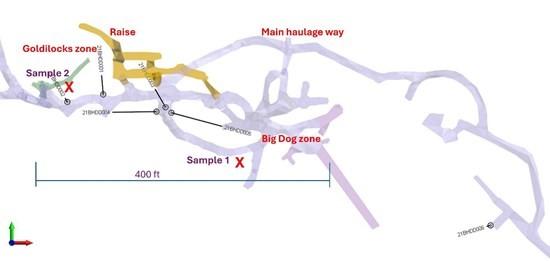
Figure 1. Underground sampling locations (X)
The 25 ton representative run of mine metallurgical sample analysis is being conducted under NI-43-101 standards to provide additional data for further resource definition and to form part of the geochemical analysis required for the Bayhorse Silver Mine Operating Permit application.
The metallurgical analysis may also confirm through the milling and flotation process, mill recoveries, tailings minerals percentages, and necessary waste water remediation to allow proper disposal of the waste water from the milling process.
One sample was taken from the Big Dog Zone working face that was prior panel sampled across and down the face returning combined silver assays of 1,642 g/t (54.8 oz/t) as reported in the Company’s news releases, BHS2022-05 and BHS2022-08.
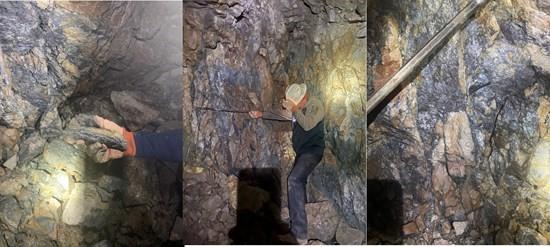
Figure 2. Big Dog working face
A second sample was taken from the western extent of the Goldilocks Zone where a diamond drill hole conducted in 2022 (BHS2022-12) intersected 2.75 meters (9 ft) of strong silver mineralization, of which 0.92 meters (3 ft) graded 1,771.58 g/t Ag (51.75 oz/t), 0.92 meters graded 104.869g/t (3.05 oz/t) and 0.92 meters graded 1,546.46 g/t (45.2 oz/t) for a weighted average grade over the intersection of 1,140.68 g/t (33.34 oz/t).
At the top of a raise into the Goldilocks Zone, Silver King Mines (1984) reported mining high grade rounds grading up to 3,110 g/t Ag (100oz/Ag) per ton, and in the middle of the raise the Company drill intersected 3.65 meters (12 t) of 844 g/t (24.67 oz/t) silver of which the highest grade interval was 2,180g/t (63.65 oz/t) over 0.6 m (2 ft), as reported in the Company’s news release, BHS2021-19.
The strike length from the Big Dog Zone to the Goldilocks Zone is +/- 122 m (400 ft), has a known vertical extent of 30 m (98 ft) and an estimated width of 60 m (200 ft). As reported in the Company’s news release BHS2026-07, analysis from the recent IP surveys indicate the vertical extent of the mineralization may extend up to 300 m (980 ft) from the currently known 30 m (98 ft) with some areas having a width of up to 120 m (400 ft).
Bayhorse CEO, Graeme O’Neill, comments, “this bulk sample is expected to mimic potential mining operations and give a clear indication of the Ore-Sorter select silver upgrade, and what the final grades and recoveries are likely to be when full-scale mining is resumed. With the very high percentages of copper, antimony, and zinc recovery in the flotation concentrate along with the silver from the development material processing, the resultant concentrate produced will be bagged and readied for further processing/smelting/leaching.”
The dominant Bayhorse mineralization is primarily tetrahedrite, (see the Company’s news release BHS2020-12) that is comprised of the critical and strategic minerals in an antimony sulfide of silver, copper, zinc and iron in veins and stockworks with minor gold present, and is refractory in nature.
The Company’s metallurgical work, including already proven antimony leaching, allows for the cost-effective separation of the antimony and sulphur thereby significantly increasing recoveries of the silver, copper and zinc for processing separately.
The silver, antimony, copper and zinc at the Bayhorse Silver Mine are all recognized as “critical and strategic minerals” in the United States.
The Bayhorse exploration model holds that the silver-copper-antimony rich mineralization at the Bayhorse Silver Mine extends across to the adjacent Pegasus porphyry copper prospect and could have its source in an underlying shallow pluton(s) that may host porphyry copper mineralization similar to what Hercules Metals has reported 40 km north of the Bayhorse Silver Mine.
This News Release has been prepared on behalf of the Bayhorse Silver Inc.’s Board of Directors, which accepts full responsibility for its content. Mark Abrams, AIPG, a Qualified Person and Director of the Company has prepared, supervised the preparation of, or approved the technical content of this news release.
About Bayhorse Silver Inc.
Bayhorse Silver Inc. is an exploration and production company with a 100% interest in the historic Bayhorse Silver Mine located in Oregon, USA with a National Instrument 43-101 inferred mineral resource of 292,300 tons at a grade of 21.65 opt (673 g/t) for 6.3 million ounces of silver. (Turner et al. 2018) and the Pegasus Project, in Washington County, Idaho. The Bayhorse Silver Mine and the Pegasus Porphyry Copper Project are 44 km southwest of Hercules Metals’ porphyry copper discovery. The Bayhorse Mine is a minimum environmental impact facility capable of processing at a mining rate up 200 tons/day that includes a state of the art 40 ton per hour Steinert Ore-Sorter that reduces waste rock entering the processing stream by up to 85%. The Company has established an up to 60 ton/day mill and standard flotation processing facility in nearby Payette County, Idaho, USA with an offtake agreement in place with Ocean Partners UK Limited. The Company has an experienced management and technical team with extensive mining expertise in both exploration and building mines.
Broad Gold Mineralization Starts at Surface, Returning 1.86 g/t A... READ MORE
Lithium Africa Corp. (TSX-V: LAF) (FSE: 6MQ) (OTCQB: LTAFF) is pl... READ MORE
Drilling also returns 134.0 m of 0.65 g/t Au in the Lower Domain;... READ MORE
Copper Road Resources Inc. (TSX-V: CRD) is pleased to announce th... READ MORE
Brunswick Exploration Inc. (TSX-V: BRW) (OTCQB: BRWXF) (FRANKFUR... READ MORE