







Auro Metals Inc. (TSX-V: AURO) (OTC Pink: AURFF) is pleased to announce the assay results of the first three drill holes from the 2026 Phase I Drill Program at its 100%-owned Santa Barbara Gold-Copper Project located in the Zamora-Chinchipe Province in southeastern Ecuador. The drill program commenced on April 14, 2026 (please refer to the Company’s news release dated May 19, 2026). To date, 12 holes have been completed and assay results for the first three have been received.
SUMMARY OF DRILL RESULTS
All three holes were drilled at the southern part of the known mineralized porphyry system of the Project which is believed to be the core area of the known porphyry mineralization system. The purpose of drilling these holes was to test the continuity of mineralization between historical drill intercepts and the extension of mineralization in up-dip and down-dip directions. Results of the drilling are as follows:
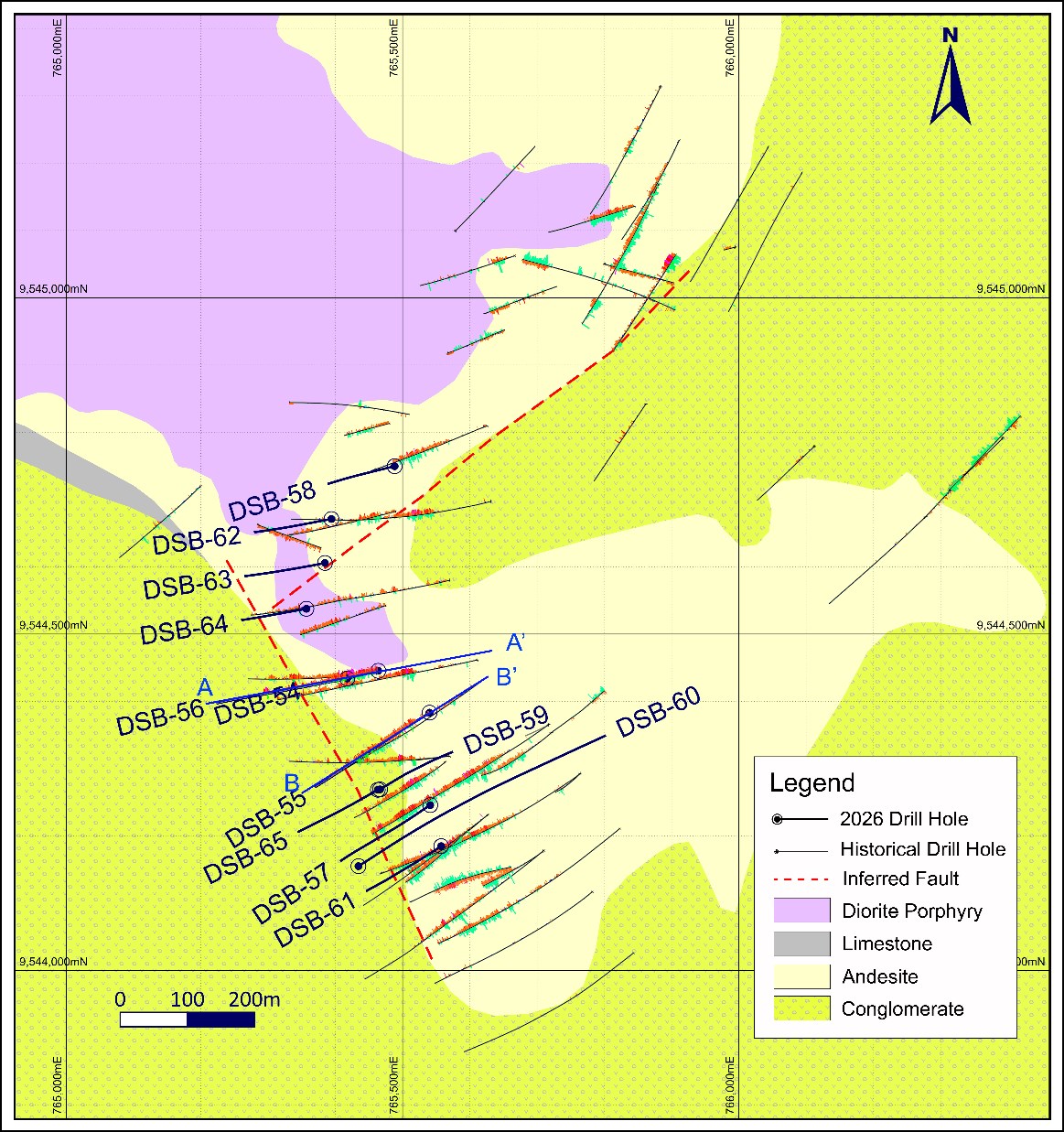
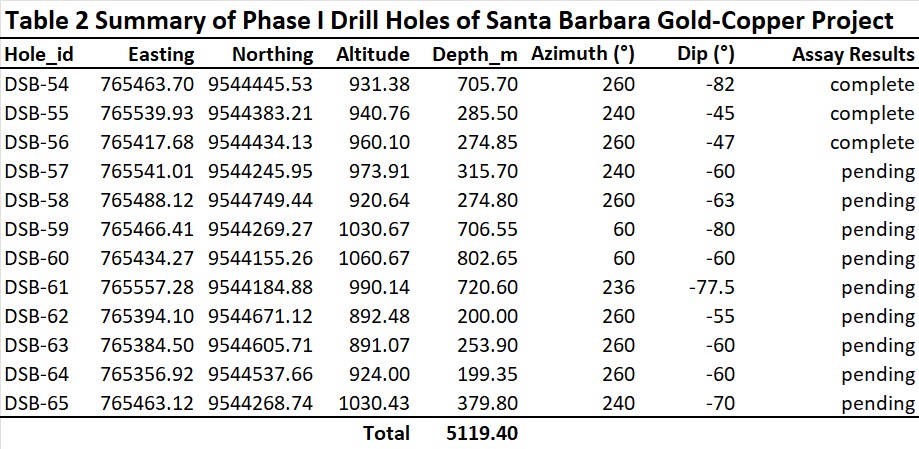
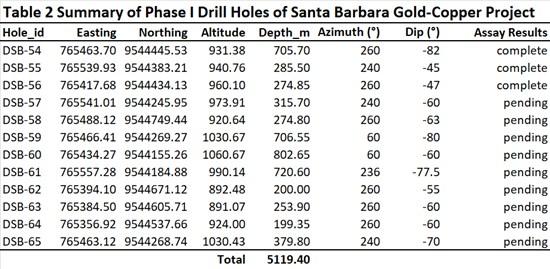
All three holes intersected wide mineralization starting from surface, and a summary of drill intercepts are presented in Table 1 below. The drill results indicate mineralization is open in both up-dip and down-dip directions, also demonstrating good consistency of gold-copper grades. Specifications of completed drillholes are provided in Table 2, and a drill plan view is shown in Figure 1.
“These first three holes drilled at Santa Barbara South from our Phase I Drill Program speak to the scale and consistency of the Project,” said Victor Feng, CEO of Auro. “DSB-54 intersected over 700 metres of continuous gold-copper mineralization starting from surface and ended in mineralization at depth. DSB-55 and DSB-56 both confirm that mineralization remains open in the up-dip direction towards surface. With 9 more holes pending assays and 4 rigs turning at site, we look forward to continuing to share assay results as they become available. Following the Phase 1 Drill Program we plan to dovetail into a planned Phase 2 Drill Program designed to continue expanding the known system and to test new targets nearby.”
| Table 1 Summary of Drill Intercepts | |||||||
| Hole_ID | Depth_from | Depth_to | Interval_m | Au_g/t | Cu_% | AuEq_g/t | |
| DSB-54 | 0.00 | 705.70 | 705.70 | 0.61 | 0.10 | 0.64 | |
| incl. | 0.00 | 235.00 | 235.00 | 0.97 | 0.11 | 1.00 | |
| DSB-55 | 0.00 | 246.00 | 246.00 | 0.56 | 0.09 | 0.58 | |
| incl. | 31.50 | 187.00 | 155.50 | 0.73 | 0.11 | 0.76 | |
| DSB-56 | 0.00 | 134.00 | 134.00 | 0.67 | 0.09 | 0.69 | |
| 164.50 | 188.50 | 24.00 | 0.89 | 0.07 | 0.90 | ||
Notes:
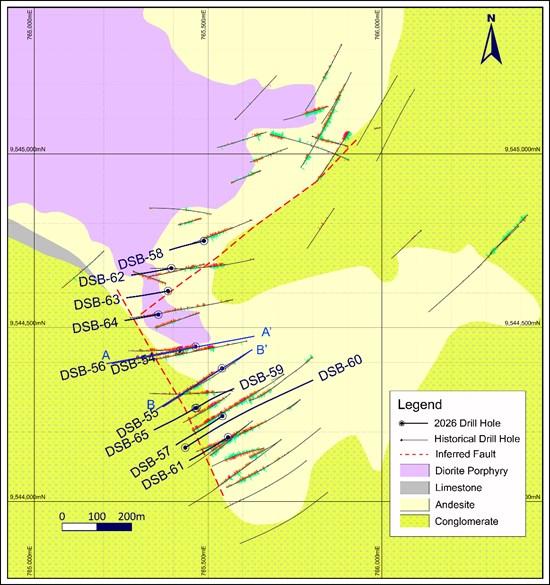
Figure 1: Plan view of drill holes
To view an enhanced version of this graphic, please visit:
https://images.newsfilecorp.com/files/7553/302426_4db36fef747f8a82_001full.jpg
DESCRIPTION OF HOLES
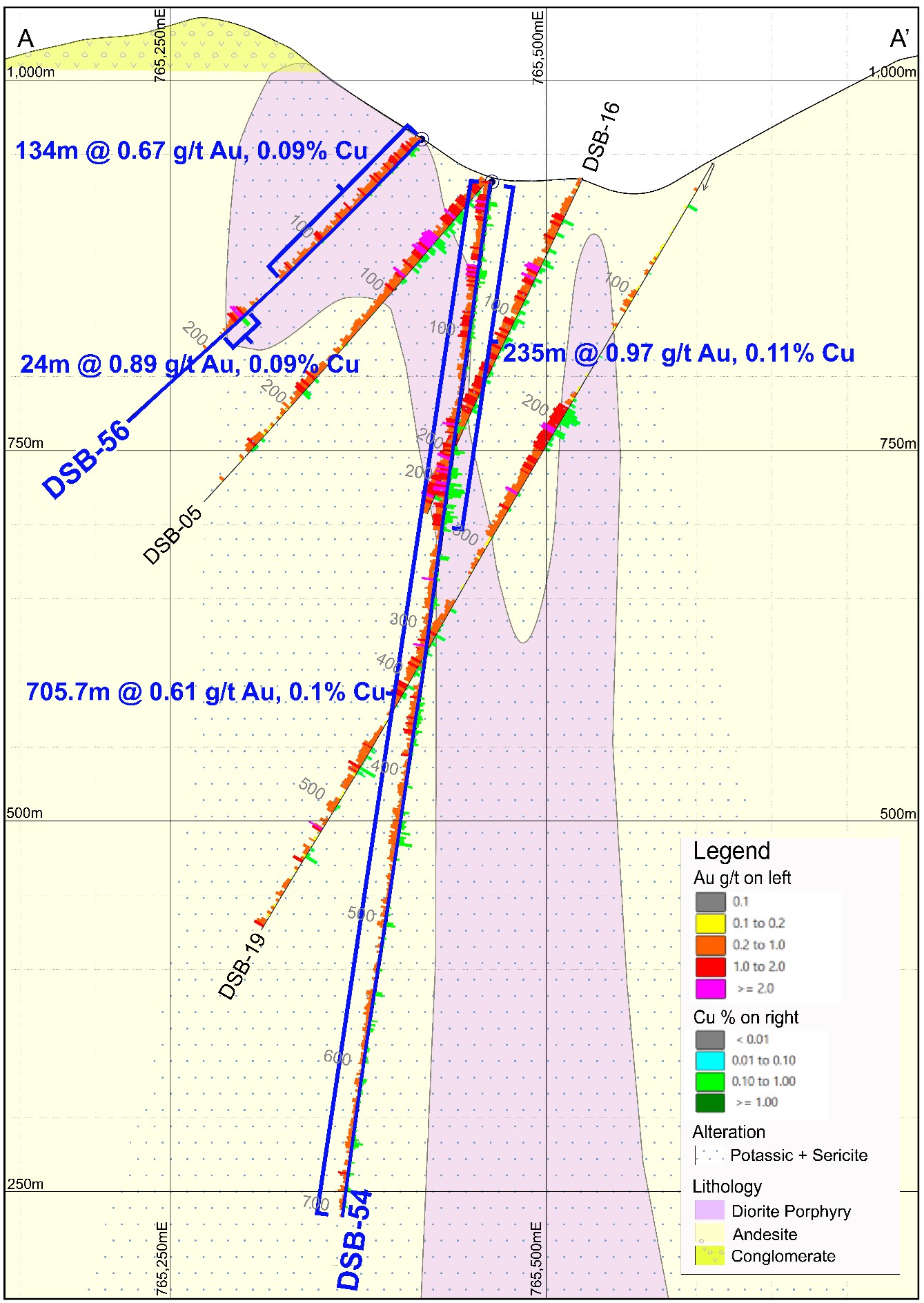
Hole DSB-54 was drilled at the northern portion of Santa Barbara South to a depth of 705.7m, and intersected 705.7m (from 0.00m to 705.7m at the end of hole) grading 0.61 g/t Au and 0.10% Cu, including 235m (from 0.00m to 235.0m) grading 0.97 g/t Au, 0.11% Cu. Gold-copper mineralization starts from surface and continues until the end of the hole (Figure 2).
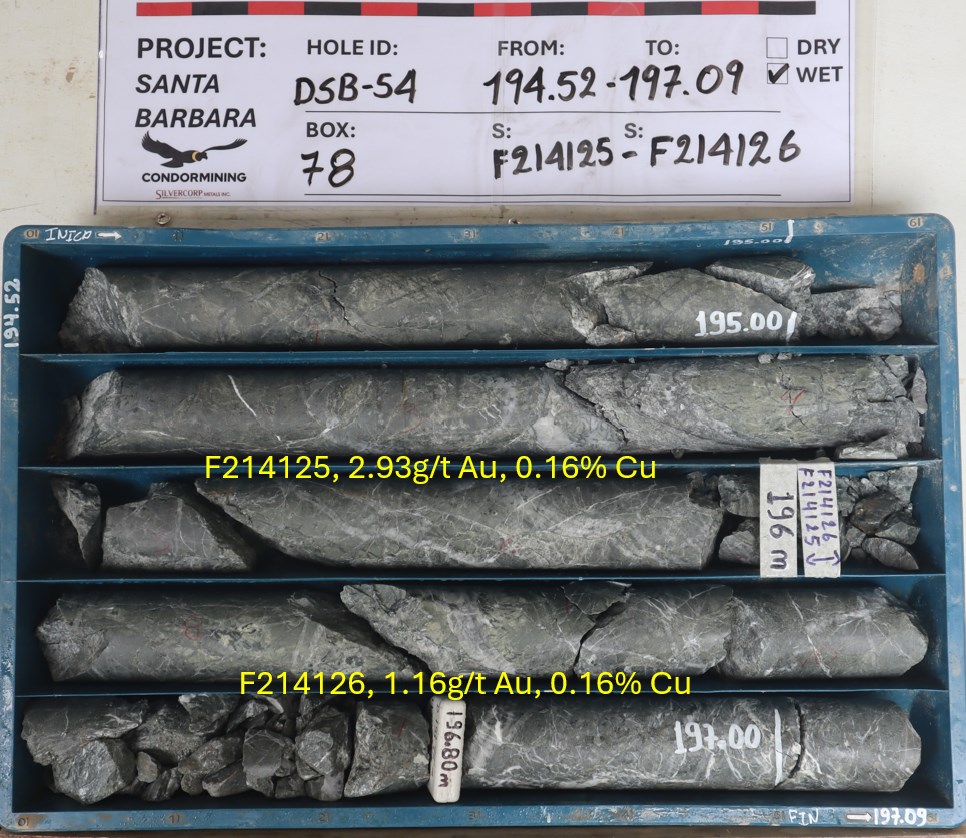
The dominant lithology intersected in this hole is aphanitic basaltic andesite which is cut by intrusive diorite dykes with or without porphyritic texture. Both rock types are strongly altered with potassic alteration featured by secondary biotite in patches and along fractures, and alterations with sericite, chlorite and epidote. Quartz veining (A and B types) is common, cutting both basaltic andesite (Figure 3) and intrusive diorite dykes. Mineralization is characterized by pyrite and chalcopyrite in forms of both dissemination and narrow veinlets and threads. Higher grade mineralization is mostly hosted in basaltic andesite associated with abundant quartz veining in the vicinity of intrusive diorite dykes.
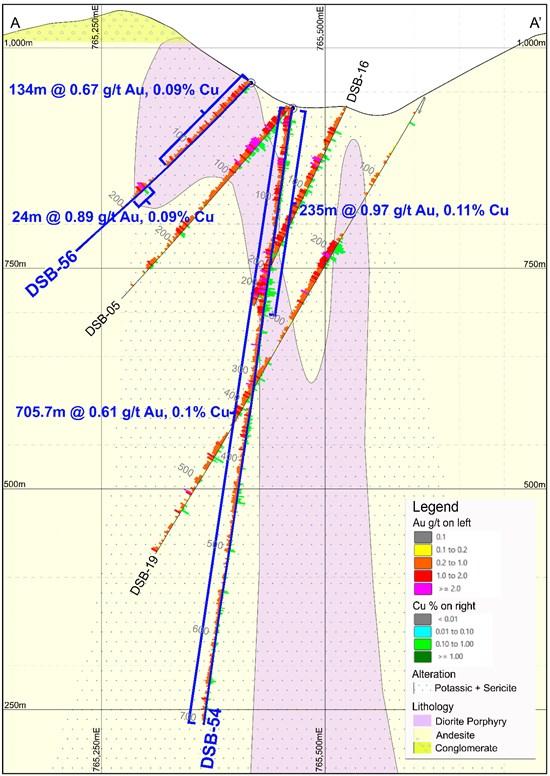
Figure 2: Section A-A’
To view an enhanced version of this graphic, please visit:
https://images.newsfilecorp.com/files/7553/302426_4db36fef747f8a82_002full.jpg
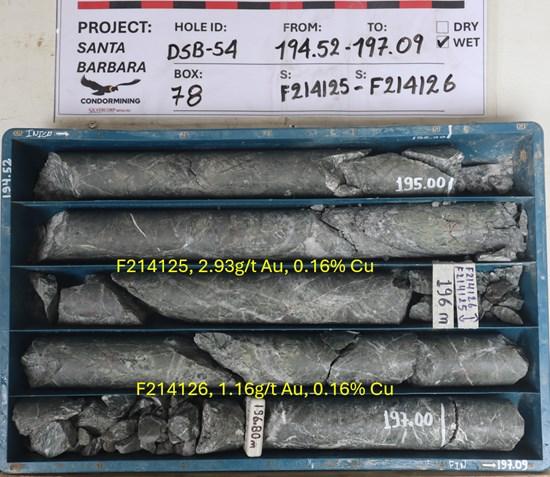
Figure 3: Core photo of DSB-54, Box 78, from 194.52m to 197.09m, mineralized basaltic andesite with milky quartz veining.
To view an enhanced version of this graphic, please visit:
https://images.newsfilecorp.com/files/7553/302426_4db36fef747f8a82_003full.jpg
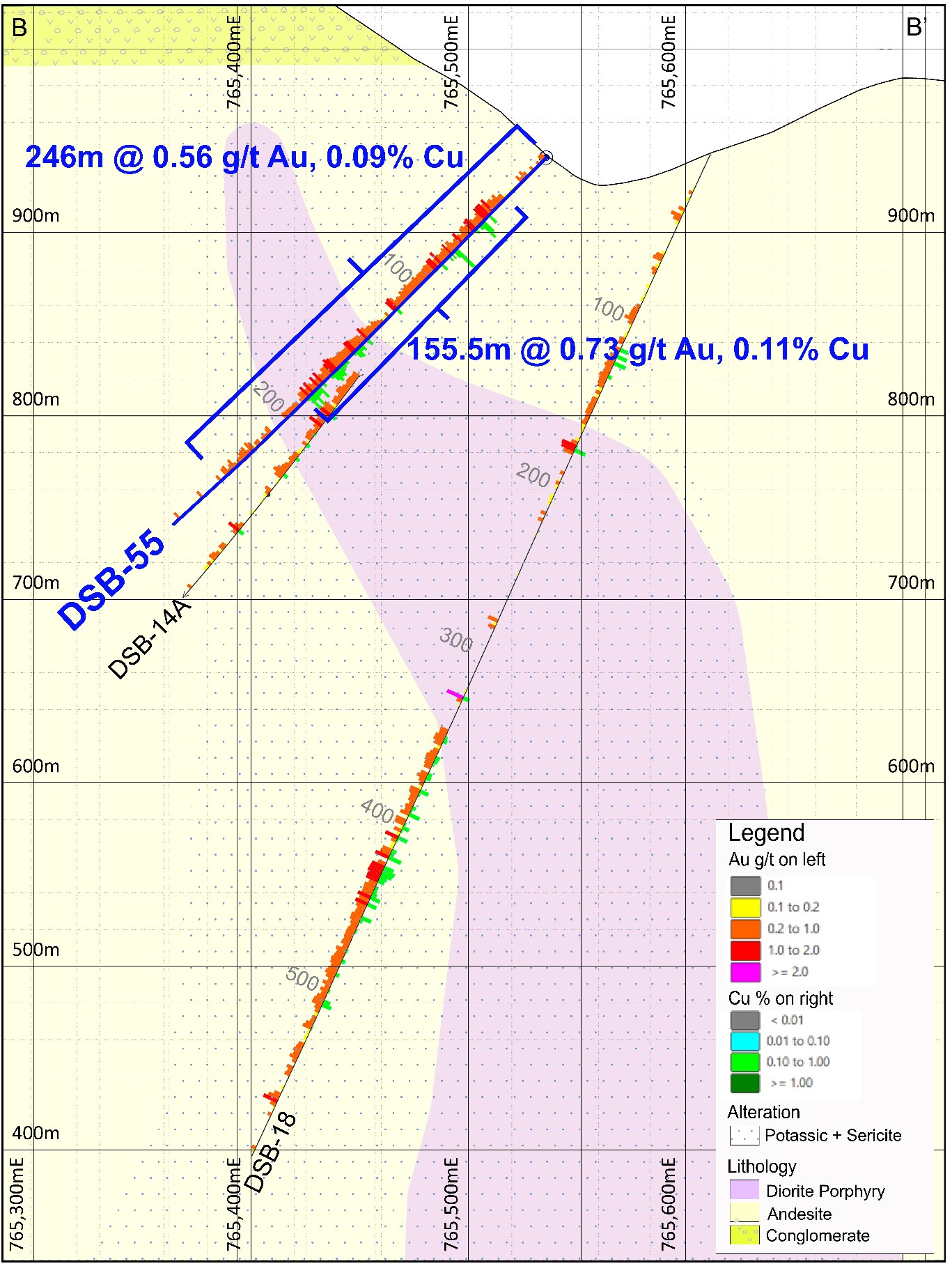
Hole DSB-55 was drilled 100m to the southeast of DSB-54, and about 150m in the up-dip direction of the historical hole DSB-18. The hole has a length of 285.5m and intersected an interval of 246m grading 0.56 g/t Au and 0.09% Cu from surface to a depth of 246m, including a higher-grade interval of 155.5m from 31.5m to 187m (Figure 4). Drill results from this hole indicate gold-copper mineralization is open in the up-dip direction to surface.
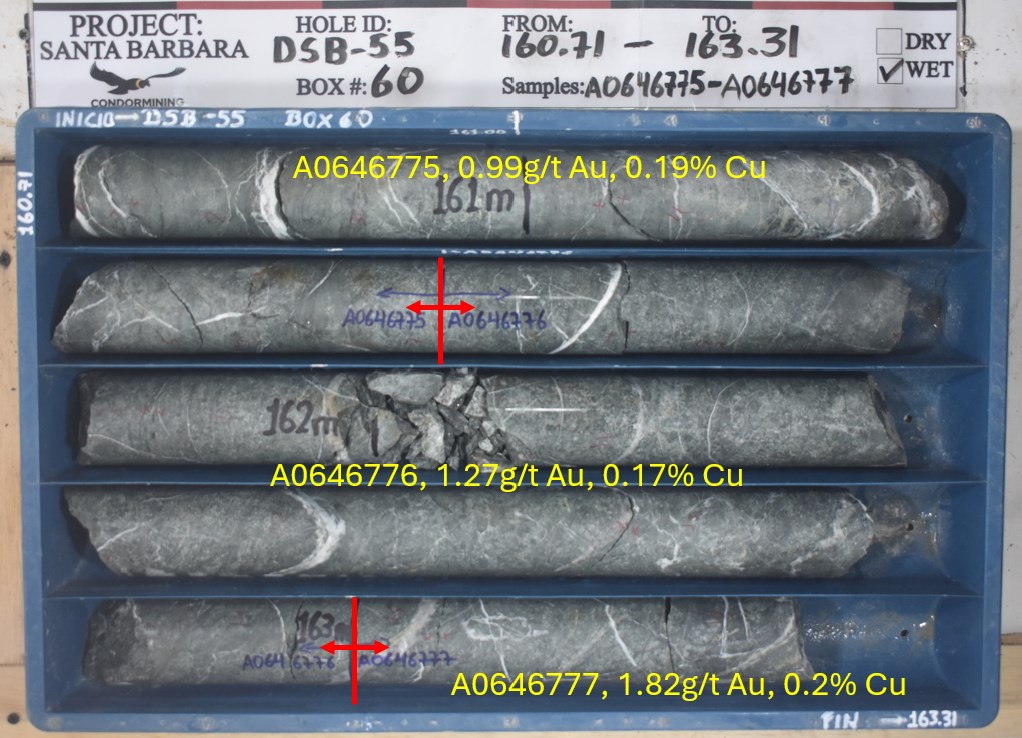
Lithology in the hole is mainly intrusive diorite which extends from surface to a depth of 243 m, and further downwards dominated by a jasperoid horizon which is the result of hydrothermal alteration. Gold-copper mineralization is concentrated in the upper diorite, but little in the lower jasperoid, characterized by disseminated pyrite and chalcopyrite plus minor small veinlets locally. Typical alteration includes secondary biotite and sericite, and quartz veining is common throughout the mineralized interval (Figure 5).
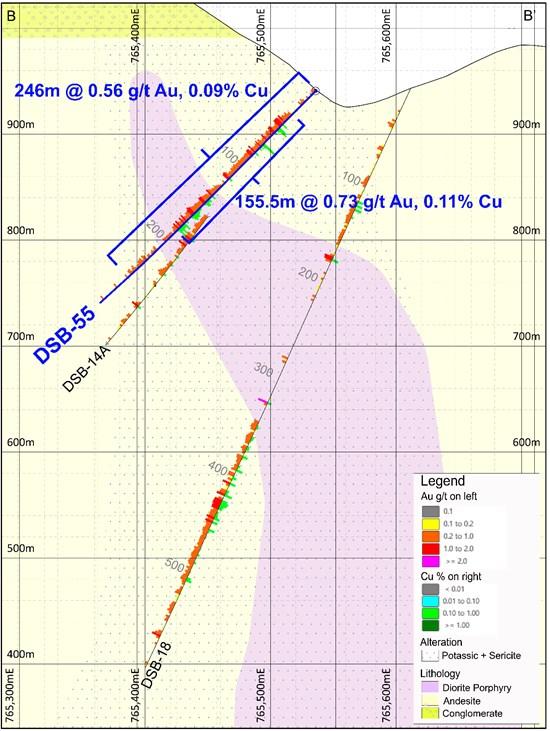
Figure 4: Section B-B’
To view an enhanced version of this graphic, please visit:
https://images.newsfilecorp.com/files/7553/302426_4db36fef747f8a82_005full.jpg
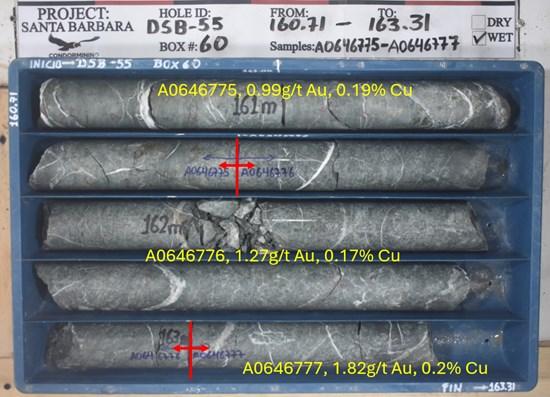
Figure 5: Core photo of DSB-55, Box 60, from 160.71m to 163.31m, mineralized diorite with quartz veining.
To view an enhanced version of this graphic, please visit:
https://images.newsfilecorp.com/files/7553/302426_4db36fef747f8a82_006full.jpg
Hole DSB-56 was drilled around 60m in the up-dip direction of historical hole DSB-05, on the same cross section of DSB-54. The hole has a length of 274.85m and intersected 134m grading 0.67 g/t Au and 0.09% Cu from 0m to 134m, and 24m grading 0.89g/t Au and 0.09% Cu from 164.5m to 188.5m. The drill results of this hole indicate mineralization is open in the up-dip direction to surface (Figure 2).
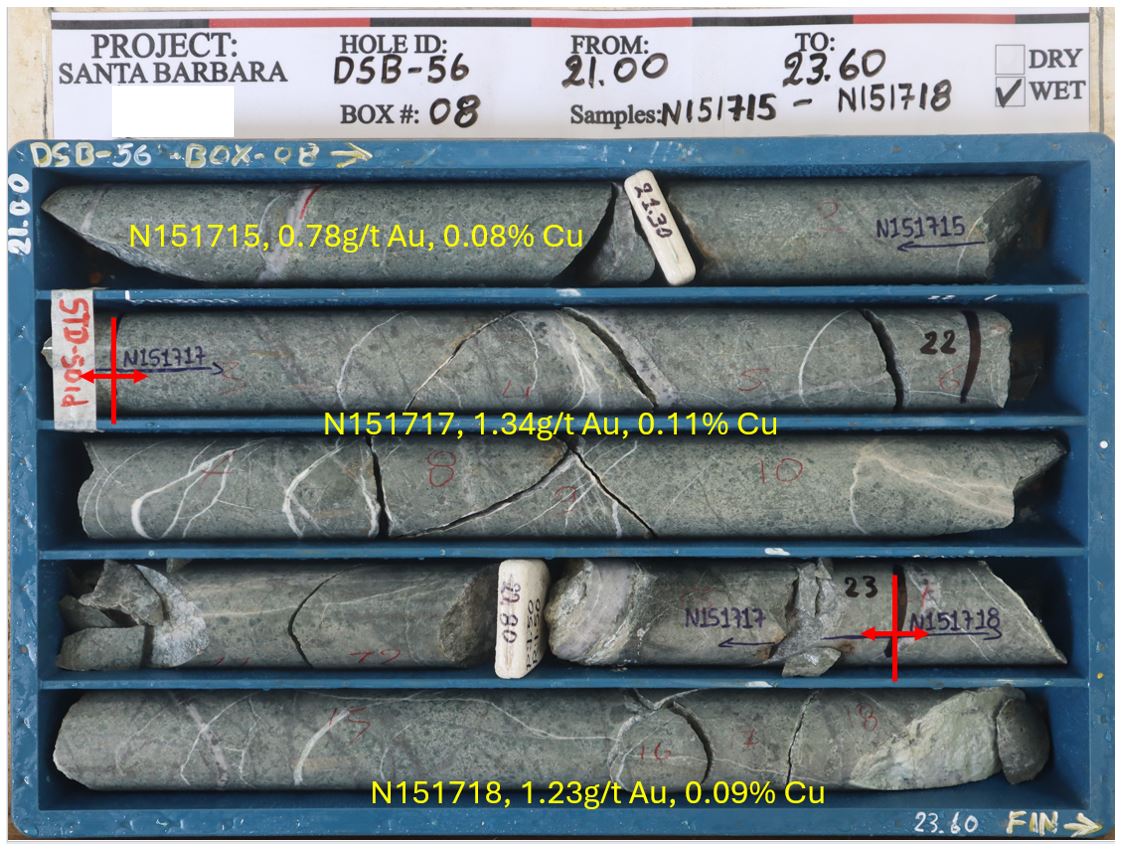
The lithology intersected in DSB-56 is dominated by intrusive diorite, starting from surface to a depth of 198m, and further downwards to the end of the hole is a jasperoid horizon. Gold-copper mineralization is well developed in the diorite, but not in the jasperoid, characterized by disseminated pyrite and chalcopyrite plus minor small veinlets locally. Typical alteration includes secondary biotite and sericite, and quartz veining is common throughout the mineralized interval (Figure 6).
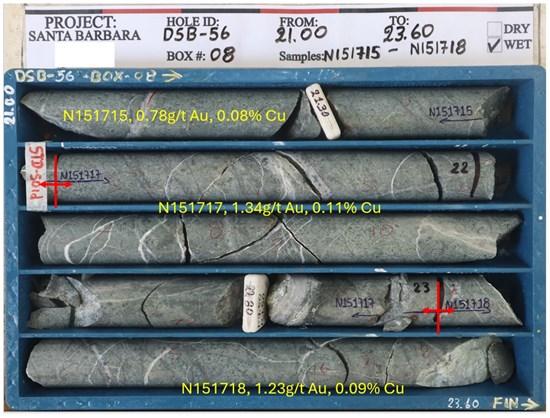
Figure 6: Core photo of DSB-56, Box 08, from 21m to 23.6m, mineralized diorite with quartz veining.
To view an enhanced version of this graphic, please visit:
https://images.newsfilecorp.com/files/7553/302426_auro.jpg
To view an enhanced version of this graphic, please visit:
https://images.newsfilecorp.com/files/7553/302426_4db36fef747f8a82_008full.jpg
Notes:
QUALITY ASSURANCE AND QUALITY CONTROL
All samples in respect of the exploration program at the Project discussed in this news release were shipped in securely-sealed bags by a chartered commercial truck, directly from the field to the sample preparation facilities of SGS in Guayaquil, Ecuador for preparation, and to SGS in Lima, Peru for geochemical analysis. SGS is a global leader in inspection, verification, testing, and certification. It is an ISO/IEC 17025 accredited laboratory independent from Auro. All samples go through fire assay (SGS code FAA313) for gold and multi-acid digestion ICP-AES multi-element assay (SGS code ICP40B) for other elements. Certified reference materials, various types of blank samples and duplicate samples are inserted into normal drill core sample sequences prior to delivery to laboratory for preparation and analysis. The overall ratio of quality control samples in sample sequences is around twenty percent.
QUALIFIED PERSON
The scientific and technical information contained in this news release has been reviewed and approved by Alex Zhang, P. Geo., a Director of the Company, who is a Qualified Person for the purposes of National Instrument 43-101 – Standards of Disclosure for Mineral Projects. The Qualified Person has verified the information disclosed herein, including the sampling, preparation, security and analytical procedures underlying such information, and is not aware of any significant risks and uncertainties that could be expected to affect reliability or confidence in the information discussed herein.
ABOUT AURO METALS INC.
Auro Metals Inc. is a mineral exploration company which holds a 100% interest in the Santa Barbara Gold-Copper Project in the Zamora Copper-Gold Belt of southeastern Ecuador. The Santa Barbara Project is a large-scale porphyry system comprising Indicated resources of 29.8 million tonnes grading 0.73 grams per tonne gold and 0.10% copper containing 697,000 ounces gold and 68 million pounds copper, and Inferred resources of 205.7 million tonnes grading 0.52 grams per tonne gold and 0.09% copper containing 3,418,000 ounces gold and 426 million pounds copper. For more detail, see the Company’s mineral resource estimate prepared in accordance with NI 43-101 by SRK Consulting, effective March 23, 2026 which can be found on SEDAR+ and the Company’s website.
On Behalf of Auro Metals Inc.
signed “Victor Feng”
Victor Feng, CEO and Director
For further information, please contact:
Victor Feng
CEO and Director
Phone: +1 (604)-336-5919
Email: info@aurometals.ca
www.aurometals.ca
Brutus Mining Inc. (CSE: BRU) (FSE: ZI3) is pleased to announce that it has closed its non-brokered ... READ MORE
Jaguar Uranium Corp. (NYSE American: JAGU) is pleased to announce an independent Mineral Resource E... READ MORE
Auro Metals Inc. (TSX-V: AURO) (OTCQB: AURFF), is pleased to announce the assay results of the fina... READ MORE
Endeavour Silver Corp. (NYSE: EXK) (TSX: EDR) is pleased to announce that repairs to the primary bal... READ MORE
Scorpio Gold Corp. (NASDAQ: SGLD) (TSX-V: SGLD) (OTCQB: SRCRF) (FSE: RY9) is pleased to announce re... READ MORE