








Altamira Gold Corp.’s (TSX-V: ALTA) (FSE: T6UP) (OTCQB: EQTRF) is pleased to report assay results from initial diamond drilling at the Guillermo target and to provide an update on ongoing exploration activities at the Maria Bonita mineral resource within its Cajueiro District, Brazil.
Highlights:
CEO Mike Bennett commented; “Our first drill hole at the Guillermo target has delivered an exciting result. This target, located 2km to the northeast of the Cajueiro Central mineral resource, is one of several within an east-west corridor extending over 8km. Three of these prospects outside our mineral resources, have now delivered positive gold intercepts in scout drilling (Tavares Norte, Morro Verde and, more recently, Guillermo). The current results continue to demonstrate the potential of the district to increase our resource base in the short term.
Drill hole MBA-034 at Maria Bonita confirms that gold mineralization continues at depth and further drilling will target newly defined zones where we believe that there is potential to discover additional mineralized gold bearing porphyry bodies outside the current mineral resource footprint.”
CAJUEIRO DISTRICT
The Cajueiro district is located approximately 75km NW of the town of Alta Floresta in the state of Mato Grosso (Figure 1) in central western Brazil. The project is easily accessible by road, lies on open farmland and has grid power and a local water supply. Cajueiro is the most advanced of the key projects that Altamira controls in the region (Figure1).
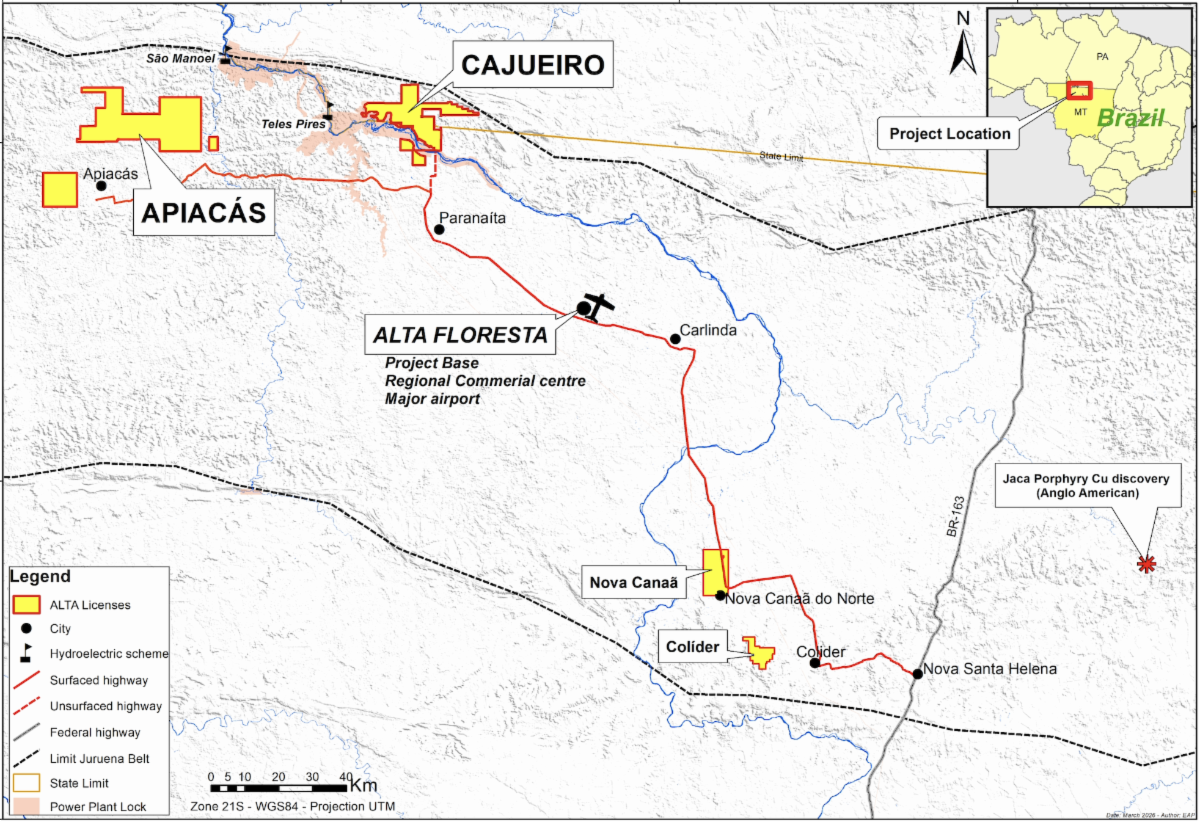
Figure 1: Location of Altamira Gold’s projects in the Alta Floresta Belt
The Cajueiro district consists of two independently estimated gold mineral resources at Cajueiro Central and Maria Bonita, plus a series of eight additional untested exploration targets within a radius of 8km of Cajueiro Central.
The Cajueiro Central area has a current open pit resource1 of 5.66Mt @ 1.02 g/t gold containing 185,000 oz in the Indicated Resource category and 12.66Mt @ 1.26 g/t gold (515,000 oz) in the Inferred Resource category (estimated using a cut-off grade of 0.25g/t Au and a gold price of US$1,500/oz).
The Maria Bonita open-pit resource consists of Indicated Resources of 24.19Mt @ 0.46g/t gold (357,800oz) and Inferred Resources of 25.64Mt @ 0.44g/t gold (362,400oz)2. These resources were calculated using a 0.2 g/t gold cut-off grade and a gold price of US$2,780/oz. These resources include near-surface saprolite Indicated Resources of 2.02Mt @ 0.59g/t gold (38,000oz) and Inferred Resources of 0.68Mt @ 0.40g/t gold (8,700oz).
The Maria Bonita porphyry gold deposit forms part of a district-scale portfolio of prospects that are interpreted as having a similar geological origin (Figure 2). The Cajueiro area is characterized by a 15km stretch of former alluvial gold workings along the Teles Pires river. The source of some of this alluvial gold is related to a pronounced east-west corridor of gold anomalies in soils and rock chips and a set of sub-cropping intrusions extending east-west over 8km, implying the presence of a long-standing and deep-seated crustal structure.
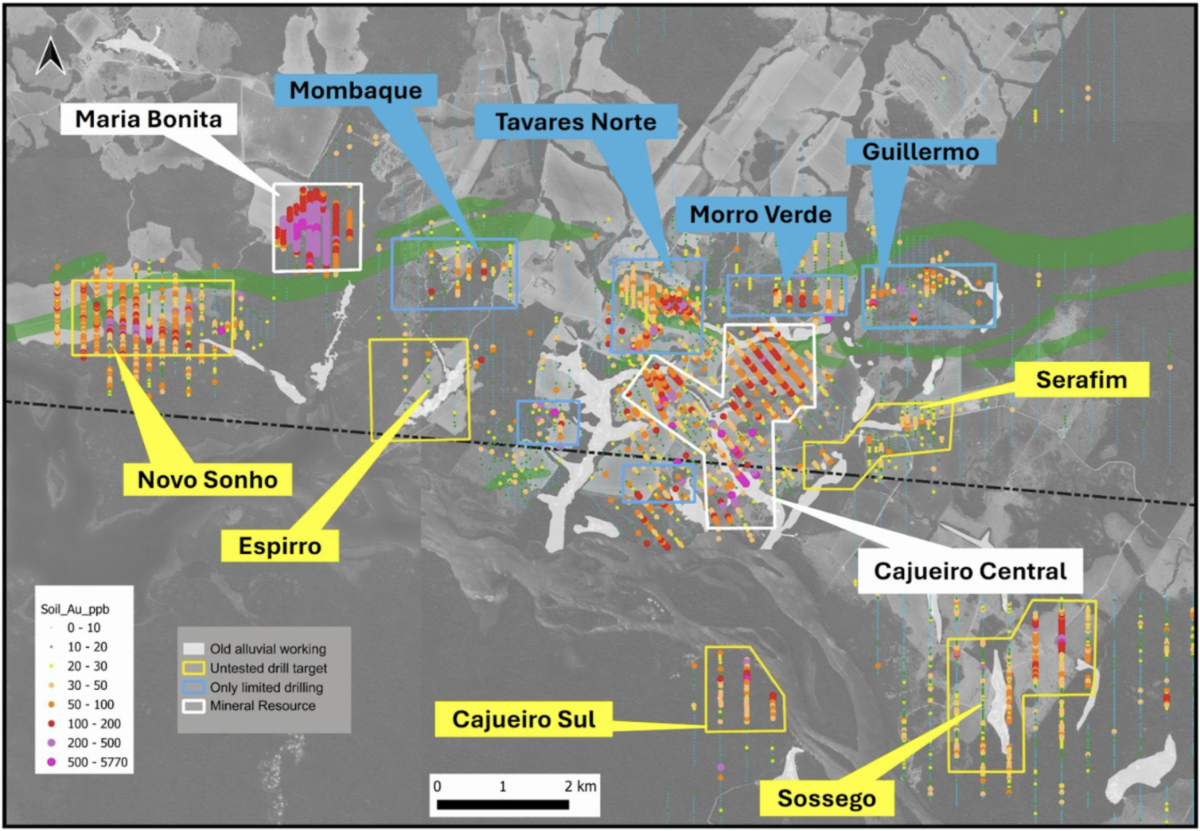
Figure 2: Cajueiro district mineral resources at Cajueiro Central and Maria Bonita (white labels) and prospects (blue labels with scout drilling, yellow labels not yet drilled). An alignment of six of the targets occur in close spatial association to a pronounced east-west fault corridor marked by later gabbroic dykes
Maria Bonita Drilling Update
Results have been received for diamond drill hole MBA-034, which tested the Maria Bonita porphyry system to a depth of more than 600 metres. Drill hole MBA-034 extended the known gold mineralization more than 100 metres below the previously tested depth of the system (Figure 3).
The deeper intersections confirm that Maria Bonita represents a vertically extensive porphyry system. The more consistent and better grade intervals are associated with the early porphyry phases that subcrop and extend to depths of ~150m below surface.
Later, lower grade porphyry phases, dominate in the deeper areas drilled, and to the east of the mineral resource drill hole MBA-033 tests the eastern limits of the mineralization and intersected multiple intervals above the mineral resource cut-off (0.2g/t gold), totalling 235m in aggregate (Table 1).
To the south-west of the mineral resource, surface rock sampling in a small pit developed for road aggregate material returned 0.6 g/t gold in quartz veined porphyry. This area lies outside the current mineral resource and suggests that further preserved centres of the early porphyry may be present within the 800 x 800m soil anomaly currently defined by the 200ppb gold contour.
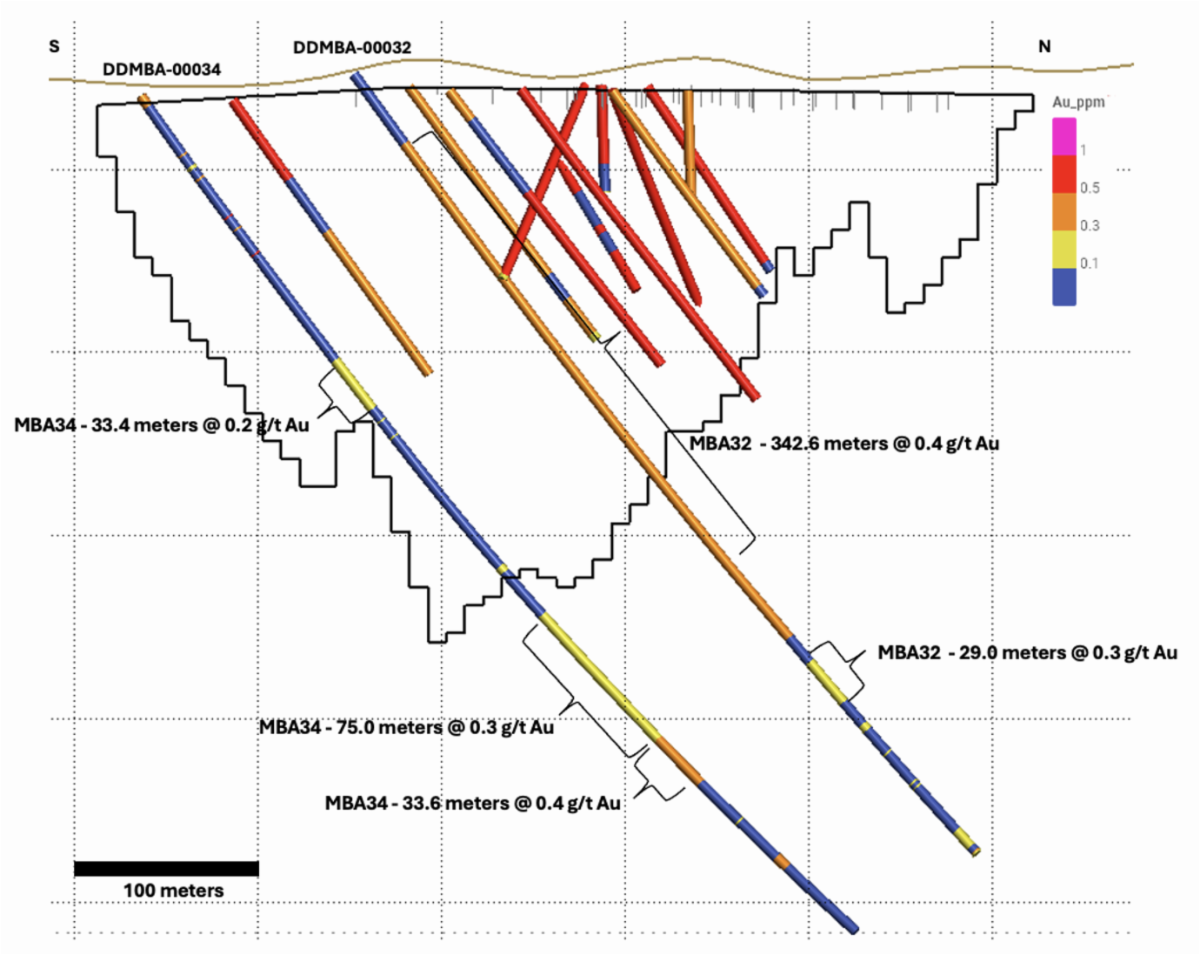
Figure 3: Section along drill holes MBA-032 (see press release October 15, 2025) and MBA-034, showing mineralized intervals and the previously reported optimized pit profile for the mineral resource estimate reported under NI43-101.
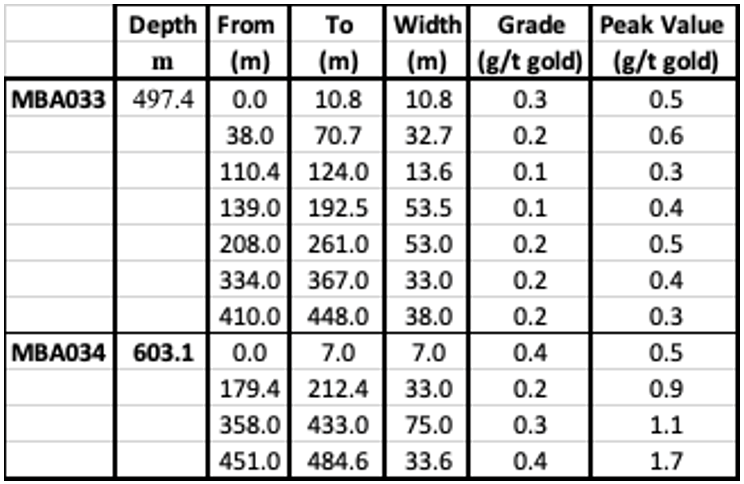
Table 1: Summary of results from drill holes MBA-033 and 034 at the Maria Bonita target.
Regional Exploration
In January, the Company initiated a diamond drilling program targeting the regional Guillermo and Mombaque targets (Figure 2). These targets have no prior drilling. Results have been received for the first drill hole at Guillermo. These targets are part of a district scale exploration program that has delivered initial results at Tavares Norte and Morro Verde (Table 2).
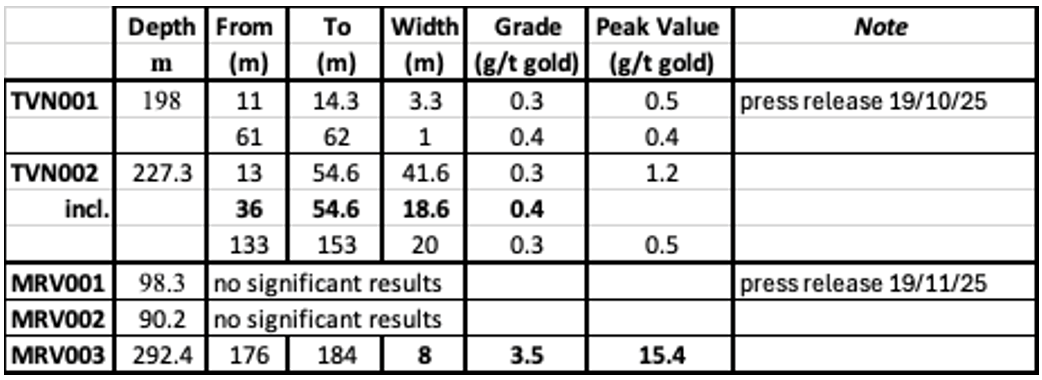
Table 2: Drill results to date from the first two district drill targets Tavares Norte and Morro Verde (see Figure 2).
Guillermo Target
The Guillermo prospect, located 2km north-east of the Cajueiro Central mineral resource, is the eastern-most prospect in an eight-kilometre east-west trend, defined by gold-in-soil anomalies with associated porphyritic intrusives, quartz veining and sericitic alteration at surface. Trenching at Guillermo found highly anomalous gold intervals including 35m @ 0.5 g/t gold (see press release April 14, 2025).
The majority of the assay results have been received for the initial drill hole (GLO-001). The hole returned 7m @ at 4.2g/t gold from 111m, including an interval of 0.9m @ 18.1g/t gold from 117.1m. This interval is hosted in a zone of altered rhyolite intrusive and is associated with quartz-carbonate-pyrite veinlets, some of which are subparallel to the core axis. Although the mineralized zone can be correlated with the interval of 9m @ 0.4g/t gold in Trench TCGLO06 (see Figure 4), the true width of the mineralized interval in the drill hole is not currently known.
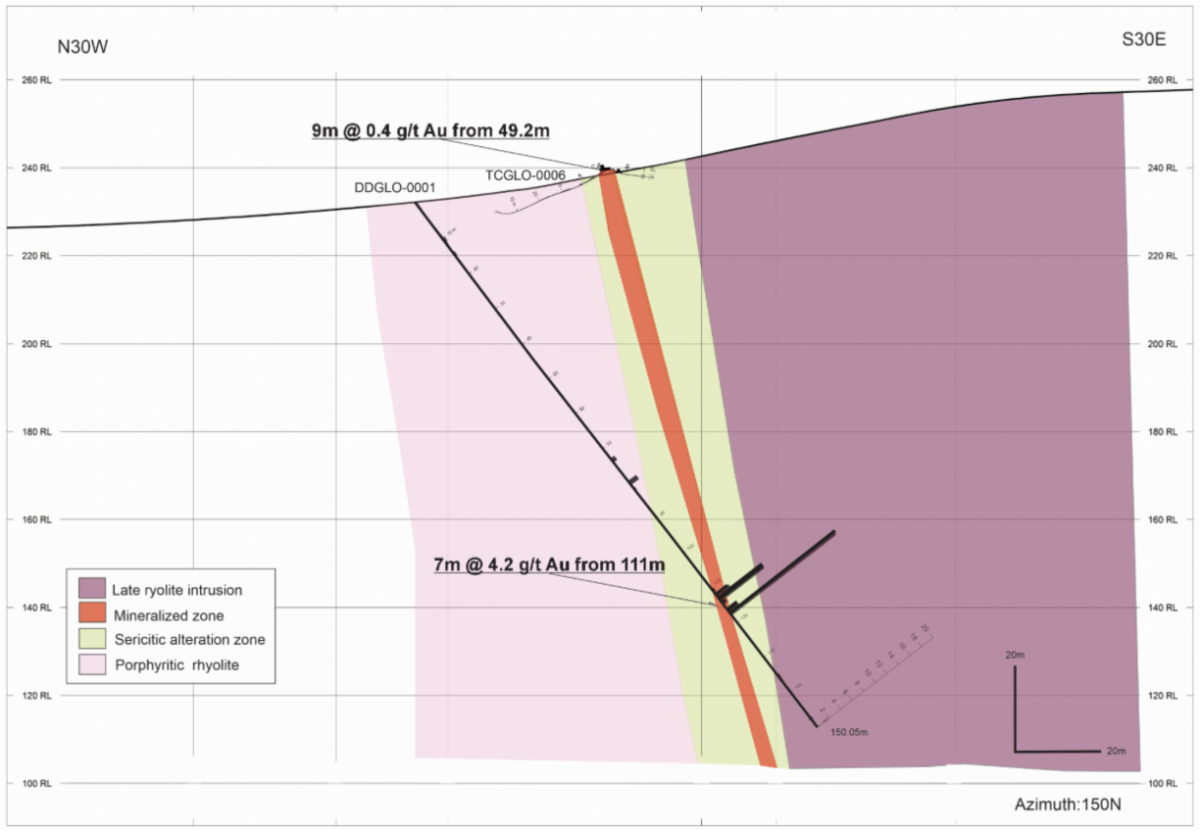
Figure 4: Cross section showing GLO-001 and surface trench TCGLO-06 at Guillermo target.
Next Steps
The Company will continue to scout drill test targets in close proximity to, but outside, the mineral resource at Maria Bonita, where several anomalies are defined by rock chip sampling and drone magnetics. Further resource drilling at Cajueiro Central will be conducted in parallel with follow-up drill testing at Tavares Norte and Morro Verde where first round drilling discovered significant mineralization.
Construction and installation of on-site accommodation and core processing facilities at Maria Bonita are also underway to support ongoing exploration activities.
Qualified Person
Fernando Benegas, FAusIMM, a consultant to the Company as well as a Qualified Person as defined by National Instrument 43-101, supervised and approved the preparation of the technical information in this news release.
About Altamira Gold Corp.
The Company is focused on the exploration and development of gold projects within western central Brazil, strategically advancing four projects spanning over 100,000 hectares within the prolific Juruena Gold Belt—an area that has historically yielded over 6 million ounces of placer gold3. The Company’s advanced Cajueiro project contains two gold deposits. Ongoing exploration and fieldwork at Cajueiro indicate the presence of multiple hard rock gold occurrences, traceable from historical alluvial gold production, highlighting the region’s exceptional gold endowment and potential scalability. With two independently established mineral resources, a highly prospective geological setting and a track record of significant discoveries, the Company is well-positioned to unlock further value across its extensive land package.
1NI 43-101 Technical Report, Cajueiro Project, Mineral Resource Estimate: Global Resource Engineering, Denver Colorado USA, 10thOctober 2019; Authors K. Gunesch, PE; H. Samari, QP-MMSA; T. Harvey, QP-MMSA
2 NI43-101 Technical Report, Mineral Resource for the Maria Bonita Prospect: VMG Consultoria, Belo Horizonte, Minas Gerais, Brazil. 12th June 2025; Author V. Myadzel
3 Juliani, C. et al; Gold in Paleoproterozoic (2.1 to 1.77 Ga) Continental Magmatic Arcs at the Tapajós and Juruena Mineral Provinces (Amazonian Craton, Brazil): A New Frontier for the Exploration of Epithermal-Porphyry and Related Deposits. Minerals 2021, 11, 714. https://doi.org/10.3390/min11070714
Manitoba-focused company, backed by the Canada Growth Fund, Orion... READ MORE
Golconda Gold Ltd. (TSX-V: GG) (OTCQX: GGGOF) is pleased to annou... READ MORE
Talamore Mining Corp. (TSX: TALA) (OTCQB: TALMF) is pleased to an... READ MORE
Atico Mining Corporation (TSX-V: ATY) (OTC: ATCMF) reports that i... READ MORE
ATERRA Metals Inc. (CSE: ATC) (OTCQB: CSSCF) is pleased to announ... READ MORE