








West Point Gold Corp. (TSX-V: WPG) (OTCQX: WPGCF) (FSE: LRA0) is pleased to announce drill results from the high-grade zone at Northeast Tyro, part of the recently completed drill program at its flagship Gold Chain Project in Arizona. The two holes reported herein, GC26-134 and GC26-137, further confirm and validate the high-grade discoveries made via reverse circulation drilling (“RC”) at the NE Tyro Zone in drill core. The highlight intervals of 9.06 grams per tonne (“g/t”) gold (“Au”) over 19.7 metres and 3.2 g/t Au over 35.7m are in line with or exceed many prior results and continue to showcase the robust widths and high-grade tenor of the system at NE Tyro.
The 2025/2026 drilling campaign, comprising RC (18,683.3m) and core (2,395.7m), has now been completed, with a total of 21,079 m drilled. Approximately 7,025m of assays are pending and will be released over the next couple of months. With this year’s drilling now complete, the team will focus on integrating the results into the Company’s maiden mineral resource estimate (“MRE”), expected to be released later in 2026.
Highlights:
“These results continue to highlight the high-grade nature of NE Tyro and the potential of this zone. Importantly, these core holes correlate well with proximal RC holes, providing confidence that the practices used for our RC drilling are producing representative results. With the 21,079m completed in the most recent drill campaign, we are now focused on analyzing the results for both our upcoming maiden resource estimate at Tyro Main and NE Tyro and the planning for our next drill program,” stated Derek Macpherson, President and CEO.
Table 1: Drill Results
| Holes | From (m) | To (m) | Width (m) | Grade (g/t Au) |
| GC26-134 | 95.8 | 115.5 | 19.7 | 9.06 |
| GC26-137 | 53.2 | 88.9 | 35.7 | 3.20 |
| Including | 66.4 | 76.6 | 10.2 | 10.23 |
Note: All widths shown are downhole; true widths are approximately 90% of downhole widths.
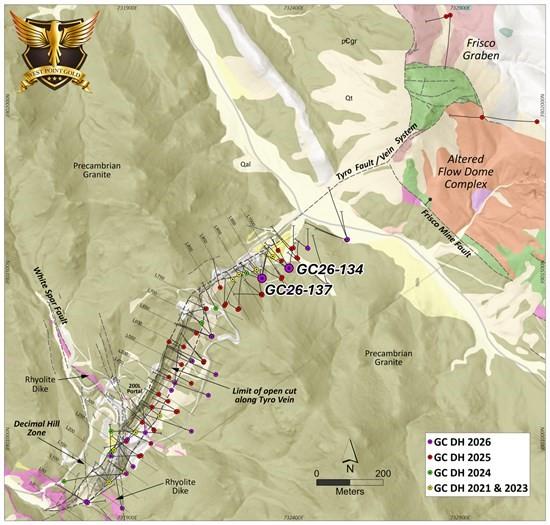
Figure 1: Plan view of the Main Tyro vein showing geology and drilling conducted in 2021, 2023, 2024, 2025, and 2026. Note the location of Hole Nos. GC26-134 and GC26-137.
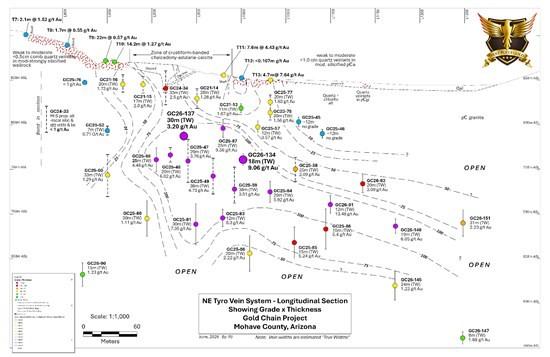
Figure 2. Longitudinal perspective of the Tyro NE zone contoured GT (g/t Au X estimated true thickness). Both Holes GC26-134 and GC26-137 are contained within the GT >100 interval.
Summary
Both Holes GC26-134 and GC26-137 targeted areas proximal to defined high-grade gold mineralization from previous drilling (Figures 3 and 4). Aside from Hole GC24-034 (Figures 2 and 4), all holes in this area have been RC. To ensure that best practices are being followed and that the RC drilling is producing consistent results, it was deemed important to cross-reference higher-grade portions with core where detailed documentation of recovery, RQD, vein styles, textures, and density occurred. In summary, these two holes support the emerging geologic and grade models generated to date and improve the definition of the high-grade gold mineralization in the NE Tyro zone at the Company’s Gold Chain project in Arizona. The two holes comprising this release represent 298.4m of the now completed 21,079m drill program.
Both holes share several similarities in sectional view (Figures 3 and 4). The NE Tyro vein is a robust, fairly uniform structure that dips to the SE at 70o to 75o, and ranges in width from 15 to 25 metres. The width of the mineralized package varies relative to the development of quartz veinlets and stockwork in the hanging wall (“HW”) and ‘outboard’ from the principal quartz vein/breccia at the footwall (“FW”). Precambrian granite, along with lenses or ‘xenoliths’ of gneiss, schist, and amphibolite, is the host rock. Perhaps most importantly, several intercepts are hosted by or adjacent to fine-grained (aphanitic) felsic dike (Miocene), likely rhyolite, forming quartz-calcite-cemented breccia and stockwork. This spatial coincidence may reflect a preference for the gold-bearing fluids to follow the dikes (more brittle) and/or the contact with the hosting Precambrian (likely broken and faulted). The modeling of these features in the upcoming weeks will provide greater insight into deeper targets.
As shown in Figures 2 through 5, both Holes GC26-134 and GC26-137 traverse the vein at about the same elevation (760 – 790m ASL) or about 100m below the surface. Quartz >> calcite veinlets in propylitized (chlorite + quartz + pyrite) Precambrian rocks define the distal zone of veining and increase with depth from a few percent to 25% with occasional gold values. The main mineralized zone commences with moderate to strong quartz-calcite veinlets, stockwork and breccia giving way to a multi-stage breccia zone up to the FW contact (Figures 5 and 6). Evidence of faulting (Miocene) and shearing in the Precambrian rocks suggest a pre-Tertiary origin for the controlling structures.
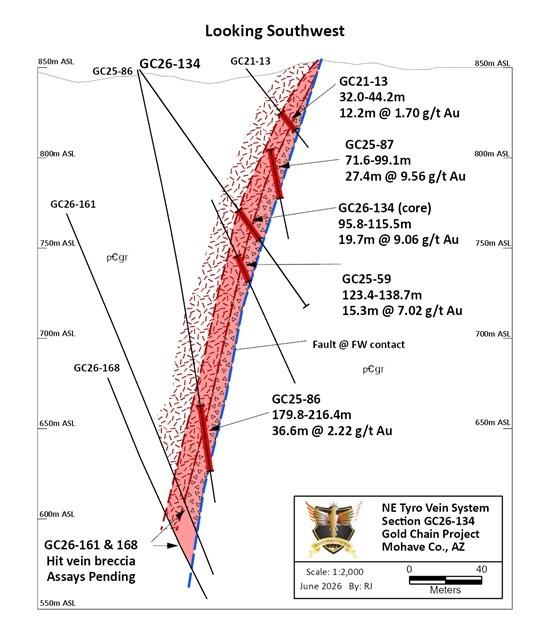
Figure 3. Geologic section drawn along GC26-134 showing vein and spatial relation to GC21-013, GC25-087, GC25-059, GC25-086, GC26-161 and GC26-168 and the surface.
Veins and breccia composing the NE Tyro vein are multi-stage and comprised of quartz-chalcedony-calcite (bladed)-adularia with only trace amounts of pyrite (Figures 5 and 6). Surface-related oxidation is minimal and only seen along post-mineral fractures. However, local intervals or breccia fragments of weakly iron-stained bladed calcite and quartz along with fine, quartz-hematite veinlets suggest an event of hydrothermal oxidation. Bladed calcite or “lattice texture” has developed in several stages and ranges from delicate bands within crustiform/coliform-banded chalcedony to coarse, angular fragments in late-stage breccia. Native gold (Figure 7) has been observed within minute dendritic growths of a black opaque, perhaps electrum or a sulfosalt. The documentation of these features may prove to be important as the Company evaluates events related to gold deposition at greater depths.
Breccia textures are prevalent in these holes and were developed during multiple events. Aside from fault breccia observed at the vein’s FW contact, the vein package consists of broad intervals of weak (further into the HW) to strong stockwork/breccia composed of fine- (chalcedony) to medium- (sucrosic) to coarsely-crystalline (comb) quartz veins and veinlets with subordinate amounts of calcite dominantly in a bladed habit and native gold (see Figure 7); adularia (?) likely occurs in select bands or vein fragments revealing a tan to light pink coloration. Some breccia masses are ‘jigsaw’ in character, suggesting little or no fragment transport. Other breccias are fine-grained, heterolithic, and reveal fluidal or ‘streaming’ textures suggesting considerable transport (and energy). The dominance of breccias at the FW portion of the vein complex suggests both recurrent movement and explosive events likely related to deeper fluid boiling and potential gold deposition.
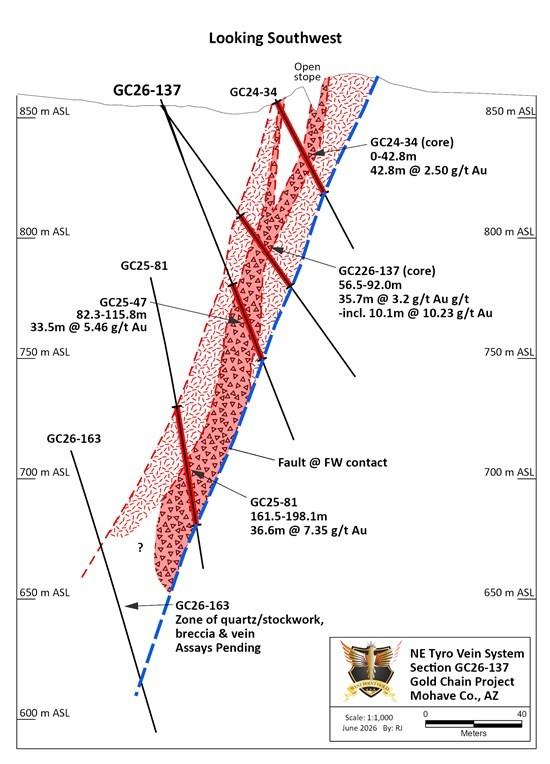
Figure 4. Geologic section drawn along GC26-137 showing vein and spatial relation to GC21-014, GC25-047, GC25-081 and GC26-163 and the surface.
Table 2: Drill hole locations and descriptions
| Hole No. | Azimuth (degrees) | Inclination (degrees) | Easting | Northing | Length (m) |
| GC26-134 | 300 | -55 | 732,386 | 3,901,513 | 160.0 |
| GC26-137 | 300 | -55 | 732,305 | 3,901,482 | 138.4 |
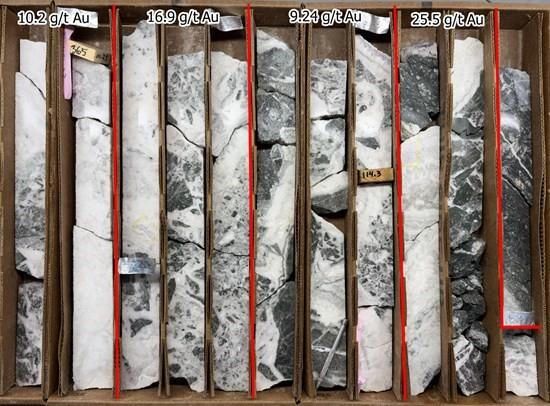
Figure 5. Photo GC26-134 showing a portion of the vein and corresponding gold values. Core reveals that the NE Tyro vein is a broad zone of multi-stage veins and breccia hosting a broad array of textures.
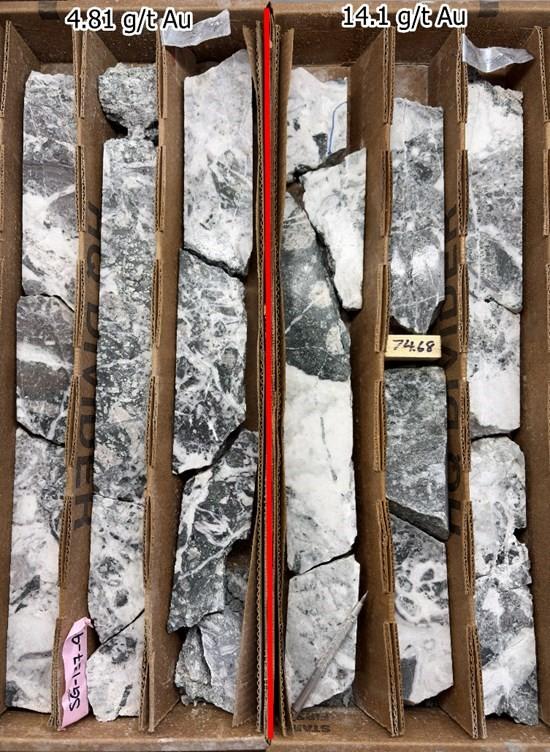
Figure 6. Photo GC26-137 showing a portion of the vein and corresponding gold values.
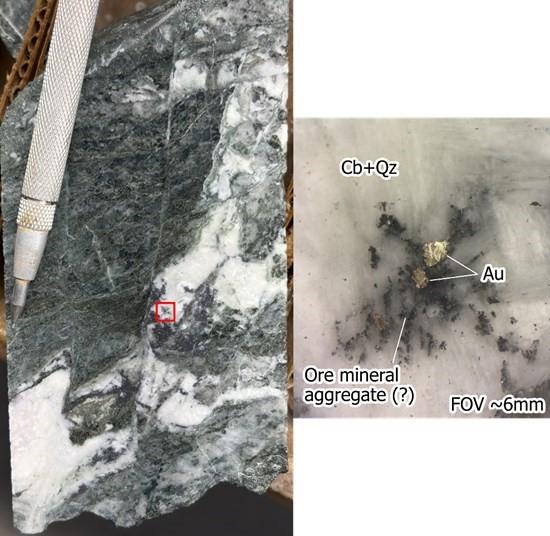
Figure 7. Photomicrograph (F.O.V. = ~6mm) of native gold within a dendritic growth of electrum and/or sulfosalt; GC26-137, 67.25m. Note bladed texture of quartz pseudomorphs after calcite.
Qualified Person
Robert Johansing, M.Sc. Econ. Geol., P. Geo., the Company’s Vice President, Exploration, is a qualified person as defined by NI 43-101 and has reviewed and approved the technical content of this press release. Mr. Johansing has also been responsible for overseeing all phases of the drilling program, including logging, labelling, bagging and transport from the project to American Assay Laboratories of Sparks, Nevada. Drillholes have a diameter of about 10cm, and samples have an approximate weight of 5 to 10kg. Samples were then dried, crushed and split, and pulp samples were prepared for analysis. Gold was determined by fire assay with an ICP finish, and over-limit samples were determined by fire assay and gravimetric finish. Silver plus 15 other elements were determined by Aqua Regia ICP-AES (IM-2A16), and over-limit samples were determined by fire assay and gravimetric finish. Both certified standards and blanks were inserted on site along with duplicates, standards and blanks inserted by American Assay. The results summarized above have been carefully reviewed with reference to the QA/QC results. Standard sample chain of custody procedures were employed during drilling and sampling campaigns until delivery to the analytical facility.
About West Point Gold Corp.
West Point Gold is an exploration and development company focused on unlocking value across four strategically located projects along the prolific Walker Lane Trend in Nevada and Arizona, USA, providing shareholders with exposure to multiple discovery opportunities across one of North America’s most productive gold regions. The Company’s near-term priority is advancing its flagship Gold Chain Project in Arizona.
Brutus Mining Inc. (CSE: BRU) (FSE: ZI3) is pleased to announce that it has closed its non-brokered ... READ MORE
Jaguar Uranium Corp. (NYSE American: JAGU) is pleased to announce an independent Mineral Resource E... READ MORE
Auro Metals Inc. (TSX-V: AURO) (OTCQB: AURFF), is pleased to announce the assay results of the fina... READ MORE
Endeavour Silver Corp. (NYSE: EXK) (TSX: EDR) is pleased to announce that repairs to the primary bal... READ MORE
Scorpio Gold Corp. (NASDAQ: SGLD) (TSX-V: SGLD) (OTCQB: SRCRF) (FSE: RY9) is pleased to announce re... READ MORE