






HIGHLIGHTS
Volta Metals Ltd. (CSE: VLTA) (FSE: D0W) (OTCQB: VOLMF) is pleased to announce drill core assay results from SL26-35, the longest drill hole of the 2026 winter drill program at its Springer Rare Earth Element deposit, near Sturgeon Falls, Ontario, Canada. Drill hole SL26-35 intersected a significant 688 m interval of Gallium and Rare Earth Element mineralization grading 0.81% Total Rare Earth Oxides and 68.13 g/t Ga2O3 from 4.6 m to 693.0 m depth.
From January to April 2026, Volta completed a 13-hole drill program at the Springer deposit (SL26-27 to 39) totalling 5,452 m. The drill program was designed to upgrade the current mineral resource estimate through infill drilling, while also expanding the known REE-Ga mineralization. Drill hole SL26-35 intersected a carbonatite dyke from west to east, demonstrating strong continuity of the REE-Ga mineralization. The hole also significantly extends the Ga-REE mineralization approximately 180 m laterally and 260 m vertically from the current open pit shell. (Figure 1).
“A 688 m continuous intersection of gallium and rare earth mineralization extends our deposit footprint well beyond the current pit shell. With geopolitical pressure on critical mineral supply chains intensifying, the scale and quality of what we are discovering and advancing at Springer puts Volta in a position we are very proud of.” Kerem Usenmez, President & CEO, Volta Metals Ltd.
Assay highlights are given in Table 1. Drill hole SL26-35 contains significant amounts of individual REEs as shown in Table 2. Assays are pending for additional drill holes. Drill hole SL26-35 collar coordinates are given in Table 3.
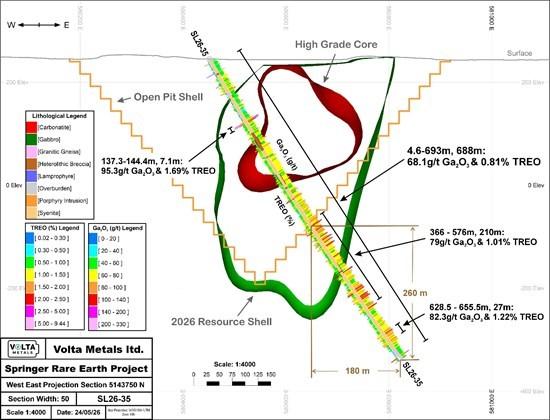
Figure 1 Cross section of SL26-35 showing TREO% and Ga2O3 g/t assays along the drill hole trace.
Table 1: Assay highlights table from drill hole SL26-35, Springer.
| From (m) | To (m) | Interval (m) | TREO (%) | Ga2O3 (g/t) | Dy2O3 (g/t) | Nd2O3 (g/t) | Pr6O11 (g/t) | Tb4O7 (g/t) |
| 4.60 | 693.00 | 688.40 | 0.81 | 68.13 | 39.2 | 1,410.3 | 417.3 | 9.7 |
| including | ||||||||
| 137.30 | 144.40 | 7.10 | 1.69 | 95.27 | 94.3 | 3,062.7 | 859.7 | 23.1 |
| 184.50 | 186.00 | 1.50 | 2.12 | 98.66 | 89.2 | 4,315.7 | 1,152.6 | 26.5 |
| 366.00 | 576.00 | 210.00 | 1.01 | 79.02 | 33.7 | 1,582.8 | 500.6 | 8.9 |
| including | ||||||||
| 379.50 | 381.00 | 1.50 | 1.98 | 125.82 | 60.7 | 2,869.3 | 919.4 | 16.9 |
| 414.00 | 415.50 | 1.50 | 1.87 | 127.70 | 37.9 | 2,577.7 | 868.7 | 12.1 |
| 489.00 | 490.50 | 1.50 | 2.30 | 121.65 | 52.0 | 3,662.5 | 1,180.4 | 15.6 |
| 529.50 | 535.50 | 6.00 | 1.75 | 101.22 | 53.9 | 2,828.5 | 865.4 | 15.4 |
| 546.00 | 553.50 | 7.50 | 1.45 | 101.06 | 31.3 | 2,461.1 | 760.9 | 9.2 |
| 628.50 | 655.50 | 27.00 | 1.22 | 82.30 | 30.7 | 2,437.2 | 690.0 | 9.8 |
| 686.00 | 687.00 | 1.00 | 2.36 | 113.18 | 37.9 | 3,557.5 | 1,149.0 | 13.2 |
*TREO% = La2O3 + CeO2 + Pr6O11 + Nd2O3 + Sm2O3 + Eu2O3 + Gd2O3 + Tb4O7 + Dy2O3 + Ho2O3 + Er2O3 + Tm2O3 + Yb2O3 + Lu2O3 + Y2O3%
**True thickness/width of mineralization is unknown
Table 2: Best interval for individual Rare Earth Elements in SL26-35, Springer.
| From (m) | To (m) | Interval (m) | Dy2O3 (g/t) | Gd2O3 (g/t) | Nd2O3 (g/t) | Pr6O11 (g/t) | Sm2O3 (g/t) | Tb4O7 (g/t) |
| 137.3 | 144.4 | 7.1 | 94.30 | 255.00 | 3,062.70 | 859.71 | 468.09 | 23.10 |
The geology of drill hole SL26-35 is hematitized brecciated syenite crosscut by white vuggy carbonatite veins. There is an excellent correlation between the Ga and REE within the dolomite carbonatite veins. Figure 2 shows an example of the typical mineralization at Springer and corresponds to 95.27 g/t Ga2O3 and 1.69 % TREO over 7.1m.

Figure 2: Core photo of drill hole SL26-35, 138.8-144.4 m showing white carbonatite with red hematite hosted by red hematitized syenite.
Details
Drill hole SL26-35 was designed to test carbonatite-hosted REE and Ga mineralization below the current conceptual open pit depth, while also collecting geotechnical data to support open pit design optimization as part of the planned Preliminary Economic Assessment study.
SL26-35 is the deepest drill hole completed to date at the Springer deposit and has successfully extended the known REE-Ga mineralization approximately 180 m laterally and 260 m vertically beyond the current open pit shell (Figure 1).
Geochemical assays and detailed petrographic analyses from the 2011, 2012 and 2025 drill programs indicate that both REE and Ga mineralization is hosted within the carbonatite system. The REEs, along with a portion of the gallium, are primarily hosted in synchysite, a well-recognized REE calcium-cerium fluorocarbonate mineral. Synchysite concentrates light rare earth elements, including cerium (Ce), lanthanum (La), neodymium (Nd), and praseodymium (Pr), as well as heavy rare earth elements like dysprosium (Dy), terbium (Tb), as well as gallium (Ga). The identification of synchysite as the principal host mineral is significant, as it is amenable to well-established REE recovery processes.
The Springer REE-Ga deposit benefits from exceptionally low levels of radioactivity relative to many rare earth element deposits. Based on 2,234 assays collected from 2025 and 2026 drill core, the deposit averages just 74 ppm thorium (Th) and 9 ppm uranium (U).
For context, Canadian federal transportation licensing requirements for radioactive materials are triggered at thorium concentrations above 17,240 ppm under the Packaging and Transport of Nuclear Substances Regulations, 2015 (“PTNSR 2015”), Section 2(2)(a). This low-radioactivity profile may represent a significant advantage in permitting, handling, transportation, and processing for the Springer project versus its peers.
Table 3: Drill hole SL26-35 collar table, UTM NAD 83, Zone 17.
| Drill hole no. | Easting (m) | Northing (m) | Elevation (m) | Azimuth (°) | Dip (°) | Length (m) |
| SL26-35 | 580451 | 5143758 | 251 | 90 | -60 | 693 |
Resource Estimate
On February 23, 2026, Volta reported an updated Mineral Resource Estimate for the Springer deposit, effective December 31, 2025, prepared by SLR Consulting (Canada) Ltd. The MRE comprises of 56.6 Mt Indicated at 0.70% TREO (including a near-surface high-grade core of 11.5 Mt at 1.10% TREO) and 119.5 Mt Inferred at 0.58% TREO (including a near-surface high-grade core of 3.0 Mt at 1.16% TREO). Resources are reported within an optimized open pit shell above a C$43/t net metal revenue cut-off. Revenue is driven primarily by praseodymium and neodymium, which account for approximately 90% of total net metal value. The updated MRE represents a 1,248% increase in Indicated Resources and an 841% increase in Inferred Resources relative to the prior 2012 estimate, placing Springer among the top 10 largest REE deposits in North America based on the S&P Global Market Intelligence database (2025).
The Company cautions that mineral resources are not mineral reserves and do not have demonstrated economic viability.
Mineralization remains open in all directions. An NI 43-101 Technical Report supporting the MRE was filed on SEDAR+ on April 9, 2026.
QA/QC Protocol
All drilling was completed by a diamond drill rig producing NQ-size core. Volta implemented a strict QA/QC protocol in processing all rock samples collected from the diamond core samples obtained from the Springer REE property. The protocol included inserting reference materials, in this case, high-concentration and low-concentration certified rare earth elements standards, blanks, and drill core duplicates, to validate the accuracy and precision of the assay results. All collected rock core samples were cut in half by a rock saw, placed in sturdy plastic bags and zip-tied shut while under the supervision of a professional geologist. The remaining half core was returned to the core box, which is stored on the Property. The samples were shipped from Volta’s core shack in Sturgeon Falls to the Saskatchewan Research Council’s facility in Saskatoon, Saskatchewan, using the Manitoulin Transport freight shipping company.
The drill core samples were subsequently analyzed at SRC, using Code 8-REE Assay (lithium metaborate/ tetraborate fusion with subsequent analysis by ICP and ICP/MS). SRC has ISO/IEC 17025: 2017 accreditation from the Standards Council of Canada. Syenite standard SY-5 from Natural Resources Canada was inserted by SRC in the sample stream for every 20 drill core samples. Standard SY-5 passed within two standard deviations for rare-earth elements (La to Lu) and Ga. All internal standards and duplicates, and all external blanks, standards and core duplicates passed a Quality Control review by the Qualified Person.
Qualified Person
The technical content of this press release has been reviewed and approved by Dr. Julie Selway, P.Geo., VP, Exploration, and Qualified Person as defined in National Instrument 43-101, Standards of Disclosure for Mineral Projects.
ABOUT VOLTA METALS LTD.
Volta Metals Ltd. is a critical mineral exploration company focused on rare earths, gallium, lithium, cesium, and tantalum. Volta owns, has optioned and is currently exploring a critical minerals portfolio of rare earths, gallium, lithium, cesium, and tantalum projects in Ontario, one of the world’s most prolific and emerging hard-rock critical mineral districts.
Volta is advancing its 4,750-hectare Springer REE Deposit, which is located on the traditional territory of the Nipissing First Nations in Sturgeon Falls. The Springer Rare Earth Element deposit is located approximately 70 km east of Sudbury, Ontario, with direct access via the Trans-Canada Highway and Highway 64. The project benefits from well-developed infrastructure including paved road access, on-site power lines fed from the Crystal Falls hydroelectric dam, a natural gas pipeline, and Canadian National Railway service, all within 8 km of the deposit.
Brutus Mining Inc. (CSE: BRU) (FSE: ZI3) is pleased to announce that it has closed its non-brokered ... READ MORE
Jaguar Uranium Corp. (NYSE American: JAGU) is pleased to announce an independent Mineral Resource E... READ MORE
Auro Metals Inc. (TSX-V: AURO) (OTCQB: AURFF), is pleased to announce the assay results of the fina... READ MORE
Endeavour Silver Corp. (NYSE: EXK) (TSX: EDR) is pleased to announce that repairs to the primary bal... READ MORE
Scorpio Gold Corp. (NASDAQ: SGLD) (TSX-V: SGLD) (OTCQB: SRCRF) (FSE: RY9) is pleased to announce re... READ MORE