








Viscount Mining Corp. (TSX-V: VML) (OTCQX: VLMGF) is pleased to provide an update on the 2026 core drilling program at the 100%-controlled Silver Cliff Project in Custer County, Colorado. Three holes (K26-09, K26-10, and K26-01) have been completed, and a fourth (K26-02) is advancing — all targeting the Tr2 and Tr3 rhyolite host units that hosted the high-grade silver intervals returned by Viscount’s previous drilling at the Kate Silver Resource. Notably, K26-09 is the first hole drilled by the Company to intersect both rhyolite host units in a single hole — a stratigraphic relationship not previously documented in Viscount’s drilling at Silver Cliff.
Drilling at Silver Cliff continues to intersect two key volcanic rock units, referred to as Tr2 and Tr3, which are part of the broader caldera system hosting mineralization. The Tr2 unit, a light-colored, porous volcanic rock, is interpreted to be particularly receptive to mineralizing fluids and has historically returned the strongest silver values on the property. Beneath it lies the Tr3 unit, a more fragmented and manganese-rich volcanic horizon that also hosts silver mineralization, though typically in a more variable distribution. The presence of mineralization across both units supports the Company’s interpretation of a large, active hydrothermal system and provides important geological context for ongoing and future drilling.
Autoclastic breccia was identified, which is a type of volcanic rock formed when a lava flow breaks apart as it cools, preserving a natural record of how the flow moved and solidified. Importantly, this process creates a highly fractured rock with open spaces between fragments. These spaces act as natural pathways for hot, mineral-rich fluids to circulate and deposit metals. As a result, autoclastic breccias are often closely associated with mineralization and can host meaningful concentrations of metals such as silver, gold, and copper.
The Kate drill program was started on April 16, 2026, and the first hole (K26-09) was spudded on April 18 in the Tr2 rhyolite unit as mapped by W. Scharp (USGS map I-1081, 1971). It is white to cream banded flows and breccia pipes in the Geyser vent area. It hosts abundant grey quartz that is both parallel with the flow banding and along fractures. Historic drill holes near this hole intersected zones containing multiple ounces of silver. At 159 feet, the hole entered Tr3, a rhyolite unit that is highly fractured, with manganese oxides filling the fractures and highly stained with iron oxides. This unit produced profitable amounts of silver in the late 1800s. Both of these rhyolite units have shown good silver mineralization in Viscount’s previous drilling. The table below shows the most significant intervals drilled before this campaign — all of them in the Tr2 and Tr3 units.
Of the two units, Tr2 has historically returned the highest silver grades in the district. The Tr2 is characterized by a porcelaneous white-to-light-gray matrix with vug development; Tr3 is the highly fractured, manganese-oxide-bearing brecciated unit immediately stratigraphically below Tr2. The K26-09/K26-10 collars are situated immediately east of the historic Geyser vent, where a shaft was sunk to a depth of 2,100 feet in the 1890s.
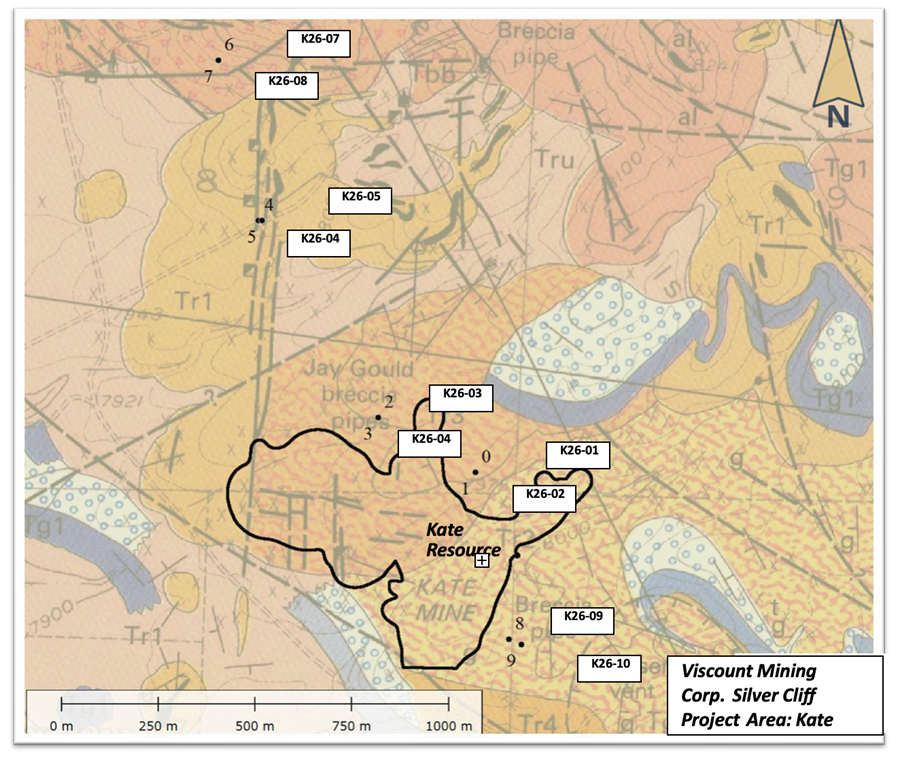
Figure 1. Silver Cliff Project drill hole location and geologic map showing holes proposed far north and around the Kate Resource area.
Drill Program Highlights
Comments from the Project Geologist
“The rock looks very promising,” said Christina Ricks, Project Geologist on site at Silver Cliff. “This is exactly what we hoped to see at this stage of the program. Across the holes drilled so far, the core is showing the hallmark visual signatures we associate with well-mineralized rock at the Kate Silver Resource. Our previous KSR drilling demonstrated that the Tr2 and Tr3 rhyolites can host high-grade silver, including 3.0 meters of 2,330 g/t and 1.5 metres of 3,280 g/t. The 2026 program is drilling that same stratigraphy, we are logging the same alteration assemblage that has accompanied silver mineralization in our prior campaigns, and we are trying to expand the resource in three directions. We now look forward to laboratory assays.”
Why This Matters: The Tr2/Tr3 Host Stratigraphy at Silver Cliff
The Silver Cliff district is one of Colorado’s historic silver camps, with documented high-grade production from the Tr3 rhyolite unit dating back to the late 1800s. The historic Geyser vent, where a shaft was sunk to 2,100 feet in the 1890s, sits immediately west of the K26-09/K26-10 collars. Viscount’s own modern drilling has confirmed that both the Tr2 and Tr3 units host high-grade silver mineralization, with the highest grades returned to date coming from Tr2 — the porcelaneous, vuggy unit that sits stratigraphically above Tr3.
The geological signature of mineralization at Silver Cliff is well understood: manganese-oxide alteration is a reliable visual indicator at the deposit scale, because manganese commonly co-precipitates with silver-bearing chlorides, bromides and sulphide minerals in breccias, matrix fillings and vuggy zones in this rhyolitic volcanic setting. The coronadite, manganese-oxide-rich fractures, limonitic staining and breccia-hosted oxide assemblage observed in the 2026 holes match the visual character of mineralized intervals returned by Viscount’s prior drilling. Table 1 — Significant Historic Intervals from Viscount’s KSR Drill Program (Tr2 and Tr3 Rhyolite Hosts)
A summary of all notable Viscount KSR drill hole intervals returned prior to the 2026 campaign. All intervals listed are hosted in the Tr2 or Tr3 rhyolite units — the same stratigraphy being drilled in the current program.
Table 1
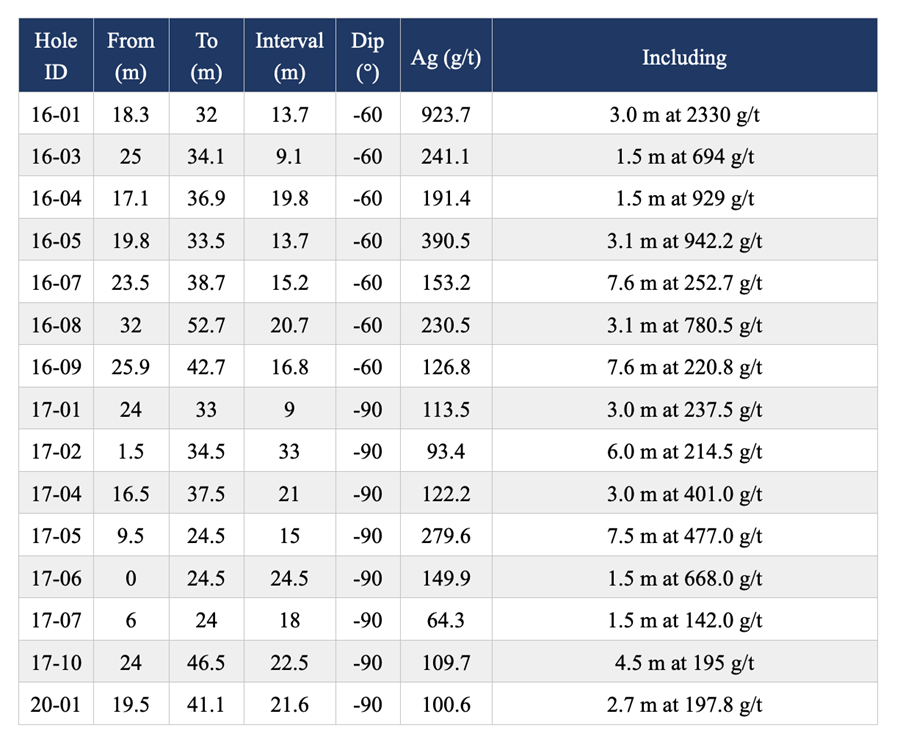
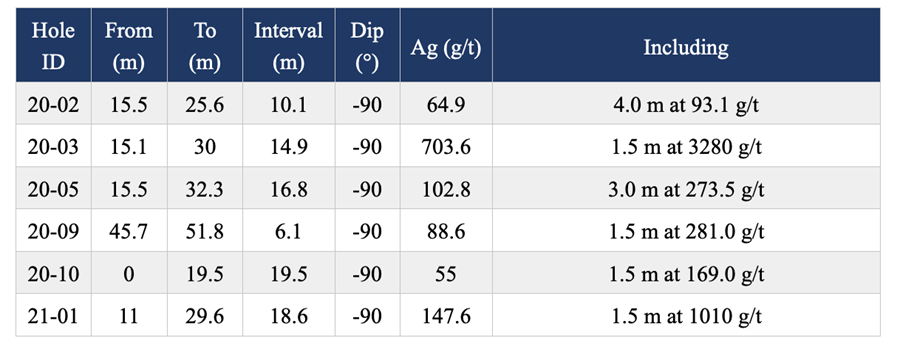
Note: Intervals reported above are core-length intervals; true widths are not known. Historic data is sourced from Viscount’s prior KSR drill campaigns (drill years 2016, 2017, 2020 and 2021, denoted by the leading digits of the Hole ID).
Project Geology
The Silver Cliff Project lies within the Wet Mountain Valley, a fault-block basin bordered by the Sangre de Cristo Range to the west and the Wet Mountains to the east — both uplifted by significant Laramide and later Cenozoic faulting. The project area overlies a large caldera and porphyry-system complex with both precious and base metal potential, hosted in a heavily eroded Tertiary-aged rhyolitic volcanic center comprising numerous overlapping flows, plugs and dikes (mapped by W. Scharp, USGS map I-1081, 1971) that are partially concealed by Pleistocene gravels. The Tr2 unit sits stratigraphically above Tr3; both have hosted silver mineralization in Viscount’s drilling, with Tr2 returning the highest historic grades in the district.
Next Steps
Quality Assurance/Quality Control Measures, Chain of Custody
All Viscount’s drilling to date has been core. The Company has implemented a rigorous quality assurance/quality control program at the Silver Cliff project. Core is retrieved from the drill site to a locked storage facility, where it is logged on site by Christina Ricks, project geologist, and then cut by independent geologists. Half of the core is bagged, and standards, blanks and duplicates are frequently inserted into the sample stream. These are then boxed and shipped via USPS to Skyline Labs in Tucson, Arizona for sample preparation and analysis. Pulps and rejects will then be retrieved and stored with the split core at the Company’s locked facility.
Qualified Person
The scientific and technical information contained in this news release has been reviewed and approved by Harald Hoegberg, P.G., an independent consulting geologist who is a “Qualified Person” as such term is defined under National Instrument 43-101 — Standards of Disclosure for Mineral Projects (“NI 43-101”). On-site geological logging and field supervision of the 2026 program is being conducted by Christina Ricks, project geologist. Visual descriptions of drill core are qualitative observations only and are not a substitute for laboratory assay data. Mineral identifications made in hand-specimen are subject to confirmation by laboratory analysis. Readers are cautioned that mineralization observed in drill core may not be representative of the deposit as a whole, and that assay results, once received, may differ materially from visual estimates. Historic results are not necessarily indicative of mineralization that may be returned by the 2026 program.
About Viscount Mining
Viscount Mining Corp. is a project generator and mineral exploration company focused on advancing high-quality silver, gold, and copper assets in the Western United States. The Company’s portfolio includes the Silver Cliff silver project in Colorado and the Cherry Creek multi-metal district in Nevada.
Silver Cliff Project — Colorado
Silver Cliff is in the historic Hardscrabble Silver District and comprises 96 lode claims with year-round paved access and established local infrastructure. The project covers a large volcanic caldera system recognized for its silver, gold, and base-metal potential.
The property includes two principal zones of focus:
Cherry Creek Project — Nevada
Cherry Creek covers 219 unpatented and 19 patented claims in a well-known historic mining district approximately 50 miles north of Ely. The property includes more than 20 past-producing mines and hosts several styles of mineralization, including silver-gold veins, carbonate-replacement (CRD) zones, jasperoids, and porphyry-related alteration. The district is 100% controlled by Viscount and is considered highly prospective for multi-metal discoveries within the broader mineralized system.
Broad Gold Mineralization Starts at Surface, Returning 1.86 g/t A... READ MORE
Lithium Africa Corp. (TSX-V: LAF) (FSE: 6MQ) (OTCQB: LTAFF) is pl... READ MORE
Drilling also returns 134.0 m of 0.65 g/t Au in the Lower Domain;... READ MORE
Copper Road Resources Inc. (TSX-V: CRD) is pleased to announce th... READ MORE
Brunswick Exploration Inc. (TSX-V: BRW) (OTCQB: BRWXF) (FRANKFUR... READ MORE