






Rick Mills, Editor/ Publisher, Ahead of the Herd:
Torr Metals has a fully funded 6,000-metre drill program starting almost immediately.
Malcolm Dorsey, CEO, Torr Metals:
It’s the start of our first drill campaign of the year. The field crew, the geos are out there lining things up right now. And then drills will start turning. The drills are close, they are in Logan Lake right now. Just need to get them out into the field, which is not a far way to go.
RM: You always do Induced Polarization (IP) with electrical or resistivity surveys so tell us about the survey results coming out of these targets.
MD: That’s a good question. I think the geophysics here is quite important for what we’re seeing and for also understanding what the regional context is for the geophysics. Because geophysics for porphyry systems or even other types of systems, they’re not always the same. You can’t take them from one region to the next.
You really need to understand what you are expecting to see locally, what kind of results would that produce. In this area, southern British Columbia and the Southern Quesnel Trough, the geophysical anomalies overall, to anybody who’s familiar with the regions, we would describe it as subtle. So, it’s important to really be able to pick out these subtle differences between the rocks.
So, what we’re seeing and what I’ve outlined in the news release is three important signatures in terms of the geophysics. We’re looking at magnetism, we’re looking at resistivity, and conversely with resistivity, you get an idea of what the conductivity is. And then we’re looking at the chargeability of them.
What does all that mean? And then what is the context regionally that we’re looking at? For that, I’ll be talking a little bit about New Afton again. It’s not saying that Bertha North is New Afton. It’s just that we’re seeing certain geological and geophysical characteristics that are analogous. What we’re seeing in the geophysics, one of the main takeaways here in the news release that you’ll get to see is that what we get in the geophysics seems to agree with what we see at surface. That there’s an upper oxidized expression.
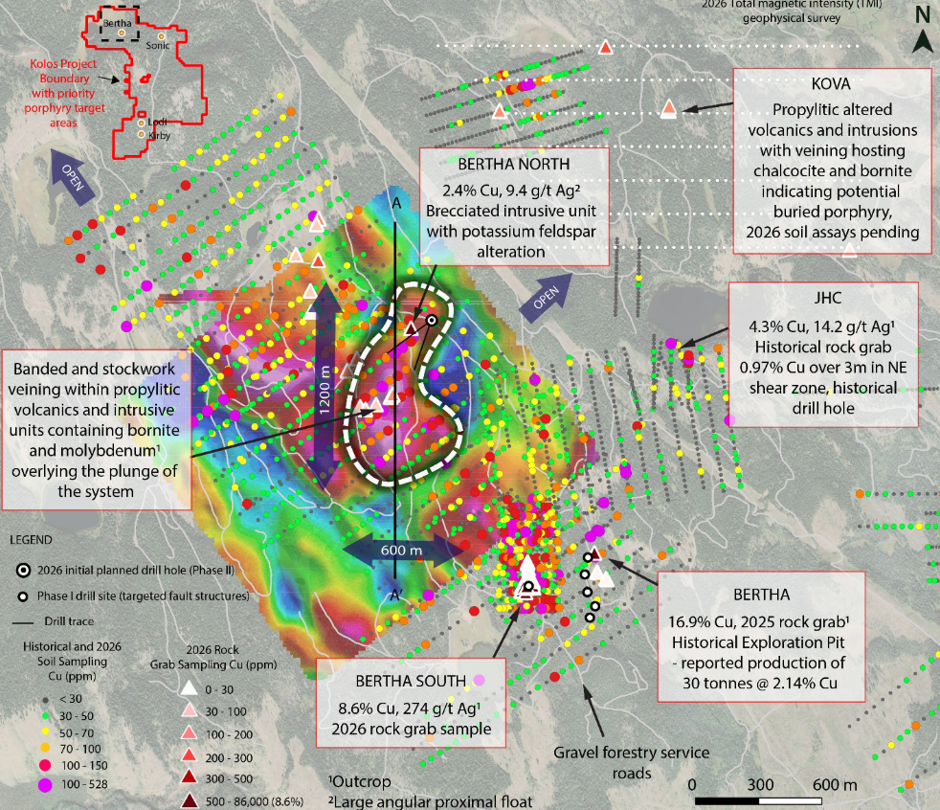
This is what we could call supergene oxidized weathering, similar to what we found in phase 1 of drilling that we reported the results on early this year. But what does that look like in terms of the geophysics? Because of the alteration that’s taken place, you’ve removed, stripped out a lot of the characteristics of the sulfides that would have been chargeable. What remains is the competent oxidized intrusive host with remnant potassic alteration based on surface observation and geophysical interpretation.
There’s still sulfides within it. We know that with the strong coincidence with our soil anomaly and surface mineralization that we’ve come across. But similar to our phase 1 drilling those sulfides would likely be more dominated by native copper, although you will have remnant chalcopyrite and bornite based on surface observations.
With this setting you don’t get as high a chargeability response, more typically 7 to 15 millivolts per volt in this region. It would also be more moderately resistive in the 400 to 500 ohm metres indicating the intrusive rock, altogether in the upper portions these overlapping signatures define a moderately conductive cap of oxidized supergene weathering.. What’s interesting is it also overlies an increasing chargeability anomaly getting above 10 mV/V.
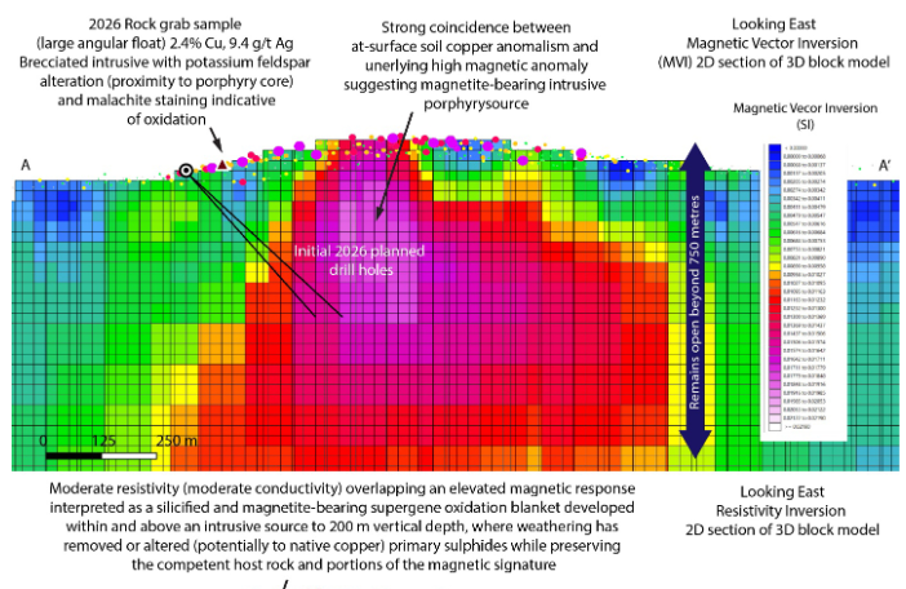
That chargeability anomaly we see as potentially the preservation of the original hydrothermal alteration and mineralization, referred to as hypogene, likely composed of chalcopyrite and bornite, which does occur within the supergene zone but as a minor remnant component, having mostly been altered through oxidation and reprecipitated as native copper.
But it’s good to see those remnant specks of chalcopyrite and bornite mixed in there with the veining and the intrusive units at Bertha North as it supports the model.
If you look at the actual millivolts over volts, what does that come out to? What’s interesting is in this area, when you see chargeabilities, it’s not like other porphyries that you might see in British Columbia, where a lot of guys will talk about higher chargeabilities as being prospective. Often in those other regions, if you get over 20 millivolts per volt, you’ll end up in a very pyritic zone. So that will be your phyllic envelope around a porphyry core.
I do want to reinforce that understanding chargeability and its regional implications is important, often you will see plenty of the industry saying being over 20 millivolts per volt is key, but all that speaks to is sulphide abundance, not necessarily the right sulphide. In my experience being over 20 is more often than not a pyrite-rich phyllic zone or abundant magnetite, with the prior being a useful vectoring tool.
Keep in mind not all regions are the same and down here in the southern Quesnel Trough, you want to see lower chargeability. For core targets it’s better if you’re seeing between 7 to 20 millivolts per volt. Anything higher than that is not necessarily a viable target.
That is exactly the range that we see here at Bertha North.
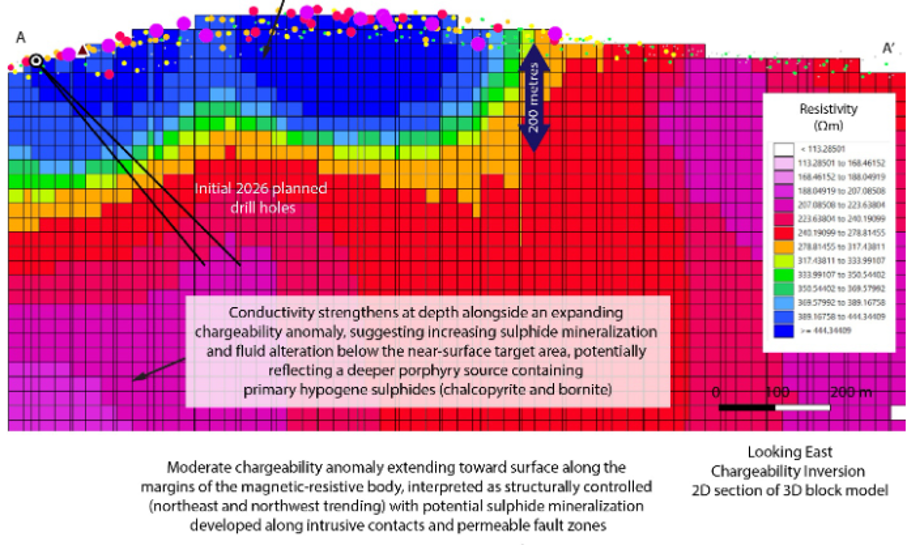
It’s interesting that overlying that chargeability anomaly is the magnetic anomaly, which is high enough to indicate the intrusive unit itself as it’s magnetite-bearing. As well as you’ve got that resistivity. The resistivity is in the realm of an intrusive body, which we’ve confirmed at surface. But over all it’s more of a moderate resistivity, which means you still have sulfide content within there that is conductive.
So, it’s moderately conductive as well, which certainly makes it a very prospective intrusive resistivity anomaly. All that together really gives us an excellent vectoring tool. We’re going in here, making sure that we’re testing within these first couple of holes, not just the resistivity anomaly, but also the conductivity, the magnetism, and the chargeability are all covered within the first two drill holes that we have planned here.
I suspect we’re going to see potentially the most prospective area ending up in the Boundary Zone, where you have the interface between the chargeability and the magnetic anomaly would be my theory, but we’ll see how that goes with the drilling.
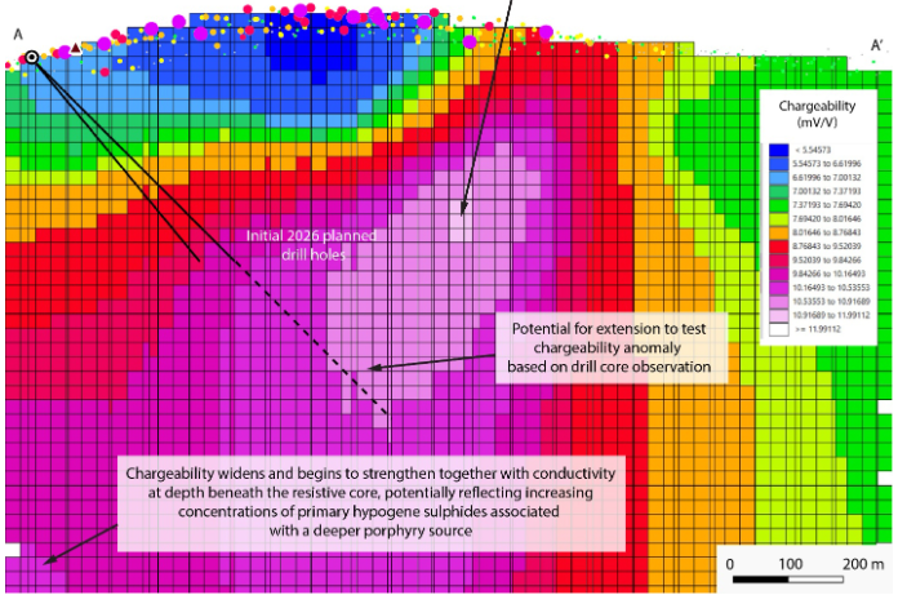
With these being the first drill holes in this target area, it’s important to drill through the Boundary Zone as well. So, there is another hole planned there that will charge right through that chargeability.
We know the geochemistry confirms that there’s mineralization here and it’s strongly coincident with the signatures we’re looking at, but we don’t quite know exactly which margins or portions of the signatures themselves are going to be the most prospective. So that’s why it’s important to drill through the entirety of it if possible.
RM: Okay, I just want to explain to the readers that we talk about New Afton mineralization. This type of mineralization is is extremely rare in British Colombia. It’s almost unheard of.
We’re not saying we have a New Afton deposit, similar size or anything like that. What we’re saying is we’re chasing that particular style of mineralization.
MD: That’s what intrigued me about this area in the first place, was that we were seeing the right geochemical units. Like the picrite unit that I’ve talked about before, it’s not only good for defining where your major regional northwest structures are, but it’s also an excellent geochemical reactor. Because of the high iron content, it will react with all of these oxidized fluids. And it’s part of the reduction process that would create native copper. That was the theory going into our first phase of drilling that we did around the Bertha area. We saw native copper at surface.
So, the question was, is this just an isolated occurrence? Or is there something substantial within these systems? That’s what we discovered in phase one. So that was discovery drilling. We confirmed there’s abundant native copper.
It occurs in multiple discrete intervals. We also confirmed that it ended up being within largely a structural leakage zone. But then the question became where is the source to all this hydrothermal native copper that we saw? It went down to 580 meters vertical depth, which means these structures are long-lived. They’re active. They allowed oxidized fluids to permeate down that deep over a long period of time, which means a long time as well for the chemical reaction of these fluids. The question was where do we move to target the source? Our objective has shifted for this phase 2 of drilling.
Now we’re targeting what we see as the highest potential to be that source area for the large amount of native copper that we found. It is important to showcase that native copper is not what you usually find in BC porphyry systems. It really is just New Afton that has that feature within the upper supergene resistive cap.
So that’s what we’re looking for in this next phase of drilling. It’s important to reinforce that that we’re using New Afton as a concept model, which is the standard approach for exploration, you have to look around and ask what exactly are we looking for and what characteristics might find something similar?
RM: We’re going to be drilling by the end of this week, the start of a 1,500-meter drill program.
MD: Yes. We’re building off that phase 1, we know more of what we need to see in these first couple of meters of drilling to confirm whether our theory is correct. As we move towards the center of the system, what we would expect is stronger potassic alteration and brecciation all within a large evolved intrusive complex.
This is something that we’ve already confirmed in rock grab samples at surface is that this exists in the Bertha North area. We’ll also be looking for increasing sulfide abundance and more of those intrusive phases, confirmation that we’re into the main body of the intrusive complex.
And then as you get deeper, you would expect to see more chalcopyrite and bornite. So unweathered copper sulfides. This would be confirmation of the geophysical model that we’re looking at here.
If the resistivity anomaly is demonstrative of a supergene oxidized weathering cap we’ll be drilling about 200 meters vertical depth.
Underneath that, it looks like if we want to test the entirety of the flanking chargeability anomaly, we could do some drilling up to 600 meters depth. We’ll see as we go along. We’ll initially start with 200 to 300 meters depth on the drilling.
And then based on what we’re seeing, we’ll determine whether or not we should go deeper.
RM: I’m looking at your news release and I’m looking at the moderate resistivity. It’s clear where you’re putting the holes.
Also, that it’s 200 meters vertical depth. The bottom one shows a deeper porphyry source containing primary hypogene, chalcopyrite and bornite, which is what you’re talking about if you went a little deeper down to 600 meters.
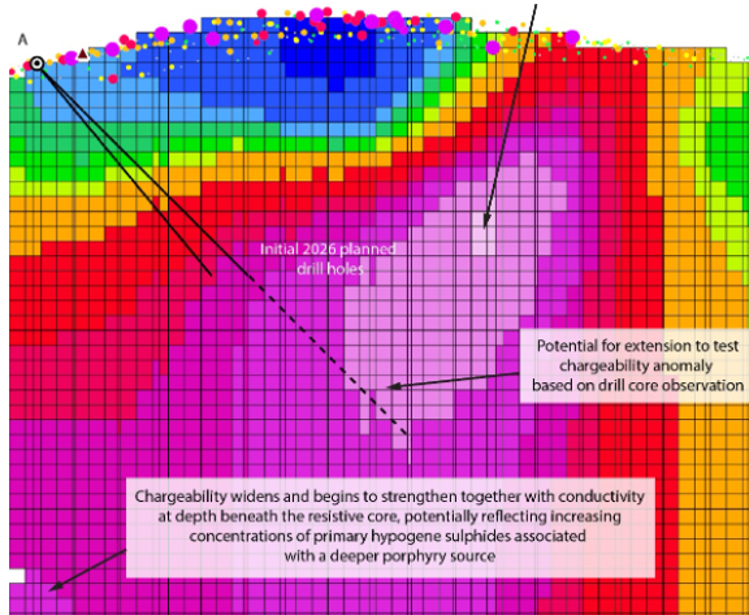
MD: Yes. We’ll have to see what’s coming out within that first 200 to 300 meters. If we’re seeing evidence of that transition zone, so if we see supergene-style within that first 200 meters or so, and then we start to see a transition into an underlying hypogene-style, then we’ll push it a bit further as we should really test in that case the chargeability anomaly itself. But with the geophysics, we’ll have to see what the interplay is between all the different characteristics that you see and what interfaces between those different signatures prove to be the most prospective zones.
This is the first ever drilling of this target, it’s brand-new and as such we need to advance methodically with drilling.
RM: New Afton had 100 meters surface expression. It’s very hard to find 100 meters, even targeting with the knowledge we have from the surveys. It’s almost like finding a needle in a haystack, isn’t it?
MD: Yes, in this area it’s a low-lying, rolling topography, which is fantastic for working in year-round. But this is due to the glaciers that came through this area and ground everything down, leaving in our case a very thin glacial till veneer which has obscured most of the area leading to it being largely underexplored.
RM: It’s basically impossible to find information on Afton because Teck had it, didn’t know what they had underneath, let it go, it got picked up, and it was a model that this company was working on that broke it wide open. There’s not a lot known about what’s going on in New Afton with New Gold (TSX:NGD) and now Coeur (TSX:CDE). It’s just not a well-known model at all.
MD: Yes, it is mostly private proprietary information. There’s not much publicly available, even in terms of the geophysics. The last IP geophysical study you can publicly get your hands on for New Afton is from the 1960s.
It’s closely guarded, one of the only studies we have to work with is a magnetotelluric survey published in 2021 which indicates resistivity is key to both the supergene and hypogene ore bodies, although its relation to chargeability is not disclosed. It’s certainly a unique system. The initial findings indicated that the grades were decent for the time, but the size of it did not look very enticing with the grade.
So, with that, you had the mining at the supergene zone in the 1970s at New Afton, and then it largely sat there. The understanding just wasn’t there that this system could have some very high grades that continued just underneath that supergene cap. Really, that is what led me to a greater appreciation for this style of system.
RM: I think there’s something important about 2025 results readers should know.
Newmont’s Saddle North Project has a cutoff grade of 0.13% copper equivalent. North Island for their deposits, use between 0.1% and 0.18%. Copper Creek’s project uses a 0.14% copper-equivalent. Osisko, for its Gaspe Copper Project, has a cutoff grade of 0.13%. That’s copper-equivalent also. And the Schaft Creek Joint Venture uses cutoffs of 0.11% to 0.15% CuEq.
I want to bring this up because it wasn’t that long ago you told me what some of the native copper intersections graded last year.
Would you mind telling me that again?
MD: Where we had concentrations of native copper mineralization, it ended up being within multiple discrete occurrences, about 68 separate discrete intervals. The higher grades did get up to about 0.44% copper and we had plenty of 0.1% to 0.2% copper as well.
That was only the native copper assays, not CuEq or other mineralization. So, it certainly speaks to the fertility of the system.
RM: When you were classifying an area as native copper, what percent or weight did you use? Was it like 0.5% or what did you use to figure that out?
MD: That’s another important factor here is that when we were working it out, there was no baseline to work with because there was no other previous drilling done in this area. We were trying to figure out what abundance of native copper do you need within the core for it to produce economic grade? I would say it ended up being fairly consistent but you need generally 0.5% cutoff in native copper abundance in the core as it was certainly producing some decent grades.
Now that we have a better idea we can certainly go back to phase 1 results if we encounter native copper and potentially if we get higher concentrations of it, we’ll have a much better idea now of what kind of grades those might produce once the assays come back, which together with XRF analysis will help direct drilling in real time.
RM: Yes, because of drilling last year and matching up what you saw and have pictures and assays of you’ll have a base to compare.
MD: We’ve got a greater understanding of what host rock we need to see, what alteration, what styles of veining, as well as what type of mineralization and abundance of native copper is needed.
RM: It doesn’t seem to take a lot of native copper to pop an assay. But is it realistic to be as excited about supergene native copper in BC as say South America?
MD: No, and that’s a good point. Something that I’d like to reinforce is a lot of people who might be a little more familiar with supergene systems, they might jump immediately to supergene enrichment like what you might see in South America.
That’s not the case here in BC. It wasn’t the same environment. It’s still supergene weathering. You get native copper developing, but it’s not enriched.
But it’s good to see the native copper because it confirms by its abundance, that our analogy that this looks like a New Afton-style system continues to hold.
RM: If you were talking to an individual or a group at one of these shows or institutional meetings, what would you tell them would be their reasons to invest in Torr Metals right now?
MD: Well, I think right now, number one, it’s our strategic location.
If you look throughout all of British Columbia, where the copper miners, the major miners are concentrating and hold hard assets, it’s in the Southern Quesnel Trough where we are. We have nine major mining neighbors around us. There’s several operating copper mines.
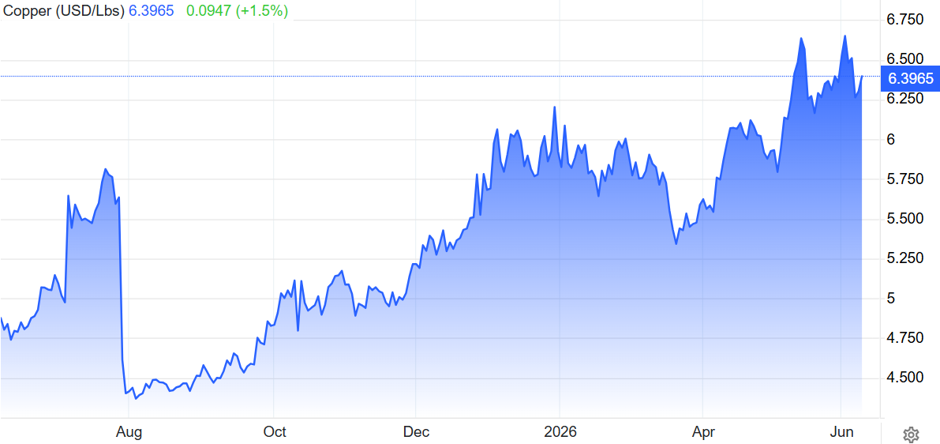
Those copper mines have near-term needs for feed. And these majors are investing billions of dollars into not just the mining infrastructure, but also M&A in the area with the recent acquisition of New Gold by Coeur Mining. Adding on to that, I’d say the most important difference between 2025 and 2026 is we’re no longer asking whether Bertha hosts copper mineralization.
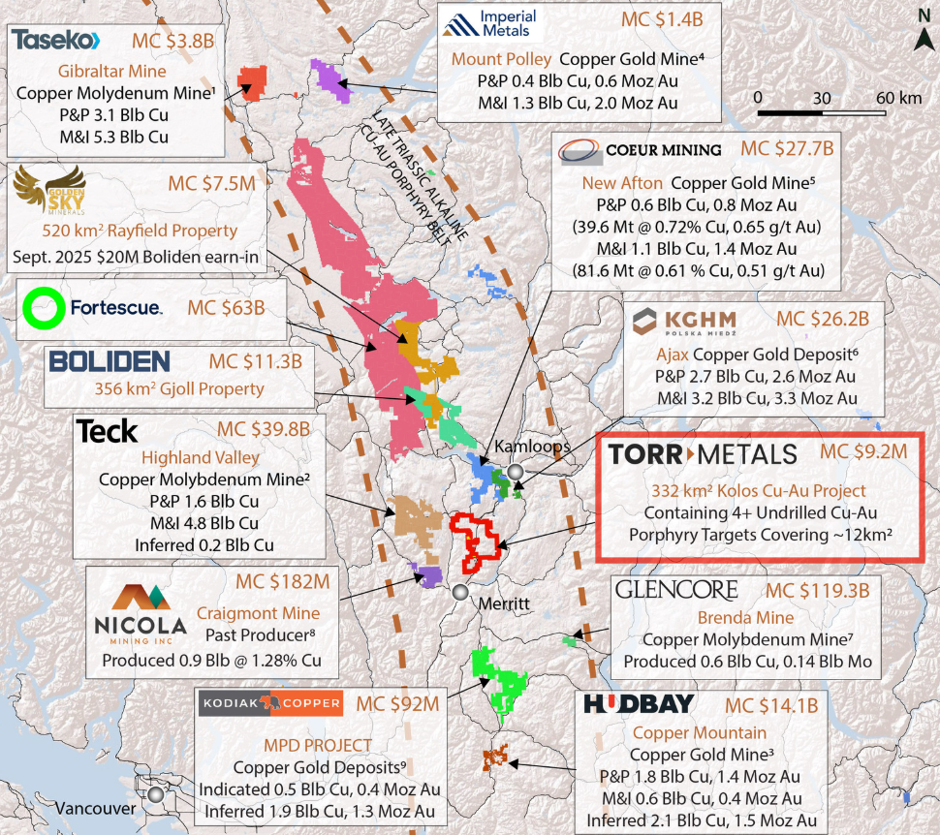
We already know that it does. So now the question is, we’ve identified what we think is the intrusive source. We’re going to go and drill it.
We’ve got the funding in the bank to drill up to 6,000 meters, which is more than enough needed to define a potential New Afton-style system. And Bertha North is the strongest target we’ve seen to date for answering that question.
RM: Okay, Torr is going drilling, it’s the start of a 1,500-meter drill program at Bertha North this week.
Thanks for doing this, Malcolm. We very much appreciate it.
MD: Thank you, Rick.
Subscribe to AOTH’s free newsletter
Richard owns shares of (Torr Metals TSX-V:TMET).
TMET is a paid advertiser on his site aheadoftheherd.com
This article is issued on behalf of TMET
Legal Notice / Disclaimer
Ahead of the Herd newsletter, aheadoftheherd.com, hereafter known as AOTH.
Please read the entire Disclaimer carefully before you use this website or read the newsletter. If you do not agree to all the AOTH/Richard Mills Disclaimer, do not access/read this website/newsletter/article, or any of its pages. By reading/using this AOTH/Richard Mills website/newsletter/article, and whether you actually read this Disclaimer, you are deemed to have accepted it.
Divests US$13.5M McEwen Copper Debt to Further Enhance Liquidity ... READ MORE
Aura Minerals Inc. (NASDAQ: AUGO) (B3: AURA33) is pleased to anno... READ MORE
Montero Mining and Exploration Ltd. (TSX-V: MON) (OTC Pink: MXTRF... READ MORE
Barksdale Resources Corp. (TSX-V: BRO) (OTCQB: BRKCF) (FSE: 2NZ) ... READ MORE
Getty Copper Inc. (TSX-V: GTC) (OTCQX: GTCDF) is pleased to an... READ MORE