








If I told you I just visited a silver system extending 400 metres deep and 3.7km laterally – with further upside still – you’d think I was describing a billion-dollar mine on the level of Pan American’s Juanicipio.
Incidentally, the company behind this silver system is also located in Mexico, on the very ground where Peñoles – one of Mexico’s oldest and largest mining companies – mined high-grade silver in the 1890s.
And yet, the company presiding over this sizable, past-producing land trades at a mere ~C$240 million market cap – a decidedly stark undervaluation that, in my view, is unlikely to last very long.
How can I be so sure? Because I walked the project myself last month, kicking rocks, meeting the team, and getting a first-hand feel for the scale of what could become Mexico’s next great silver discovery.
Of course, I’m talking about Capitan Silver (TSXV: CAPT; OTCQX: CAPTF; FSE:2CD) and its flagship project, Cruz de Plata, located in Eastern Durango approximately 2.5 hours drive from the city of Torreón.
Naturally, I have plenty of exclusive insights to relay to Silver Advisor readers. So consider this your photo-packed guide to everything you need to know about Capitan Silver: A Mexican Silver Giant in the Making.
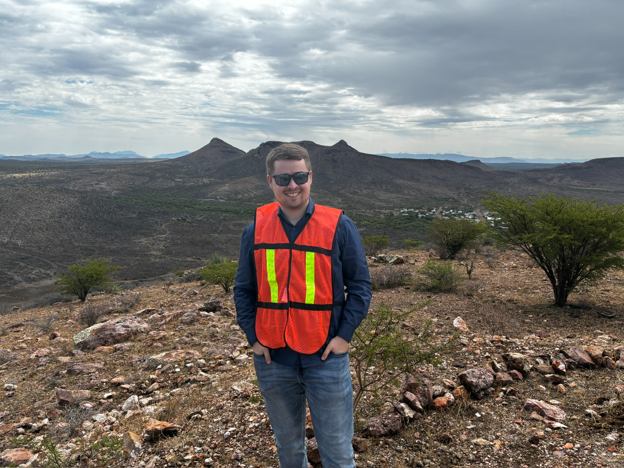
Yours truly on site at Cruz de Plata, atop the “Capitan Hill” area of the property.
Meet the Team
Any mining analyst worth his salt will tell you that the “people” aspect is equally as important as the project itself. So before we dive into the high-grade silver, let’s take some time to meet the Capitan team.
First up is Capitan’s Mexican-born CEO, Alberto Orozco. Based in nearby Hermosillo, Alberto brings over 30 years of Mexican mining industry experience, including a tenure as Exploration Director at Argonaut Gold, before it was ultimately acquired by Alamos Gold for US$325 million in 2024. At its peak, Argonaut built a valuation of approximately C$1.3 billion, after putting 3 mines into production on time and on budget. Therefore, given that Alberto helped drive this growth – most notably via the expansion and development of Argonaut’s +1 Moz Au projects: San Antonio, La Colorada, El Castillo and San Agustín – this is exactly the type of “green flag” we love to see when analysing management track records.
More broadly, Alberto is a respected figure in Mexican mining, as is reinforced by his 6-year tenure as Chairman of the Board of the Sonora Mining Cluster. Not least, he is a sharp geologist in his own right, holding a Masters in Geology with Honours from the Universidad de Sonora. A PhD Candidate in Earth Science from Dalhousie University, his research focused specifically on the geology of northwest Mexico and was published in the journal Tectonophysics.
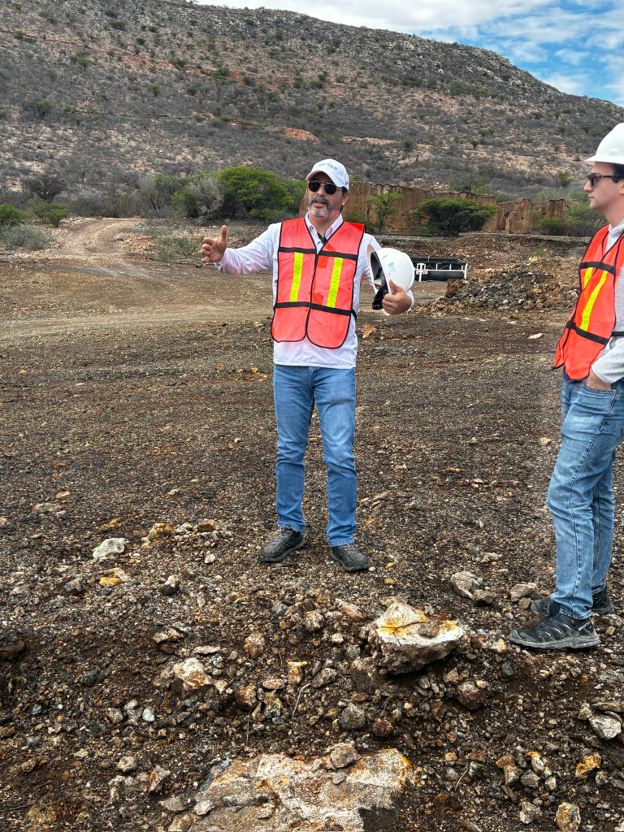
Capitan CEO, Alberto Orozco, flanked by the silver-rich Jesús María trend and some historic workings left by Peñoles.
Then there’s the company’s VP Exploration, Marc Idziszek. Holding an MSc in Geology from the University of Toronto, Marc comes from genuine mining pedigree. His uncle, Chet Idziszek, is a geologist who, in 1988, was credited and celebrated as the co-discoverer of what is today Skeena Gold and Silver’s Eskay Creek. Today, it is deemed one of the greatest precious metals discoveries in Canadian history.
Following in his uncle’s footsteps, Marc has spent two decades advancing projects from grassroots to mine-ready, most notably in Senegal as part of the team that delineated over 5 Moz of gold at the Sabodala project, now operated by Teranga Gold. Since September 2025, Marc has leveraged that experience to oversee Capitan’s four-rig, 60,000 metre drill program at Cruz de Plata (more on that later).
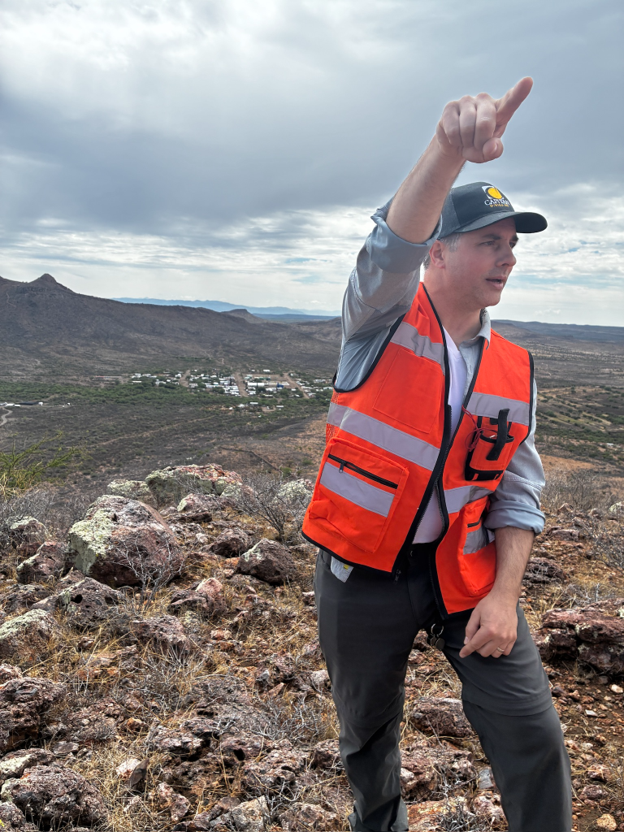
Capitan’s VP Exploration, Marc Idziszek, pointing in the direction we think the company’s share price is headed.
A further string to Capitan’s bow, Fernando Alanís Ortega – retired, long-standing CEO of Industrias Peñoles, Former President of the Mexican Chamber of Mines and Former President of the Silver Institute – serves as a Director on the company’s board.
In part, Alberto’s connections in Mexico helped with this coup. However, it was also Peñoles’ historic mining operations at Cruz de Plata, along with the project’s sheer scale, that enticed Mr Ortega out of retirement to partake in Capitan’s story.
Impressively, the standard does not drop among Capitan’s strategic investors and management, who account for ~70% of Capitan’s common shares, resulting in a notably tight share structure with less than 1/3 the shares outstanding of its peers.
Within that, one of Europe’s largest silver investors, London-based Jupiter Asset Management, holds ~16%, globally renowned mining investor and fund manager, Michael Gentile, holds ~11%, and $1 trillion asset manager, Schroders, holds ~3%. All three participated in Capitan’s landmark C$29M raise in December 2025, rounding out a robust shareholder base, which also includes 8% held by Construplan – one of Mexico’s largest and most respected privately-held construction and contract mining companies.
Introducing Cruz De Plata
During Alberto’s opening presentation at camp, I began to comprehend why many sharp individuals and institutions have been drawn to Capitan, given the immense progress made in such a short space of time.
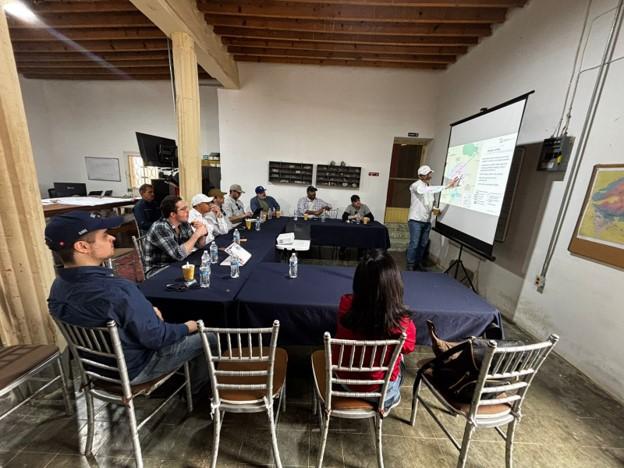
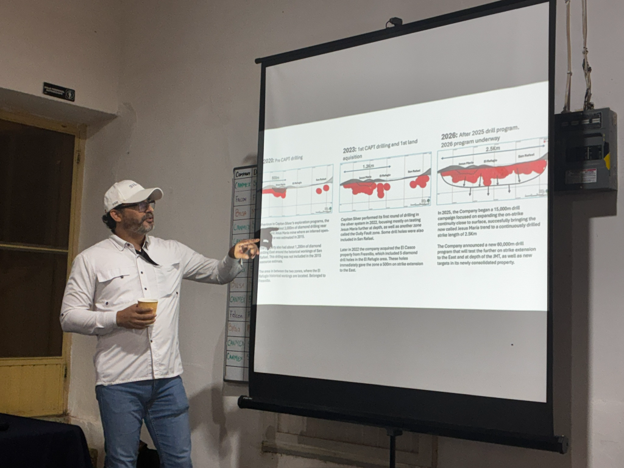
As Alberto illustrates here, Capitan’s Cruz de Plata project comprises of two distinct systems: 1) The Jesús Maria Silver Trend and 2) The Capitan Hill Gold Deposit.
Specifically, the Jesús María trend – which serves as the silver backbone of Cruz de Plata – only had a strike length of approximately 800 metres in 2020. However, at that point, a key portion of the mineralised trend known as El Refugio belonged to Fresnillo, with Capitan yet to drill a hole at the project.
Fast forward to 2022, Capitan struck a deal with Fresnillo to acquire the El Casco property, which included 5 diamond drill holes in the El Refugio area. In 2023, this paved the way for the company to drill and extend the mineralisation at Jesús María, bringing the continuously drilled strike length to 1.3km.
Since then, Capitan has effectively doubled the strike length of Jesús María to 2.5km – and up to 400 metres down-dip – after 25,000 metres of 2025 drilling connected the on-strike continuity across Jesús María, El Refugio and San Rafael. This was enabled by the strategic acquisition of seven additional concessions from Fresnillo in August 2025 for US$4 Million – half of which has already been paid.
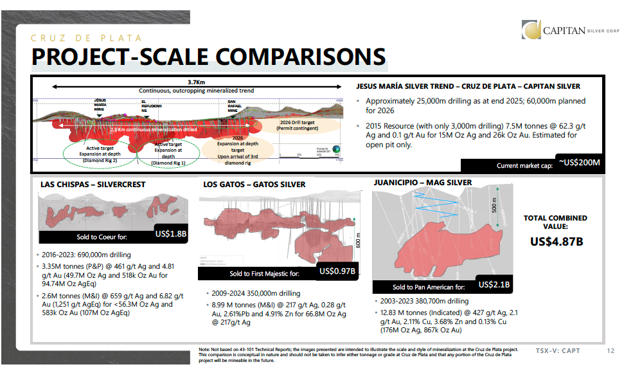
As a result, the silver mineralisation at Jesús María already rivals the scale of billion-dollar buyouts such as First Majestic’s Los Gatos, which spans roughly 1.8km along strike. And yet, the company believes the silver system could extend at least 3.7km laterally and 800 metres deep. Staggeringly, that would be near the depth of Pan American’s Juanicipio, with the key distinction that Capitan’s system begins at surface.
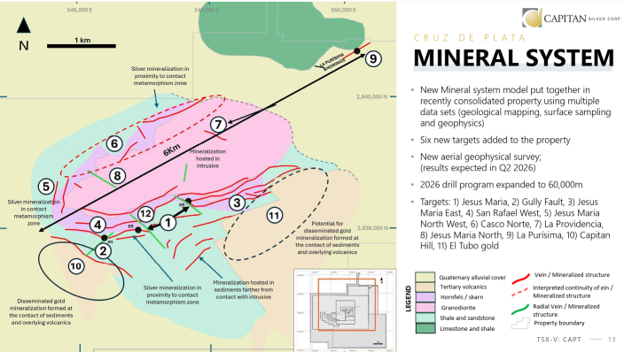
More broadly, there are at least 11 targets across 6km of strike length at Cruz de Plata for Capitan to test – a number that is expected to rise upon receipt of results from an aerial geophysical survey in Q2 2026, with the company ultimately targeting a cumulative 21km of mineralized structures this year.
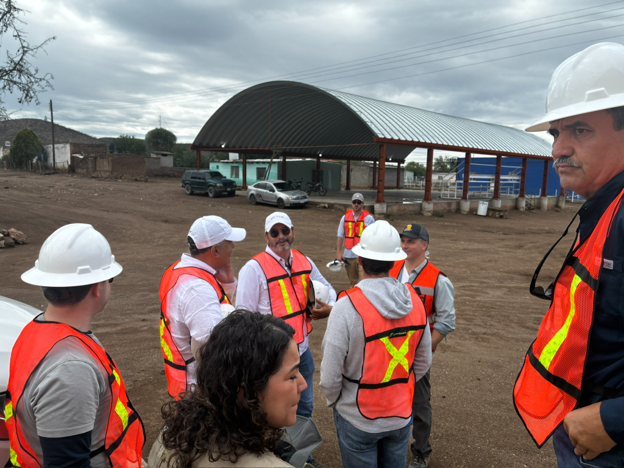
Eager to comprehend this scale in person – and the areas of Cruz de Plata being targeted as part of Capitan’s fully-funded 60,000 metre drill program – we geared ourselves up for the drive to site.
Capitan Hill: The Vantage Point
“Sometimes you have to climb the mountain to see the full picture” is an apt adage for Capitan Hill – the company’s pit constrained oxide gold deposit, which offers the perfect vantage point over Cruz de Plata.
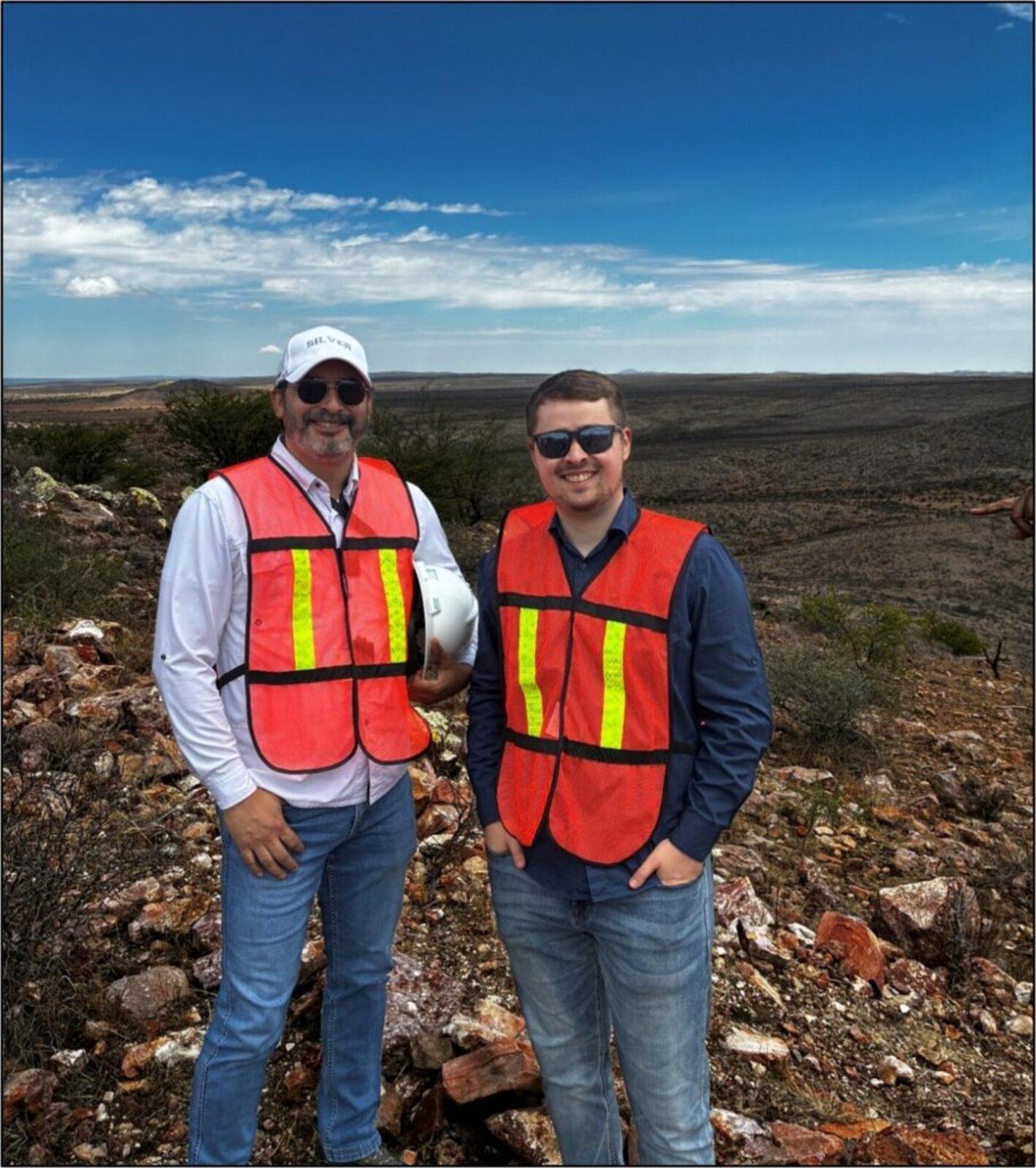
Boots on the ground at Capitan Hill with Alberto.
Right off the bat, it’s worth noting that Capitan Hill itself is not the company’s immediate priority. Although as of 2025, it does host a resource of 525 Koz of gold at 0.41 g/t across 39.8 Mt, including 4.24 Moz of silver based on ~19,000 metres of drilling. While premature, a historic resource which was published on a small area of silver trend in 2015 also exists, where a mere ~3,000 metres of drilling identified a small open pit containing ~15M oz of silver.
Furthermore, Capitan Hill bears a striking resemblance to San Agustín – an open pit oxide gold deposit hosting a reserve of 7.36 Mt at 0.29 g/t gold for 68 Koz, which recently began producing under Heliostar Metals in January 2026, with the expectation of 45 Koz of gold and US$40M in cash flow at US$3,000 gold.
That’s relevant because it was Alberto and his team who advanced San Agustín at Argonaut Gold. Not only that, but Capitan Hill is larger and higher grade than San Agustín. As a result, the deposit is a familiar – and potentially significant – layer of gold upside that complements Capitan’s silver-focused strategy.
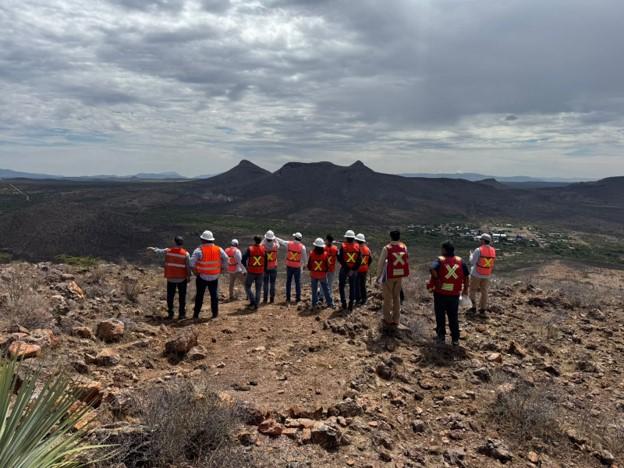
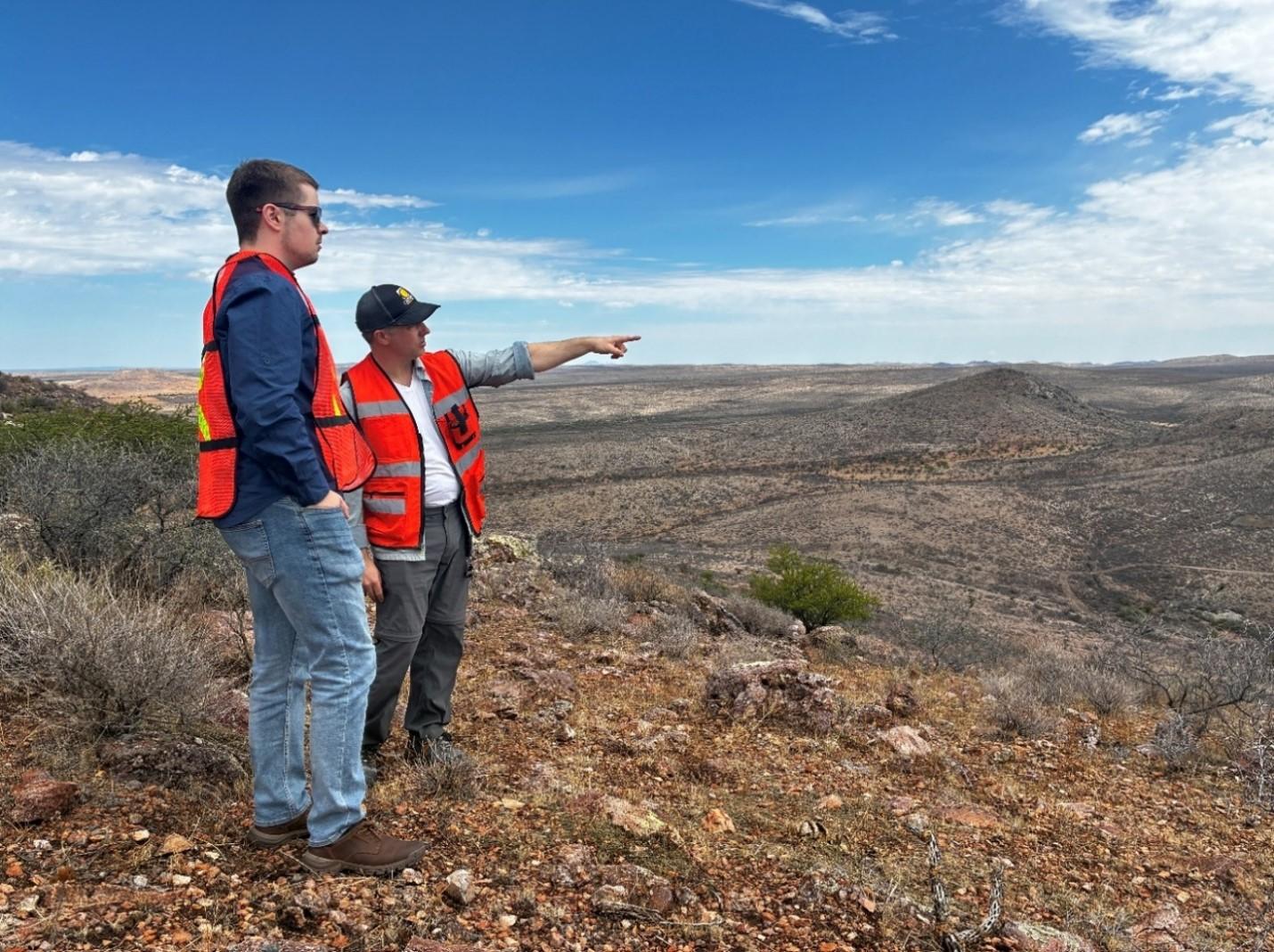
Jesús María: The Heart of Capitan’s Silver-focused Strategy
After observing Jesús María from afar atop Capitan Hill, it was time to get up close and personal with the geology – and what better way to do so than with the exposed trenches below?
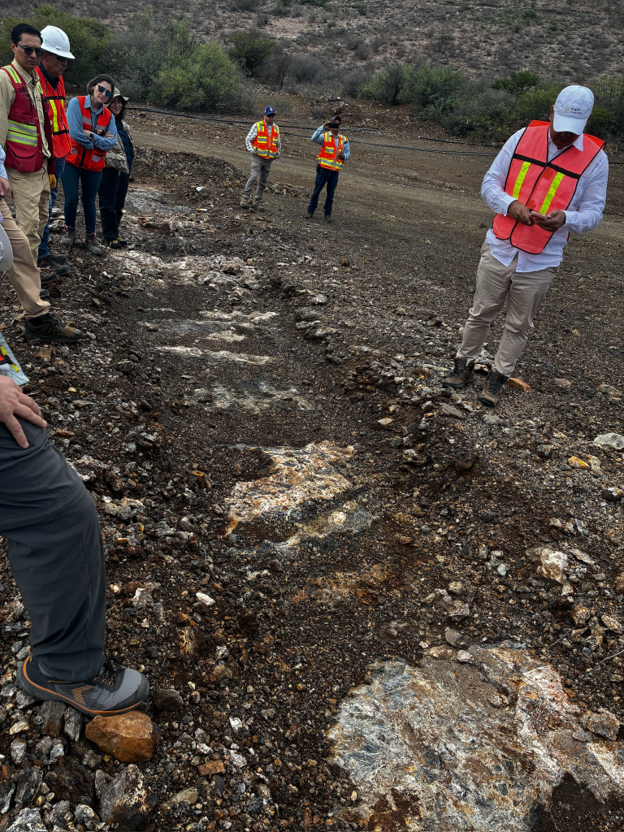
In technical terms, the trenches reveal brecciated sediments bearing classic calcite-siderite veining with base metals. When prospecting, these breccias are strong indicators of silver mineralization, and generally represent the upper portion of the hydrothermal system (base metal absent).
Later on, after a “pleasant walk” to an area of the property called Jesús María North, we observed similar breccia textures to what we saw in the trenches. There, the mineralisation mirrors the main Jesús María trend – i.e. the same distance from the granodiorite, the same east-northeast orientation – with the key difference being that surface exposure is notably more limited than on the main trend.
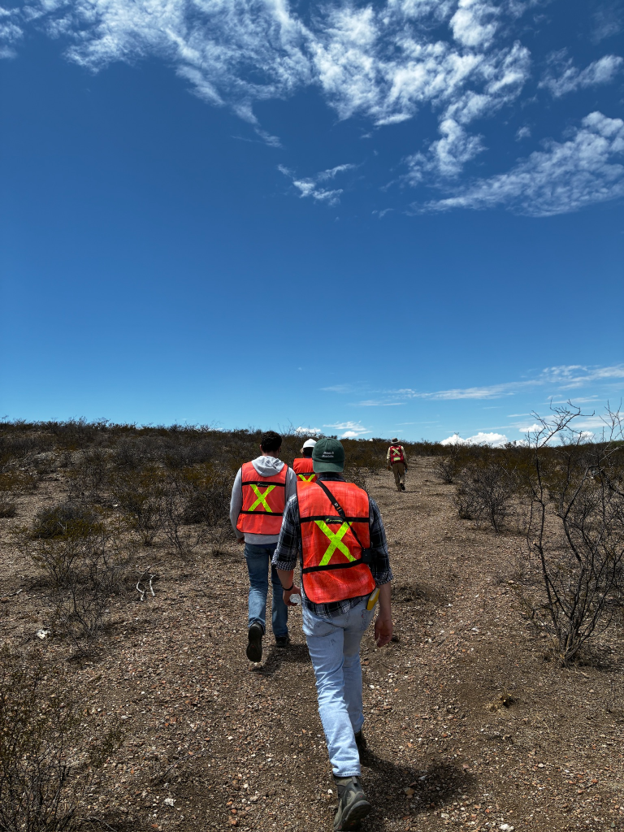
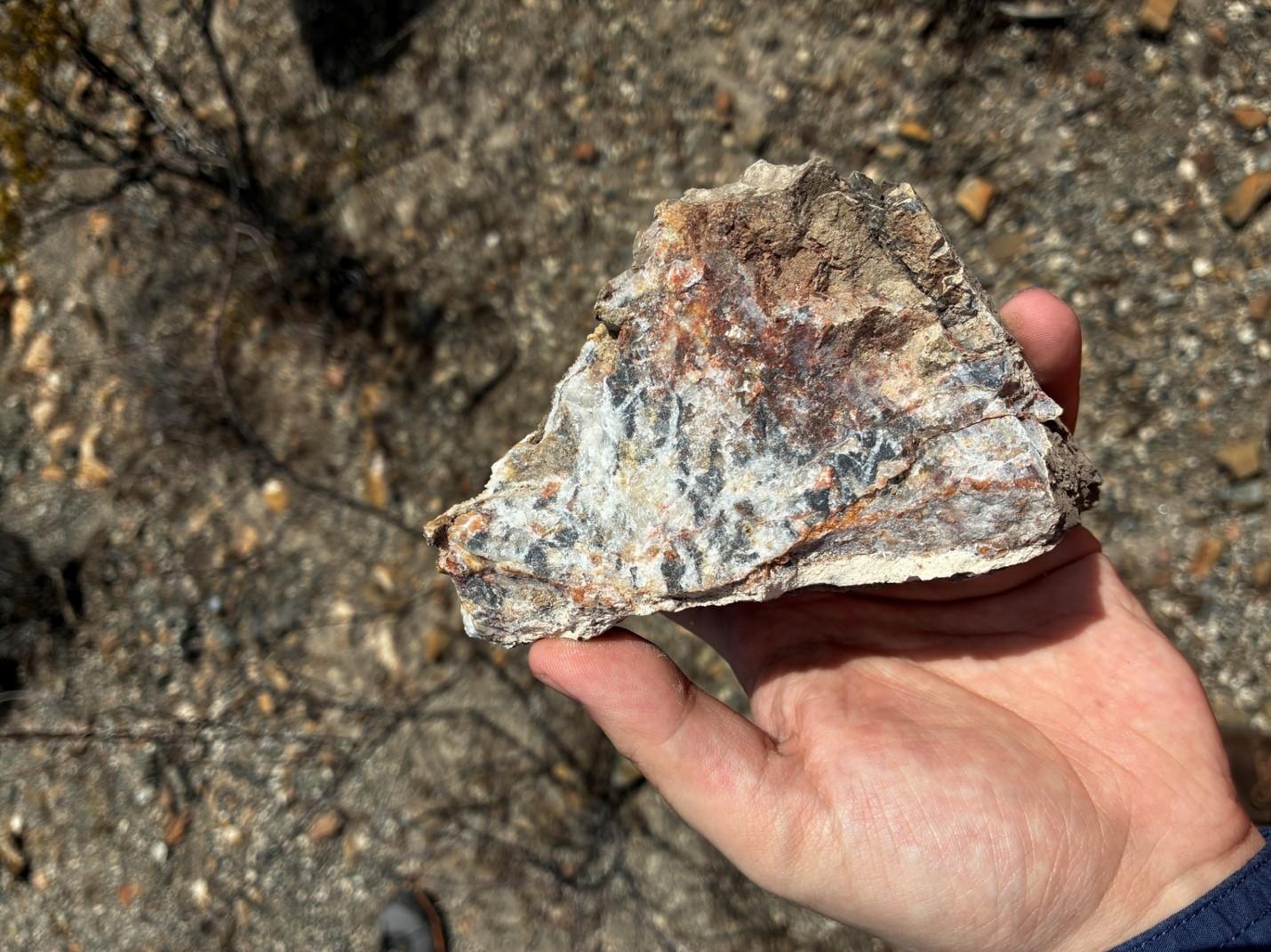
More breccia textures picked up from Jesús María North after a “pleasant walk”. I ended the day with 25,000+ steps which gives you an idea how pleasant it was. A good workout nonetheless!
Ultimately, the trenches help reveal the extensive continuity of the broader silver system at Cruz de Plata, while also speaking to the “low-hanging fruit” geology underpinning the Jesús María trend, with most of the high grade silver intercepts drilled to date falling within the upper 250 metres from surface.
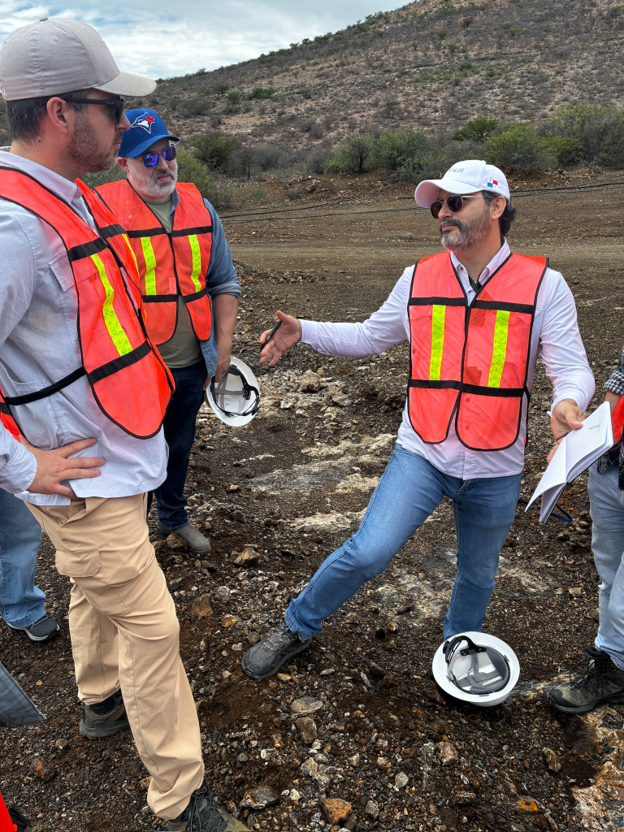
Alberto waving his arms about in true geologist style in the trenches of Jesús María.
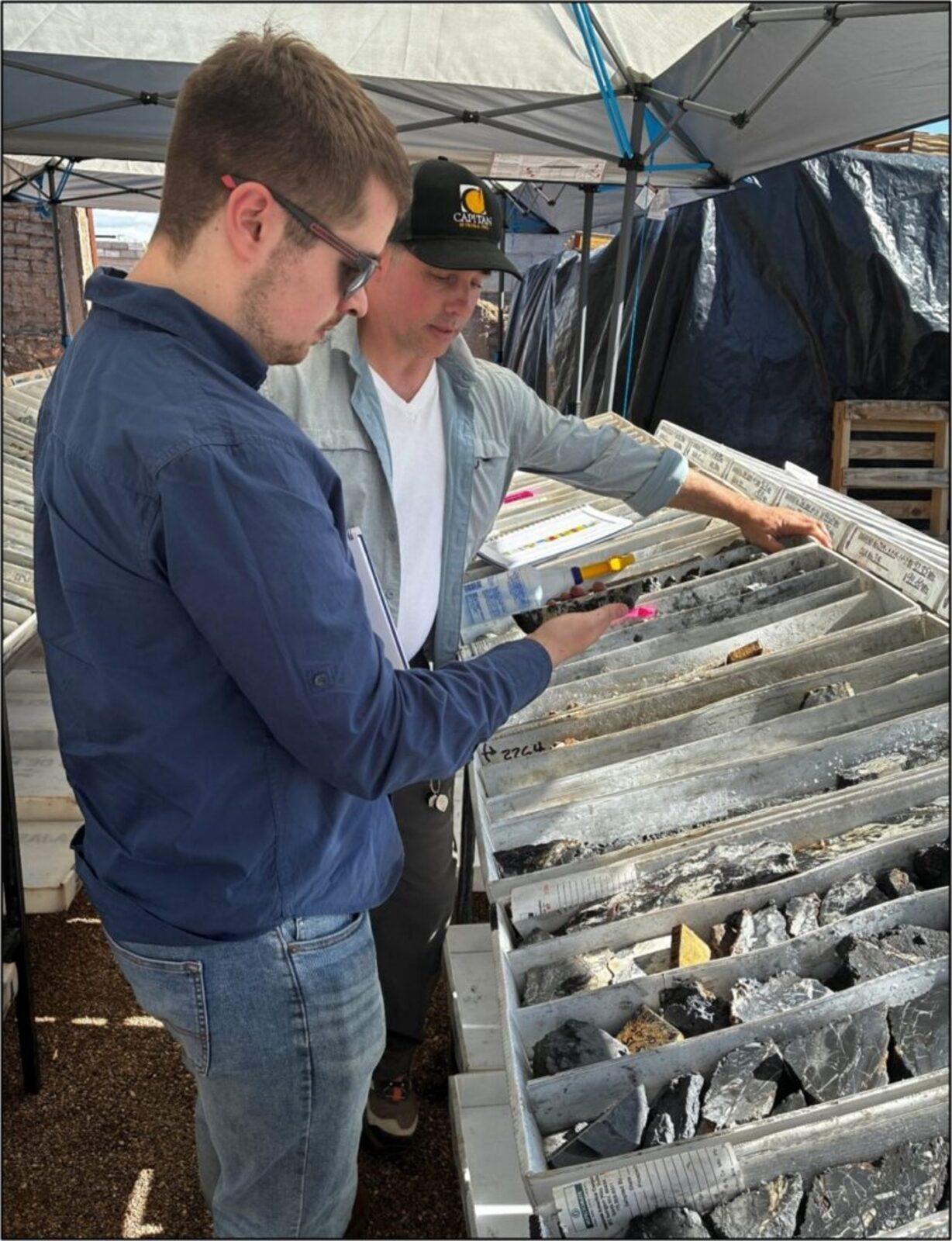
Case in point, the highest grade silver hole to date (JM-DDH-13-06) returned a broader 13.7 metre interval at 381 g/t AgEq, including a stunning 3,409 g/t silver over 0.9 metres – all from just ~80 metres downhole. Luckily, I had the pleasure of seeing this interval up close, as part of a core shack tour later in the day.
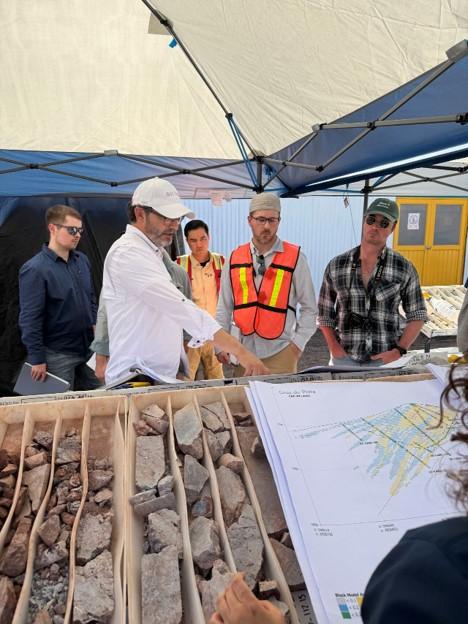
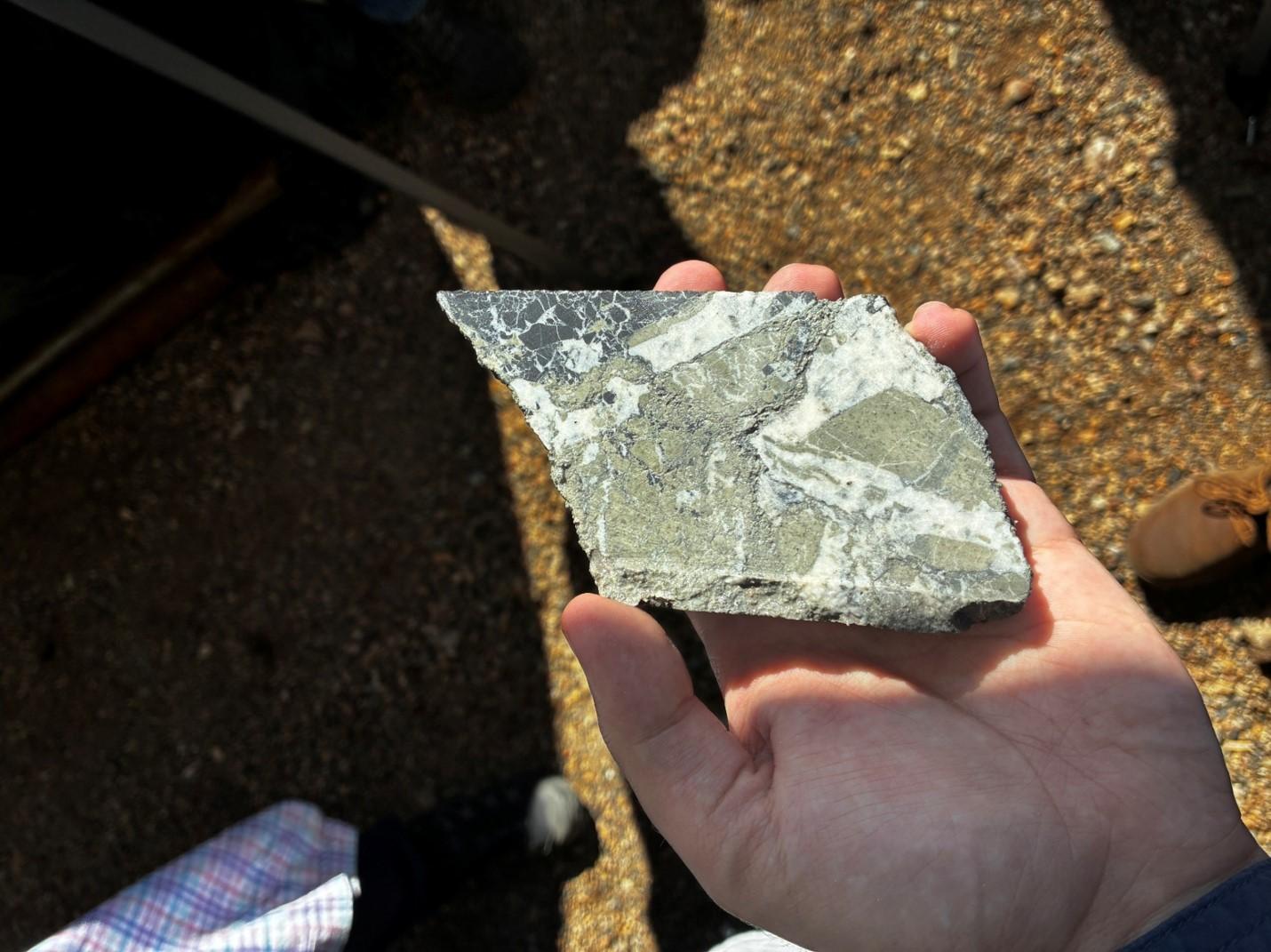
Image 1: Yours truly listening to Alberto articulate Cruz de Plata’s potential with fellow analysts. Image 2: THAT interval from hole JM-DDH-13-06. A semi-massive sulphide breccia of sphalerite (brown) and galena (dark grey), it’s typical of the polymetallic Jesús María trend and associated with high-grade silver and strong base metal returns.
More recently, May 2026 assays returned silver-rich highlights of 934.6 g/t AgEq over 1.3 metres, within a broader interval of 157.3 g/t AgEq over 20.0 metres – of which 84% was pure silver. Drilled west of the Peñoles Fault at just 172 metres depth, the hole in question (26-ERDD-08) barely scratches the surface of Jesús María, which is developing into Capitan’s high-grade silver hub.
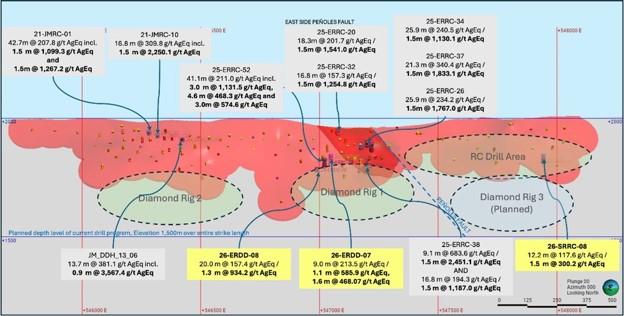
Picking up where the old timers left off, Capitan’s high-grade silver hub is surrounded by the historic workings of Peñoles. Founded in 1887, the longstanding Mexican mining company produced grades up to 2,000 g/t silver at Jesús María in the 1890s, before the Mexican Revolution halted output in 1910.
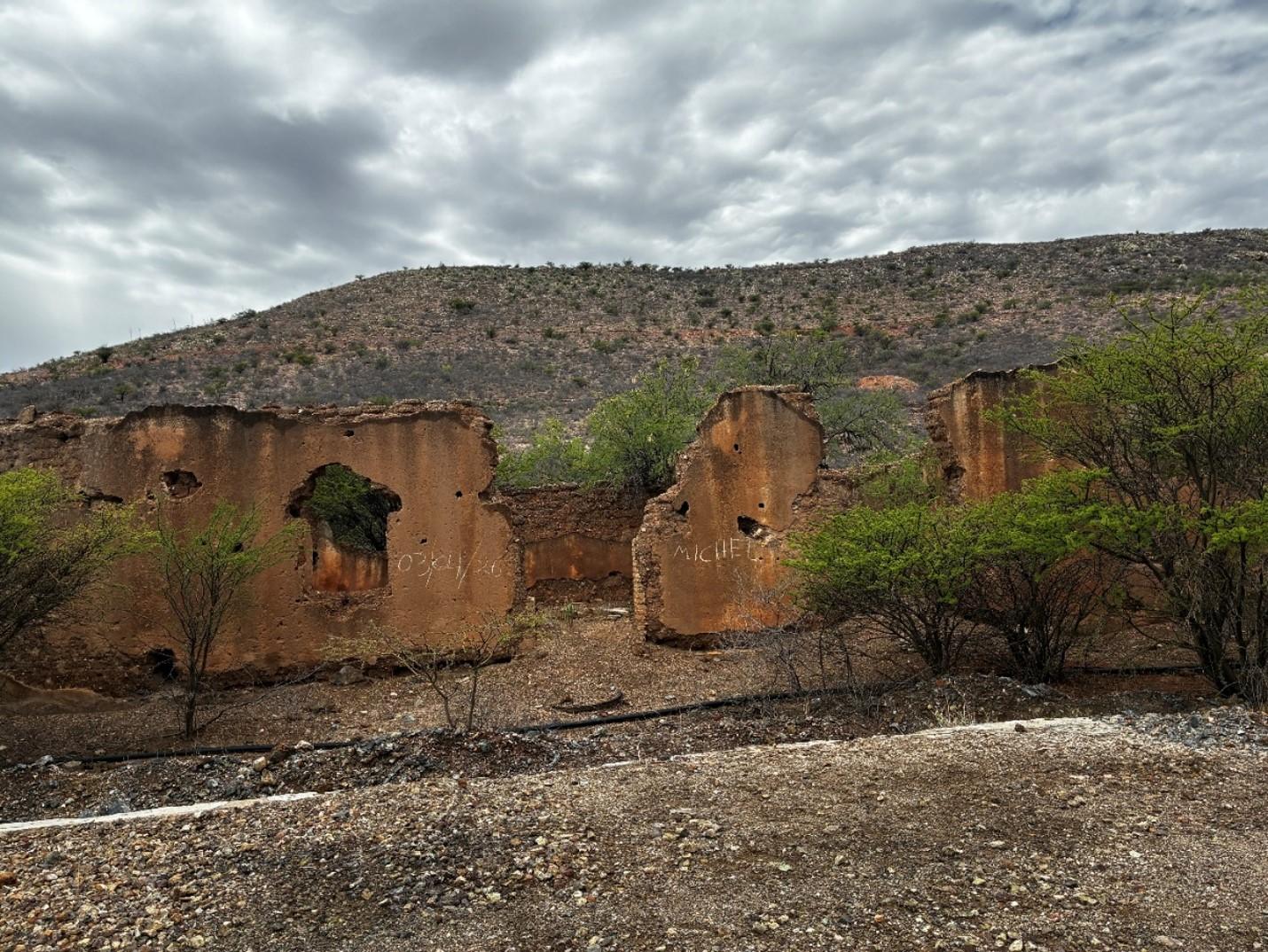
Historical workings at the Jesús María mine.
Importantly, this past-producing pedigree extends to another historic mine on the Jesús María trend called San Rafael. Here, production grades were slightly lower than the Jesús María mine at 300-1,000 g/t silver, albeit the historical workings serve as a lasting reminder of unexplored potential.
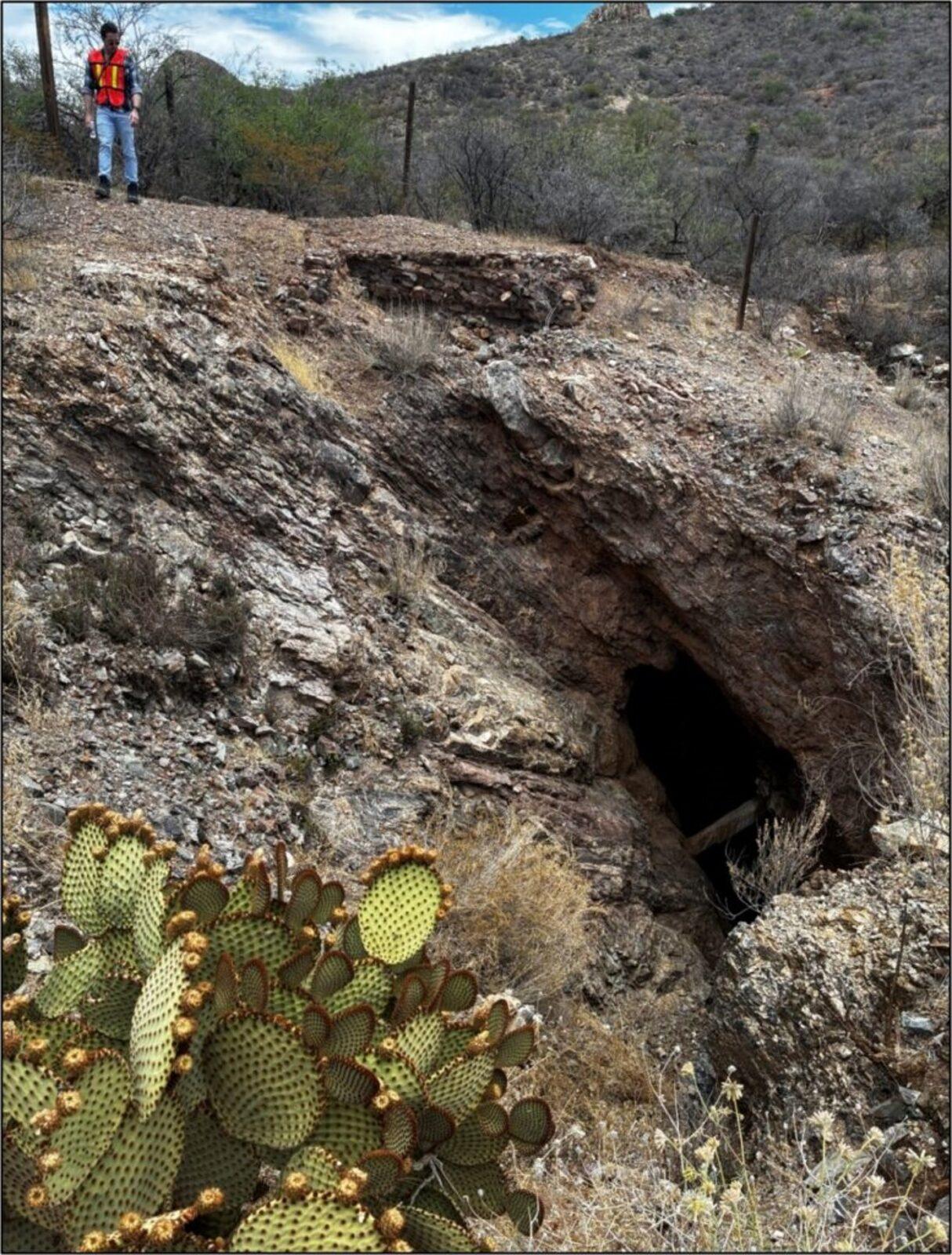
San Rafael historical workings, east side of the fault.
Beyond that, historical drilling at San Rafael further corroborates this potential, highlighted by an intercept of 8.9 metres grading 101 g/t silver and 0.63 g/t gold, with the broader program identifying multiple stacked mineralized zones that remain only partially tested.
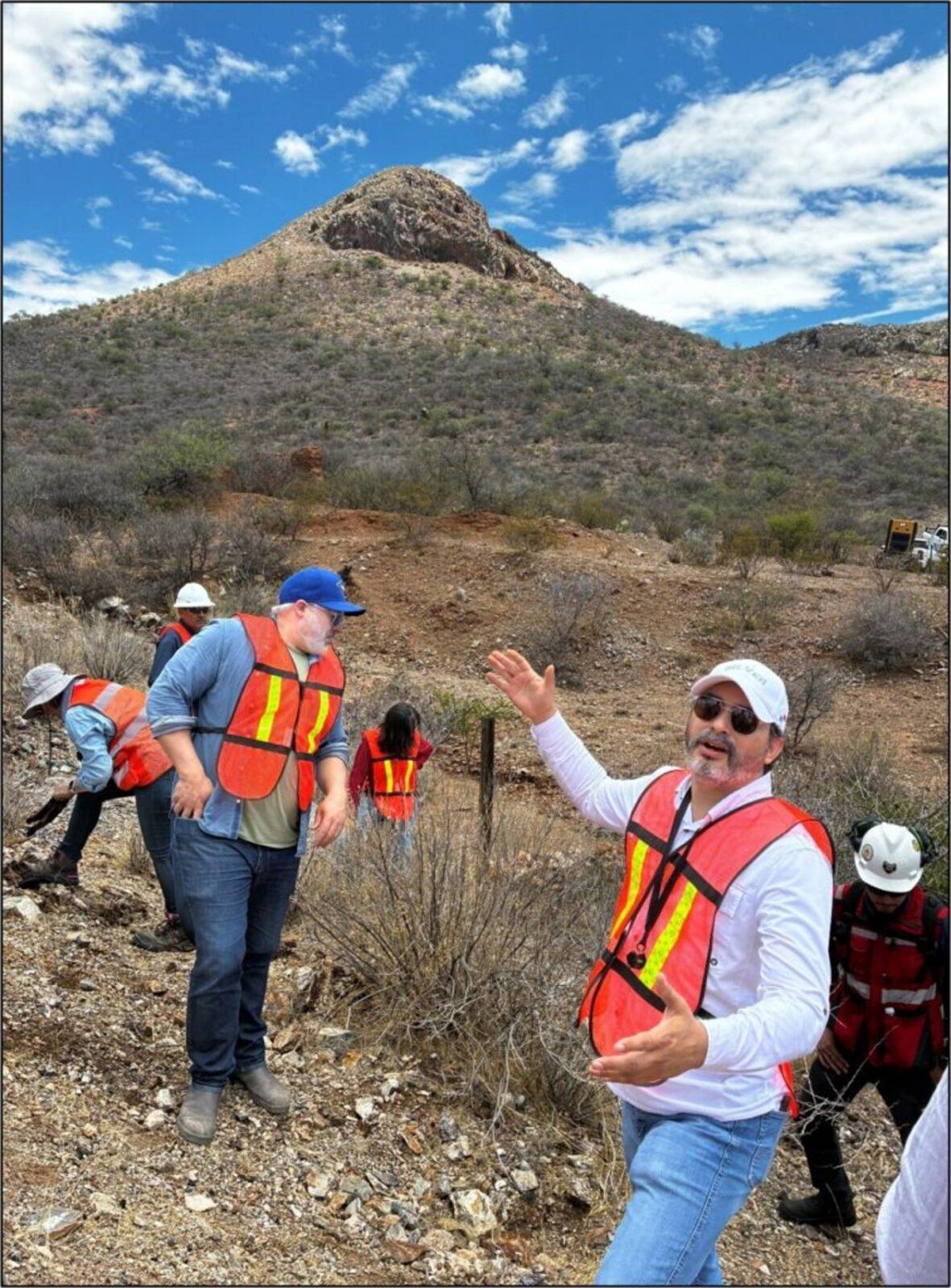
Alberto at San Rafael in front of some volcanics. He notes how the lack of base metals in the mineralization suggests the Eastern portion of the trend is still high in the system, leaving more of it to be defined at depth.
Sitting between San Rafael and Jesús María, El Refugio is the third historic mine that doubles up as one of Capitan’s principal targets. For the most part, that’s because drilling carried out by Fresnillo from 2018 to 2020 successfully tested the El Refugio zone at depth, tracing it down to ~400 metres below surface.
As a reminder, the silver mineralisation at Jesús María has mostly come above depths of 250 meters. Therefore, if Capitan can prove El Refugio as the metaphorical glue that connects Jesús María and San Rafael together – and do so at 400 meter depths – the company’s stock would be poised for a major re-rating, as investors see a collection of isolated vein systems transform into a district-scale silver corridor.
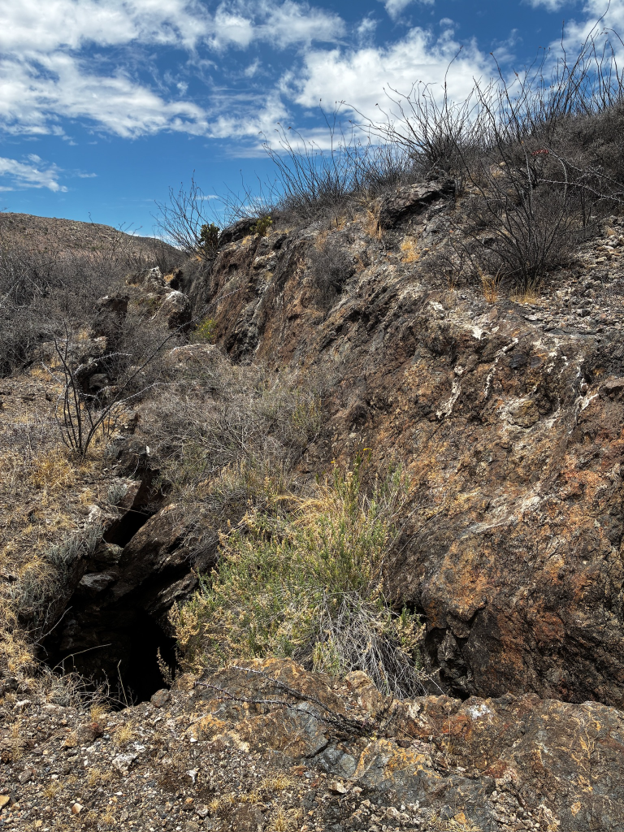
An exposed shaft at El Refugio, where a broad zone of structures and veins is visible at surface – offering a rare glimpse of the vein continuity and thickness of the high-grade zones that Capitan is now drilling.
The Bottom Line
From past-producing pedigree to high-grade potential, Cruz de Plata is an increasingly interconnected silver system, which stands to rival the scale of multi-billion-dollar silver deposits such as Juanicipio.
Throughout 2026, Capitan will continue to systematically demonstrate this immense scale, with its fully-funded 60,000 metre drill program, which is spearheaded by four drill rigs – three diamond and 1 RC.
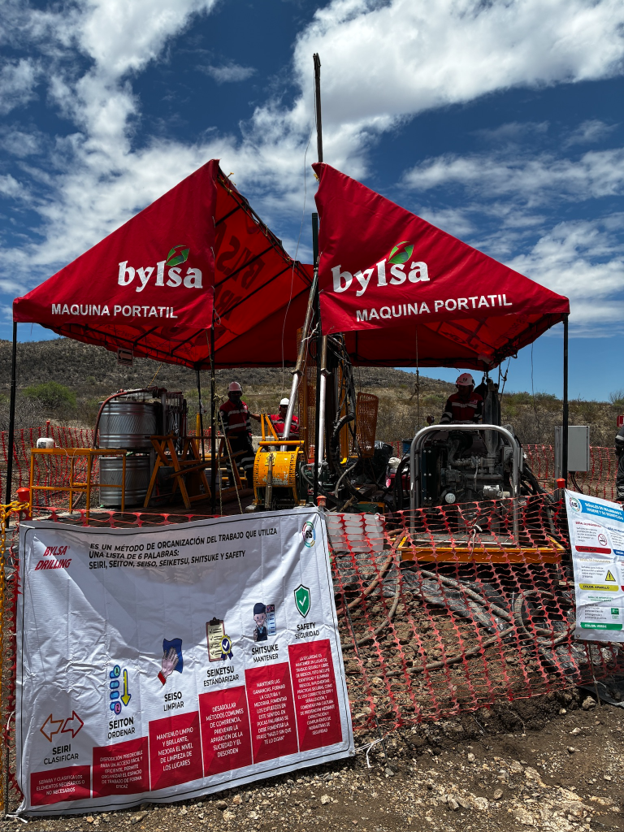
One of the diamond drill rigs was stationed at El Refugio during my visit.
In due course, these drill results will be incorporated into a resource estimate, which we expect to reach 100 Moz AgEq quite comfortably, with at least 60% – and potentially up to 90% – of that being pure silver.
Upon the publication of that estimate, the lid will be lifted on Cruz de Plata’s potentially giant scale, which we ultimately see growing further toward 200+ Moz AgEq, provided that drills continue turning past 2026.
In the meantime, Capitan trades at a ~C$240M market cap which, in our view, fails to price in the upside potential from Cruz de Plata’s Jesús Maria Silver Trend – a coveted Intermediate Sulphidation Epithermal System like Juanicipio.
Naturally, both Peter Krauth and I hold a full weighting in the stock, with a view to successive re-ratings as drill results, and ultimately a resource estimate, confirm our assumptions regarding Cruz de Plata’s scale.
Courtesy of the Silver Mining Investor
Brutus Mining Inc. (CSE: BRU) (FSE: ZI3) is pleased to announce that it has closed its non-brokered ... READ MORE
Jaguar Uranium Corp. (NYSE American: JAGU) is pleased to announce an independent Mineral Resource E... READ MORE
Auro Metals Inc. (TSX-V: AURO) (OTCQB: AURFF), is pleased to announce the assay results of the fina... READ MORE
Endeavour Silver Corp. (NYSE: EXK) (TSX: EDR) is pleased to announce that repairs to the primary bal... READ MORE
Scorpio Gold Corp. (NASDAQ: SGLD) (TSX-V: SGLD) (OTCQB: SRCRF) (FSE: RY9) is pleased to announce re... READ MORE