








Infill drilling, including hole 26-SPX-RC105 (12.24 g/t Au over 6.4 m) and 26-SPX-RC199 (6.26 g/t Au over 10.2 m), is targeting resource upgrade and conversion within the pit limits
Infill assays are materially higher grade than the M&I and Inferred resource grade of 1.18 g/t and 1.72 g/t, respectively
Talamore Mining Corporation (TSX: TALA) (OTCQB: TALMF) is pleased to report results from 30 holes of an ongoing 40,000-metre infill and exploration drilling program at its wholly-owned Coffee Gold Project in Canada’s Yukon Territory. Drilling is currently targeting the higher-grade Supremo Extension zone (Figures 1 & 2), which presently hosts an Indicated Resource of 2,437 kt at a grade of 1.18 grams per tonne (g/t) gold for a contained 92,000 ounces of gold, and an Inferred Resource of 6,059 kt at a grade of 1.72 g/t gold for a contained 335,000 ounces of gold. The Inferred grade at Supremo Extension is significantly higher than the 1.15 g/t Au grade of the overall Coffee Gold Project resource estimate and thus provides a compelling target for converting high-grade ounces to the Indicated category for inclusion in the Feasibility Study currently underway.
Today’s release includes assay results from 30 reverse circulation holes totalling 4,356 metres of a planned 25,000 metres of infill drilling at Supremo Extension. A total of 223 drill holes for approximately 32,852 metres have been completed through July of this year, with results for 100 holes comprising 13,764 metres released to date.
Drilling Highlights
Highlights of the holes reported herein from the Supremo Extension structural system include:
Tim Warman, President and CEO of Talamore Mining, commented, “These latest results provide important confirmation of the high-grade continuity and resource growth potential we see at Supremo Extension. The intercepts reported today are materially above current resource grades, in some cases extending beyond the limits of the existing resource pit and continue to support our objective of converting higher-grade ounces for inclusion in the Feasibility Study now underway. As we advance Coffee toward a construction decision, results like these reinforce our view that Supremo Extension will be an important part of the Coffee Gold Project.”
Geology and Context of Results
The Coffee Gold Project consists of multiple mineralized structural zones forming the equivalent of a large vein swarm with individual structural zones from one to over thirty metres in width and extending up to four-kilometres in strike length (Figure 1). The Supremo Extension portion of the Coffee deposit is at the intersection of a steep dipping northeasterly trending high grade structure and a shallower east-dipping structural zone. The shallow dipping structure is unique relative to the other structural zones in the Coffee deposit because of the much thicker mineralization, lower trace metal concentrations and higher silver content. The intersection of these two structural trends creates wide zones of much higher-than-average grade that become ideal for open pit mining.
These 30 drill holes continue the campaign to infill between existing completed cross sections on the Supremo Extension target, to increase drill density and upgrade resources from Inferred to Indicated for inclusion in the Feasibility Study currently underway. Infill and/or expansion drilling has also started on the Supremo and Latte zones.
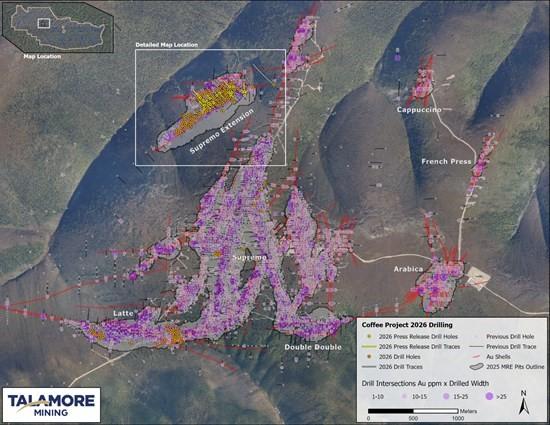
Figure 1. Known mineralized systems and existing drill holes at the Coffee Gold Project. Resource pit outlines in Figures 1 through 6 are based on the report entitled “NI 43-101 Technical Report for the 2025 Mineral Resource Estimate Update on the Coffee Gold Project, Yukon, Canada” prepared for Fuerte Metals Corporation by Micon International, with an effective date of August 21, 2025, and an issue date of October 6, 2025.
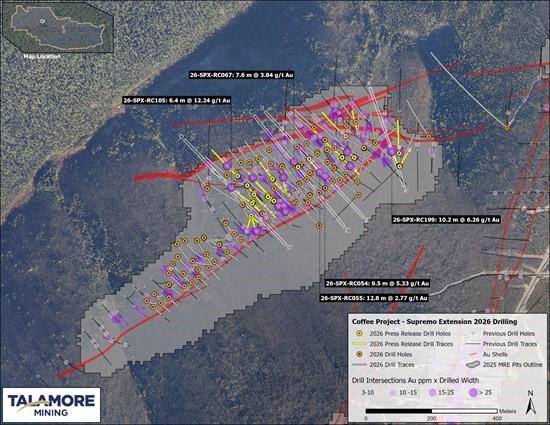
Figure 2. Location of drill holes and cross-sections from the current release, Supremo Extension.
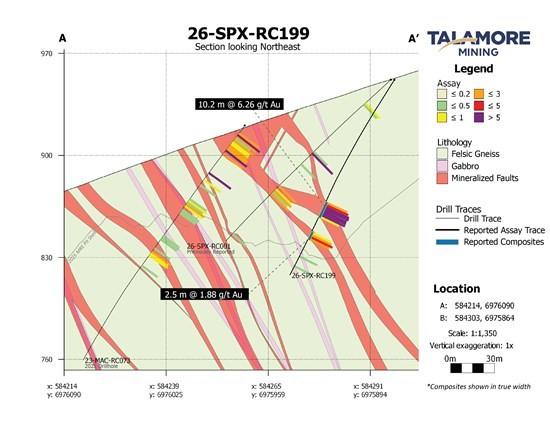
Figure 3. Cross-section A-A’ through the Supremo Extension showing increasing grade and width at depth.
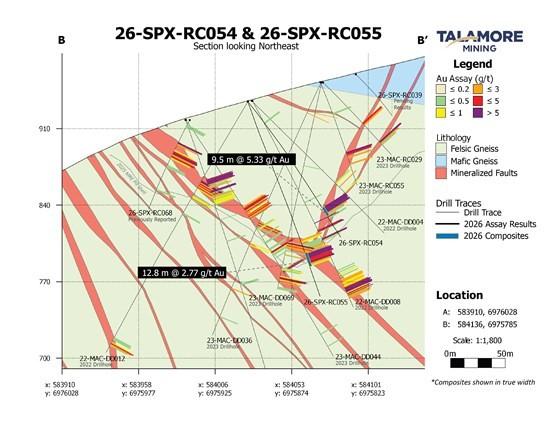
Figure 4. Cross-section B-B’ through the Supremo Extension showing high-grade intercepts, with potential to expand the pit to include significant intercepts below the current resource pit shell.
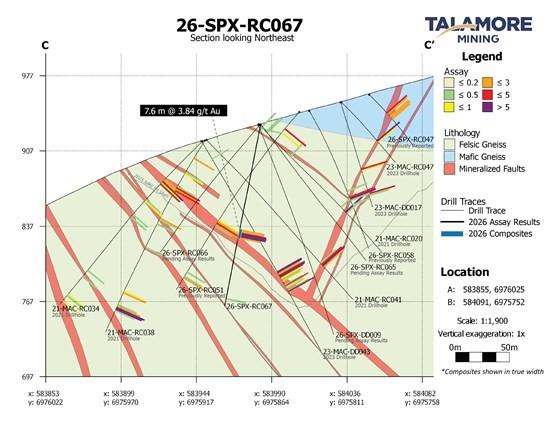
Figure 5. Cross-section C-C’ through the Supremo Extension showing intercepts within the shallower eastward-dipping mineralized structure, adding confidence to the existing model and opportunity to upgrade the resource classification in this area.
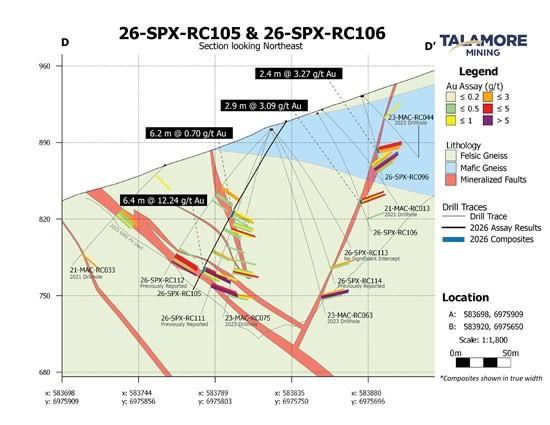
Figure 6. Cross-section D-D’ through the Supremo Extension showing high-grade continuity on the shallow eastward-dipping structure.
Table 1. Drill Results
| Drill Hole | From (m) |
To (m) |
Drill Length (m) |
True Width (m) |
Au g/t | Zone |
| 26-SPX-RC004 | 19.8 | 29.0 | 9.2 | 7.1 | 0.84 | Supremo Extension |
| 26-SPX-RC015 | 4.6 | 15.2 | 10.7 | 10.2 | 2.00 | Supremo Extension |
| 26-SPX-RC018 | 105.2 | 117.4 | 12.2 | 9.6 | 2.75 | Supremo Extension |
| 26-SPX-RC025 | 18.3 | 25.9 | 7.6 | 2.6 | 1.60 | Supremo Extension |
| 26-SPX-RC027 | 57.9 | 61.0 | 3.1 | 2.8 | 4.10 | Supremo Extension |
| 26-SPX-RC027 | 70.1 | 74.7 | 4.6 | 4.4 | 1.13 | Supremo Extension |
| 26-SPX-RC028 | 71.6 | 88.4 | 16.8 | 11.6 | 2.11 | Supremo Extension |
| 26-SPX-RC029 | 125.0 | 146.3 | 21.3 | 16.4 | 0.95 | Supremo Extension |
| 26-SPX-RC054 | 118.9 | 131.1 | 12.2 | 9.5 | 5.33 | Supremo Extension |
| 26-SPX-RC055 | 135.6 | 161.5 | 25.9 | 12.8 | 2.77 | Supremo Extension |
| 26-SPX-RC067 | 99.1 | 108.2 | 9.1 | 7.6 | 3.84 | Supremo Extension |
| 26-SPX-RC079 | 68.6 | 74.7 | 6.1 | 4.9 | 4.61 | Supremo Extension |
| 26-SPX-RC081 | 97.5 | 102.1 | 4.6 | 2.6 | 7.38 | Supremo Extension |
| 26-SPX-RC086 | 62.5 | 70.1 | 7.6 | 3.0 | 0.62 | Supremo Extension |
| 26-SPX-RC086 | 138.7 | 146.3 | 7.6 | 5.7 | 1.54 | Supremo Extension |
| 26-SPX-RC088 | 42.7 | 47.2 | 4.6 | 3.6 | 1.82 | Supremo Extension |
| 26-SPX-RC092 | 111.3 | 123.4 | 12.2 | 8.5 | 2.32 | Supremo Extension |
| 26-SPX-RC097 | NSV | Supremo Extension | ||||
| 26-SPX-RC099 | 120.4 | 128.0 | 7.6 | 6.9 | 1.13 | Supremo Extension |
| 26-SPX-RC103 | 106.7 | 109.7 | 3.1 | 2.5 | 5.80 | Supremo Extension |
| 26-SPX-RC104 | 126.5 | 129.5 | 3.1 | 2.2 | 4.40 | Supremo Extension |
| 26-SPX-RC105 | 99.1 | 106.7 | 7.6 | 6.2 | 0.70 | Supremo Extension |
| 26-SPX-RC105 | 157.0 | 164.6 | 7.6 | 6.4 | 12.24 | Supremo Extension |
| 26-SPX-RC106 | 88.4 | 93.0 | 4.6 | 2.9 | 3.09 | Supremo Extension |
| 26-SPX-RC107 | 70.1 | 77.7 | 7.6 | 5.8 | 3.96 | Supremo Extension |
| 26-SPX-RC113 | NSV | Supremo Extension | ||||
| 26-SPX-RC118 | 50.3 | 76.2 | 25.9 | 22.9 | 1.21 | Supremo Extension |
| 26-SPX-RC193 | 111.3 | 117.4 | 6.1 | 4.0 | 3.05 | Supremo Extension |
| 26-SPX-RC194A | 158.5 | 160.0 | 1.5 | 1.1 | 3.76 | Supremo Extension |
| 26-SPX-RC195 | 149.4 | 172.2 | 22.9 | 21.0 | 1.48 | Supremo Extension |
| 26-SPX-RC196 | 68.6 | 77.7 | 9.1 | 7.6 | 0.70 | Supremo Extension |
| 26-SPX-RC196 | 150.9 | 169.2 | 18.3 | 15.8 | 1.54 | Supremo Extension |
| 26-SPX-RC197 | 33.5 | 36.6 | 3.1 | 2.7 | 1.55 | Supremo Extension |
| 26-SPX-RC199 | 96.0 | 108.2 | 12.2 | 10.2 | 6.26 | Supremo Extension |
| 26-SPX-RC199 | 118.9 | 125.0 | 6.1 | 2.5 | 1.88 | Supremo Extension |
NSV – No Significant Values
Table 2. Drill Hole Locations
| Drill Hole | Easting | Northing | Elevation (masl) |
Azimuth | Dip | Hole Depth (m) |
| 26-SPX-RC004 | 584299 | 6975920 | 936.6 | 356.8 | 46.1 | 152.4 |
| 26-SPX-RC015 | 584175 | 6975974 | 927.1 | 343.0 | 48.6 | 120.4 |
| 26-SPX-RC018 | 584162 | 6975907 | 949.4 | 307.9 | 75.8 | 201.2 |
| 26-SPX-RC025 | 584136 | 6975972 | 930.6 | 310.9 | 44.8 | 167.6 |
| 26-SPX-RC027 | 584125 | 6975903 | 948.0 | 135.2 | 44.4 | 91.4 |
| 26-SPX-RC028 | 584125 | 6975904 | 948.0 | 134.2 | 65.4 | 100.6 |
| 26-SPX-RC029 | 584125 | 6975907 | 947.7 | 314.3 | 45.3 | 187.5 |
| 26-SPX-RC054 | 584025 | 6975903 | 934.8 | 141.8 | 49.8 | 150.9 |
| 26-SPX-RC055 | 584025 | 6975903 | 934.8 | 142.4 | 68.7 | 190.5 |
| 26-SPX-RC067 | 583991 | 6975878 | 931.4 | 312.7 | 78.4 | 172.2 |
| 26-SPX-RC079 | 583918 | 6975777 | 931.5 | 137.5 | 43.4 | 96.0 |
| 26-SPX-RC081 | 583918 | 6975777 | 931.5 | 137.7 | 65.0 | 111.3 |
| 26-SPX-RC086 | 583914 | 6975839 | 918.8 | 140.8 | 56.3 | 166.1 |
| 26-SPX-RC088 | 583913 | 6975843 | 918.8 | 317.3 | 47.9 | 131.1 |
| 26-SPX-RC092 | 583899 | 6975787 | 923.8 | 142.0 | 62.8 | 157.0 |
| 26-SPX-RC097 | 583876 | 6975701 | 932.3 | 199.0 | 54.2 | 65.5 |
| 26-SPX-RC099 | 583857 | 6975794 | 909.6 | 138.3 | 52.3 | 160.0 |
| 26-SPX-RC103 | 583854 | 6975772 | 912.2 | 146.6 | 49.1 | 134.1 |
| 26-SPX-RC104 | 583853 | 6975767 | 912.6 | 147.1 | 62.9 | 178.3 |
| 26-SPX-RC105 | 583852 | 6975767 | 912.5 | 305.2 | 54.6 | 181.4 |
| 26-SPX-RC106 | 583848 | 6975730 | 916.7 | 137.6 | 58.9 | 120.4 |
| 26-SPX-RC107 | 583848 | 6975730 | 916.7 | 162.0 | 44.7 | 91.4 |
| 26-SPX-RC113 | 583822 | 6975762 | 901.9 | 157.0 | 46.2 | 131.1 |
| 26-SPX-RC118 | 583807 | 6975851 | 885.2 | 310.2 | 44.7 | 160.0 |
| 26-SPX-RC193 | 583848 | 6975730 | 916.7 | 197.2 | 61.2 | 140.2 |
| 26-SPX-RC194A | 583836 | 6975822 | 899.3 | 146.0 | 56.0 | 201.2 |
| 26-SPX-RC195 | 583918 | 6975775 | 931.8 | 318.7 | 46.8 | 201.2 |
| 26-SPX-RC196 | 583959 | 6975794 | 939.8 | 334.4 | 63.2 | 181.4 |
| 26-SPX-RC197 | 584148 | 6975885 | 953.5 | 135.3 | 46.7 | 61.0 |
| 26-SPX-RC199 | 584300 | 6975880 | 951.9 | 328.1 | 57.6 | 152.4 |
Coordinate system NAD83 Zone 7N
The goal of targeting the higher-grade infill portion within the main Supremo Extension is to increase both the size and the grade of the resource for inclusion in the current Feasibility Study work. The current open-pit mineral resource estimate comprises:
Table 3. 2025 Coffee Gold Project Mineral Resource Estimate
| Resource Category | Tonnage (kt) |
Gold Grade (g/t) |
Metal Content (gold koz) |
| Measured | 1,200 | 1.80 | 69 |
| Indicated | 78,846 | 1.14 | 2,888 |
| Measured + Indicated | 80,046 | 1.15 | 2,957 |
| Inferred | 21,200 | 1.17 | 800 |
Notes to Table 3:
Quality Assurance and Quality Control Procedures
RC samples are collected at the drill rig by a qualified subcontractor in conjunction with rock chips for logging. Samples are collected every 5 ft (~1.52 m) for the entire hole, with the exception of the first sample of each hole where intervals may be longer depending on recovery while casing is set. Large retention bags (36″x24″) are marked with the depth of the interval and small sample bags (12″x 20″) are marked with a sample ID corresponding to a sample tag book where depth interval and hole information are recorded. The sample is collected in a clean bucket from under the cyclone. The full sample and bucket are weighed and then the sample is split using a riffle splitter (1/8 split) into a retention bag and a sample bag. The retention and sample bags are weighed on a scale, and the total weight, retention bag weight, and sample bag weight are recorded in the corresponding sample tag book.
A representative spear sample is taken from the waste bucket and is dry and wet sieved on site. Chips from the sieved sample are placed in a chip tray marked with the corresponding depth interval. Retention bags are folded over and are stacked neatly at the drill site; sample bags are closed and arranged into sample shipments at the drill site. A geologist regularly checks in on each drill to ensure sample integrity, quality, and that the site is being maintained in a clean and orderly manner to prevent sampling errors and contamination. When groundwater is encountered, the drillers will attempt to “dry” the interval before it reaches the cyclone. If a sample is wet, the sample will be spear sampled rather than split, and ‘wet sample’ is noted in the tag book. A geologist will supervise sampling during wet drilling conditions to ensure the sample is representative.
The cyclone is checked regularly for contamination and cleaned as necessary, regardless of drilling conditions. The collected samples are brought to the main core processing area at the end of every shift where they are laid out and the sample count and sequence numbers are checked to verify against the completed tag books. Standards and blanks occur every 10 samples and the standard type is generated randomly in the acQuire database upon entry. Standards and blanks are inserted by the geo-technicians during shipment preparation. Standards and blanks procedures for RC sampling are the same as diamond drill core sampling.
All reverse circulation samples collected in 2026 were submitted to ALS Canada Ltd. for preparation and assaying. Samples were typically received, crushed, and pulverized by the ALS Whitehorse preparation facility, and shipped to ALS North Vancouver for assaying. Prepared samples were assayed for gold using a conventional lead-fire assay procedure (Au-ICP21, ICP-AES) on 30 g sub-samples (50 g samples were used in 2010). Fire-assayed samples with grades in excess of 10 g/t gold were re-assayed from a second 30 g split (50 g split in 2010) using a fire assay procedure and a gravimetric finish (Au-GRA21). All regular drill samples were analyzed for a suite of 48 elements utilizing a four-acid digestion with a combination of ICP-AES and ICP-MS finishes (ME-MS61).
Qualified Person
Mr. Charlie Ronkos, MMSA is Talamore’s EVP Exploration and the Qualified Person who has approved the technical information disclosed in this release.
Messrs. Alan J. San Martin, P.Eng. and Charley Murahwi, P.Geo. from Micon International Limited are the Qualified Persons (QPs) who prepared the Coffee Gold Project Mineral Resource Estimate. Micon International Limited is “Independent” of Talamore as defined by Section 1.5 of NI 43-101. The estimate was prepared by Micon International Limited in Accordance with National Instrument 43-101 with an effective date of August 21, 2025.
About Talamore Mining
Talamore Mining Corporation (formerly Fuerte Metals Corp.) is a Canadian exploration and development company advancing the Coffee Gold Project in Yukon, Canada. Coffee is a 100%-owned, open-pit heap leach gold project in the final stages of permitting and engineering, as the Company works toward a construction decision. The project hosts 3.0 million ounces of Measured and Indicated resources and an additional 0.8 million ounces of Inferred resources. In addition to Coffee, Talamore holds a portfolio of copper and gold assets in Chile and Mexico, providing longer-term growth potential.
Talamore recognizes that protection of the land and water around the Coffee Gold Project is of central importance to the Trondëk Hwëch’in, White River First Nation, Selkirk First Nation, and the First Nation of Na-Cho Nyäk Dun. The Company is focused on building long-term relationships grounded in transparency, respect, and follow-through. From day one, Talamore’s approach is simple: do the work properly, be honest about it, and follow through on what we say.
Brutus Mining Inc. (CSE: BRU) (FSE: ZI3) is pleased to announce that it has closed its non-brokered ... READ MORE
Jaguar Uranium Corp. (NYSE American: JAGU) is pleased to announce an independent Mineral Resource E... READ MORE
Auro Metals Inc. (TSX-V: AURO) (OTCQB: AURFF), is pleased to announce the assay results of the fina... READ MORE
Endeavour Silver Corp. (NYSE: EXK) (TSX: EDR) is pleased to announce that repairs to the primary bal... READ MORE
Scorpio Gold Corp. (NASDAQ: SGLD) (TSX-V: SGLD) (OTCQB: SRCRF) (FSE: RY9) is pleased to announce re... READ MORE