







Super Copper Corp. (CSE: CUPR) (OTCQB: CUPPF) (FSE: N60) is pleased to announce assay results for the first four holes of its maiden drill program at the El Alto target, Cordillera Cobre Project, Atacama Region, Chile. All four holes intersected structurally hosted copper mineralization, and every one of the eight holes completed to date has logged copper-bearing mineralization along the same northwest trend.
Hole DH26CC-002 intersected 19.2 m of 0.34% copper and 3.3 grams per tonne (g/t) silver (Ag) (0.38% CuEq1) from 310.0 m, including 1.3 m of 2.21% Cu and 24.7 g/t Ag (2.56% CuEq1), and ended in copper at 501.9 m. Hole DH26CC-003, drilled from the same pad at a shallower dip, intersected 10.0 m of 0.49% Cu and 6.0 g/t Ag (0.58% CuEq1) from 110.0 m downhole, approximately 80 m below surface, including 2.0 m of 1.08% Cu and 15.7 g/t Ag (1.30% CuEq1). Together the two holes tie the mineralized structure between two pierce points and define its general strike and dip, giving the next phase of drilling clear targets.
What These Results Mean
Initial results may answer early questions that every copper project has to answer.
Zachary Dolesky, CEO of Super Copper, commented: “This is what you want from a first drill program: copper in every hole assayed, grade above 2% copper, and a hole that finished in copper at 500 metres. We now have a mineralized structure that can be traced between holes, and a system that is still open where our deepest sample stopped in copper. Our plan is straightforward: get the remaining assays in, map where the best copper concentrates, and drill further out and deeper to establish the scale of this system. This is the start of the story at El Alto, and we expect a steady flow of results through the rest of the year.”
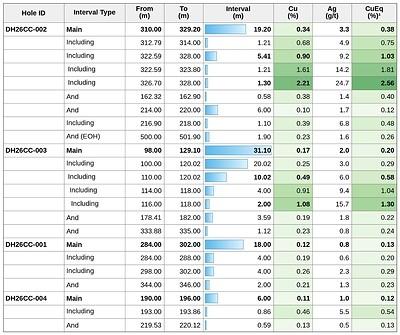
Intervals are drilled core lengths reported at a 0.1% Cu cut-off with up to 4 m of internal dilution; “incl.” intervals are reported without a cut-off. Intervals below cut-off are omitted here and appear in the full table on the Company’s website. True widths have not been determined; the mineralized structures are interpreted as sub-tabular and their orientation is being constrained by ongoing drilling (see “Assay Methodology & QA/QC”). Copper and silver grades are reported separately. ¹ CuEq (%) = Cu (%) + Ag (g/t) × 0.0140, using metal prices of US$5.20/lb copper and US$50/oz silver and assuming 80% metallurgical recovery for both metals. Recoveries have not been established by test work, and copper-equivalent grades are provided for illustrative purposes only.
2026 Maiden Drill Program: Status
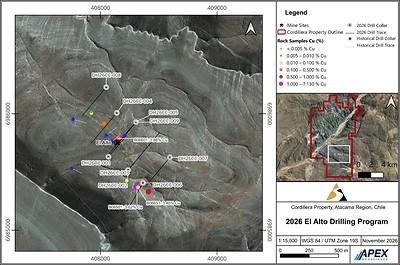
The Company has completed more than 3,850 m of drilling to-date and expects the maiden program to exceed 4,000 m in November 2026. All drill holes have reported copper-bearing mineralization along the main northwest trend.
| Hole | Dip / Azimuth | Depth (m) | Status |
| DH26CC-001 | −50° / 040° | 502.7 | Assays herein |
| DH26CC-002 | −65° / 040° | 505.0 | Assays herein |
| DH26CC-003 | −45° / 040° | 593.2 | Assays herein |
| DH26CC-004 | −45° / 220° | 476.0 | Assays herein |
| DH26CC-005 | −45° / 220° | 512.2 | At laboratory |
| DH26CC-006 | −45° / 210° | 401.1 | At laboratory |
| DH26CC-007 | −50° / 220° | 506.2 | Sampling complete |
| DH26CC-008 | −45° / 220° | [361+, drilling] | In progress |
A ninth hole is being drilled from these results. Assays are expected to flow through November.
DH26CC-002: The Main Structure at Depth
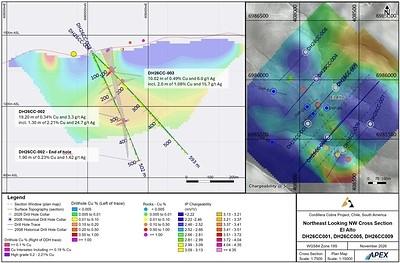
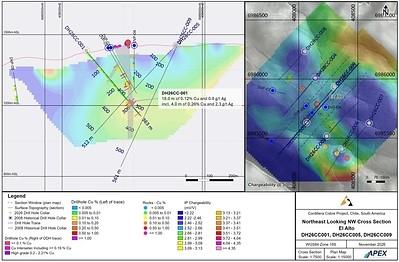
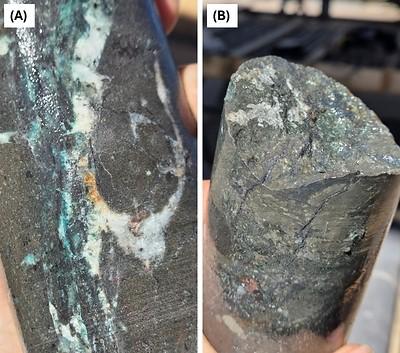
Drilled at −65° to 505.0 m, hole 2 intersected the main mineralized structure approximately 280 m below surface in the core of the principal geophysical target. Grade is carried by chalcocite in calcite veinlets, peaking at 2.21% Cu with 24.7 g/t Ag. Above the main zone the hole cut copper-bearing structures (6.0 m at 0.10% Cu including 1.1 m at 0.39% Cu), and its final sample graded 0.23% Cu at 501.9 m, leaving the mineralization open at depth (Figure 2).
DH26CC-003: Same Pad, Shallower Dip
Drilled at −45° in the in the same azimuth of DH26CC-002, hole 3 tested the horizons on the other side of the section and returned a strong intercept: 10.0 m at 0.49% Cu and 6.0 g/t Ag from 110 m, including 2.0 m at 1.08% Cu and 15.7 g/t Ag allowing to correlate mineralization between DH26CC-002, determining general strike and dip of mineralized structure within El Alto System. Another intercept, its pierce point 150 m north-east of hole 2, returned 1.1 m at 0.13%, determining new copper bearing secondary structures or splays (Figure 2).
DH26CC-001 and DH26CC-004: Extending the Trend
Hole 1, drilled approximately 200 m northwest along the corridor, returned 18.0 m at 0.12% Cu including 4.0 m at 0.26% Cu from 298 m, plus 2.0 m at 0.21% Cu from 344 m, confirming the mineralized trend before the hole was terminated at 502.7 m due to drilling difficulties (Figure 3).
Hole 4, drilled in the opposite direction approximately 400 m northwest of holes 2 and 3, confirmed that the mineralized structures continue along the trend as a sub-tabular body, returning 6.0 m at 0.11% Cu including 0.9 m at 0.46% Cu with 5.5 g/t Ag.
Together the four holes demonstrate structural control along a zone of weakness interpreted to follow the northwest trend along the axis of a syncline in a volcanic sequence that contains permeable tuff layers with copper-bearing clasts and copper in the matrix. The full 800 m corridor, its feeder structures and the prospective permeable (manto-style) layers are the targets of the next phase.
What’s Next
These results cover the first four holes ever drilled by Super Copper. The plan from here:
Assay Methodology & QA/QC
Drill core was logged, cut and sampled by APEX Geoscience under the Company’s QAQC protocol, with certified reference materials, blanks, field duplicates and preparation duplicates inserted into the sample stream. Samples were analyzed by ALS by four-acid digestion with 48-element ICP-MS finish (ME-MS61); over-limit copper by ore-grade re-assay (hole 2 samples E17404/E17405/E17409; hole 3 sample F0000159). Cyanide-soluble copper (Cu-AA17) was determined on selected mineralized samples in all four holes: mineralized-zone results for holes 2, 3 and 4 range from 87% to 100% of total copper (values marginally above 100% reflect inter-method variance and are reported as 100%); hole 1’s low-grade upper zone returned partial solubility (29–73%). Blanks returned no significant copper and standards performed within expected limits for zones of interest. Gold is below 0.015 g/t throughout. Intervals are drilled core lengths; the orientation of mineralization is not yet fully constrained. CuEq% = Cu% + (Ag g/t × 0.01402) at US$5.20/lb Cu and US$50/oz Ag, assuming 80% recoveries for both metals; recoveries have not been established. Copper and silver are also reported separately.
Qualified Person
The scientific and technical information in this news release has been reviewed and approved by Michael Dufresne, M.Sc., P.Geol., P.Geo., a qualified person as defined by National Instrument 43-101.
Reference
Maksaev, V. and Zentilli, M. (2002). Chilean Strata-bound Cu-(Ag) Deposits: An Overview. In Porter, T.M. (ed.), Hydrothermal Iron Oxide Copper-Gold & Related Deposits: A Global Perspective, Vol. 2, pp. 185–205. PGC Publishing, Adelaide.
About Super Copper Corp.
Super Copper is a mining exploration company focused on acquiring, advancing and consolidating global copper assets from early discovery through late-stage development. The Company is advancing its Cordillera Cobre and Castilla copper projects in the Atacama Region of Chile, a region with established mining infrastructure and the operations of global majors. By operating a single, integrated technical team and a milestone-driven acquisition strategy, Super Copper aims to build a portfolio of scalable projects capable of supplying the world’s accelerating demand for copper.
NexGold Mining Corp. (TSX-V: NEXG) (OTCQX: NXGCF) is pleased to ... READ MORE
Premier American Uranium Inc. (TSX-V: PUR) (OTCQB: PAUIF) is plea... READ MORE
Highlights Three-hole shallow drill program completed at Destiny.... READ MORE
Thunder Gold Corp. (TSX-V: TGOL) (FSE: Z25) (OTCQB: TGOLF) is ple... READ MORE