







Stallion Uranium Corp. (TSX-V: STUD) (OTCQB: STLNF) (FSE: B76) is pleased to announce the completion of a ground-based Step-Wise Moving Loop Time-Domain Electromagnetic survey at the Coyote Target on its Moonlite Property, located in the Athabasca Basin of northern Saskatchewan. The survey was completed by Abitibi Geophysics. The Company also reports that is has mobilized an airborne VTEM survey over its Stone Island Target, also on the Moonlite Property in the Athabasca Basin.
“The SWML survey has successfully defined and modelled multiple high-quality conductors across the Coyote Target,” said Darren Slugoski, VP Exploration of Stallion Uranium. “With nine conductors identified; seven of which exhibit strong conductance levels; the modelling completed by Abitibi provides the resolution required to precisely position drill holes and optimize drill orientations. This work materially improves our confidence in drill targeting and directly supports a focused and technically driven winter drill program.”
Matthew Schwab, CEO of Stallion Uranium, added, “This survey represents a key technical milestone at Moonlite. The identification of multiple strong, structurally complex conductors within a broader gravity-low anomaly reinforces our confidence in the Coyote Target and positions Stallion well as we advance toward drilling commencement.”
Highlights:
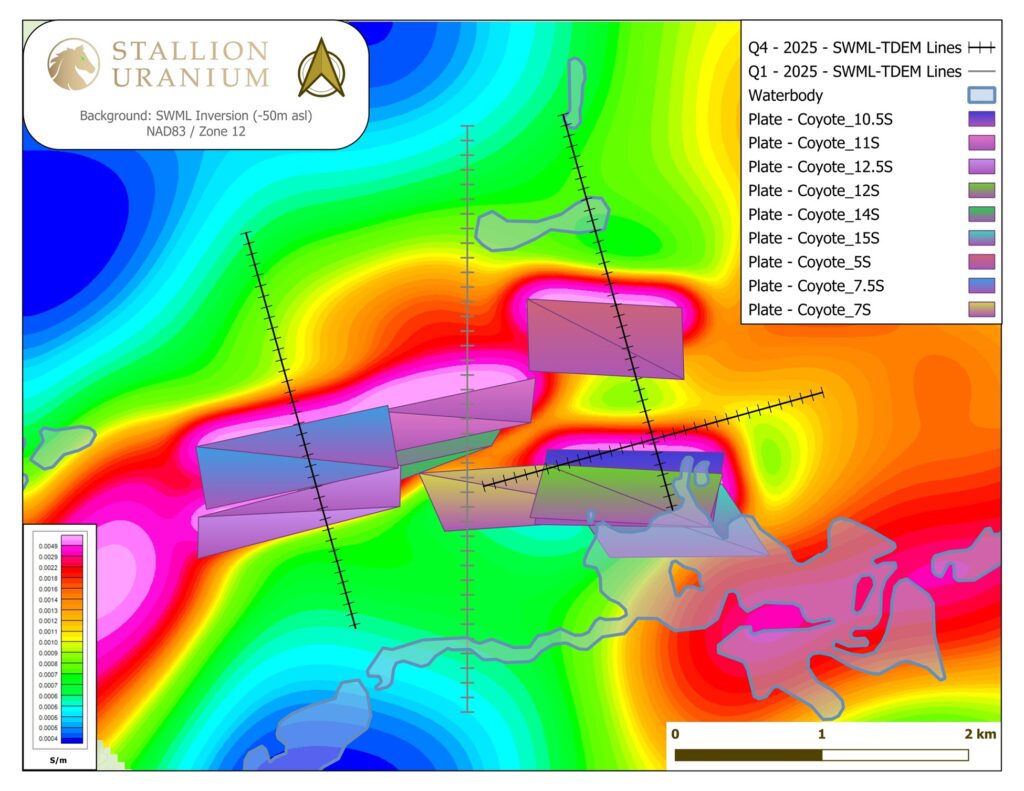
Figure 1: Results of SWML Plate Modeling with EM Plates
25 m below Unconformity
Survey Overview:
Preliminary interpretation of the SWML-TDEM data has identified nine discrete electromagnetic conductors within the expanded survey area at the Coyote Target. Of these, six conductors exhibit strong conductance values exceeding 10 Siemens, which are considered significant in the context of basement-hosted uranium exploration in the Athabasca Basin.
The identified conductors are interpreted and modelled as:
Additional moderate conductors defined by the survey include Coyote_7.5S, Coyote_7S, and Coyote_5S.
These conductors occur within the broader Coyote Target area and are interpreted to be structurally controlled. Their geometry, continuity, and depth extent are currently being integrated with existing geological and geophysical datasets.
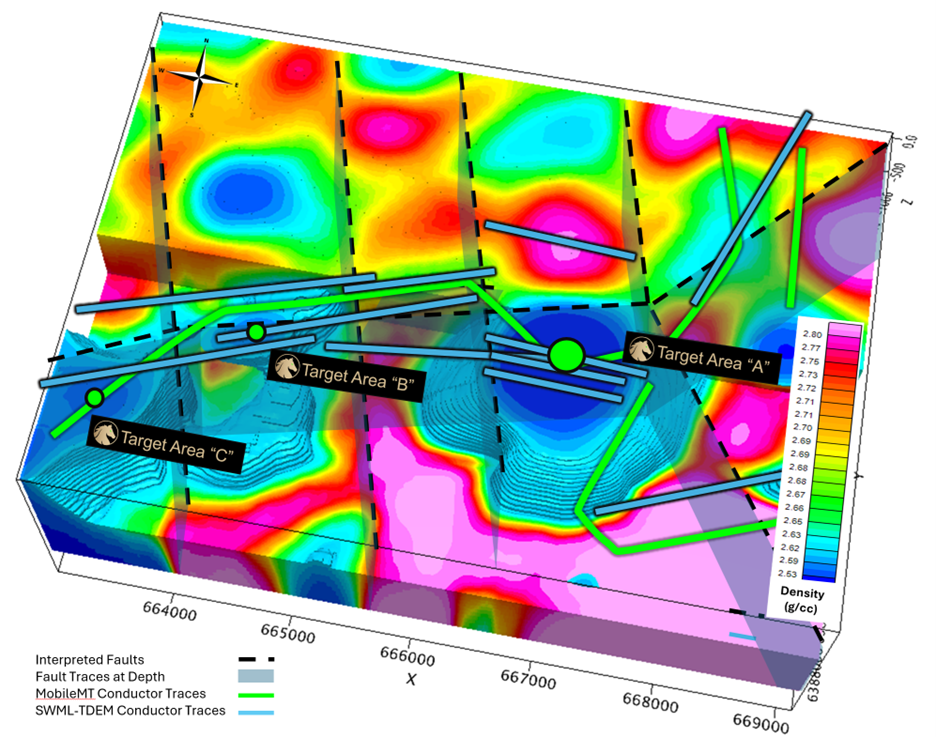
Figure 2: Coyote Target – 3D image of SWML Plate Traces over 3D Gravity
Results:
Inversion modelling of the gravity data identified multiple density low zones proximal to the unconformity, most notably a large, circular density low located in the southeastern quadrant of the survey grid. Maxwell plate modelling of the ground EM data delineated high-conductivity plates (10-15 S) that exhibit strong spatial correlation with these density lows. This correspondence is interpreted to indicate hydrothermal alteration developed within a graphitic shear zone, consistent with structurally controlled basement-hosted uranium systems.
To further constrain the geometry and continuity of the conductive features, a joint inversion incorporating Ground TEM and larger-scale MobileMT data was undertaken by Computational Geosciences Inc. This approach was critical in refining conductor trends, as it is not limited by the thin-plate assumption inherent in the Maxwell plate modelling workflow. The joint inversion augments the plate modelling by allowing for curvilinear conductor geometries and improved definition of strike extents. Notably, a break in the main conductor trend is observed coincident with a density high in the gravity model, indicating a likely structural control on conductor development and continuity.
SWML-TDEM Survey:
Abitibi Geophysics completed the SWML-TDEM survey over a single 5.8 km-long line using nine overlapping transmitter loops (each 400 m x 600 m), recording high-resolution electromagnetic responses at regularly spaced receiver stations along the profile. This survey was conducted using Abitibi Geophysics’ proprietary ARMIT-TDEM system, which captures both B-field and dB/dt responses across three components simultaneously. These two data types are sensitive to different conductivity ranges and, when combined, enhance the detection and resolution of subsurface conductors.
The use of stepwise overlapping loops improves resolution compared to fixed-loop systems and is particularly well-suited for identifying discrete conductors in the complex basement geology of the Athabasca Basin. The data were collected using 10 Hz base frequency, with robust stacking, QA/QC protocols, and real-time data validation to ensure high-quality results.
About the Plate Modeling:
Once field data were collected, advanced 3D modeling was conducted using EMIT Maxwell software to convert raw EM data into interpretable geological features. The modeling process used the Leroi algorithm to simulate conductive plates within a layered-earth model; a critical feature for Athabasca-style settings where strong resistivity contrasts exist above and below the unconformity.
Modeling began with verification of survey geometry and the removal of noisy or suspect readings. Conductor plates were then inserted, oriented, and refined to match the observed EM response across multiple components. The final plate models were evaluated for geological plausibility, structural coherence, and data fit. The resulting models were exported and integrated with gravity, historical, and structural datasets to prioritize drill targets with the highest discovery potential.
VTEM™ Plus Survey Mobilization – Stone Island Target:
Stallion Uranium has commenced mobilization of a helicopter-borne VTEM™ Plus (Versatile Time Domain Electromagnetic) geophysical survey over the Stone Island Target at its Moonlite Project in the eastern Athabasca Basin, Saskatchewan. Mobilization of the survey began on January 6, 2026, marking the first geophysical survey conducted by the Company on the Moonlite Project since the claims were staked.
The VTEM™ Plus survey is designed to identify electromagnetic conductors and structural features beneath Athabasca sandstone cover that may be associated with uranium mineralization. The resulting targets are expected to be relatively shallow and amenable to efficient follow-up exploration. The survey will also provide detailed magnetic data to aid in mapping lithological boundaries and structural trends across the Stone Island area.
Results from the VTEM™ Plus survey will establish a foundational geophysical dataset for the Stone Island Target and will be integrated with geological interpretations to refine target generation and guide future exploration programs at the Moonlite Project.
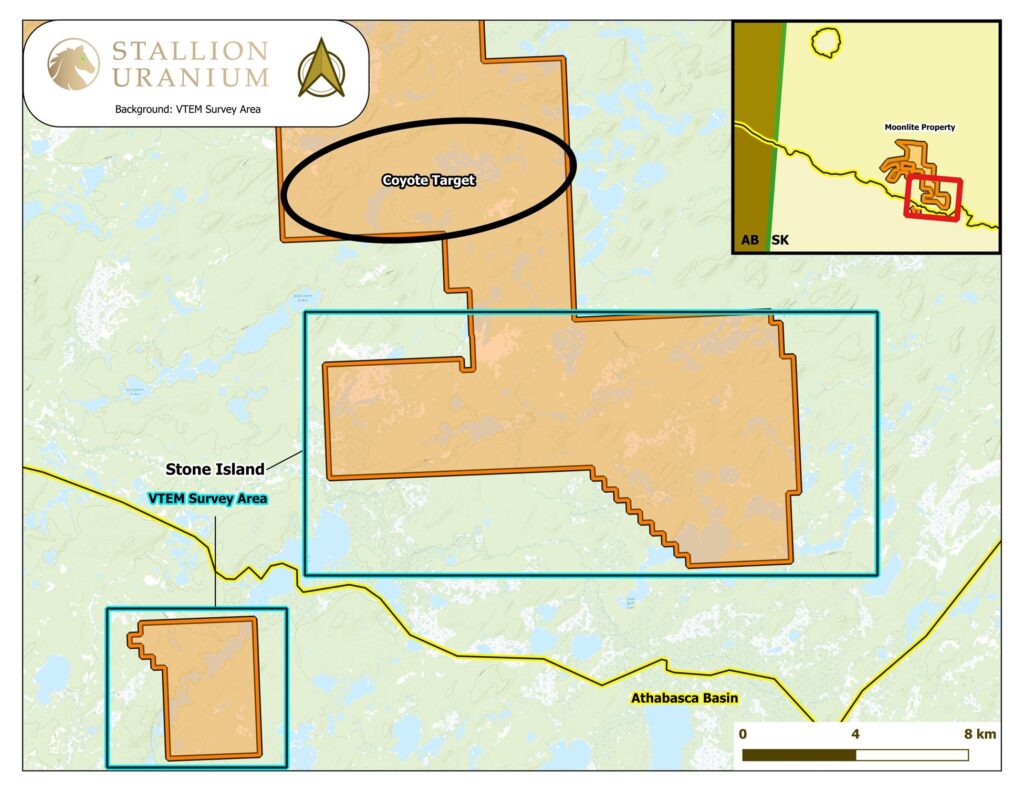
Figure 3: VTEM™ survey area
Qualifying Statement:
The foregoing scientific and technical disclosures for Stallion Uranium have been reviewed and approved by Darren Slugoski, P.Geo., VP Exploration, a registered member of the Professional Engineers and Geoscientists of Saskatchewan. Mr. Slugoski is a Qualified Person as defined by National Instrument 43-101.
Kyle Patterson, P.Geo., President of Convolutions Geoscience, has reviewed and approved the foregoing scientific and technical disclosures for Convolutions Geoscience Corporation. Kyle is a registered member of the Professional Engineers and Geoscientists of Saskatchewan and the Engineers and Geoscientists of British Columbia.
About Stallion Uranium Corp.:
Stallion Uranium is working to ‘Fuel the Future with Uranium’ through the exploration of roughly 1,700 sq/km in the Athabasca Basin, home to the largest high-grade uranium deposits in the world. The company, with JV partner Atha Energy holds the largest contiguous project in the Western Athabasca Basin adjacent to multiple high-grade discovery zones. With a commitment to responsible exploration and cutting-edge technology such as the use of the proprietary Haystack TI technology, Stallion is positioned to play a key role in the future of clean energy.
Our leadership and advisory teams are comprised of uranium and precious metals exploration experts with the capital markets experience and the technical talent for acquiring and exploring early-stage properties. For more information visit stallionuranium.com.
Brutus Mining Inc. (CSE: BRU) (FSE: ZI3) is pleased to announce that it has closed its non-brokered ... READ MORE
Jaguar Uranium Corp. (NYSE American: JAGU) is pleased to announce an independent Mineral Resource E... READ MORE
Auro Metals Inc. (TSX-V: AURO) (OTCQB: AURFF), is pleased to announce the assay results of the fina... READ MORE
Endeavour Silver Corp. (NYSE: EXK) (TSX: EDR) is pleased to announce that repairs to the primary bal... READ MORE
Scorpio Gold Corp. (NASDAQ: SGLD) (TSX-V: SGLD) (OTCQB: SRCRF) (FSE: RY9) is pleased to announce re... READ MORE