






Gallium, Rare Earth and Scandium Results From Eleven New Cruzeta Holes in Spark’s Expanded 37-Hole Campaign
Spark Energy Minerals Inc. (CSE: SPRK) (OTC Pink: SPARF) (FSE: 8PC) reports results from eleven additional RC holes at Cruzeta, bringing the number of reported holes at the target to 28 since drilling began in December 2025. To date, drilling has consistently encountered gallium mineralization from surface, followed by broad rare earth mineralization below. A systematic review of the complete 28-hole dataset now adds a new element to the Cruzeta story: scandium.
Spark‘s Highest Gallium Result at Cruzeta to Date: 91.4 g/t Ga₂O₃, With Gallium From Surface in All Eleven Holes
The 91.4 g/t Ga₂O₃ result occurs over 2 m within a broader 32 m interval from surface grading 73.9 g/t Ga₂O₃. Broad rare earth mineralization continues beneath the surface gallium horizon, supporting Spark’s interpretation of a vertically zoned weathering profile at Cruzeta.
Scandium Reported From Surface in Seven Cruzeta Holes, Best 30 m at 21.5 g/t Sc₂O₃
Scandium has been included in the routine multi-element analytical suite since the first Cruzeta sample batch and is reported in the laboratory certificates for every hole. On re-examination of the complete 28-hole dataset the Company has now compiled and interpreted those results for the first time. Seven Cruzeta holes return a scandium interval from surface. The best is 30 m from surface at 21.5 g/t Sc₂O₃ in ARA-RC-021, which includes 26.1 g/t Sc₂O₃ over 2 m from 12 m in a sample that also assays 75.3 g/t Ga₂O₃. Scandium at Cruzeta is associated with the iron and titanium oxide fraction of the weathering profile, which is the same fraction that carries the gallium, rather than with the clay fraction that hosts the adsorbed rare earths. Higher individual values do occur outside that surface horizon, including 38.3 g/t Sc₂O₃ over 2 m from 52 m in ARA-RC-028, within the deeper rare earth zone. Spark intends to request a lower-detection-limit analytical method on retained sample pulps and to add scandium to the metallurgical scope at ANSTO.
Key Results From the Latest Cruzeta Drilling
“Cruzeta has progressed from a five-hole maiden program to a 28-hole target-scale dataset, and the mineralized sequence continues to repeat,” said Dr. Fernando Tallarico, Chief Executive Officer of Spark Energy Minerals Inc. “The 91.4 g/t gallium result and the identification of scandium sharpen our priorities: complete the ANSTO work, re-analyze scandium using a lower-detection-limit method and plan the infill drilling needed to support a future maiden mineral resource estimate.”
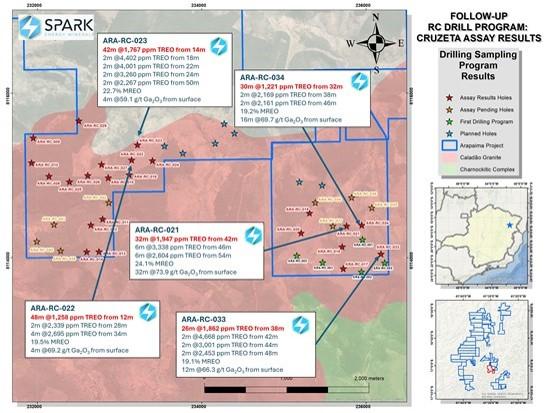
Figure 1: Plan map of the Cruzeta target showing RC drill-hole locations and status across Spark‘s maiden and follow-up RC drill programs.
Expanded Multi-Target Follow-Up Program
The eleven holes, ARA-RC-021 through ARA-RC-029, ARA-RC-033 and ARA-RC-034, bring the number of reported Cruzeta holes to 28 and form the Cruzeta component of Spark’s broader multi-target follow-up RC program at Arapaima.
Spark originally announced a minimum 20-hole follow-up program across three priority areas at Arapaima. As drilling progressed, encouraging results supported additional drill coverage and the Company expanded the program to 37 holes, for total drilling of 2,024 metres.
Together with the five-hole maiden program, Spark has now completed 42 RC holes across the Project. Results from holes completed at other targets within the Arapaima Project are excluded from this release and will be reported separately.
Selected Drill Results
The following five holes combine the strongest gallium and rare earth results from the eleven-hole batch. Complete sample-level results for all 28 reported Cruzeta holes are available in the supporting schedule below:
| Hole | Ga₂O₃ composite | Peak 2 m Ga₂O₃ | TREO composite | Peak 2 m TREO |
| ARA-RC-021 | 32 m from 0 m @ 73.9 g/t | 91.4 g/t | 32 m from 42 m @ 1,947 ppm | 3,908 ppm |
| ARA-RC-022 | 4 m from 0 m @ 69.2 g/t | 72.6 g/t | 48 m from 12 m @ 1,258 ppm | 2,900 ppm |
| ARA-RC-023 | 4 m from 0 m @ 59.1 g/t | 61.8 g/t | 42 m from 14 m @ 1,767 ppm | 4,402 ppm |
| ARA-RC-033 | 12 m from 0 m @ 66.3 g/t | 80.7 g/t | 26 m from 38 m @ 1,862 ppm | 4,668 ppm |
| ARA-RC-034 | 16 m from 0 m @ 69.7 g/t | 82.0 g/t | 30 m from 32 m @ 1,221 ppm | 2,170 ppm |
Table 1. Selected results from the eleven-hole Cruzeta batch. Gallium composites are reported from surface above a 50 g/t Ga₂O₃ basis; rare earth composites above a 500 ppm TREO basis. Both are contiguous over a minimum 4 m length, with no internal dilution. Intervals are down-hole widths; true widths are not known.
Why Gallium, Rare Earths and Scandium Matter
Gallium is generally recovered as a by-product of processing bauxite and, to a lesser extent, zinc ores rather than from primary gallium mines. The U.S. Geological Survey estimates that China accounted for approximately 99% of worldwide primary low-purity gallium production in 2025. Gallium is used in compound semiconductors supporting telecommunications, electric-vehicle charging, LED lighting, solar cells, aerospace systems and defense electronics. Magnet rare earths are used in high-performance permanent magnets for electric motors, wind turbines and advanced technologies.
Scandium is used principally in high-strength, lightweight aluminium alloys and solid oxide fuel cells. The U.S. Geological Survey reports that scandium was produced exclusively as a by-product in 2025, primarily from nickel and titanium processing streams and previously processed residues. At Cruzeta scandium occurs in the same surface horizon as the gallium.
Next Steps
Metallurgical test work at ANSTO in Australia is in progress. Spark intends to add scandium to that scope alongside gallium and rare earth elements. Planning is also underway for an infill drilling program at Cruzeta designed to support a future maiden mineral resource estimate. Assay results from targets outside Cruzeta remain pending and will be reported separately.
Drill Hole Information
The holes are vertical RC drill holes (dip −90°). Collar coordinates are in SIRGAS 2000 UTM Zone 24S. Reported intervals are down-hole widths; true widths are not known and may differ materially.
| Hole | Area | Easting | Northing | RL (m) | Depth (m) | Dip |
| ARA-RC-021 | Cruzeta East | 235,764 | 8,114,387 | 941 | 74 | −90° |
| ARA-RC-022 | Cruzeta West | 233,147 | 8,115,189 | 863 | 60 | −90° |
| ARA-RC-023 | Cruzeta West | 233,217 | 8,115,373 | 864 | 56 | −90° |
| ARA-RC-024 | Cruzeta West | 233,401 | 8,115,180 | 883 | 36 | −90° |
| ARA-RC-025 | Cruzeta West | 232,391 | 8,114,923 | 932 | 56 | −90° |
| ARA-RC-026 | Cruzeta West | 232,614 | 8,115,001 | 961 | 66 | −90° |
| ARA-RC-027 | Cruzeta West | 232,781 | 8,115,135 | 1,027 | 38 | −90° |
| ARA-RC-028 | Cruzeta West | 232,142 | 8,114,992 | 1,004 | 74 | −90° |
| ARA-RC-029 | Cruzeta West | 232,505 | 8,115,664 | 1,000 | 74 | −90° |
| ARA-RC-033 | Cruzeta East | 236,183 | 8,114,046 | 796 | 64 | −90° |
| ARA-RC-034 | Cruzeta East | 235,948 | 8,114,395 | 826 | 62 | −90° |
Table 2. Drill-hole collar information for the eleven-hole Cruzeta batch. Cruzeta East and Cruzeta West are subdivisions of a single continuous target.
Technical Notes and Reporting Basis
“TREO” means total rare earth oxides and is calculated as the arithmetic sum of CeO₂, La₂O₃, Pr₆O₁₁, Nd₂O₃, Sm₂O₃, Eu₂O₃, Gd₂O₃, Tb₄O₇, Dy₂O₃, Ho₂O₃, Er₂O₃, Tm₂O₃, Yb₂O₃, Lu₂O₃ and Y₂O₃. “MREO” means magnet rare earth oxides and is calculated as Nd₂O₃ + Pr₆O₁₁ + Dy₂O₃ + Tb₄O₇. Samarium is not included. “NdPr” means Nd₂O₃ + Pr₆O₁₁.
Gallium is reported as gallium oxide (Ga₂O₃) and scandium as scandium oxide (Sc₂O₃), each in grams per tonne. TREO, MREO, NdPr, Ga₂O₃ and Sc₂O₃ values are in-situ analytical assay results only. They should not be interpreted as recoverable oxides, metal-equivalent grades, mineral-equivalent grades or implied metallurgical recoveries.
Reported intervals are length-weighted composites over a minimum 4 m length, contiguous, with no internal dilution. Rare earth intervals are reported above a 500 ppm TREO basis. Gallium and scandium intervals are reported from surface above a 50 g/t Ga₂O₃ basis and a 15 g/t Sc₂O₃ basis respectively. Individual high-grade sample values are not necessarily representative of the mineralization sampled.
The analytical detection limit for scandium under the method used is 5 g/t elemental scandium, equivalent to approximately 7.7 g/t Sc₂O₃. Across the 28-hole Cruzeta dataset, 41 percent of samples returned at or below that limit. Because the 15 g/t Sc₂O₃ reporting basis is approximately twice the detection limit, no reported scandium interval contains a below-detection sample. Scandium is reported by the laboratory to whole units of elemental scandium, where one part per million of scandium is equivalent to approximately 1.5 g/t Sc₂O₃. In the supporting sample-level data, results below detection are carried at half the detection limit. Spark intends to request a lower-detection-limit method and to re-analyze retained sample pulps. No metallurgical recovery of scandium has been demonstrated.
Quality Assurance / Quality Control, Sampling and Analytical Procedures
Samples were collected at 2 m down-hole intervals from vertical RC drill holes, with one 4 m sample taken in ARA-RC-003 where ground conditions limited sample recovery. Each sample was split using a Jones riffle splitter to approximately 2 kg for analysis, with approximately 1 kg retained for archiving and future metallurgical test work. The quality-control program comprised a blank as the first sample of each drill-hole batch from ARA-RC-006 onward, a field duplicate every 20 samples, and two certified reference materials every 15 samples in the five maiden holes and every 25 samples in all subsequent holes. Control samples are excluded from the reported assay tables.
Samples were submitted to the independent SGS Geosol Ltda laboratory in Vespasiano, Minas Gerais, Brazil. Sample preparation comprised crushing and pulverizing followed by Jones splitting (code PRP70J_A2-PA). Analysis was by ICP-MS/OES following sodium peroxide fusion for 56 elements, including rare earth elements, gallium and scandium (code ICM90A).
Data Verification
In accordance with NI 43-101, the Qualified Persons have verified the data underlying the scientific and technical information in this news release. Verification included review of laboratory certificates of analysis against the Company’s assay database, review of quality-control results, including blanks, field duplicates and certified reference materials, and review of drill-hole collar and survey information.
The data reviewed were found to be consistent with the Company’s assay database and adequate for the purpose of this disclosure. Verification was limited to data available as of the date of this news release; no independent verification sampling or re-assaying was undertaken, and the results have not been verified by, and do not constitute, a mineral resource estimate.
The Qualified Persons are not aware of any drilling, sampling or analytical factors that would materially affect the accuracy or reliability of the assay data disclosed, subject to the assumptions, limitations and cautionary statements described in this news release.
Exploration-Stage Property; No Mineral Resource or Economic Analysis
The Arapaima Project is an exploration-stage property. No mineral resource or mineral reserve has been estimated for the Project, and no preliminary economic assessment, pre-feasibility study, feasibility study or other economic analysis has been completed. There is no certainty that further exploration will result in the delineation of a mineral resource or that any mineralization identified will prove economically or technically viable to extract.
No recovery of scandium, gallium or rare earth elements has been demonstrated, and no economic assessment of those elements has been undertaken. Nothing in this release should be interpreted as a statement that they occur in economically recoverable concentrations at Arapaima.
Cautionary Statement Regarding Exploration Results
The exploration results disclosed in this release are preliminary. Reported drill intercepts are not necessarily indicative of mineralization elsewhere on the property or at depth. References to a “system,” “horizon,” “footprint,” “continuity,” “repeatability,” “zonation” or deposit “style,” including any ionic-adsorption-clay interpretation, reflect the Company’s current geological interpretation only and have not been verified by a mineral resource estimate. Reverse circulation sampling may be subject to contamination, sample loss and down-hole dilution.
Qualified Person
The scientific and technical information in this release has been reviewed and approved by Jonathan Victor Hill, BSc (Hons), FAusIMM, VP Exploration, Country Manager & Director of the Company, and Dr. Fernando Tallarico, P.Geo., FSEG, Chief Executive Officer & Chairman of the Company, each a Qualified Person as defined by National Instrument 43-101 — Standards of Disclosure for Mineral Projects. Neither Qualified Person is independent of the Company.
About Spark Energy Minerals Inc.
Spark Energy Minerals Inc. is a Canadian company advancing the exploration and development of critical minerals essential to the clean-energy transition. The Company’s primary focus is Brazil, where it controls a significant land position within the country’s emerging Lithium Valley. Spark’s flagship Arapaima Project spans approximately 91,900 hectares and hosts multiple targets for gallium, scandium, rare earth and lithium mineralization.
Brutus Mining Inc. (CSE: BRU) (FSE: ZI3) is pleased to announce that it has closed its non-brokered ... READ MORE
Jaguar Uranium Corp. (NYSE American: JAGU) is pleased to announce an independent Mineral Resource E... READ MORE
Auro Metals Inc. (TSX-V: AURO) (OTCQB: AURFF), is pleased to announce the assay results of the fina... READ MORE
Endeavour Silver Corp. (NYSE: EXK) (TSX: EDR) is pleased to announce that repairs to the primary bal... READ MORE
Scorpio Gold Corp. (NASDAQ: SGLD) (TSX-V: SGLD) (OTCQB: SRCRF) (FSE: RY9) is pleased to announce re... READ MORE