







Southern Cross Gold Consolidated Ltd (TSX: SXGC) (ASX: SX2) (OTCQX: SXGCF) (FSE: MV3) announces results from two drill holes from the 100%-owned Redcastle Project in Victoria (Figures 1 to 7). Redcastle is located 64 km to the NNW of the Company’s Sunday Creek project (Figure 7).
Best results included 26.2 g/t Au over 0.14 m from 112.98 m and 15.4 g/t Au over 0.22 m from 321.84 m in drill hole SDDRE016 at the Laura prospect, two of eight individual high-grade gold intervals from that hole, which confirmed Costerfield-style gold-antimony mineralization including visible gold over more than 250 m of vertical extent. The true thickness of the mineralized intervals is interpreted to be approximately 70% to 85% of the sampled thickness for all reported holes.
Four High Level Takeaways:
Michael Hudson, President & CEO, states: “These are the first deep holes ever drilled beneath the Laura prospect at Redcastle, and they have done exactly what we hoped. We have intersected high-grade gold, visible gold and antimony in the same Costerfield-style vein architecture that has made this corner of Victoria one of the highest-grade gold endowments on earth.
“Redcastle sits just 7 km along strike from Costerfield, on a parallel structure, with 14 reefs over a 900 m wide corridor and 17 km of historic workings that have barely been scratched below the water table. SDDRE016 tells us the system has real depth potential, and it is only the beginning of a sustained regional campaign.
“With eleven rigs now turning across our landholding and results pending from 71 holes, Redcastle adds a genuine second engine of discovery alongside Sunday Creek as we drill through to the first quarter of 2027.”
For Those Who Like the Details – Highlights:
Drill Hole Discussion
Two drill holes are reported here targeting the Laura and Beautiful Venus prospects within the broader Redcastle Project, drilled in a west-to-east orientation to optimize high intersection angles across the steeply dipping vein architecture.
SDDRE016
SDDRE016 was designed to test the mineralized western limb of an NNW-SSE trending Redcastle Anticline, targeting at depth several bedding-parallel to sub-parallel structures expressed as workings at surface, together with a large IP chargeability body modelled from 155 m. The hole intersected steeply west-dipping bedding and vein-hosted pyrite-arsenopyrite mineralization from 102 m to 360 m, before passing through an anticlinal hinge at approximately 380 m to a final depth of 410.45 m. Mineralized veins were absent between the hinge zone and the end of hole.
Three styles of mineralized features were logged: a deformed black shale unit, bedding-parallel laminated veins, and steep to vertical extensional veins. Mineralization is punctuated by arsenopyrite-pyrite halos developed around veins, with antimony and gold hosted within the veins themselves. Visible gold was intersected in subvertical extensional veins fringed by arsenopyrite haloes, reminiscent of Costerfield-style mineralization.
As one of the first holes to test the Laura prospect to this depth, SDDRE016 is highly encouraging. The headline 26.2 g/t Au intercept lies at a vertical depth of approximately 86 m below surface, while deeper high-grade veins extend the mineralized system to more than 250 m of vertical extent. Further drilling is required to define strike and dip continuity between intercepts. Better results included:
SDDRE017
SDDRE017 tested the Beautiful Venus prospect, drilled west to east where the previous hole MDDRE014 intersected old workings at a vertical depth of 42.5 m.
Trace antimony was observed in a steep extensional vein at 66.5 m down hole. The hole returned low-tenor gold, with a best individual result of 0.91 g/t Au over 0.29 m from 140.71 m, and confirms the structural and vein setting for future targeting at the prospect.
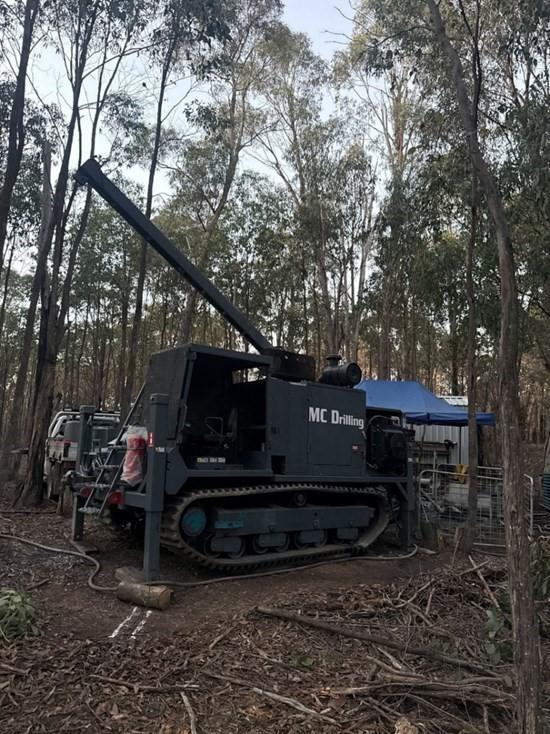
Figure 1: Regional drill rig set up at Redcastle.
About Redcastle
The Redcastle Gold-Antimony Project, located 110 km north of Melbourne and 64 km NNW of Sunday Creek in central Victoria. The project comprises three granted exploration licences (EL5546, EL7498 and EL7499) covering a combined 7,500 hectares. The project straddles the northern tenements of Alkane Resources’ Costerfield gold-antimony mine, sitting 7 km along strike from Costerfield on a parallel north-south structure and 24 km east of Agnico Eagle’s Fosterville mine.
The Redcastle goldfield is a structurally controlled epizonal system, centred on the western limb of the plunging Redcastle Anticline and hosted in thinly interbedded Silurian sandstones and mudstones. Gold mineralization occurs in bedding-parallel laminated quartz veins striking ~345° and dipping steeply westward, containing quartz, carbonate, visible gold and stibnite, with a narrow arsenopyrite-pyrite halo in the surrounding host rock. The field is distinguished by closely spaced reefs, with 14 individual reefs occurring across a 900 m cross-strike distance on the western side, and combined historic workings extending over 17 km of strike.
First discovered in 1859, Redcastle is one of the most significant historic epizonal high-grade goldfields in Victoria. Reef mining during the 1859 to 1865 period delivered exceptional grades from narrow, continuous structures: the Welcome Group of mines extracted 20,583 oz at 254.6 g/t Au over 2 km of strike length down to a maximum depth of 125 m, and the Redcastle Gold Mining Company produced 35,000 oz at 33 g/t Au from Clarke’s Reef. Historic mining was shallow (average ~55 m depth) with individual reef widths typically under 0.6 m and average mining widths of approximately 1 m.
Further Information
Further discussion and analysis of the Redcastle project is available at https://www.southerncrossgold.com/projects/redcastle on the SXGC website. These data, along with an interview on these results with President & CEO/Managing Director Michael Hudson can be viewed at www.southerncrossgold.com.
No upper gold grade cut is applied in the averaging and intervals are reported as drill thickness. However, during future Mineral Resource studies, the requirement for assay top cutting will be assessed. The Company notes that due to rounding of assay results to one decimal place, minor variations in calculated composite grades may occur.
Figures 1 to 7 show project location, plan and longitudinal views of drill results reported here and Tables 1 to 2 provide collar and assay data. The true thickness of the mineralized intervals reported individually as estimated true widths (“ETW”), otherwise they are interpreted to be approximately 70% to 85% of the sampled thickness for other reported holes. No compositing has been undertaken.
Critical Metal Epizonal Gold-Antimony Deposits
Redcastle (Figure 7) is an epizonal gold-antimony deposit formed in the late Devonian (like Fosterville, Costerfield and Sunday Creek), 60 million years later than mesozonal gold systems formed in Victoria (for example Ballarat and Bendigo). Epizonal deposits are a form of orogenic gold deposit classified according to their depth of formation: epizonal (<6 km), mesozonal (6 km to 12 km) and hypozonal (>12 km).
Epizonal deposits in Victoria often have associated high levels of the critical metal, antimony, and Sunday Creek and Redcastle are no exception. China claims a 56 per cent share of global mined supplies of antimony, according to a 2023 European Union study. Antimony features highly on the critical minerals lists of many countries including Australia, the United States of America, Canada, Japan and the European Union. Australia ranks seventh for antimony production despite all production coming from a single mine at Costerfield in Victoria, located nearby to all SXGC projects. Antimony alloys with lead and tin which results in improved properties for solders, munitions, bearings and batteries. Antimony is a prominent additive for halogen-containing flame retardants. Adequate supplies of antimony are critical to the world’s energy transition, and to the high-tech industry, especially the semi-conductor and defence sectors where it is a critical additive to primers in munitions.
About Southern Cross Gold Consolidated Limited
Southern Cross Gold Consolidated Ltd. is defining a leading gold-antimony project at the Sunday Creek Gold-Antimony Project, located 60 km north of Melbourne. Sunday Creek is a significant gold and antimony drill discovery in a Tier 1 location, with high-grade drill results including 88 composite intersections exceeding 100 g/t Au from 126.3 km of drilling. The mineralization follows a “Golden Ladder” structure over 12 km of strike length, with structures tested from surface to 1,200 m depth.
Sunday Creek’s strategic value is enhanced by its dual-metal profile. The Company has a critical mineral the Western world needs. This has gained increased significance following China’s export restrictions on antimony, a critical metal for defence and semiconductor applications. Southern Cross’ inclusion in the US Defense Industrial Base Consortium (DIBC) and Australia’s AUKUS-related legislative changes position it as a potential key Western antimony supplier.
Technical fundamentals further strengthen the investment case, with preliminary metallurgical work showing non-refractory mineralization suitable for conventional processing and gold recoveries of 93% to 98% through gravity and flotation.
With a strong cash position, 1,392 Ha of strategic freehold land ownership, and a large 200 km drill program planned through Q1 2027, SXGC is well-positioned to advance this globally significant gold-antimony discovery in a tier-one jurisdiction, delivering milestone by milestone.
Brutus Mining Inc. (CSE: BRU) (FSE: ZI3) is pleased to announce that it has closed its non-brokered ... READ MORE
Jaguar Uranium Corp. (NYSE American: JAGU) is pleased to announce an independent Mineral Resource E... READ MORE
Auro Metals Inc. (TSX-V: AURO) (OTCQB: AURFF), is pleased to announce the assay results of the fina... READ MORE
Endeavour Silver Corp. (NYSE: EXK) (TSX: EDR) is pleased to announce that repairs to the primary bal... READ MORE
Scorpio Gold Corp. (NASDAQ: SGLD) (TSX-V: SGLD) (OTCQB: SRCRF) (FSE: RY9) is pleased to announce re... READ MORE