






Rick Mills, Editor/ Publisher, Ahead of the Herd:
Malcolm, could you explain more about what a Tier 1 mining jurisdiction is using the area Torr is operating in as an example?
Malcolm Dorsey, President and CEO, Torr Metals (TSX-V:TMET):
When looking for Tier 1 mining jurisdictions, for me the biggest indicator is going to be who are the operators in the area? Are you talking mostly small market cap juniors? Are you talking juniors that are moving into production or pre-production, trying to reach that mid-tier status?
But where it’s truly Tier 1 is where are the majors being attracted, where are they concentrating? You should have large land packages owned by majors throughout with multiple operating mines.
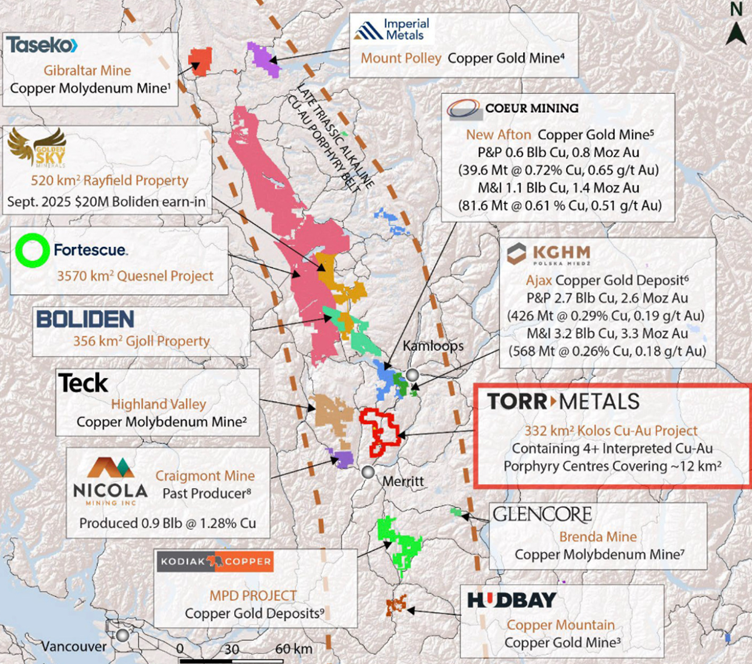
If you transport that image to southern British Columbia it’s the exact same thing. When we’re looking within the Southern Quesnel Trough, you have the greatest concentration of major copper producers in British Columbia. You have nine major miners.
You’ve got several operating copper mines, and these are all strung out along a north-south trend. So that, I think, really defines that this is an area that’s important. This is an area where there’s major mining operations already existing, but also where there’s excellent opportunities for finding additional new deposits.
RM: Where Torr is working is the opportunity for juniors to gain a large land position realistic?
MD: In terms of building a large land package, I think that’s now no longer possible within the Southern Quesnel Trough, at least a truly prospective land package. Myself, and my brother, Cameron, we spent several years working in the Quesnel Trough, and we were able to acquire large land packages privately back when people didn’t care about copper, back in 2017.
What really attracted me to this area, between the city of Kamloops and the town of Merritt, was following along the same porphyry trends. I’d been eyeing it for quite a few years. It had been a patchwork of different claims held by mainly prospectors in the area, which had been the case for quite a few decades.
It was just a matter of waiting for the opportunity for that ground to become available and then jumping on that opportunity. So that’s what I ended up doing in 2023 when I staked the beginnings of the Kolos Project. Since then, I have expanded it whenever there was opportunity to expand through staking.
The majority of the 332-square-kilometer project is 100%-owned by Torr, outside of the strategic option that I made last year on the Bertha property, which is 57 square kilometers. It was building a land package that I don’t think there’s any opportunity for something like that now. And when you look at what we’ve got, we’ve defined four very compelling copper-gold porphyry targets. None of them have been drilled before because none of them were defined before.
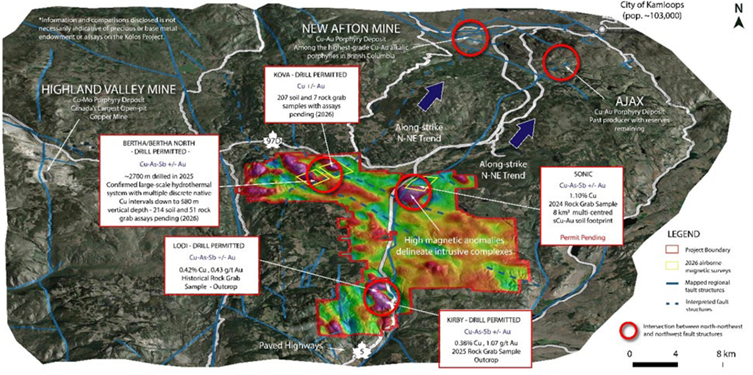
So, Torr has done the work over the last two years, all the groundwork to really define these targets. And we now have the largest land package with what I think are four of the most compelling undrilled targets closest to the New Afton mine, which is 30 kilometers to our north, as well as Highland Valley, which is 30 kilometers to our west.
RM: Tell us about the major assets held by the majors, those mines are getting old.
MD: The closest would be Highland Valley, which recently received permission to expand their operation. So, they would be good until about 2040. Teck (TSX:TECK.B) had previously slated about $2.4 billion to expand and update their mining infrastructure for new mine expansions.
That being said, though, that mine has been in operation for a very long time. Obviously, with these large copper mines, as you continue operations, the grade is decreasing, production is decreasing. You’re starting to scrape the bottom of the barrel in many ways.
And then you’ve got the New Afton deposit, which is smaller. It’s only 100 million tonnes to our north. It’s a copper-gold system, whereas Highland Valley is a copper-moly system. Coeur Mining (TSX:CDE) just acquired New Gold, which had two assets, New Afton and the Rainy River gold mine in northern Ontario.
Coeur Mining acquired New Gold in a $7 billion US share transaction. They specifically cited that New Afton they wanted not just for the gold production, as it was actually the highest gold-producing porphyry in BC back in 2015, but they wanted it as well as their first-ever copper producing asset.
We’re looking for the same style of system with Torr and the Kolos Project. There’s definitely a potential synergy there. If we make a significant new discovery, it could potentially be of the same style, with similar mineralization as what you might see around New Afton. So, there may be strategic relevance given proximity and system style; of course, any potential processing or feed scenario would require significant additional exploration, technical studies and approvals.
Major mining companies are here in our area of operation spending billions of dollars in M&A as well as on permanent infrastructure. You can be assured that these guys are not spending this money without wanting to also ensure the continuation of these mines. For that, they are going to need new sources of feed and there’s a very limited pipeline that could provide that. Really, I think in this area, it’s going to come down to new discoveries being made.
RM: It’s interesting watching the LOM, the life of mine on some of these larger copper mines in British Columbia. As the price of copper goes up, obviously, what was not economic at $3.50 or $4 a pound is suddenly economic at $6 a pound. But the fact remains, you can extend the life of mine on higher prices and copper prices are certainly moving higher. So that’s a big beneficiary.
But to stay in business, you’ve got to have a little bit of forward thinking and what are you going to replace your mined reserves with? The juniors have the projects, the land packages that might contain those resources that a major could turn into mining reserves.
The other thing that you mentioned is the gold is becoming very attractive. Now, the gold price has come off a little bit, but the gold component in some of these copper porphyries is very important to see because it’s an important byproduct credit.
MD: Yes. That is a bit of a BC specialty. New Afton is one of the highest-grade copper-gold porphyries in British Columbia. So, it’s a bit unusual in that its copper grades are more around 0.7% copper. But what makes BC attractive with these copper-gold alkalic systems is that the gold content tends to be quite high.
I like to say that they are often as much a gold deposit as they are a copper deposit.
But I think it is important as well, just to go back to your point, that these majors are forward-thinking, they think in terms of multi-decades, they’re not just knee jerk reactions. So, they are going to be watching, they’re going to be looking for where new discoveries are made that could be utilized for them.
That’s something that I keep touching on. It’s not just proximity that you want. It’s great to have a project that adds value and to have a project that’s next door to major miners. But you need to solve a problem for them.
In this case, their problem is that they are running out, they are going to need near-term feed. We’re looking for a similar style of system to what they’re currently mining. It is reasonable to expect operators to evaluate ways to extend mine life through potential transactions. Of course, I can’t speak for them but that’s potentially something to leverage in our case.
RM: Yes. People need to realize that these major miners, they’re not interested in an eight-year mine. They want something that spans literally decades. They want their life of mine to be 30 years.
Acquisitions can keep a very expensive mine to build going, paying you back over and over for your initial investment.
MD: I think an interesting thing as well is, because I have done project assessment for major miners in my past career as a geologist, it’s always interesting looking at new ideas. What Torr is doing with Kolos, these are all brand new. These four targets we’ve defined, they’ve never been defined before. Whereas stuff that’s been around for decades, the major miners are well aware of them. They’re very well aware of what the potential could be.
They’ve looked at it before, or they’ve looked at it multiple times over the past couple of cycles. It’s easier when you’ve got something brand new, because that’s when you turn their head. That’s when you surprise them.
Because they don’t know exactly what you’re going for, what you’re going to find. Whereas if it’s an old project, they know what the likelihoods are that are going to come out of your exploration.
RM: There’s really not a lot of new projects out there that have the ability to move a majors needle, when something new shows up on their radars they would naturally be concerned they might miss an opportunity. They have to be paying attention to what Torr Metals is doing.
MD: You do see that. It’s important to reinforce, all those nine major miners hold the ground or the mines.
They have hard assets. These are not just earn-in JVs or strategic investments. This is an area where they’re actually planting their flag.
With that, even in the last couple of years here, you would have seen Fortescue (ASX:FNG) and Boliden move in. They staked up just to my north. Fortescue staked the largest land package in all of British Columbia. I think it’s just over 3,000 square kilometers. So, that’s telling you right there that these guys are sitting in their head offices on opposite sides of the world asking, “Where do you think we could find another new porphyry system?” Both landed on the idea that’s going to be in southern BC within the Quesnel Trough. So, I think that really tells you these guys have very large databases.
They have very technical skilled teams. And when they’re canvassing, looking for where they think there’s going to be new opportunity, they decided that it was just going to be within the Southern Quesnel trough, very close to where my land package is.
RM: BC is considered a safe mining jurisdiction, the Southern Quesnel Trough especially so.
MD: That and integrated supply chains, as well as existing mining infrastructure, roads, highways going everywhere. You don’t need helicopters and you can operate year-round.
It’s phenomenal. It’s got everything else that you’re looking for, for accelerating a project quickly.
RM: You’ve made another discovery on the property, at least another potential mineralized zone.
So, why don’t we pick up where we left off in April in our last talk? I’ll put the links in so people can catch up. Tell us what you’ve been up to over the last month or so, and then we’ll do a deep dive on the Kolos.
Under the Spotlight Part I – Malcolm Dorsey, CEO Torr Metals
Under the Spotlight Part II – Malcolm Dorsey CEO Torr Metals
MD: Our first-ever drill program was late last year. We wrapped it up in December and then we released results. Something that I think came out of Phase 1, it showcased that we were in the periphery of a very large copper-gold porphyry system, but we were not in the center of it.
We drilled a geophysical target, some high-grade 17% copper outcropped at surface. What we could see in terms of the geophysics was this chargeability anomaly that was coincident with a relatively smaller, moderate resistivity anomaly. The ground cover in this area, there’s not much exposure for outcrops; the answers are going to come out of drilling. You need to drill these targets to get an idea of what the regional geology is. That first-ever drilling we did 2,700m.
What it showcased was really what I view as a large leakage feature. What that means is that we hit 68 discrete intervals of native copper which is quite interesting and unique, as when you look around in regional systems, the only one that really produces abundant native copper is the New Afton deposit, about 25 km north. So, it showed that but also showed that this mineralization goes down to 580m vertical depth, together with oxidation, which is a lot of alteration.
It’s deep reaching, it’s long-lived. In terms of prospectivity, from a technical perspective, that’s quite something. Really what you’ve done is you’ve confirmed that a large system exists, and there’s a porphyry pump somewhere, that’s pumping all this copper into this hydrothermal structural leakage.
RM: The other important thing is that we hit a picrite unit.
MC: Yes, picrite I’ve talked about many times before, it’s an excellent reducing agent. It’s chemically reactive because it’s got a lot of iron in it.
It’s an early primitive intrusive unit. Why it’s important in this region is because, especially when you find a large picrite unit like we did, it is the earliest intrusive portion of a complex that defines your regional structures. And regional structures are important for concentrating the mineralization.
So, now we’re following that picrite boundary. We’ve defined it in the geophysics. We’re stepping out just over a kilometer to our northwest along that boundary, and we’re going after what we’re calling the Bertha North target.
This one is different from our Phase 1 drilling, because it’s a larger, stronger resistivity anomaly, and it’s got a buried chargeability anomaly underneath it. That’s a different combination than what we drilled in Phase 1. Based on the geophysics, we believe that this could be a mineralized intrusive unit, which is what we were looking for. What we were missing in Phase 1 was the main body of the porphyry. So, now we’re trying to find the center of that porphyry system.
RM: You now have a strong vector now to the core, is that what you’re saying?
MD: We’ve got a vector, we had the geophysical signature. So, after the Phase 1 drilling, after going through that data and digesting it over the wintertime, we developed, added to our model, and it showcased that this is the geophysical signatures we were missing.
We’ve now found those at Bertha North. As soon as the snow melted in April, we got up there and field crews went around in this area. We previously had a large soil anomaly here, about 800 by 500 meters, but nobody historically had ever talked about there being outcrop in this area.
So, I wanted the field crews to go look for this potential outcrop, and they ended up finding quite a bit of outcrop. Within that outcrop, what we’re seeing is exactly the features that we were missing. We’re seeing a concentration of sheeted and stockwork veining.
That veining is altered, so you have a potassium feldspar alteration, which is indicative of hotter fluids closer to a potential core of a porphyry system. You have a wide variety of copper mineralization, so you get chalcocite, chalcopyrite, bornite, together with some native copper. What that tells you is this is a fertile system, and it’s hosted within an altered intrusive body.
So, that’s everything that we were missing in Phase 1, and we’ve been able to locate it specifically by using the geophysics that we did. Now we have all that, indicating that we’ve got our mineralized intrusive. This could be the potential source to the very extensive native copper that we encountered in Phase 1.
RM: Just to break in here, it’s not unusual to have several drill programs before getting into the heart of a copper porphyry.
MD: Yes. These are very large systems. They can have multi-kilometer extent to them before you come into the core of it.
It’s all about what we did in Phase 1. We were successful in that we confirmed that a large system exists. Now, though, Phase 2 is going to be vectoring towards the potential source of that system. Once we used those vectors to identify Bertha North, we were also able to identify our new Kova target.
No work, no surface geochemistry has ever been done up in that area. It’s about 2 kilometers along strike to the northeast. Interestingly, if you follow along strike from Bertha North going northeast, you go through Kova, and then you’ll eventually end up at the New Afton deposit, about 25 kilometers to the northeast of our Bertha North target.
I do believe that is the fundamental primary structural control for porphyry distribution and mineralization in this area. It’s interesting that Kova, we went up there utilizing the same exploration strategy that identified Bertha North. Right away while driving around on the forest service roads we were coming across mineralized outcrops, same style of mineralization, alteration within an intrusive unit as well.
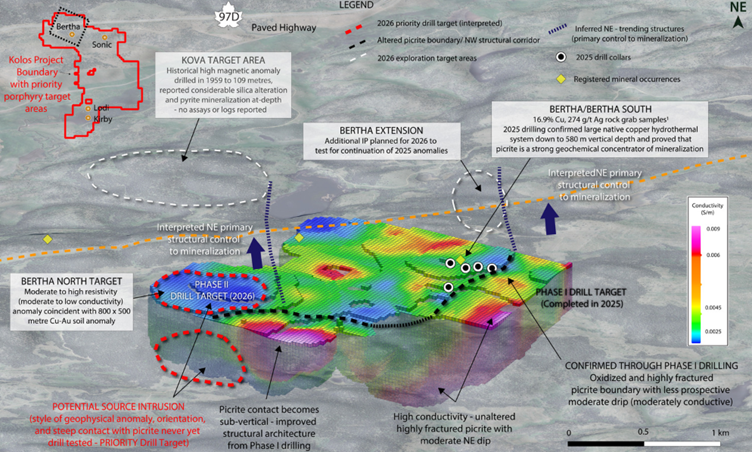
We’re currently completing some IP over Bertha North and Kova. That IP will be utilized to really refine our drill targeting, which is going to be part of Phase 2 here.
RM: You’ve been on the ground for a number of weeks and have gotten a very early and fast start.
MD: We’ve been on the ground since April, doing the necessary work to refine these targets, which was some additional geochemical sampling. We need to collect about 500 soils testing extensions, as well as the Kova target. We collected about 50 rock grab samples, mostly from outcrop that had never been sampled before.
That all has to be done in preparation for Phase 2. In Phase 2, I’m aiming for towards the end of May, beginning of June, to mobilize for drilling.
RM: When you’re looking at these projects, I know there’s ground cover and some of it’s buried, but there’s an awful lot of smoke in the Kolos land package. Let’s talk about Sonic, Kirby and Lodi and see if we can put it all together for our readers in just how much smoke there is in the Kolos project area.
MD: Definitely. That’s something that with Kolos has always been the pleasant surprise. We knew that it had been underexplored, but it was only once we got going in 2023, then we started simply driving around the forestry service roads in this area.
There’s FSRs are crisscrossing the property, so you can drive everywhere with no problem in a truck, and in many cases, you could do it in a sedan car. It was just driving around the property. There were only a few historical mineral occurrences, but pretty quickly we were finding more just driving around and finding new mineralized outcrops throughout the property.
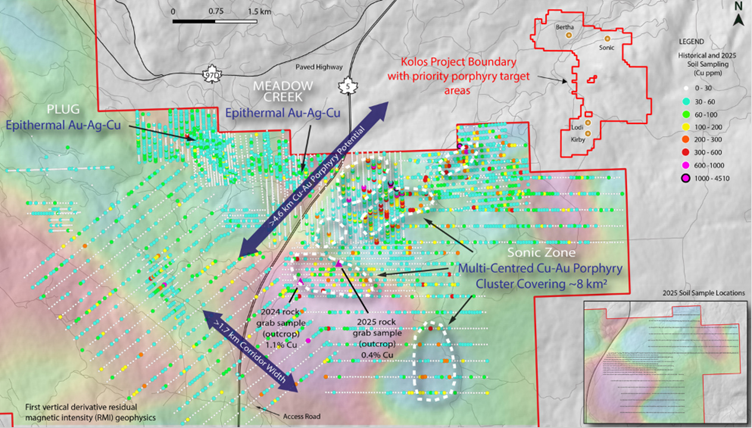
Sonic is one of those. The Sonic Zone is up in the northeast portion of the property. There was really nothing up in that area that had been done before.
The way we had identified it was using some regional geophysics that had been done by the government a couple of years ago. It had looked quite prospective based on the geophysics. Then as you’re driving up into the area, looking out of the windows of the truck to see if any rock outcrop is poking up, because this area does have a very thin till veneer, so that is one of the reasons it’s been under explored.
If it were up in the mountains, you’d probably be looking at big gossans exposed everywhere. Instead, we have that hidden underneath a relatively flat topography. But we looked out and we saw mineralized intrusive units.
The Sonic Zone has several different types of intrusive units, so a true intrusive complex. With that, we were able to identify right away zones of potassium and phyllic-style alteration, which is generally what you get closer to the potential core of a porphyry. We’ve been able to collect rock grab samples from outcrops that returned over 1% copper.
Those were the first-ever rock grab samples of this target area. Since then, we’ve defined a very large soil anomaly on the margins of this high magnetic geophysical signature. This area does seem to have a bit of a cluster porphyry system that’s developed.
It’s a very large footprint and it’s along strike of the Ajax deposit. Ajax is about 30 kilometers to the northeast of Sonic. It’s held by KGHM and it’s got about 3 billion pounds of copper, 3 million ounces of gold.
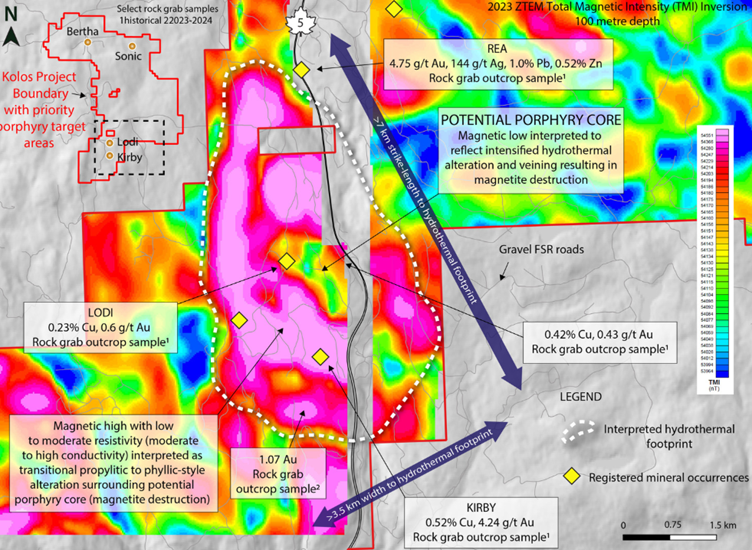
It’s a very large copper-gold system. With the Ajax, what you’re looking at is more typical BC-style grade. So, around the 0.3, 0.4% copper, 0.3 grams per tonne gold. A bit of a lower-grade, larger-tonnage-style system than what we’re looking for over at Bertha North and Kova, but still showcases that here’s another large-scale, compelling target, that covers a very large area. And then if you go down to the Kirby-Lodi, that is where we first started in 2023. That’s in the southern portion of the project area. What we found there was high grades as well. So, 0.5% copper, over 4 grams per tonne gold in rock outcrop.
We did some ZTEM back in 2023 that showcases a hydrothermal footprint that’s almost 24.5 square kilometers right next to Highway 5. This style of footprint is certainly on the scale of a very large system. Even if you’re looking towards Galore Creek, the hydrothermal footprint of Galore Creek is about the same up in northern British Columbia. So, this certainly is a highly prospective target as well, similar in features to what we see at the Sonic Zone.
More along the lines of a potential analog of Copper Mountain or Ajax for Kirby-Lodi or Sonic targets. It’s important to note that Kirby was one of the only historical occurrences on the property, and that one was only found in 2014. So, it really showcases to you the underexplored nature of this property, and the fact that we’ve been able to define these targets in the shadow of these giant mining operations for the first time.
RM: There’s a lot of smoke and we’re going drilling into it.
MD: Yes, we’re fully funded for an additional 6,000 meters of drilling. We’re focusing initially up on the Bertha North and Kova targets. That’s because we see the strongest potential for more of a mid-tonnage, high-grade-style system along the lines of New Afton.
That’s just looking at geological comparisons and also reinforcing that we’re looking for New Afton-style mineralization with the native copper and higher gold. That’s the potential we see within that area. We want to leverage that.
Any major looking at this is also going to see we also have the Sonic Zone, we have Kirby-Lodi. So that’s added value to the property that you have these two potentially larger cluster porphyry systems that are on the scale of these larger-tonnage deposits in the area.
RM: How many meters of drilling do you think you’re going to get done? And which project is going to get the meters?
MD: Following what I learned from working for major mining companies, you always want to do about 2,000 to 4,000 meters of drilling on a brand-new exploration target. That’s because that range will right away give you an idea, is this target worth following up further or do you need to move on to the next target? You saw that at Bertha, we drilled 2,700 meters. I think that answered to us what Bertha was and we were able to vector towards Bertha North.
We’re aiming to do about 2,000 meters at Bertha North, 2,000 meters at Kova. That’ll leave us with flexibility of an additional up to 2,000 meters to dedicate towards whichever target that we potentially might see some promising returns on.
RM: You wouldn’t leave a discovery to go drill Sonic.
MD: We don’t need to drill every target right away on the property. There’s a lot of value and if we find something and along the style of what we’re looking for in the Bertha North and Kova area, we don’t need to go and drill the other targets. We just define what the value is there. And then you’ve got that extra built-in value of we’ve got these additional large targets that have never been drilled.
It means that here’s a district-scale land package where we haven’t gone and stuck holes into everything. And so, any major looking at it will be able to see there’s upside here that could last decades. There’s multiple systems that remain untested.
RM: I talk to a lot of CEOs and a lot of them proclaim quite loudly, “We’re going mining, we can mine it.” You’ve got a different attitude.
I have no doubt that you could put together a team to advance this through mining, but that’s not really your objective here, is it?
MD: No, I’ve previously worked on plenty of projects that went up to those stages. Previously I did work on Sabina Gold and Silver’s Back River Project, which ended up being close to 9 million ounces and was sold to B2Gold (TSX:BTO). I also worked at Benchmark Metals and their Lawyers deposit.
I’d say the niche that I really enjoy is going from the early stage up to a maiden resource. I think that’s where you get the most value return as a shareholder.
Like you said, we certainly could put together a team. There are people on the board who have that experience, but it’s not something that we’re looking for. And I don’t think something that’s necessary here either, because if you’re up in the middle in a remote region and you don’t find a world-class deposit, you may be in that boat of where you’re going to have to go take it all the way to mining.
But where we’re located, I don’t think you have to go that far. It’s not the goal either. The goal here being that we define a brand-new discovery together with showcasing that this is just one of four compelling targets.
And so, there’s three additional ones that you could have similar results, potentially, and really showcasing that, leveraging that towards a potential transaction. The fact that we’ve strategically positioned ourselves in an area where a new discovery is going to matter, where you have direct access to mining infrastructure, roads that already exist, you don’t have to talk about hypothetical, “We’re going to build the road at some point.”
RM: You’re not really interested in a joint venture and hanging around on a major’s coattails waiting for them to release news either.
MD: No, of course, as the project progresses, we will continue with talks, we’ll consider many different avenues to advance or bring value to the shareholder. But I also don’t think a partnership such as that is necessary for this project. As we’re sitting in a good position, we’ve got some excellent targets. And with that, we’re moving towards our Phase 2 drill program. If we make a discovery here, I think there’s going to be a lot of leverage that we can have for the project and the company.
RM: Let’s go over to Filion. You and I have talked about this, but I don’t think a lot of people know how prospective, how much potential, this gold project has.
MD: Filion was a project I acquired in 2023 because I wanted to diversify the project portfolio and I specifically wanted an orogenic gold project in Ontario. I settled on this particular area, again, utilizing my experience in early-stage project generation to stake it for the company. So, the company owns Filion 100%.
It’s 202 square kilometers right off the Trans-Canada Highway. So again, it’s the same MO that we can drive on to the property, to the gold occurrences. We operate out of the nearby town of Kapuskasing, which has a regional airport.
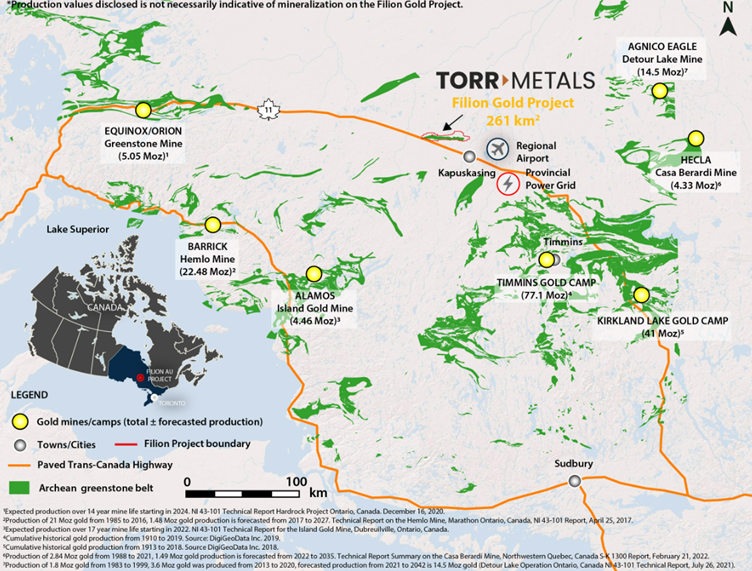
There’s a provincial power grid. There’s rail lines, everything that you would want for rapid advancement. And you’re right off the Trans-Canada Highway 11, the northern portion.
If you go about 200 kilometers down the highway, you’ll come to Equinox (TSX:EQX) and their Greenstone mine, which is 5 million ounces. If you go about 150 kilometers to the east, you’ll end up at Casa Berardi, which is also close to 5 million ounces still. This is a prolific gold region.
What I liked about this project is I identified within the government geophysics what I believe to be first-order structures. We’re on the southern boundary of a terrane and that terrane is between us and Equinox which is on the northern boundary.
So, the same structural setting as the Greenstone mine. What I liked about it as well was it was an area that had seen some historical trenching, largely done by a single prospector back almost 80 years ago.
As I was reading his old reports, it came to mind that this is a greenstone belt and one that’s hardly been explored.
Late last year, we used some LiDAR to identify where these historical trenches are. They cover about 900 meters strike length, about 300 meters across with some cross trenching. We went back and tested roughly 140 meters.
Those samples came back up to just over 13 g/t gold in a setting that is very similar to what you would see geologically in some of the regional gold systems. And in this region, the gold systems are all multi-million ounce.
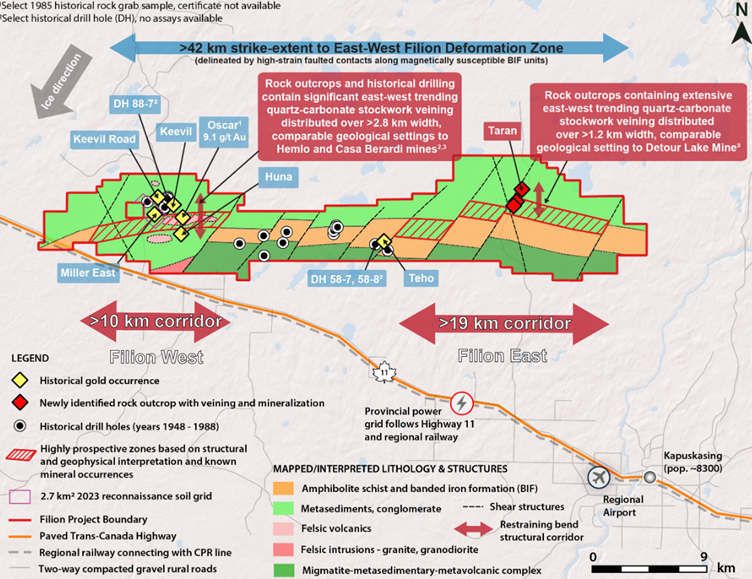
Regionally we see very large systems, on Filion we see very prospective geology. And we’ve only explored 8% of our land package. The rest of it remains unexplored.
It was good to get that grade confirmation because 13 g/t comes out quite similar to what historically had been talked about 80 years ago. So, it brings some confidence to the historical reports. As you go along strike in this area, those same reports talk about historical rock grabs up to 91 grams per tonne gold.
So, there’s very high-grade gold potential in an area that’s really been unexplored. We’re seeing the gold concentrated along the limb of a large fold structure, where it intersects with this gold-bearing, very large shear system. In terms of structural setting, this is highly prospective and a great setup as well.
RM: When you went in and tested those trenches, you didn’t just take some loose rocks, you cleaned them up and went right down to bedrock and that’s bedrock sampling that Torr did confirming the OG’s results?
MD: Yes, I’d say of the rock grab samples, probably about a third was from the trenches, but the high grades here, 7 g/t, 13 g/t, were taken out of outcrop; so, hacking it out of the outcrop that was exposed within the trench. This, I think, really confirms that there is gold here. This gold has never been drilled from what we can see from any of the historical reports.
Now with modern geophysics that we’ve done over the past two years, we’ve been able to identify that there’s a reason for the gold to be here. It seems to be concentrating along this very large fold structure where that limb of the fold intersects a very large gold-bearing shear system. And we’ve got 60 kilometers of that shear system, so we’re calling it the Filion Fault.
This is essentially all brand-new interpretations, a brand-new area that’s really not seen any concentrated exploration in 80 years. So, I’m very excited about the potential that we see with this project, especially in this type of gold market, having a brand-new potential discovery next to the Trans-Canada Highway would be quite phenomenal.
RM: Just back to the Kolos. In Torr’s last update, you were saying that in this new drill program, it’ll be interesting to see whether it could potentially lead to one or more copper-gold porphyries. You mentioned the outcrops, you mentioned the potassic alteration, which is indicative of the porphyry core. I’m just wondering when you go to do the drilling, what will you be looking for that confirms that you’ve got a copper-gold porphyry here?
MD: That’s a good question. With the next round of drilling, what I’m looking to see within that first 2,000m of drilling that we have planned for Bertha North, we want to see evidence of mineralization associated with this intrusive body. We want to hit that sheeted veining and stockwork veining that’s mineralized within the drilling as well. And seeing the styles of alteration.
So previously, the drilling that we did at Bertha, we encountered largely propylitic to some localized phyllic alteration. Phyllic is good to see. It means that you’re within the range of the core of the system as phyllic is the last shell that you have before you hit the core.
And then the core you tend to see potassic alteration. So, we want to see more of that potassic alteration. We do see within the geophysics, there’s certainly the potential here for a bit of an oxidation blanket as well.
That would be similar to what we had been seeing within Bertha. More of this supergene-style weathering, native copper, perhaps along the picrite boundary again.
But what we really want to hit this time around is potentially into the hypogene zone. The hypogene zone is going to be characterized by, we’ll see more of that altered and mineralized intrusive unit, as well as changes in the mineralization. We want to start to see that chalcopyrite, that bornite associated with the veining and alteration within the intrusive unit.
That’s what we’ll be watching for, that we’re looking for in this next round of drilling at Bertha North, and then at Kova as well, pending the IP results.
RM: Do you see that as a potential stock catalyst to say to the market, “Look, we’ve got a new porphyry here.”
MD: If we hit something that’s brand new and we pull some numbers out of that, then I think that certainly could be a potential catalyst.
I think the market will certainly recognize that this could be something, not just the fact that it’s brand new, but also that it’s in an area where it would solve the problems that the major miners have, which is more feed. They need new discoveries in this area. and I think that would bode well for us.
RM: Copper’s at $6.31 a pound.
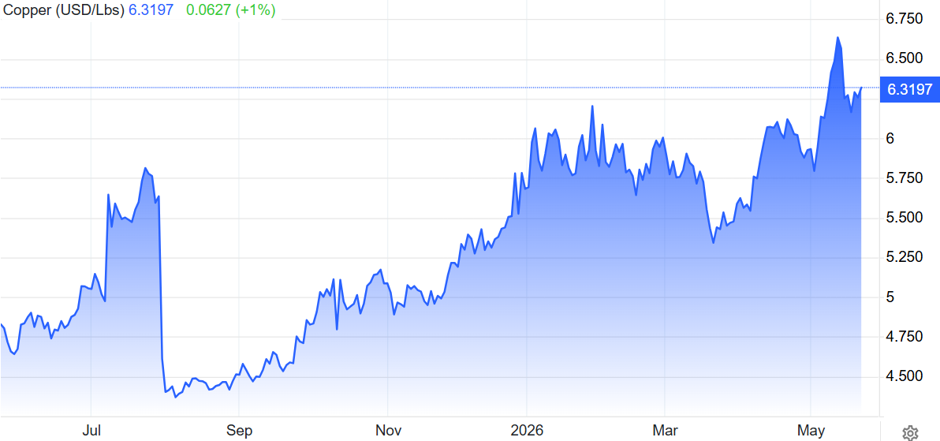
MD: Yes, copper’s holding up very well. I think what you’re looking forward to here, and some of what we’ve talked about before, that there’s supply issues that are going to affect copper production, and major miners, I think, are going to be looking towards areas where there’s integrated supply chains, which is really North America.
Within North America, two of the most prospective areas, Arizona is certainly one where you see a lot of majors concentrating. But if you go to Canada and look for where copper producers are concentrating, it’s in southern British Columbia within the Quesnel Trough where our Kolos Project is.
RM: Gold is currently at $4,500. Last September it was about $3,300. So gold is definitely of interest here as well at $4,500.
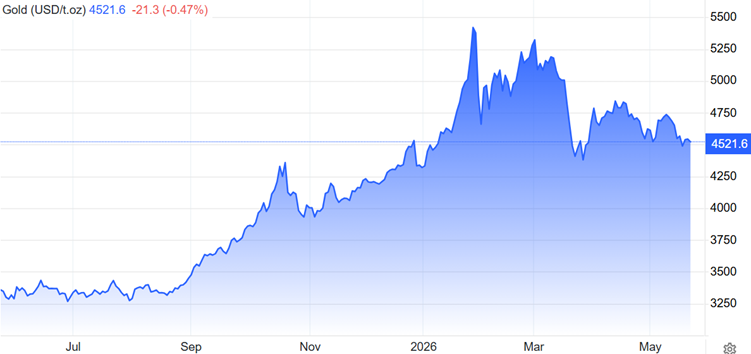
MD: Yes. Why not have the best of both commodities? And you see CEOs such as the CEO of Barrick in this past year, reiterating that what they want is copper-gold porphyries, and that means these copper-gold-alkalic porphyry systems. Coeur moved on New Gold, they say for the copper exposure.
RM: Well, they changed their name from Barrick Gold to Barrick Mining and Coeur was better known as a premier mid-tier silver producer.
It was interesting to hear you talk about the potential as a feedstock for the nearby mines like New Afton or Highland Valley.
You’ve also got companies like Kodiak Copper (TSX-V:KDK) in the area. Do you see this as a contest between the juniors in the area to advance your projects?
MD: That’s a good question. I don’t see it as a competition. Really as as more and more gets proven up within this belt, especially in what now I’m calling the Copper-Gold Gap between Kamloops and Princeton, basically within that gap. So, to the north of it, you’ve got a whole bunch of majors. To the south, you’ve got Hudbay (TSX:HBM) at Copper Mountain outside of Princeton, British Columbia.
But that gap in between, the two largest land packages held by juniors is me with the Kolos Project and Kodiak Copper and their MPD project. I think what you’ve got here is as we prove up more and more potential for new discoveries and in Kodiak Copper’s case defining resources, you’re going to attract more attention to this gap space where majors have not moved in on yet.
But I think what it speaks to is this area is going to get consolidated, especially as Kodiak Copper continues with their exploration, as I continue with my exploration I think it’s just going to attract more interest.
RM: Copper Mountain, Hudbay, they’ve opened up a new mining area, have they not? They’ve extended the life of that mine.
MD: Yes, they’ve extended and they’re settling into their operations down there as well. I believe they’re also looking around for additional opportunities within the region. So, all of these companies with these operating mines are going to be now looking to find a solution to that problem. And anyone who can provide what they need, which is additional feed, I think it’s all going to work into a potential district consolidation for one of these players who are already there or others who have yet to enter but are looking.
RM: Kodiak Copper is more advanced with a resource. And I’ll say they’re also a sponsor of Ahead of the Herd as Torr Metals is.
I agree the area will be consolidated.
MD: When you look at that map that I have in my presentation of copper porphyry trend in the Quesnel Trough, like I mentioned before, you see a whole bunch of major miners going towards the north. But then as you go towards the south, you really only have Hudbay and Copper Mountain right now.
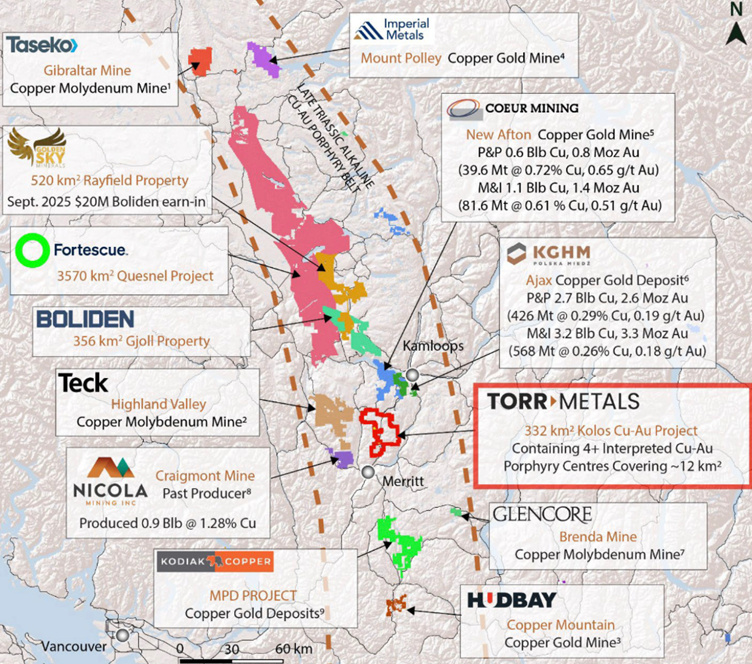
But that’s just because that space in between Kamloops and Princeton, basically in between New Afton and Copper Mountain, that space has not been extensively explored. Kodiak Copper really is the first to accumulate a large land package and got going years before I did, exploring and now they have a resource. And then there’s Torr as well to the north of Kodiak Copper filling that space and doing earlier-stage exploration with the next round of drilling coming up here imminently.
I think that’s where the opportunity lies, that majors are all to our north. They’re going to be moving to the south because the south is held by, even if you just look at Torr and Kodiak Copper, those are two very large land packages that could be prospective to these majors.
RM: Your brother Cameron has a place in this too, I know you don’t mind talking about Kodiak. I know you don’t mind talking about your brother’s company because you realize that what’s good for one is good for all.
MD: Oh, exactly. There is a space between myself and Kodiak Copper, and my brother is now heading a company that’s got a project within that space. That’s North Valley Resources (CSE:NVR) and their Comstock Project.
He’s looking to build that out as well. So essentially you’ll have what I think are the three premier junior companies in this gap space. When you think about that, that there’s three companies that have very prospective land packages, it certainly would be attractive for a major looking towards consolidation.
RM: Well, connecting the dots. I mean, absolutely.
Let’s get back to Torr specifically. We just gave a lot of reasons, but would you sum up the investment opportunities in Torr Metals for us, please?
MD: For Torr Metals, what we’re offering here is pre-discovery valuation. This is the opportunity now to get in prior to making a potential significant new discovery in a district that’s surrounded by three operating mines looking for near-term feed.
That’s the immediate focus. But in the meantime, we also have that added flexibility of a large district-scale, orogenic gold system in northern Ontario with upside potential as well for new discovery.
RM: Great to catch up with you, Malcolm. Thank you for doing this.
MD: Thanks for the opportunity, Rick.
Richard (Rick) Mills
aheadoftheherd.com
Subscribe to AOTH’s free newsletter
Richard does not own shares of Torr Metals (TSX-V:TMET). TMET is a paid advertiser on his site aheadoftheherd.com This article is issued on behalf of TMET
Legal Notice / Disclaimer
Ahead of the Herd newsletter, aheadoftheherd.com, hereafter known as AOTH.
Please read the entire Disclaimer carefully before you use this website or read the newsletter. If you do not agree to all the AOTH/Richard Mills Disclaimer, do not access/read this website/newsletter/article, or any of its pages. By reading/using this AOTH/Richard Mills website/newsletter/article, and whether you actually read this Disclaimer, you are deemed to have accepted it.
Divests US$13.5M McEwen Copper Debt to Further Enhance Liquidity ... READ MORE
Aura Minerals Inc. (NASDAQ: AUGO) (B3: AURA33) is pleased to anno... READ MORE
Montero Mining and Exploration Ltd. (TSX-V: MON) (OTC Pink: MXTRF... READ MORE
Barksdale Resources Corp. (TSX-V: BRO) (OTCQB: BRKCF) (FSE: 2NZ) ... READ MORE
Getty Copper Inc. (TSX-V: GTC) (OTCQX: GTCDF) is pleased to an... READ MORE