








Phoenix Metals Corp. (TSX: PCA) is pleased to announce results from the first nine holes, totaling 3,063m drilled at the Lexington Target in the Greenwood Copper Gold District near Grand Forks, British Columbia.
Summary:
Drilling Highlights:
Note: Refer to Table 1 for the complete Lexington drill results. The drilling highlights presented above represent selected intercepts only and are not necessarily representative of all assay results received
Nick Campbell, President & CEO of Phoenix Metals, stated:
“The Phase 1 drill program was designed to test Lexington for a potential bulk tonnage target zone of near surface mineralization and confirm the zone of high-grade mineralization associated with the underground resource estimate at Lexington. Every one of the first nine holes at Lexington intersected broad zones of copper-gold mineralization.
These holes demonstrate the potential for Lexington to be developed into a bulk tonnage open pit target. Hole LXDDH-26-001 was the highlight of the first set of results, returning 1.30% CuEq (0.22% Cu, 1.02 g/t Au, 3.79 g/t Ag) over 169m, which includes a 38m interval grading 3.66%CuEq. This hole demonstrates how the high-grade structures within the broad mineralized zone at Lexington can potentially upgrade gold values within a bulk tonnage target. We completed the 14-hole Phase 1 drill program at Lexington in September. Given the initial results, Phoenix decided to drill a further six holes at Lexington (Phase 2), which were completed in October. Lexington remains open along strike to the northwest and southeast exploration potential beyond these initial encouraging results.
The primary targets for the Phase 1 drill program at the Greenwood Copper Gold District are the Lexington, Phoenix South and JD/Golden Crown targets. In October, Phoenix completed the Phase 1 and Phase 2 programs at Lexington. We are on track to complete Phase 1 at Phoenix South and begin Phase 1 at JD/Golden Crown in November. With results from Lexington and initial results from Phoenix South expected before the end of 2026 and a large backlog of drill results to be released in 2027, this is an exciting time for Phoenix Metals.”
Lexington Target
Phoenix Metals initiated exploration drilling at the Lexington Property in May 2026. The Phase 1 program was designed to evaluate the high-grade underground mineralization and test the potential for near surface bulk tonnage mineralization at Lexington. The Phase 1 program was completed on September 30, 2026, with a total of 14 holes completed, totaling 4,807m of drilling. Based on the visual results and geological interpretation, a follow-up Phase 2 program was completed in October 2026. Phase 2 consisted of six holes for 1,543m to drill test along strike to the north and south, up dip and down dip from the initial target area. In total, 20 drill holes were completed at the Lexington target for 6,350m. The results from the first nine holes LXDDH-26-001 – LXDDH-26-008A are summarized in Table 1.
The main host of mineralization at Lexington is a Jurassic package of diorite, quartz diorite, dacite and lesser andesite. The top of this package is limited by an interpreted thrust fault, marked by serpentinite, referred to as the “No. 7 Fault”. Above the No. 7 Fault lie chert, quartz-chlorite and quartz-sericite schist, argillite and lesser greenstone of the Anarchist Schist (presumed Paleozoic). The serpentinite–Jurassic–serpentinite package continues along strike to the northwest, and to the southeast. Younger unmineralized Eocene plagioclase-porphyritic dykes occasionally cut the sequence to displace or overprint mineralization.
Anomalous Au, Cu and Ag occur throughout the mixed dacite, andesite, diorite, and quartz-diorite sequence with the highest grades occurring at or near their contacts with the serpentinites above and below. Sulphides are mainly pyrite and chalcopyrite, with local chalcocite and rare molybdenite; visible gold is exceedingly rare. Across most of the interval, sulphides are disseminated, fracture-controlled and locally banded. In high-grade intervals they form semi-massive to massive lenses up to several tens of centimetres thick, which together span several metres of true width. The dacite–diorite interval as a whole represents a bulk-tonnage target whereas high-grade zones along the serpentinite contacts were historically mined underground at the Lexington and City of Paris mines.
Table 1: Lexington Drill Results Summary
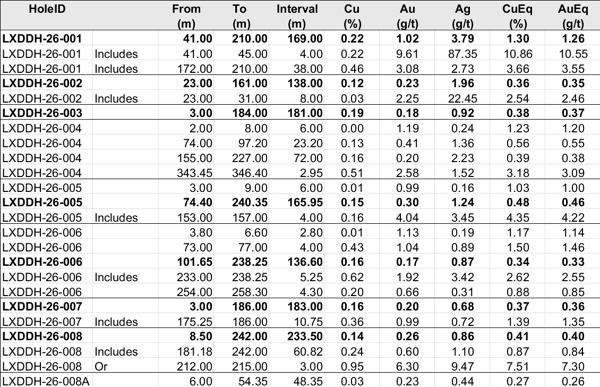
Note: Reported intervals are length-weighted averages of core lengths; true widths are not yet determined. Intervals were selected to represent broad zones of continuous mineralization and may include internal dilution of lower-grade or unmineralized material.
Copper-equivalent (CuEq) and gold-equivalent (AuEq) values use metal prices of US$6.00/lb Cu, US$4,000/oz Au and US$50/oz Ag, and metallurgical recoveries of 85% Cu, 90% Au and 60% Ag. Copper and gold recoveries are based on those used in the current Mineral Resource Estimate for Lexington (P&E Mining Consultants, effective December 31, 2025). Silver recovery is assumed, as no metallurgical testwork for silver has been completed. There is no certainty that the constituent metals will be recovered in amounts consistent with the assumptions used in the equivalent calculations.
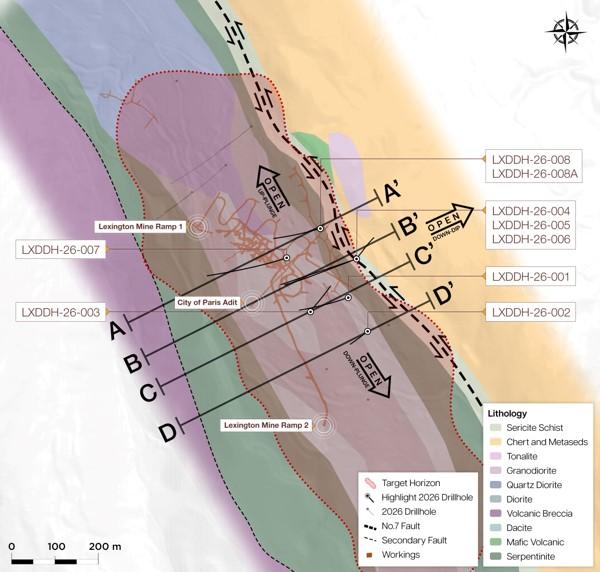
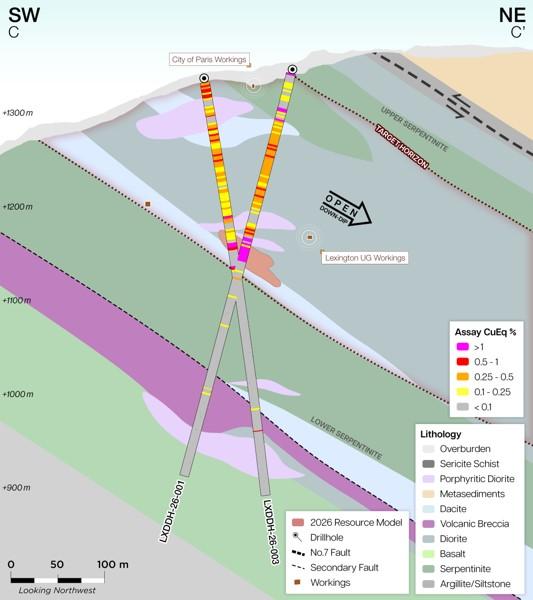
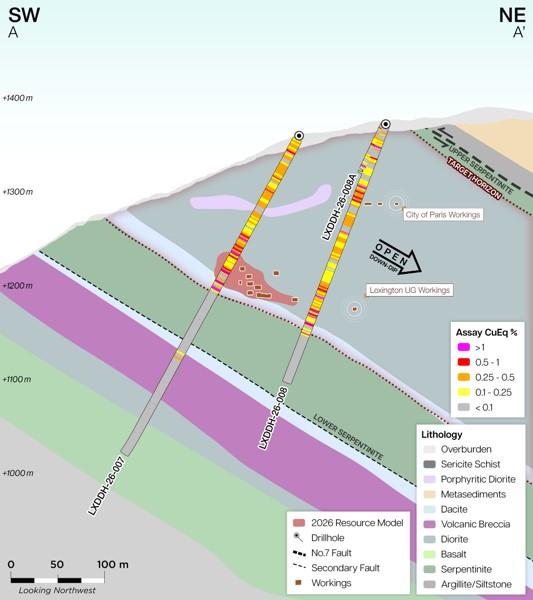
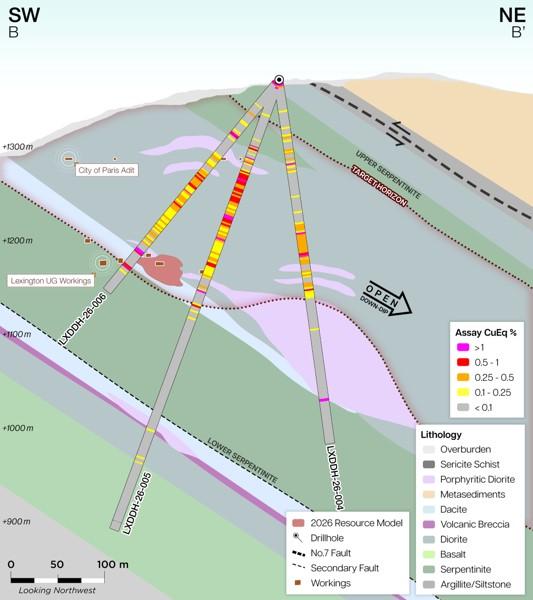
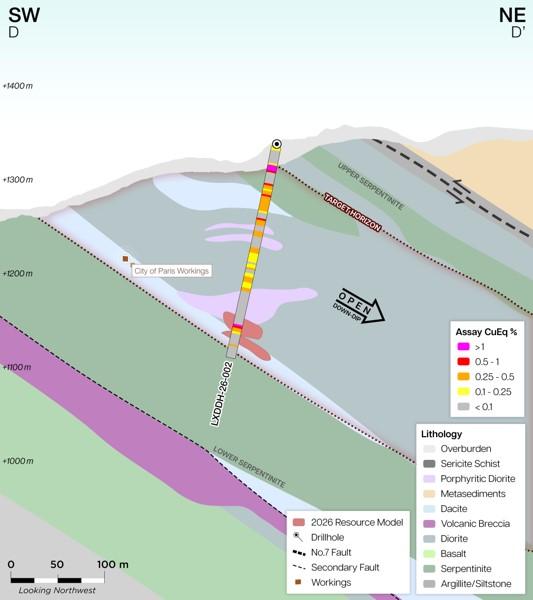
Figure 1 shows a plan map of the first nine holes at Lexington with drillhole attributes in Table 2 and cross sections provided in Figures 2-5. Note that holes LXDDH-26-001,002, 003, 007 and 008 all intersected near surface mineralization within the diorite unit ending with the contact of the lower unmineralized serpentinite unit. Holes LXDDH-26-004, 005 and 006 were collared off the same drill pad. These holes drilled through the unmineralized upper serpentinite unit as expected before intersecting broad zones of mineralization within the diorite unit with mineralization ending at the contact with the lower serpentinite unit.
Based on the 2026 drilling, surficial geological mapping and more than 170 holes drilled within the Lexington target historically, Phoenix Metals identified a potential bulk tonnage target horizon over 1,500m along strike and 300m wide with 2026 drilling intersecting mineralization to approximately 225m vertical depth. These initial results suggest that mineralization remains open down dip, with significant potential to expand the zone along strike to the northwest (up plunge) and southeast (down plunge) based on historical drilling and surficial mapping.
Figure 1: Lexington Plan Map
Source: Phoenix Metals Corp.
Figure 2: Cross Section C-C’
Source: Phoenix Metals Corp.
Figure 3: Cross Section A-A’
Source: Phoenix Metals Corp.
Figure 4: Cross Section B-B’
Source: Phoenix Metals Corp.
Figure 5: Cross Section D-D’
Source: Phoenix Metals Corp.
Table 2: Drillhole Locations and Attributes
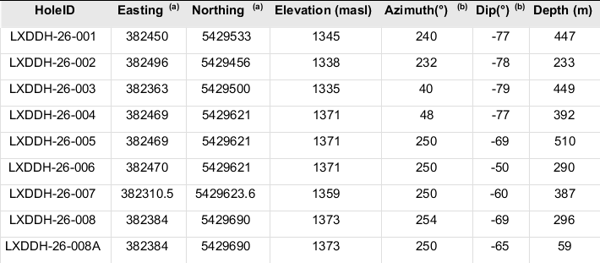
(a)Drillhole coordinates are presented in NAD83 UTM Z11. Collar locations were collected by handheld GPS; a final high-accuracy survey has not yet been completed (b) Azimuth and Dip are planned and may vary downhole
Greenwood Project Exploration Strategy
The 55,000m Phase 1 drill program for the Greenwood Copper Gold District is designed to test for bulk tonnage resource potential at the Lexington Target (14-holes, expanded to 20), the Phoenix South Target (32 holes) and the JD/Golden Crown Target (67 holes). The Phase 1 and Phase 2 drill programs at the Lexington target have been completed with assay results for the remaining 11-holes outstanding. At Phoenix South, 30 of the 32-hole Phase 1 drill program have been completed with drilling set to begin at the JD/Golden Crown target in November 2026. The first assay results from Phoenix South and additional assay results from Lexington are expected in December 2026. Assay results from the Phase 1 program at Lexington, Phoenix South and JD/Golden Crown are expected to continue into Q1 2027 as the company systematically explores the Greenwood Copper Gold District.
QA/QC
Mineralized intersections reported herein are downhole core lengths, true widths are not yet defined. Where possible, drill holes were planned to intersect mineralization perpendicular to interpreted orientation.
All drilling for the reported holes was completed by Paycore Drilling Ltd using a skid mounted diamond drill rig with HQ core size. Drill core was transported to Phoenix Metals’ secure core facility on site, where it was geologically and geotechnically logged, then photographed. Sample intervals were marked by Phoenix geologists, and the core was saw-cut, with one half sent for analysis and the other half retained on site.
Samples were delivered by bonded carrier to ALS Global in Kamloops, BC, for preparation using ALS procedure PREP-31A: crushing to 70% passing 2 mm, then splitting and pulverizing to 85% passing 75 microns. Assay pulps were then transported by ALS to the ALS Global Analytical laboratory in North Vancouver, BC to be analyzed.
Samples were analyzed by ALS method ME-MS61 (48 element analysis, four-acid digestion with ICP–MS and ICP-AES finish). Au was analyzed by ALS method Au-AA23 (30 g Fire Assay AAS Finish). Over-limit samples were re-analyzed by fire assay with gravimetric finish (Au-GRA21) for gold, and by four-acid digestion with ICP-AES finish for copper (Cu-OG62) and silver (Ag-OG62).
A Quality Assurance/Quality Control protocol was incorporated into the program and included the insertion of certified reference materials and blanks at a rate of approximately 4% and 4%, respectively. Field duplicates were also inserted at approximately 1% to assess sampling precision. ALS Global is independent of the Company.
Qualified Person
The technical content of this news release has been reviewed and approved by Nathan Schmidt, P.Geo., a Qualified Person under National Instrument 43-101 Standards of Disclosure for Mineral Projects (EGBC Licence 48336). Mr. Schmidt is an Operations Director and Principal Geologist with Dahrouge Geological Consulting Ltd. (EGBC Permit to Practice 1003035), the consulting firm engaged by Phoenix Metals Corp.
Mr. Schmidt has verified the scientific and technical data disclosed in this news release, including the sampling, analytical and QA/QC data underlying the reported results. Verification included checking the reported intervals and metal-equivalent calculations against the assay database and reviewing drill core logs. Mr. Schmidt noted no errors or omissions during the data verification process.
About Phoenix Metals
Phoenix Metals Corp. is focused on the advancement of the Greenwood Precious Metals Project, a 12,000+ hectare copper-gold district located near Grand Forks, British Columbia, Canada. The Company was created in Partnership with the Osoyoos Indian Band whose traditional territories underly the Greenwood Precious Metals Project. Phoenix Metals is led by an accomplished group of serial mine entrepreneurs with shareholder alignment supported through substantial director ownership and technical bench strength provided through JDS executives and recognized industry experts.
First Phosphate Corp. (NASDAQ: PHOS) (CSE: PHOS) (OTCQX: FRSPF) ... READ MORE
Gold Mineralization extended below resource pit shell at Golden L... READ MORE
Contango Silver and Gold Inc. (NYSE American: CTGO) (TSX: CTGO) a... READ MORE
Goldgroup Mining Inc. (NYSE American: GORO) (TSX-V: GORO) is plea... READ MORE
Latest Drilling Intersects 46 Metres at 0.42% Copper including 1... READ MORE