








Initial operation to target mining and processing of 500,000 tonnes per year over 20 years
Resouro Strategic Metals Inc. (ASX: RAU) (TSX–V: RSM) (OTCQB: RSGOF) has delivered on a major milestone: it has completed a Preliminary Economic Assessment (PEA) for a starter operation at its flagship Tiros Rare Earths and Titanium Project in Minas Gerais, Brazil. The PEA was prepared by a team led by Norda Stelo according to National Instrument 43-101 Standards of Disclosure for Mineral Projects. All financial figures are expressed in U.S. dollars unless otherwise stated.
“The project’s robust economics are based on high levels of total rare earth oxides and titanium oxide grades,” said Christopher Eager, Resouro’s CEO. “We believe that starting with a small high-grade operation will minimize the social and environmental impacts, reduce the time to production, and significantly de-risk the Project. Our goal with this staged approach is to support future financing and provide a pathway for larger scale development.”
The PEA is preliminary in nature. It includes Inferred Mineral Resources that are considered too speculative geologically to have the economic considerations applied to them that would enable them to be categorized as Mineral Reserves, and there is no certainty that the PEA will be realized. It is not a feasibility study. Mineral Resources that are not Mineral Reserves do not have demonstrated economic viability.
Key highlights of the PEA include:
The PEA referred to in this release is equivalent to a Scoping Study under JORC Code (2012) reporting guidelines. It has been undertaken for the purpose of initial evaluation of a potential development of the Tiros Project in Minas Gerais, Brazil. The PEA is presented in U.S. dollars to an accuracy level of +/- 50%.
The PEA is preliminary in nature. There is no certainty of economic viability or that the Tiros Project envisioned by the PEA will be realized. Future studies (Prefeasibility Studies and Feasibility Studies) may yield material changes.
The PEA is based on the material assumptions highlighted throughout this announcement. Anyone or more of these material assumptions may not prove correct, with the result that the actual outcomes for the Tiros Project may differ materially from those described in this announcement.
These include assumptions about the availability of funding. To achieve the potential project development outcomes indicated in the PEA, CAPEX of approximately US$159M and US$32M of contingency is needed (Resouro presently has a market capitalization of approximately US$23.5 million). Investors should note that there is no certainty that the Company will be able to raise funding when needed, however the Company has concluded it has a reasonable basis for providing the forwardlooking statements included in this announcement and believes that it will be able to fund the development of the Tiros Project. It is also possible that such funding may only be available on terms that may be dilutive to or otherwise affect the value of the Company’s existing shares. It is also possible that the Company could pursue other strategies to provide alternative funding options. Given the uncertainties involved, investors should not make any investment decisions based solely on the results of the PEA.
The Mineral Resources underpinning the production target in the PEA have been prepared by a competent person in accordance with the requirements of the JORC 2012. For full details on the Mineral Resource estimate, please refer to the ASX announcement of 9 April 2025. The Company confirms that it is not aware of any new information or data that materially affects the information included in that release and that all material assumptions and technical parameters underpinning the estimates referred to therein continue to apply and have not materially changed. Mine planning assumptions at the PEA level are conceptual and will be refined in subsequent studies.
The PEA evaluates the development of a 500,000 tpa processing operation targeting mineralisation within the previously announced 1.4 billion tonnes Measured and Indicated Resource in the Capacete Formation in Northern Minas Gerais State, Brazil.
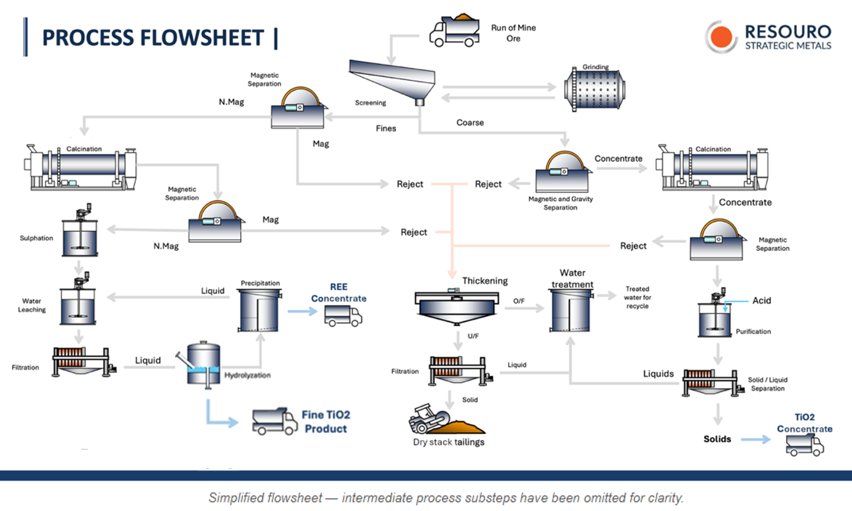
The PEA is based on the TREO-TiO2 resource base and incorporates a flowsheet integrating beneficiation, calcination, magnetic and electrostatic separation, acid leaching, and rare earth recovery, producing both titanium dioxide concentrates and rare earth products.
Resouro’s PEA scenario starts with a high-grade initial operation based on a staged development approach that has been designed to reduce upfront capital requirements, reduce development and execution risk, shorten the pathway toward production, generate operational cash flow to support future growth, and preserve significant resource optionality for future expansion.
| General | unit | Life of Mine (LOM) total/average |
| TREO price assumption | US$ / kg | 57.4 |
| Rare earth elements (REE) run of mine grade | ppm | 10,852 |
| Steady state REE in product | tonnes | 3,636 |
| Titanium dioxide (TiO2) price assumption – coarse circuit | US$ / tonne | 900.0 |
| TiO2 run of mine grade | % | 26.2 |
| Steady state contained TiO2 in concentrate – coarse circuit | thousand tonnes per annum (ktpa) | 42.3 |
| TiO2 price assumption – fine circuit | US$ / tonne | 650.0 |
| Steady state contained TiO2 in concentrate – fine circuit | ktpa | 47.8 |
| Mine life | years | 20 |
| Processing rate per year | tpa | 500,000 |
| ROM Feed over Life of Mine (LOM) | Mt | 9.5 |
| Waste | Mt | 20 |
| Strip Ratio | 2.7:1 | |
| Economics (pre-tax) |
Net present value (8% discount rate) US$ Million (M) 1,138.8
| Internal rate of return | % | 62.7 |
| Payback | years | 1.3 |
| Life of Mine (LOM) average annual cash flow | US$ M | 115.2 |
| LOM cumulative cash flow | US$ M | 2,535.8 |
| Economics (after-tax) | ||
| Net present value (8% discount rate) | US$ M | 714.9 |
| Internal rate of return | % | 44.2 |
| Payback | years | 1.9 |
| LOM average annual cash flow | US$ M | 70.0 |
| LOM cumulative cash flow | US$ M | 1,673.9 |
| Costs | ||
| Initial capital – net[1] | US$ M | 159.6 |
| Initial capital – gross | US$ M | 191.1 |
| Sustaining capital – post tax | US$ M | 59.6 |
| Average annual operating costs | US$ M | 109.5 |
| Average cost per tonne for run of mine | US$ M | 219.0 |
Notes:
The Tiros Project hosts a large-scale titanium dioxide and rare earth resource within the Capacete Formation, comprising:
The current NI 43-101 Technical Report for the Tiros Rare Earth Elements (REE) Project, Minas Gerais, Brazil, was prepared for Resouro by Atticus Geoscience Consulting, has an effective date of 9 April 2025, and an issuing date of 23 May 2025.
The Company is not aware of any new information or data that materially affects the information included in that announcement and that all material assumptions and technical parameters underpinning the estimates in that announcement continue to apply and have not materially changed. The report was prepared according to NI 43-101 and Form 43-101 F1 and was signed by Qualified Persons Simon Mortimer (M.Sc., MAusIMM, FAIG) and Luis Oviedo (P.Geo., QP CCCRRM #013).
The grade of the Measured and Indicated Resource at Tiros supports a phased development approach, with a dual-revenue model based on titanium dioxide and rare earth product streams. The operation targets a 9.5 Mt high grade area of mineralization that grades 26.3% TiO2 and 10,852 ppm TREO, which accounts for less than 1% of the Company’s 1.4 billion tonne Measured and Indicated Resource.
It is designed to be 500,000 tonne per annum initial operation over 20 years with potential for future expansion once the initial operation is advanced and technical, commercial, and permitting milestones are achieved. It will be a simple open-pit mine with free digging near-surface mineralisation and an environmentally conscious design that assumes dry-stack tailings.
The mine plan used for this PEA is conceptual and is based on a simplified, flat mining sequence. Mine scheduling and sequencing are expected to be refined in subsequent studies.
The PEA assumes a proposed processing route comprising:
Final products are expected to include:
Please see Appendix B for process flowsheet diagram.
The economic analysis is based on a dual-revenue model from rare earth and titanium dioxide product streams. Revenue assumptions are based on long-term TREO basket pricing and titanium dioxide concentrate pricing with the TREO basket reflecting the distribution of rare earth elements within the Tiros deposit.
The PEA estimates initial capital of approximately US$191 million, sustaining capital of approximately US$59 million, and average annual operating costs of approximately US$109 million, equivalent to approximately US$219 per tonne of run of mine (ROM) material processed. Estimates are based on an assumed exchange rate of USD 1.00 = BRL 5.00.
These estimates are preliminary and will be refined through future engineering, metallurgical test work, permitting work, and PFS level studies.
The PEA is based on a Class 5 level capital and operating cost estimate appropriate for a preliminary economic assessment. The estimates remain preliminary and will be refined through additional engineering, metallurgical test work, permitting work, and future studies.
Operating costs are primarily driven by reagent consumption, energy, mining, stockpile management, personnel, and maintenance. The capital and operating cost estimates have been prepared based on current PEA-level engineering, process assumptions, and supplier / consultant inputs. All costs have been reviewed by the relevant technical consultants and Qualified Persons / Competent Persons as part of the PEA process.
Further work during the next study phase is expected to focus on optimising the flowsheet, improving beneficiation, increasing acid recycling and reducing operating costs.
Variation
| -40% | -30% | -20% | -10% | 0% | 10% | 20% | 30% | 40% | |
| TREO Basket Price FOB Santos (US$/kg) | 34.5 | 40.2 | 46.0 | 51.7 | 57.4 | 63.2 | 68.9 | 74.7 | 80.4 |
| Post-tax NPV8 (M, US$)
Post-tax IRR (%) |
283.2
23.2 |
390.6
28.4 |
498.7
33.7 |
606.8
38.9 |
714.9 | 823.0
49.4 |
931.1
54.6 |
1039.2
59.9 |
1147.3
65.1 |
| 44.2 | |||||||||
| Pre-tax NPV8 (M, US$)
Pre-tax IRR (%) |
491.0
32.9 |
652.4
40.3 |
814.5
47.8 |
976.6
55.3 |
1,138.8 | 1,300.9
70.1 |
14,63.0
77.5 |
1,625.2
84.9 |
1,787.3
92.2 |
| 62.7 | |||||||||
| Ti02 prices | |||||||||
| Fine (US$/t) | 390 | 455 | 520 | 585 | 650 | 715 | 780 | 845 | 910 |
| Coarse (US$/t) | 540 | 630 | 720 | 810 | 900 | 990 | 1080 | 1170 | 1260 |
| Post-tax NPV8 (M, US$) | 544.3 | 587.0 | 629.6 | 672.3 | 714.9 | 757.5 | 800.2 | 842.8 | 885.4 |
| Post-tax IRR (%) | 35.9 | 38.0 | 40.0% | 42.1% | 44.2% | 46.2% | 48.3% | 50.4% | 52.4% |
| Pre-tax NPV8 (M, US$)
Pre-tax IRR (%) |
883.0
51.0 |
946.9
53.9% |
1010.9
56.8% |
1,074.8
59.8% |
1,138.8 | 1,202.7
65.6% |
1,266.7
68.5% |
1,330.6
71.4% |
1,394.6
74.4% |
| 62.7% | |||||||||
| TiO2 weight recoveries | |||||||||
| Fine | 5.74 | 6.70 | 7.66 | 8.62 | 9.57 | 10.53 | 11.49 | 12.44 | 13.40 |
| Coarse | 5.09 | 5.93 | 6.78 | 7.63 | 8.48 | 9.33 | 10.17 | 11.02 | 11.87 |
| Post-tax NPV8 (M, US$) | 557.4 | 596.8 | 636.1 | 675.5 | 714.9 | 754.3 | 793.6 | 833.0 | 872.4 |
| Post-tax IRR (%) | 36.6 | 38.5 | 40.4 | 42.3 | 44.2 | 46.1 | 47.9 | 49.8 | 51.7 |
| Pre-tax NPV8 (M, US$)
Pre-tax IRR (%) |
902.4
51.9 |
961.5
54.6 |
1,020.6
57.3 |
1,079.7
60.0 |
1,138.8 | 1,197.9
65.4 |
1,257.0
68.0 |
1,316.1
70.7 |
1,375.2
73.4 |
| 62.7 | |||||||||
| REE weight recovery (%) | 0.44 | 0.51 | 0.58 | 0.65 | 0.73 | 0.80 | 0.87 | 0.95 | 1.02 |
| Post-tax NPV8 (M, US$)
Post-tax IRR (%) |
284.6
23.2 |
391.7
28.5 |
499.4
33.7 |
607.1
38.9 |
714.9 | 822.6
49.4 |
930.4
54.6 |
1,038.1
59.8 |
1,145.9
65.1 |
| 44.2 | |||||||||
| Pre-tax NPV8 (M, US$)
Pre-tax IRR (%) |
493.1
33.0% |
654.0
40.4 |
815.6
47.9 |
977.2
55.3 |
1,138.8 | 1,300.4
70.1 |
1,462.0
77.4 |
1,623.6
84.8 |
1,785.2
92.1 |
| 62.7 | |||||||||
| CAPEX | 114.7 | 133.8 | 152.9 | 172.1 | 191.2 | 210.3 | 229.4 | 248.5 | 267.6 |
| Post-tax NPV8 (M, US$) | 791.4 | 772.2 | 753.1 | 734.0 | 714.9 | 695.8 | 676.7 | 657.5 | 638.4 |
| Post-tax IRR (%) | 70.3 | 61.1 | 54.1 | 48.6 | 44.2 | 40.5 | 37.3 | 34.6 | 32.3 |
| Pre-tax NPV8 (M, US$)
Pre-tax IRR (%) |
1,215.2
99.1 |
1,196.1
86.4 |
1,177.0
76.6 |
1,157.9
68.9 |
1,138.8 | 1,119.7
57.5 |
1,100.5
53.2 |
1,081.4
49.4 |
1,062.3
46.2 |
| 62.7 | |||||||||
| OPEX | 111.8 | 130.4 | 149.0 | 167.7 | 186.3 | 204.9 | 223.5 | 242.2 | 260.8 |
| Post-tax NPV8 (M, US$) | 958.6 | 897.6 | 836.7 | 775.8 | 714.9 | 654.0 | 593.1 | 532.1 | 471.2 |
| Post-tax IRR (%) | 57.3 | 54.0 | 50.7 | 47.4 | 44.2 | 41.0 | 37.8 | 34.7 | 31.6 |
| Pre-tax NPV8 (M, US$) | 1,500.7 | 1,410.2 | 1,319.7 | 1,229.3 | 1,138.8 | 1,048.3 | 957.8 | 867.3 | 776.8 |
| Pre-tax IRR (%) | 81.0 | 76.4 | 71.8 | 67.2 | 62.7 | 58.2 | 53.7 | 49.3 | 44.9 |
The Tiros Project environmental and permitting pathway is a critical path item for project development, financing, construction, and operations. Based on current assessments, the Project is expected to be licensed in Minas Gerais through the state environmental system, rather than federally, because the Project is located entirely within Minas Gerais.
The current regulatory assessment classifies Tiros as a large mining project with medium potential environmental impact requiring a full three-phase environmental licensing process: Preliminary License (LP), Installation License (LI), and Operating License (LO).
The primary environmental study requirement is expected to be a full Environmental Impact Assessment (EIA) and Environmental Impact Report (RIMA), supported by baseline studies, public consultation, fauna licensing, archaeological and cultural heritage work, water and vegetation authorizations as required, and technical review by the state environmental authorities.
Resouro has initiated a structured environmental permitting workplan for Tiros and has engaged Sete Soluções e Tecnologia Ambiental Ltda to support the licensing process and environmental study work program. Formal project-level approvals remain subject to completion and acceptance of the required environmental studies and the statutory licensing process.
Current community engagement is preliminary and ongoing, including communications with local communities, landholders, and municipal authorities in Tiros and São Gotardo. Formal project-level approvals remain subject to completion and acceptance of the required environmental studies and the statutory licensing process.
The PEA is an important milestone in advancing the Tiros Project toward development. Building on the outcomes of the study, the Company intends to progress a range of technical, engineering, permitting, and commercial activities to further de-risk the Tiros Project and support advancement toward the next stage of development.
Next steps include infill drilling in the defined starter pit areas, additional sample generation, further metallurgical test work, flowsheet optimization, product specification work, continued environmental studies, and stakeholder engagement.
The Company also intends to assess staged expansion opportunities beyond the initial 500,000 tonne per annum initial operation, including future production scenarios in the range of 5 to 10 million tonnes per annum, subject to technical, economic, permitting, financing, and market outcomes.
A future PFS is expected to focus on flowsheet optimisation, beneficiation improvements, acid recycling opportunities, alternative process routes, product specification work, and staged scale-up scenarios.
This news release has been reviewed and approved by the relevant Qualified Persons under NI 43-101 and Competent Persons under the JORC Code, as applicable.
Competent Person (JORC)
The information in this announcement that relates to production targets, processing, capital and operating cost estimates, and forecast financial information derived therefrom is based on, and fairly represents, information compiled or reviewed by Mr Simon Mortimer (M.Sc., FAusIMM, MAIG), a Competent Person who is a Fellow of The Australasian Institute of Mining and Metallurgy and a Member of the Australian Institute of Geoscientists. Mr Mortimer is an independent consultant engaged by the Company through Atticus Geoscience Consulting and has sufficient experience that is relevant to the style of mineralisation and type of deposit under consideration and to the activity being undertaken to qualify as a Competent Person as defined in the 2012 Edition of the Australasian Code for Reporting of Exploration Results, Mineral Resources and Ore Reserves (the JORC Code). Mr Mortimer consents to the inclusion in this announcement of the matters based on his information in the form and context in which it appears.
The Mineral Resources underpinning the production target in the PEA have been prepared in accordance with the requirements of the JORC Code 2012. For full details on the Mineral Resource estimate, please refer to the ASX announcement of 9 April 2025. The Company confirms that it is not aware of any new information or data that materially affects the information included in that release and that all material assumptions and technical parameters underpinning the estimates referred to therein continue to apply and have not materially changed.
Qualified Persons
The scientific and technical information in this press release has been reviewed and approved by the Qualified Persons (QP) listed below, each of whom is independent of the Company as defined in and required by NI 43-101.
A complete PEA technical report prepared in accordance with NI 43-101 in support of the disclosed PEA results herein will be filed on SEDAR+ and on the Company’s website within 45 days from today’s date. The PEA technical report is intended to be read as a whole, and sections should not be read or relied upon out of context.
Resouro is a Canadian incorporated mineral exploration and development company, listed on the ASX, TSXV, OTC, and FSE, focused on the discovery and advancement of economic mineral projects in Brazil, including the Tiros Titanium-Rare Earths Project and the Novo Mundo Gold Project. The Tiros Project has 28 mineral concessions totalling 497 km2 located in the state of Minas Gerais, one of the best infrastructurally developed states of Brazil, 350 km from the state capital of Belo Horizonte.
Appendix A – Mineral Resource Estimate
Appendix B – Process Flowsheet Diagram
Appendix C – JORC CODE 2012 TABLE 1
Tiros Rare Earths and Titanium Project – PEA / Scoping Study Announcement
The PEA is preliminary in nature. Mineral Resources are not Ore Reserves and do not have demonstrated economic viability. No Ore Reserve is declared in this announcement.
| Section | JORC Table 1 criterion | Explanation / requirement | Commentary for this announcement |
| Section 1 – Sampling Techniques and Data | Sampling techniques | Nature and quality of sampling; measures taken to ensure sample representativity. | The announcement is supported by the 2025 NI 43-101 Technical Report for the Tiros REE Project, which incorporates historical Vicenza/Iluka information and Resouro drilling completed between 2023 and early 2025. Resouro completed air core, diamond and auger drilling at Sao Gotardo, Tiros Central and Tiros North; the Mineral Resource estimate is limited to part of Tiros Central. Sampling includes 1 m intervals, with rare earth and TiO2 assays used for Mineral Resource estimation. |
| Drilling techniques | Drill type, core diameter, downhole tools and whether core is oriented. | The NI 43-101 mineral resource estimate records forty (40) air core drill holes totalling 2,190 m, seventy-nine (79) diamond drill holes totalling 5,241.3 m and twenty-five (25) auger holes totalling
263.5 m. Historical Vicenza/Iluka air core drilling and historical diamond drilling were also reviewed and, where validated, incorporated. Detailed rig types, core orientation procedures and down-hole survey methods should be cross-referenced to the technical report and underlying database. |
|
| Drill sample recovery | Method of recording and assessing sample recoveries and results assessed. | The announcement does not report new drill intercepts. The NI 43-101 report indicates that assay and drilling information was reviewed by the QP and considered adequate for Mineral Resource estimation. Recovery recording, sample representativity and any recovery bias should be confirmed by the Competent Person in the final ASX release if new exploration data are reported. | |
| Logging | Whether core and chip samples have been geologically and geotechnically logged to a level sufficient to support Mineral Resource estimation. | The NI 43-101 report describes the mineralisation as hosted in the Capacete Formation, with lithology, mineralisation and weathering models used in the Mineral Resource estimate. Logging supported modelling of high-grade and low-to-medium-grade domains and oxidation/weathering domains. No new logging data are being reported in this PEA announcement. | |
| Sub-sampling techniques and sample preparation | If core, whether cut or sawn; sample preparation methods; quality-control procedures. | Samples were prepared and assayed at SGS Geosol. The NI 43-101 mineral resource estimate states that 6,141 core samples from the 2023-2024 drilling campaign were submitted for analysis, including 838 QA/QC samples, representing approximately 13.7% of submissions. Sample preparation details, including splitting and laboratory procedures, are described in the technical report and can be cross-referenced rather than repeated in full in this announcement. | |
| Quality of assay data and laboratory tests | Nature, quality and appropriateness of assaying and laboratory procedures. | TiO2 was analysed by lithium metaborate fusion followed by ICP-AES, with over-limit values reanalysed by XRF. Rare earth elements were analysed by lithium metaborate fusion with ICP-MS determination. QA/QC included certified reference materials, blanks, field duplicates and pulp duplicates. The QP concluded that the assay methods and QA/QC results were adequate for Mineral Resource estimation. | |
| Verification of sampling and assaying | Verification of significant intersections by independent or alternative company personnel; use of twinned holes. | The NI 43-101 report states that the QPs reviewed historical and current data and that Luis Oviedo completed a site visit on 8 April 2024. The QPs reported no reason to doubt the adequacy of the historical sample preparation, security and analytical procedures as presented and considered the data suitable for the purposes of the report and Mineral Resource estimate. |
| Section | JORC Table 1 criterion | Explanation / requirement | Commentary for this announcement |
| Location of data points | Accuracy and quality of surveys used to locate drill holes, collar surveys and topographic control. | The technical report includes collar location review and topographic control, including a LIDAR survey/topographic surface used for the Mineral Resource estimate. The Property is located in Minas Gerais, Brazil and comprises 28 exploration concessions totalling approximately 49,763 ha.
Coordinate and survey details should be retained in the technical report cross-reference. |
|
| Data spacing and distribution | Data spacing for Exploration Results and Mineral Resource estimation; whether spacing is sufficient. | The Mineral Resource estimate is based on air core, diamond and auger drilling data, with a block model prepared using 100 m x 100 m x 10 m parent blocks with sub-blocking. Resource classification reflects data spacing, data quality, geological continuity and grade continuity. This PEA announcement does not report new Exploration Results. | |
| Orientation of data in relation to geological structure | Whether sample orientation achieves unbiased sampling of possible structures. | The deposit is described as a near-surface regolith/sedimentary TiO2-REE system developed within the Capacete Formation. Vertical air core, diamond and auger drilling is considered appropriate for the broad, near-surface geometry of the mineralised horizons. No new structural or true-width interpretation is reported in this announcement. | |
| Sample security | Measures taken to ensure sample security. | The NI 43-101 report describes sample preparation, analysis and security and concludes that procedures, policies and protocols for capture and verification of drilling information are sufficient and appropriate for Mineral Resource estimation. Detailed chain-of-custody procedures should remain available in the underlying technical file. | |
| Audits or reviews | Results of audits or reviews of sampling techniques and data. | The 2025 NI 43-101 Technical Report provides an independent review of the Mineral Resource estimate by Qualified Persons Simon Mortimer and Luis Oviedo. QA/QC, data verification, block model validation, visual validation, swath plots and nearest-neighbour checks are described in the report. | |
| Section 2 – Reporting of Exploration Results | Mineral tenement and land tenure status | Type, reference name / number, location and ownership including agreements or material issues. | The Tiros Project comprises 28 exploration concessions covering approximately 49,763 ha in
Minas Gerais, held by Tiros Minerais Estrategicos Mineração Ltda, which is 90% owned by Resouro Strategic Metals and 10% owned by RBM Consultoria Mineral EIRELI. The Property covers Tiros North, Tiros Central, Sao Gotardo and Campos Altos target zones. The Mineral Resource estimate is limited to part of Tiros Central. |
| Exploration done by other parties | Acknowledgment and appraisal of exploration by other parties. | The NI 43-101 report acknowledges historical exploration by Aguia Metais, Vicenza and the Vicenza-Iluka joint venture, including historical drilling and metallurgical work. Resouro completed drilling and metallurgical testing after entering into an agreement with RBM in July 2023. Historical data were reviewed and incorporated where considered adequate by the QP. | |
| Geology | Deposit type, geological setting and style of mineralisation. | The Project is located in the Sao Francisco Craton and the mineralisation is hosted by epiclastic rocks of the Capacete Formation, part of the Mata da Corda Group. The deposit is interpreted as a secondary concentration formed through surface weathering and sedimentary processes from REE- and Ti-bearing source rocks. The Capacete Formation contains the TiO2 and REE mineralisation. | |
| Drill hole information | Summary of all information material to understanding Exploration Results. | No new Exploration Results or individual drill intercepts are reported in this PEA announcement. Drill-hole information, including collar locations, sample summaries and results for Resouro auger, air core and diamond drilling, is set out in the 2025 NI 43-101 Technical Report. | |
| Data aggregation methods | Weighting, grade truncations, metal equivalents and aggregation methods. | This announcement reports Mineral Resource and PEA metrics rather than new Exploration
Results. TREO, MREO and TiO2 are reported consistently with the 2025 NI 43-101 report. Any |
| Section | JORC Table 1 criterion | Explanation / requirement | Commentary for this announcement |
| aggregation, grouping of rare earth oxides, or equivalent calculations should be defined and consistent with the technical report. | |||
| Relationship between mineralisation widths and intercept lengths | Geometry of mineralisation relative to drill angle and true width. | No new drill intercept widths are reported. The Mineral Resource is a block-model estimate of near-surface mineralisation and should be interpreted from the geological and mineralisation models presented in the technical report rather than from individual intercept widths. | |
| Diagrams | Appropriate maps, sections and tabulations. | The announcement includes a conceptual operation schematic and a process flowsheet. The 2025 NI 43-101 report includes location, tenure, drill-hole, geology, domain, weathering, block model and classification figures that support the Mineral Resource disclosure and should be crossreferenced as needed. | |
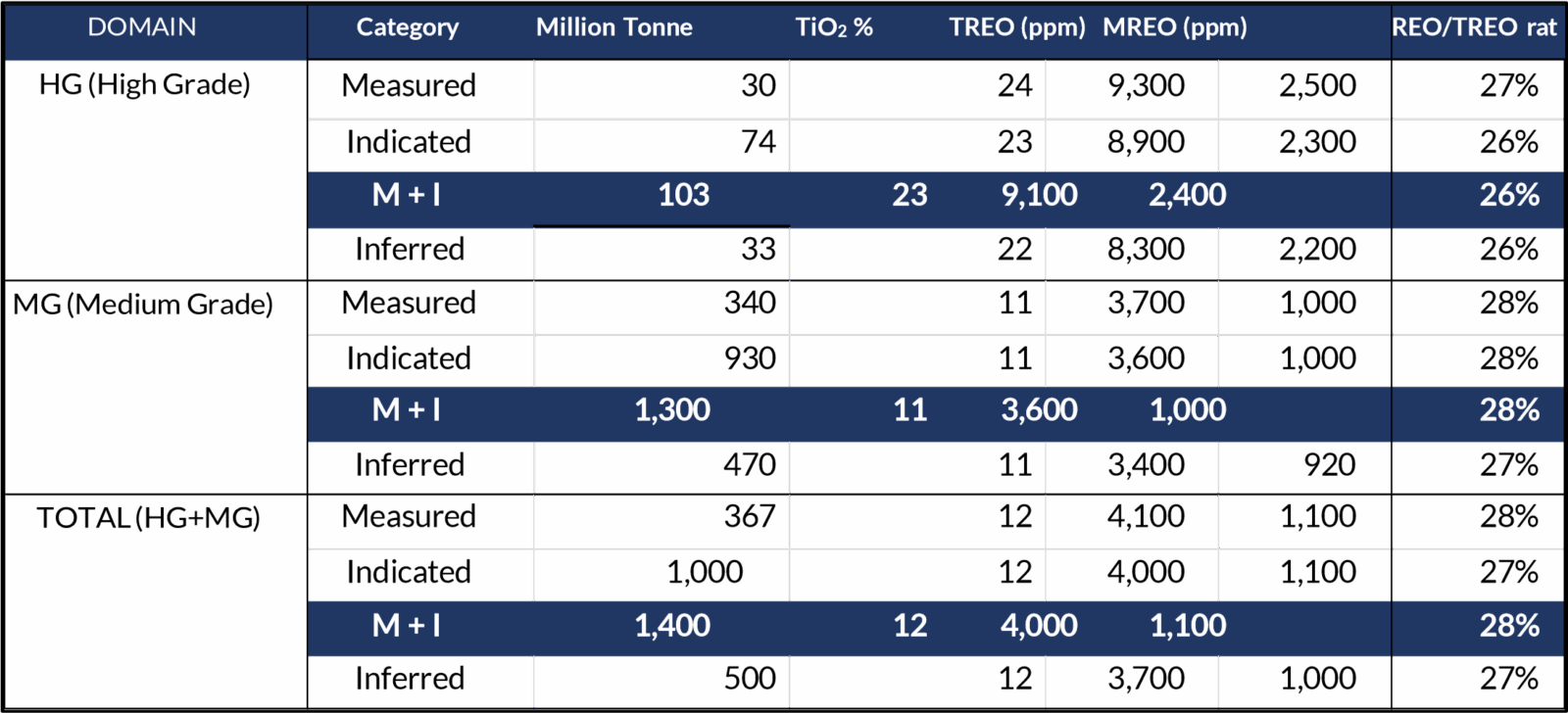
| Balanced reporting | Representative reporting of both low and high grades and widths. | The announcement presents the total, medium-grade and high-grade Mineral Resource domains and distinguishes Measured, Indicated and Inferred categories. It does not selectively report new drilling results. | |
| Other substantive exploration data | Other exploration data, including metallurgical, bulk density, geotechnical, groundwater and processing information. | The 2025 NI 43-101 report includes bench-scale beneficiation testwork and reports titanium occurring primarily as anatase, with minor ilmenite, and other minerals including kaolinite, quartz, hematite and silicates. The technical report describes a conceptual flowsheet including grinding, size classification, low intensity magnetic separation, gravity density separation, calcination, medium-intensity magnetic separation, electrostatic separation, hydrochloric acid and other leaching and solid-liquid separation. | |
| Further work | Nature and scale of planned further work. | The announcement states that next steps include infill drilling in defined open-pit areas, additional sample generation, metallurgical testwork for PFS, optimisation of beneficiation and acid recycling, analysis of alternative process routes and staged scale-up from 500,000 tpa to 5-10 Mtpa, together with permitting and stakeholder engagement. | |
| Section 3 – Estimation and Reporting of Mineral Resources | Database integrity | Measures taken to ensure data integrity and validation. | The NI 43-101 report describes database compilation, validation, data handling and estimation inputs. The Mineral Resource estimate used 1 m composites, density modelling, domain interpretation and Ordinary Kriging, with checks against input data and nearest-neighbour estimates. |
| Site visits | Comment on site visits by the
Competent Person and outcome. |
Luis Oviedo, QP, visited the Project and Resouro offices from 8 to 12 April 2024 and completed a personal inspection of the Tiros Project on 8 April 2024 accompanied by Resouro geologist Rodrigo Mello. Simon Mortimer did not visit the Property. Site-visit details are disclosed in the NI 43-101 certificates and report. | |
| Geological interpretation | Confidence in geological interpretation and any alternate interpretations. | The geological interpretation separates the Capacete Formation mineralisation into low-tomedium-grade and high-grade TiO2-TREO domains, supported by lithology, mineralisation and weathering models. The high-grade domain is reported as 103 Mt M+I at 23% TiO2, 9,100 ppm TREO and 2,400 ppm MREO, plus 33 Mt Inferred at 22% TiO2, 8,300 ppm TREO and 2,200 ppm MREO. | |
| Dimensions | Extent and variability of the Mineral Resource. | At a 1,000 ppm TREO cut-off, the Mineral Resource comprises 1.4 Bt Measured and Indicated at
12% TiO2, 4,000 ppm TREO and 1,100 ppm MREO, plus 500 Mt Inferred at 12% TiO2, 3,700 ppm TREO and 1,000 ppm MREO. The high-grade domain comprises 103 Mt M+I and 33 Mt Inferred as disclosed above. |
| Section | JORC Table 1 criterion | Explanation / requirement | Commentary for this announcement |
| Estimation and modelling techniques | Estimation method, assumptions, block size, interpolation and validation. | The NI 43-101 report states that estimation used a block model with 100 m x 100 m x 10 m parent blocks and sub-blocking, 1 m composites, density modelling, Ordinary Kriging with multiple passes and validation including visual checks, comparison of means, swath plots and nearest-neighbour checks. | |
| Moisture | Whether tonnages are estimated on dry or natural moisture basis. | The announcement does not specify the moisture basis of the Mineral Resource. The final announcement should state, or cross-reference the NI 43-101 report for, whether tonnages are reported on a dry basis and whether moisture assumptions affect processing or production forecasts. | |
| Cut-off parameters | Basis of adopted cut-off grades or quality parameters. | The Mineral Resource is reported at a 1,000 ppm TREO cut-off. Domain modelling includes a highgrade domain and a low-to-medium-grade domain. The final PEA announcement should use cut-off and domain terminology consistent with the NI 43-101 report and prior ASX/JORC disclosure. | |
| Mining factors or assumptions | Mining method, minimum mining dimensions and dilution / loss assumptions. | The PEA assumes a starter operation processing 500,000 tpa for 20 years, using 9.5 Mt of the highgrade domain. The release describes simple open-pit mining, free-digging near-surface mineralisation, mining and stockpiling of medium-grade material. Detailed pit optimisation, dilution, mining loss and geotechnical assumptions should be disclosed in the PEA technical report. | |
| Metallurgical factors or assumptions | Metallurgical process assumptions, recovery factors and product specifications. | The PEA assumes a process route including beneficiation, calcination at approximately 600 C, magnetic/electrostatic separation, acid leaching, hydrolyzation/sulphation/water
leach/precipitation, and solid liquid separation for TiO2 and TREO recovery. The updated pricedeck model assumes saleable products comprising coarse 84.7% TiO2 anatase concentrate (-300 micron /+75 micron), fine 57.9% TiO2 anatase concentrate (-20 micron), and TREO in a mixed rare earth carbonate (MREC) product. Product specifications and recoveries remain preliminary and subject to customer testwork, impurity and penalty assessment, and PFS-level confirmation. |
|
| Environmental factors or assumptions | Assumptions regarding waste, process residue, water and permitting. | The PEA announcement includes an environmentally conscious design and potential dry-stack tailings. Environmental impact assessment, residue characterisation, water balance, tailings/drystack design and permitting remain preliminary. The release states that the Project is expected to be licensed in Minas Gerais by the State environmental authorities and that Resouro has initiated a structured permitting workplan with Sete Soluções e Tecnologia Ambiental Ltda. | |
| Bulk density | Assumptions and methods for bulk density determination. | The NI 43-101 report includes density modelling and reports basic statistics of density data by oxidation/weathering model. Detailed density values and measurement methods should be crossreferenced to the technical report rather than restated in full in this announcement. | |
| Classification | Basis for classification into Measured, Indicated and Inferred categories. | The Mineral Resource is classified into Measured, Indicated and Inferred categories based on data quality, drilling density, geological continuity, grade continuity and estimation confidence. The report includes classification parameters and a plan view of the Mineral Resource classification. | |
| Audits or reviews | Results of audits or reviews of Mineral Resource estimates. | No separate Ore Reserve audit is applicable because no Ore Reserve is declared. The Mineral Resource estimate was prepared and validated by the QPs in the 2025 NI 43-101 report. Any additional independent reviews should be described if completed. | |
| Discussion of relative accuracy / confidence | Statement of relative accuracy and confidence level of the Mineral Resource estimate. | The PEA targets only 9.5 Mt over 20 years, representing about 0.7% of the 1.4 Bt Measured and Indicated Mineral Resource. The announcement should retain proximate cautionary language that |
| Section | JORC Table 1 criterion | Explanation / requirement | Commentary for this announcement |
| the PEA is preliminary, Mineral Resources are not Mineral Reserves and do not have demonstrated economic viability. | |||
| Section 4 – Estimation and Reporting of Ore Reserves / PEA
Material Assumptions |
Ore Reserves | Description of Ore Reserve estimate, if any. | No Ore Reserve is declared in this announcement. The PEA is based on Mineral Resources and is preliminary in nature. Mineral Resources are not Mineral Reserves and do not have demonstrated economic viability. |
| Production target and mine plan | Basis for production target and mine life. | The production target is a starter operation processing approximately 500,000 tpa for 20 years, totalling 9.5 Mt, with average ROM grades of 10,852 ppm TREO and 26.2% TiO2. The release states that this represents approximately 0.7% of the 1.4 Bt Measured and Indicated Mineral Resource and is directed at the high-grade domain. The final ASX release should disclose the proportion of Measured, Indicated and Inferred Mineral Resources underpinning the production target and include cautionary language if any Inferred material is used. | |
| Processing and recovery assumptions | Metallurgical basis for production schedule and financial model. | The proposed processing flowsheet includes scrubbing and grinding, magnetic separation, gravity separation, calcination, magnetic/electrostatic, acid leaching and solid liquid separation for coarse TiO₂ recovery. For minus 75 micron fines, magnetic separation, calcination, magnetic separation, acid leaching, hydrolysis, precipitation and solid-liquid separation for fine TiO2 recovery, followed by REE recovery as a MREC. The updated METSIM® model assumes coarse TiO2 anatase concentrate grading 84.7% TiO2 at –300 / +75 micron, fine TiO2 product concentrate grading 57.9% TiO2 at -20 micron, and a mixed rare earth carbonate (MREC). The release discloses steadystate annual TREO equivalent production of 3,636 t/y and steady-state contained TiO2 in concentrate of 90.2 t/y. Final disclosure should state final recoveries, payable product forms, TiO2 concentrate specifications, impurity penalties, moisture basis and logistics assumptions. | |
| Capital and operating costs | Basis and accuracy of CAPEX and OPEX. | Upfront investment cost is US$191.1 million (M) on a gross basis, or US$159. 6 M net. Ongoing/sustaining investment cost is US$59.6 M on a gross basis, or US$48.1 M net. The combined gross capital requirement disclosed in the release is therefore US$250.7 M before any further PEA-level revisions. Total annual operating cost is US$109.5 M/y, equivalent to US$219.0/t ROM at 500,000 t/y. Reagents inclusive of transport are the dominant OPEX item at US$94.4 M/y, or US$188.9/t ROM, approximately 86.3% of annual operating cost. This indicates a high sensitivity to reagent costs, including risks related to reagent supply availability, transport dependency and price volatility.
The capital and operating cost estimates presented in this PEA are classified as Class 5 and are considered preliminary in nature, with an expected accuracy range of approximately ±35%. The cost estimates are based on a tax framework of approximately 10% and include a contingency of 25% applied to upfront CAPEX only.
The estimates include direct and indirect costs, including freight, EPCM, owner’s costs, commissioning and start-up, first fill, land acquisition, vendor’s assistance, and indirect costs of construction, and exclude certain costs not defined at the PEA level [e.g., financing costs, escalation, and corporate overheads, as applicable], which should be confirmed at the PFS level.
|
| Section | JORC Table 1 criterion | Explanation / requirement | Commentary for this announcement |
| Sustaining capital has been incorporated over the mine life based primarily on mine development and earthworks, including closure-related activities, with timing to be defined in subsequent study phases. Closure costs remain preliminary in nature and subject to further definition and refinement in subsequent study phases. | |||
| Market studies and product pricing | Commodity price, payability, sales terms and offtake assumptions. | Assumes a conceptual gross separated REO-equivalent TREO basket price of US$57.43/kg before payability, refining, logistics, royalties and product discounts, derived from long-term rare earth oxide pricing benchmarks sourced from the Argus Media market study. The REO-equivalent basket price is derived from oxide-level pricing assumptions, represents a notional equivalent value and does not correspond to a directly marketable product without further processing, recovery and commercial adjustments. An assumed nominal MREC payability of 70%, based on benchmark industry assumptions and subject to commercial terms, has been applied, equivalent to a modelled payable price of US$40.20/kg REO-equivalent.
TiO₂ anatase concentrate pricing assumptions are informed by the Project Blue Titanium Dioxide Concentrate Study, which indicates indicative pricing for comparable anatase concentrate products in the range of approximately US$485/t to US$829/t, based on benchmark comparisons to ilmenite and titanium slag feedstocks, rather than direct market transactions for the proposed products. The higher price cases applied in this PEA reflect potential, unverified product specification improvements, grade variability and market conditions relative to these benchmark products and are therefore above the Project Blue base-case range. These assumptions are considered conceptual and are not directly supported by published market pricing, as no established pricing benchmarks currently exist for anatase concentrate products. TiO₂ concentrate prices adopted in this PEA are: coarse TiO2 at US$540/t low, US$900/t base and US$1,260/t high and fine TiO₂ at US$390/t low, US$650/t base and US$910/t high.
These prices are benchmarked to mineral feedstock markets (including sulphate-route pigment, welding flux and titanium slag applications), rather than finished TiO₂ pigment products, and are considered conceptual in nature. Proposed products may not be suitable for all end markets, including chloride-route pigment production and titanium sponge applications, without further specification and testwork.
Final pricing should be supported by offtake and/or customer testwork, including confirmation of product quality, particle size, impurity levels, penalties, payability, freight, moisture and commercial sales terms.
|
|
| Economic analysis | NPV, IRR, discount rate and financial assumptions. | The model shows post-tax NPV8 of US$714.9 M and post-tax IRR of 44.2%, and pre-tax NPV8 of US$1,138.8M and pre-tax IRR of 62.7%. The discount rate remains 8%. Upfront gross investment cost remains US$191.1M, gross ongoing/sustaining CAPEX US$59.6M and annual OPEX US$109.5M/y (US$219.0/t ROM). Final disclosure should confirm tax, royalty, payability, foreign exchange, working capital, sustaining capital timing and material sensitivity assumptions. | |
| Social, environmental and permitting | Status of environmental studies and approvals. | The release describes Minas Gerais as a favourable jurisdiction and includes a dedicated environmental and permitting section. The current disclosure states that Tiros is expected to be | |
| Section | JORC Table 1 criterion | Explanation / requirement | Commentary for this announcement |
| licensed by the State of Minas Gerais through the SISEMA/SEMAD/COPAM framework, is classified as a large project with medium potential environmental impact, resulting in a Minas Gerais Class 5 licensing classification, and is expected to require LP, LI and LO licensing plus EIA/RIMA, public consultation and related fauna, water, vegetation, archaeological, cultural heritage and residue/waste authorizations as required. Final disclosure should confirm that statutory approvals remain subject to completion and acceptance of required studies. | |||
| Classification and confidence | Use of Inferred Resources and cautionary statements. | The release includes a PEA cautionary statement. ASX disclosure should keep cautionary language proximate to the production target and forecast financial information, particularly if any Inferred Resources underpin the production target. The final release should confirm resource category proportions and the Competent Person basis for the production target. |
[1] CAPEX completed to PEA – Class-5 standards and includes US$32 million in Contingency. Tax payable on up-front capital may be partially redeemed over the life of the operation.
Brutus Mining Inc. (CSE: BRU) (FSE: ZI3) is pleased to announce that it has closed its non-brokered ... READ MORE
Jaguar Uranium Corp. (NYSE American: JAGU) is pleased to announce an independent Mineral Resource E... READ MORE
Auro Metals Inc. (TSX-V: AURO) (OTCQB: AURFF), is pleased to announce the assay results of the fina... READ MORE
Endeavour Silver Corp. (NYSE: EXK) (TSX: EDR) is pleased to announce that repairs to the primary bal... READ MORE
Scorpio Gold Corp. (NASDAQ: SGLD) (TSX-V: SGLD) (OTCQB: SRCRF) (FSE: RY9) is pleased to announce re... READ MORE