






Pinion: 112.7m at 0.72 g/t Au (oxide)
Dark Star: 36.6m at 3.53 g/t Au, including 19.8m at 5.23 g/t Au (oxide)
Orla Mining Ltd. (TSX: OLA) (NYSE: ORLA) is pleased to provide an update on its exploration activities at the South Railroad Project in the second half of 2023. This news release presents the first of two updates from the 2023 infill and extension drilling, totaling seven drillholes and representing 2,508 metres. Drilling at South Railroad in 2023 totalled 14,695 metres and additional results from other exploration targets will be shared in a subsequent update.
Highlights
“Since acquiring the South Railroad project in August 2022, Orla has made substantial progress in near-deposit exploration, satellite deposit testing, and expanding our land position along the Carlin Trend. The recent positive drill results outside the projected open pits highlight the project’s low exploration maturity and significant growth potential. In 2024, we will focus on expanding resources at existing deposits and continuing exploration across the property, which could soon be expanded to include Pony Creek”.
– Sylvain Guerard, Orla’s SVP Exploration
2023 Pinion and Dark Star Exploration Highlights
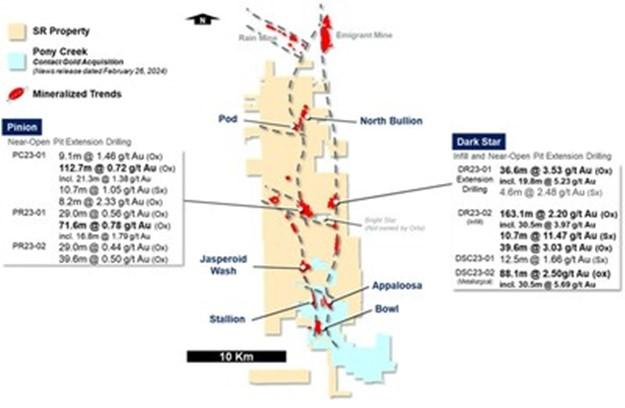
In 2023, Orla extended oxide-hosted gold mineralization at the Pinion and Dark Star deposits, with highly positive drill intersections outside of the projected open pits (Figure 1). Meanwhile, infill drill results met expectations, confirming robust oxide mineralization within projected pits, while supplying material for new metallurgical column test work to further optimize the planned development project.
Pinion SE Extension Drilling
At the Pinion deposit, a review of available geological data suggested gold mineralization may be continuous in the southeastern part of the deposit over the Pinion SE target area, where faulting had been previously interpreted as limiting or displacing extension of the mineralization. To test the continuity of gold mineralization, three drill holes totaling 822 metres were completed. All three drillholes intercepted significant oxide-hosted gold mineralization, including 0.72 g/t Au over 112.7 metres (oxide) confirming the continuity of gold mineralization to the southeast without fault displacement interference (Figure 2). These results, combined with historical drill intersections, indicate geological continuity and suggests gold mineralization extends to at least 350 metres outside of the projected open pit.
Significant results from drilling at Pinion:
| Pinion | |
| PC23-01
incl. |
0.72 g/t Au over 112.7 m (oxide)
1.38 g/t Au over 21.3m |
| PR23-01
incl. |
0.78 g/t Au over 71.6 m (oxide)
1.79 g/t Au over 16.8 m |
| PR23-02
and |
0.44 g/t Au over 29.0 m (oxide)
0.50 g/t Au over 39.6 m (oxide) |
Dark Star Exploration Drilling (Project Open Pit extension and Geophysical Target)
Exploration drilling at the Dark Star deposit consisted of 1,112 metres in two drillholes. Results from these two exploration drill holes identified the potential to extend oxide mineralization beyond the currently defined mineral resources and explained a seismic anomaly identified below the Dark Star deposit.
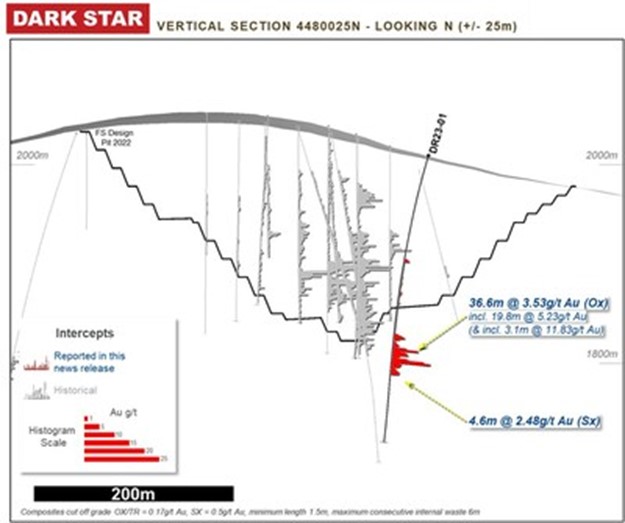
Drillhole DR23-01 targeted the potential extension of high-grade mineralization east of the currently designed open pit limit, returning wider and higher-grade oxide hosted gold mineralization than nearby drill holes and average resources grade, including 3.53 g/t Au over 36.6 metres (oxide), 5.23 g/t Au over 19.8 metres approximately 50 metres outside of the projected open pit limit (Figure 3). The exceptional results from this extension drilling suggests the potential to define additional oxide mineralization, possibly associated with a previously unknown feeder structure for the Dark Star deposit. Additional drilling is planned for 2024 to follow-up on these highly encouraging results, testing the feeder structure model and defining the potential to grow resources and expand the projected open pit.
Drillhole DC23-01 was drilled in the northern part of the Dark Star deposit to test the potential extension of mineralization and was extended to investigate an anisotropic, antiformal seismic anomaly approximately 400 metres below the Dark Star deposit. Assay results from the upper part of the hole returned low grade Au (1.66 g/t Au over 12.5 metres (Sulphide) from 256.5 metres) approximately 30 metres outside the currently defined open pit at Dark Star. Drilling also intercepted unmineralized Tonka Formation conglomerate at depth, explaining and validating the seismic target.
Significant exploration results from Dark Star:
| Dark Star Extension | |
| DR23-01
incl. incl. |
3.53 g/t Au over 36.6 m (oxide)
5.23 g/t Au over 19.8 m (oxide) 11.8 g/t Au over 3.1m (oxide) |
Dark Star Infill and Metallurgical Drilling
One reverse circulation and one core drillhole were completed within the northern pit at the Dark Star deposit (Figure 4) to support ongoing project development work.
The reverse circulation hole, DR23-02, was drilled to confirm continuity of high-grade Au in oxide mineralization at the base of the designed open pit. Highly positive assay results, 2.20 g/t Au over 163.1 metres (oxide), incl. 3.97 g/t Au over 30.5 metres, confirmed the modeled grade, limits of gold mineralization, and continuity of high-grade mineralization at the base of the designed open pit.
The core drillhole, DSC23-02, was drilled to provide material for run-of-mine column test work. The strong assay results, 2.50 g/t Au over 88.1 metres (oxide), incl. 5.69 g/t Au over 30.5 metres1, from hole DSC23-02 are consistent with historical drill data and the mineral resource estimate block model. The run-of-mine column test work is expected to be undertaken in 2024.
| ________________________________________ | |
| 1 | Hole DSC23-02 was chip sampled, rather than quarter-cut, to preserve the maximum amount of core for metallurgical test work. All remaining core from the reported mineralized interval is expected to be consumed during the metallurgical testing. |
Dark Star Infill and Metallurgical Drilling
| Dark Star Infill Drilling | |
| DR23-02
incl. and incl. |
2.20 g/t Au over 163.1 m (oxide)
3.97 g/t Au over 30.5 m (oxide) 2.56 g/t Au over 27.4 m (oxide) |
| DSC23-02
incl. |
2.50g/t Au over 88.1m (oxide)
5.69g/t Au over 30.5m (oxide) |
2024 Pinion and Dark Star Planned Exploration
Orla is committed to growing the Pinion and Dark Star deposits through exploration in 2024. As part of the broader South Railroad exploration program totaling approximately 14,000 metres, Orla plans to drill 4,400 metres across 16 holes, with a focus on exploration near the Pinion and Dark Star deposits. Near-deposit exploration in 2024 will seek to define the extension of oxide mineralization beyond the currently defined open pit extents, building on the drill success from 2023, and supporting resources expansion efforts.
The 2024 exploration program at South Railroad is planned to commence in the spring of 2024 and is expected to continue through October 2024.
South Railroad Project Resources & Reserves and Pinion & Dark Star Geological Setting
The South Railroad Project covers a strike length of over 25 kilometres along the southern part of the prolific Carlin Gold Trend, Nevada. Gold mineralization at South Railroad occurs mainly as disseminated Carlin-type ore-stage pyrite in stratiform breccia and stratigraphic horizons within a complex fault network. The property hosts multiple zones of oxide, transition and sulphide mineralization, throughout the entire land package, with current oxide measured and indicated mineral resources of 1.8 Moz (75.3 Mt at 0.74 g/t Au) inclusive of proven & probable mineral reserves of 1.6Moz (65.2 Mt at 0.77 g/t Au) at the Pinion and Dark Star deposits.


Qualified Persons Statement
The scientific and technical information in this news release has been reviewed and approved by Mr. Sylvain Guerard, P Geo., SVP Exploration of the Company, who is the Qualified Person as defined under the definitions of National Instrument 43-101.
To verify the information related to the 2023 drilling programs at the South Railroad property, Mr. Guerard has visited the property in the past year; discussed logging, sampling, and sample shipping processes with responsible site staff; discussed and reviewed assay and QA/QC results with responsible personnel; and reviewed supporting documentation, including drill hole location and orientation and significant assay interval calculations.
Quality Assurance / Quality Control –2023 Drill Program
All gold results at South Railroad were obtained by fire assay fusion and optical emission finish (FA-PB30-ICP) at American Assay Labs in Sparks, Nevada, USA. Over limit gold assays were determined using fire assay fusion with gravimetric finish (GRAVAu-30). Gold cyanide extraction was determined using a 2-hour cyanide leach (AuCN30). All other elements were determined by 4 acid and boric acid dissolution with ICP-OES+MS method (ICP-2AM50). Quality Assurance/Quality Control and interpretation of results were performed by qualified persons employing a Quality Assurance/Quality Control program consistent with NI 43-101 and industry best practices. Certified reference material (standards), blank, or rig duplicate were inserted approximately every tenth sample for Quality Assurance/Quality Control purposes by the Company. American Assay Labs is independent of Orla. There are no known drilling, sampling, recovery, or other factors that could materially affect the accuracy or reliability of the drilling data at South Railroad.
For additional information on the Company’s previously reported drill results, see the Company’s press releases dated February 8, 2023 (Orla Mining Drills Significant Gold Intersections at Multiple Oxide Targets upon Reactivation of Exploration at South Railroad Project, Nevada),
The mineral reserve estimate for the South Railroad Project consists of 333 koz of proven gold reserves (8,960 k tonnes at 1.17 g/t gold) and 1,271 koz of probable gold reserves (56,239 k tonnes at 0.72 g/t gold). The open pit mineral resource estimate for the South Railroad Project consists of 343 koz of measured gold resources (9,561 k tonnes at 1.13 g/t gold), 1,410 koz of indicated gold resources (65,450 k tonnes at 0.68 g/t gold), and 653 koz of inferred gold resources (21,805 k tonnes at 0.93 g/t gold). The underground mineral resource estimate consists of 66 koz of inferred gold resources (457 k tonnes at 4.49 g/t gold). For additional detail, see the South Railroad Report (as defined below). Mineral resources are inclusive of mineral reserves.
About Orla Mining Ltd.
Orla is operating the Camino Rojo Oxide Gold Mine, a gold and silver open-pit and heap leach mine, located in Zacatecas State, Mexico. The property is 100% owned by Orla and covers over 160,000 hectares. The technical report for the 2021 Feasibility Study on the Camino Rojo oxide gold project entitled “Unconstrained Feasibility Study NI 43-101 Technical Report on the Camino Rojo Gold Project – Municipality of Mazapil, Zacatecas, Mexico” dated January 11, 2021 (the “Camino Rojo Report”), is available on SEDAR+ and EDGAR under the Company’s profile at www.sedarplus.ca and www.sec.gov, respectively. Orla also owns 100% of Cerro Quema located in Panama which includes a gold production scenario and various exploration targets. Cerro Quema is a proposed open pit mine and gold heap leach operation. The technical report for the Pre-Feasibility Study on the Cerro Quema oxide gold project entitled “Project Pre-Feasibility Updated NI 43-101 Technical Report on the Cerro Quema Project, Province of Los Santos, Panama” dated January 18, 2022, is available on SEDAR+ and EDGAR under the Company’s profile at www.sedarplus.ca and www.sec.gov, respectively. Orla also owns 100% of the South Railroad Project, a feasibility-stage, open pit, heap leach project located on the Carlin trend in Nevada. The technical report for the 2022 Feasibility Study entitled “South Railroad Project, Form 43-101F1 Technical Report Feasibility Study, Elko County, Nevada” dated March 23, 2022 (the “South Railroad Report”), is available on SEDAR+ and EDGAR under the Company’s profile at www.sedarplus.ca and www.sec.gov, respectively. The technical reports are available on Orla’s website at www.orlamining.com.
Critical Metals Corp. (Nasdaq: CRML) a leading critical minerals ... READ MORE
Holes SH26-22 and SH26-23 return up to 930 g/t AgEq within broade... READ MORE
Pasinex Resources Limited (CSE: PSE) (FSE: PNX) a growing zinc-fo... READ MORE
Aya Gold & Silver Inc. (TSX: AYA; NASDAQ: AYA) is pleased to... READ MORE
New Break Resources Ltd. (CSE: NBRK) (OTCQB: NBRKF) (FSE: O91) ha... READ MORE