








High-grade orogenic quartz-tourmaline veins encountered within a broad, intrusive-hosted gold system that remains open at depth and along trend
Nuvau Minerals Inc. (TSX-V: NMC) is pleased to report initial assay results from its summer drilling program at Thundermine, one of the primary gold-focused targets, within its Matagami Mining District Property, in Québec, Canada. Initial drilling has intersected exceptionally high-grade quartz-tourmaline veins within a much broader intrusive-hosted mineralized system, providing important new information on the scale and character of the emerging Thundermine gold system.
VIDEO DISCUSSING THUNDERMINE AND TODAY’S RESULTS
Hear directly from Nuvau management on the Thundermine results and what the geology is telling us.
Highlights of drill results:
“These initial assay results from Thundermine, together with the geological data accumulated from 10 holes of drilling, are very encouraging and have established this as a highly prospective gold target. These are the first assays from our summer drill program,” said Christina McCarthy, Nuvau’s Chief Executive Officer. “We have intersected high-grade gold veins within a much broader disseminated intrusive and are seeing the same setting continue as we step away from the limited area that was drilled historically.”
McCarthy added, “The similarities to the quartz-tourmaline gold systems with the large-scale gold deposits in the Sigma-Lamaque district in Val-d’Or provide a compelling geological model to follow, and Thundermine remains open at depth and along strike. With seven holes still pending and only a small part of the larger prospective trend tested, we are just getting started.”
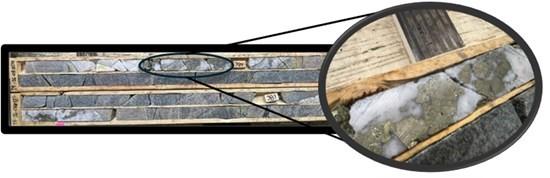
Figure 1: Mineralization and visible gold in quartz-tourmaline veining from TH-26-08.
From Historical Gold Occurrences to an Emerging Gold System
Thundermine, located in the northern sector of Nuvau’s Matagami property, was first explored for copper in the late 1950s, before limited drilling in the 1980s identified an adjacent gold showing in six holes. Selective historical sampling returned non-verified intervals1 including 78.16 g/t Au over 1.0 metre, 26.40 g/t Au over 0.8 metres, and 3.73 g/t Au over 9.4 metres. Despite these results, the gold showing saw no follow-up drilling for nearly 40 years.
Nuvau returned to Thundermine in 2026 for the first modern, systematic, evaluation of its gold potential. Winter drilling intersected 5.28 g/t Au over 6.1 metres, including 7.22 g/t Au over 3.1 metres, approximately 200 metres below the historical intercepts. In the summer, Hole TH-26-05 tested a historical mineralized position, providing modern geological observations and assays against which the historical information could be compared. Subsequent holes stepped out approximately 25 to 50 metres from historical intercepts and from one another (Figure 2), extending the tested footprint approximately 80 metres to the southeast and 200 metres deeper than historical drilling, with all 10 holes intersecting the targeted tonalitic intrusive and associated hydrothermal system.
The emerging picture is increasingly compelling.
Drilling is outlining a broad, mineralized intrusive cut by multiple generations of gold-bearing veins, including locally very high-grade quartz-tourmaline veins. The setting shares characteristics with the well-known orogenic gold systems of the Sigma-Lamaque district in Val-d’Or, providing an important geological model for continued exploration. Combined historical and Nuvau drilling now traces the geological framework for more than 300 metres along trend and more than 400 metres vertically, and it remains open to the southeast and at depth within a broader kilometre-scale area of interest.
Table 1: Selected Thundermine drillhole assays above 5 grams of gold per tonne of rock (g/t). All reported lengths are measured along the drill core and do not necessarily represent the true thickness of the mineralized zone.
| Drillhole | From (metres) | To (metres) | Length (metres) | Au (g/t) >5 g/t |
| TH-26-04 | 432.10 | 432.50 | 0.40 | 6.02 |
| 562.85 | 564.00 | 1.15 | 8.95 | |
| 564.90 | 565.95 | 1.05 | 11.36 | |
| TH-26-05 | 103.05 | 103.75 | 0.70 | 24.75 |
| 177.15 | 177.55 | 0.40 | 31.51 | |
| 204.25 | 204.70 | 0.45 | 37.85 | |
| 280.60 | 281.15 | 0.55 | 12.91 | |
| 282.20 | 282.70 | 0.50 | 36.20 | |
| TH-26-06 | 122.00 | 123.50 | 1.50 | 9.29 |
| 363.45 | 363.95 | 0.50 | 6.97 | |
| 374.65 | 375.15 | 0.50 | 10.64 | |
| TH-26-08 | 268.60 | 269.10 | 0.50 | 7.67 |
| 303.80 | 304.30 | 0.50 | 11.88 | |
| 357.00 | 357.50 | 0.50 | 11.06 | |
| 373.00 | 373.50 | 0.50 | 7.59 | |
| 383.35 | 384.20 | 0.85 | 629.15 | |
| 387.45 | 387.80 | 0.35 | 236.95 |
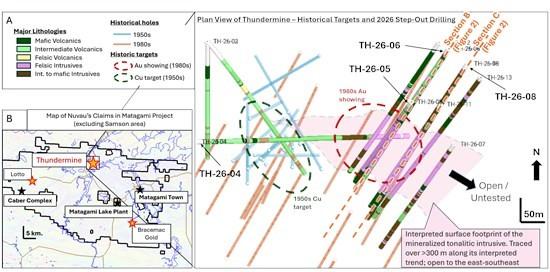
Figure 2: Plan View (A) of Thundermine target (B) Location of Thundermine within Nuvau’s Matagami property package.
Geological Context and Emerging Model
Drilling is progressively defining the three-dimensional architecture of the Thundermine intrusive-hosted gold system. The tonalitic intrusive forms a steeply dipping body interpreted to be approximately 150 metres thick, with locally developed branches or apophyses extending into the surrounding volcanic sequence (Figure 3).
Pervasive sericite-silica alteration is associated with multiple generations of quartz-carbonate-tourmaline(-fuchsite) veins containing pyrite and minor chalcopyrite. The relative timing and spatial relationships between these vein generations and associated alteration are not yet fully resolved, and alternative interpretations are being evaluated.
Gold mineralization is spatially associated with the vein system, with locally high-grade mineralization hosted in discrete veins and broader disseminated and veinlet-hosted mineralization developed in the altered intrusive around and between them. The persistence of the intrusive, alteration, and vein assemblages across the drillholes supports geological continuity of the hydrothermal system, although their intensity and associated gold grades vary between and within holes (Figure 4).
At a broader scale, drilling, structural interpretation and geophysical data define a kilometre-scale prospective trend centred on the intersection of local and regional structural breaks, interpreted to have provided a favourable setting for intrusive emplacement and subsequent hydrothermal fluid circulation (Figure 5).
With assays from seven holes pending, Nuvau is integrating analytical results with lithological, alteration, structural, and mineralogical observations to refine the geological model and controls on higher-grade mineralization. The expanded dataset will test these interpretations and guide subsequent step-out drilling along trend and at depth.
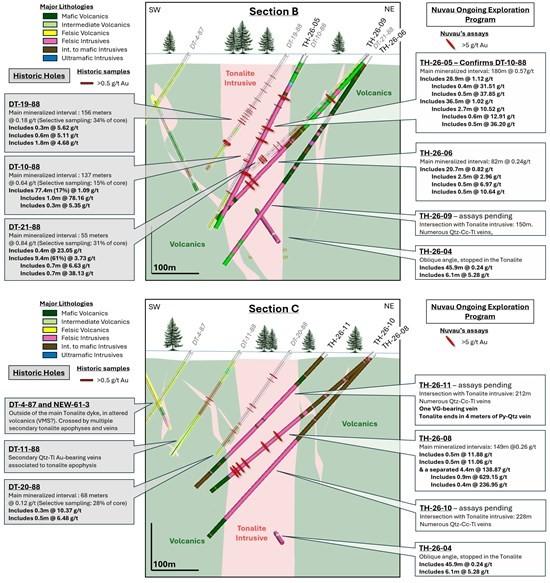
Figure 3: Cross section B and C, looking northwest (60 m projection window). All reported lengths are core lengths; true widths are unknown. All reported gold grades are length-weighted averages. Unsampled intervals resulting from selective sampling are assigned a grade of 0 g/t Au for the purpose of calculating composite grades.
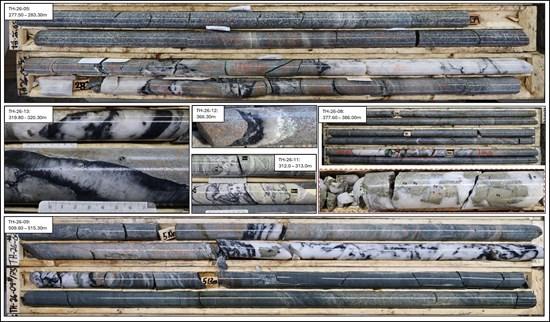
Figure 4: Selected core photographs showing representative veining and alteration within the mineralized tonalitic intrusive. Gold occurs in veins, veinlets, and disseminated in the associated alteration.
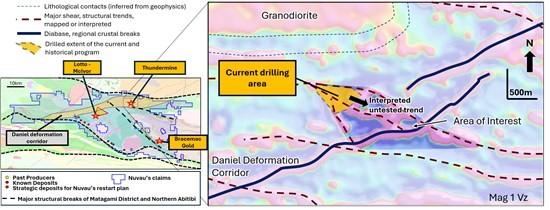
Figure 5: Geological and structural setting of the Thundermine target within Nuvau’s Matagami property integrating drilling and magnetic data and highlights the currently tested area relative to the broader prospective footprint.
Table 2: Selected Thundermine summer drillhole assays above 1 g/t Au. Composite intervals represent the length-weighted average gold grade across the main mineralized intervals within the tonalitic intrusive; mineralization also occurs outside these intervals. Unsampled intervals and assays below the detection limit are assigned 0 g/t Au for composite calculations. All reported intervals are lengths measured along the drill core. The true thickness of the mineralized zones cannot yet be determined from the available drilling.
| Drillhole | Composites (downhole) | From (metres) | To (metres) | Length (metres) | Au (g/t) >1 g/t |
| TH-26-05 | 102.3m to 282.7m 180.4 m @ 0.57 g/t Au |
102.30 | 103.05 | 0.75 | 1.98 |
| 103.05 | 103.75 | 0.70 | 24.75 | ||
| 116.00 | 116.50 | 0.50 | 1.26 | ||
| 122.10 | 123.00 | 0.90 | 2.59 | ||
| 123.00 | 123.50 | 0.50 | 4.20 | ||
| 148.30 | 148.80 | 0.50 | 3.26 | ||
| 157.60 | 158.10 | 0.50 | 3.93 | ||
| 164.70 | 165.20 | 0.50 | 1.16 | ||
| 177.15 | 177.55 | 0.40 | 31.51 | ||
| 183.20 | 183.75 | 0.55 | 2.03 | ||
| 204.25 | 204.70 | 0.45 | 37.85 | ||
| 205.40 | 206.00 | 0.60 | 1.13 | ||
| 228.00 | 228.70 | 0.70 | 2.86 | ||
| 250.00 | 250.90 | 0.90 | 1.78 | ||
| 254.50 | 255.10 | 0.60 | 1.99 | ||
| 257.20 | 258.00 | 0.80 | 2.19 | ||
| 261.70 | 262.20 | 0.50 | 1.37 | ||
| 275.00 | 275.50 | 0.50 | 1.35 | ||
| 280.00 | 280.60 | 0.60 | 2.56 | ||
| 280.60 | 281.15 | 0.55 | 12.91 | ||
| 281.15 | 282.20 | 1.05 | 1.58 | ||
| 282.20 | 282.70 | 0.50 | 36.20 | ||
| 335.20 | 335.95 | 0.75 | 3.82 | ||
| 356.50 | 357.00 | 0.50 | 4.00 | ||
| TH-26-06 | 122.00 | 123.50 | 1.50 | 9.29 | |
| 293.3m to 375.2m 81.9 m @ 0.24 g/t Au |
293.30 | 293.80 | 0.50 | 1.28 | |
| 329.30 | 330.00 | 0.70 | 1.20 | ||
| 354.50 | 356.25 | 1.75 | 3.57 | ||
| 356.25 | 356.95 | 0.70 | 1.46 | ||
| 363.45 | 363.95 | 0.50 | 6.97 | ||
| 374.65 | 375.15 | 0.50 | 10.64 | ||
| TH-26-08 | 259.7m to 373.5m 113.8 m @ 0.26 g/t Au |
259.70 | 260.20 | 0.50 | 1.57 |
| 268.60 | 269.10 | 0.50 | 7.67 | ||
| 303.80 | 304.30 | 0.50 | 11.88 | ||
| 309.75 | 310.70 | 0.95 | 1.08 | ||
| 331.90 | 332.60 | 0.70 | 2.60 | ||
| 333.10 | 333.60 | 0.50 | 2.51 | ||
| 350.90 | 351.50 | 0.60 | 1.96 | ||
| 357.00 | 357.50 | 0.50 | 11.06 | ||
| 372.50 | 373.00 | 0.50 | 1.67 | ||
| 373.00 | 373.50 | 0.50 | 7.59 | ||
| 383.4m to 387.8m 4.4 m @ 138.87 g/t Au |
383.35 | 384.20 | 0.85 | 629.15 | |
| 387.45 | 387.80 | 0.35 | 236.95 | ||
| 388.30 | 388.80 | 0.50 | 1.44 | ||
| 388.80 | 389.60 | 0.80 | 2.18 | ||
| 402.00 | 403.40 | 1.40 | 1.79 |
Table 3: Drillhole locations.
| DDH | UTM X | UTM Y | UTM Z | Azimuth | Dip | Depth | Visible Gold | Assays |
| TH-26-05 | 296898 | 5524056 | 255 | 214 | -63 | 416 | X | Received |
| TH-26-06 | 296975 | 5524172 | 255 | 215 | -49 | 480 | Received | |
| TH-26-07 | 296990 | 5523980 | 255 | 215 | -47 | 378 | X | Pending |
| TH-26-08 | 297014 | 5524142 | 255 | 214 | -42 | 470 | X | Received |
| TH-26-09 | 296975 | 5524172 | 255 | 214 | -55 | 546 | Pending | |
| TH-26-10 | 297014 | 5524142 | 255 | 215 | -50 | 521 | Pending | |
| TH-26-11 | 296957 | 5524058 | 255 | 212.5 | -47 | 393 | X | Pending |
| TH-26-12 | 296951 | 5524193 | 255 | 215 | -47 | 450 | X | Pending |
| TH-26-13 | 297046 | 5524109 | 255 | 216 | -53 | 570 | X | Pending |
| TH-26-14 | 297046 | 5524109 | 255 | 216 | -46 | 492 | X | Pending |
Quality Assurance, Quality Control, and Data Verification
Drill core is logged, photographed, sawn in half, and sampled at Nuvau Minerals’ secure core facility. One half of the core is submitted for analysis, and the remaining half is retained on site for reference. Samples are sealed in individually labelled plastic bags and transported under chain-of-custody procedures to MSALABS in Val-d’Or, Québec, an independent ISO/IEC 17025-accredited laboratory.
Samples are dried, crushed to achieve approximately 70% passing 2 mm, and prepared for analysis. Gold assays are completed using PhotonAssay™ technology on a nominal 500 g aliquot. The Company’s quality assurance and quality control (QA/QC) program includes certified reference materials, blanks and duplicate samples, representing approximately 11% of all submitted samples. Additional QA/QC samples are inserted at intervals that contain visible mineralization. MSALABS also applies its internal quality control procedures in accordance with its accredited analytical protocols.
Analytical results are reviewed through a comprehensive QA/QC verification process, including the evaluation of standards, blanks, and duplicate samples. Reanalysis is conducted systematically where QA/QC criteria are not met. The Qualified Person reviews the analytical results, QA/QC data, and verification procedures disclosed herein and considers the results to be reliable and suitable for reporting.
Qualified Person
The scientific and technical information contained in this news release has been reviewed and approved by Bastien Fresia, P. Geo. (Qc), Director of Technical Services and a “qualified person” for the purposes of National Instrument 43-101.
About Nuvau
Nuvau Minerals is a Canadian mining and exploration company advancing a historic mining camp toward a production restart while generating new critical metal and gold discoveries. Its flagship asset is the past-producing Matagami mining district in northern Québec. Nuvau controls a 1,380-square-kilometre land package and benefits from access to permitted mining infrastructure, including an option on a 3,000 tpd concentrator. The Company’s strategy is to combine district-scale exploration targeting zinc-copper VMS deposits and newly recognized gold potential with resource growth and project development.
Brutus Mining Inc. (CSE: BRU) (FSE: ZI3) is pleased to announce that it has closed its non-brokered ... READ MORE
Jaguar Uranium Corp. (NYSE American: JAGU) is pleased to announce an independent Mineral Resource E... READ MORE
Auro Metals Inc. (TSX-V: AURO) (OTCQB: AURFF), is pleased to announce the assay results of the fina... READ MORE
Endeavour Silver Corp. (NYSE: EXK) (TSX: EDR) is pleased to announce that repairs to the primary bal... READ MORE
Scorpio Gold Corp. (NASDAQ: SGLD) (TSX-V: SGLD) (OTCQB: SRCRF) (FSE: RY9) is pleased to announce re... READ MORE