







NorthWest Copper Corp. (TSX-V: NWST) is pleased to announce additional copper-gold assay results from the Western Zone at its 100% owned Kwanika project in British Columbia, highlighted by 73.9 metres grading 1.39% copper equivalent, including a higher-grade interval of 25.9 metres grading 2.19% CuEq, anchored by 1.58 g/t gold.
The three holes form part of the Company’s completed 43-hole, 12,291 metre 2026 exploration program. The drilling achieved several key objectives, including extending higher-grade mineralization approximately 50 metres up-dip and closing a geological gap in Unit 2 proximal to current mineral resources. These results expand the known extent of mineralization, improve geological and grade continuity, while reducing drill-hole spacing to approximately 50 metres in targeted areas.
Immediately below the current mineral resource, drilling intersected primary copper-gold porphyry mineralization, highlighting potential for additional mineralization beyond the currently defined resource. Drilling also confirmed the presence and orientation of a broad, low-grade, mineralized structure below known mineralization supporting opportunities to identify parallel mineralization at depth.
Western Zone Drill Hole Highlights:
| K-26-260: | 73.9 metres of 0.51% Cu and 0.79 g/t Au (1.39% CuEq) from 457.0 metres, |
| including 25.9 metres of 0.48% Cu and 1.58 g/t Au (2.19% CuEq) from 505 metres | |
| K-26-260: | 74.8 metres of 0.23% Cu and 0.49 g/t Au (0.78% CuEq) from 600.2 metres |
| K-26-258: | 10.9 metres of 0.33% Cu and 0.62 g/t Au (1.01% CuEq) from 406.2 metres |
Paul Olmsted, CEO of NorthWest stated: “These results represent another positive step forward at Kwanika, combining significant copper-gold grades with meaningful advances in our understanding of the Western Zone. The grades and significant mineralized widths reinforce the quality of existing mineralization at Kwanika and its potential for continued expansion. Importantly, we are extending known mineralization, improving geological continuity and identifying additional exploration opportunities beyond the current mineral resource. Together, these results strengthen our confidence in Kwanika as we advance our mineral resource and development objectives.”
2026 Kwanika Exploration Program
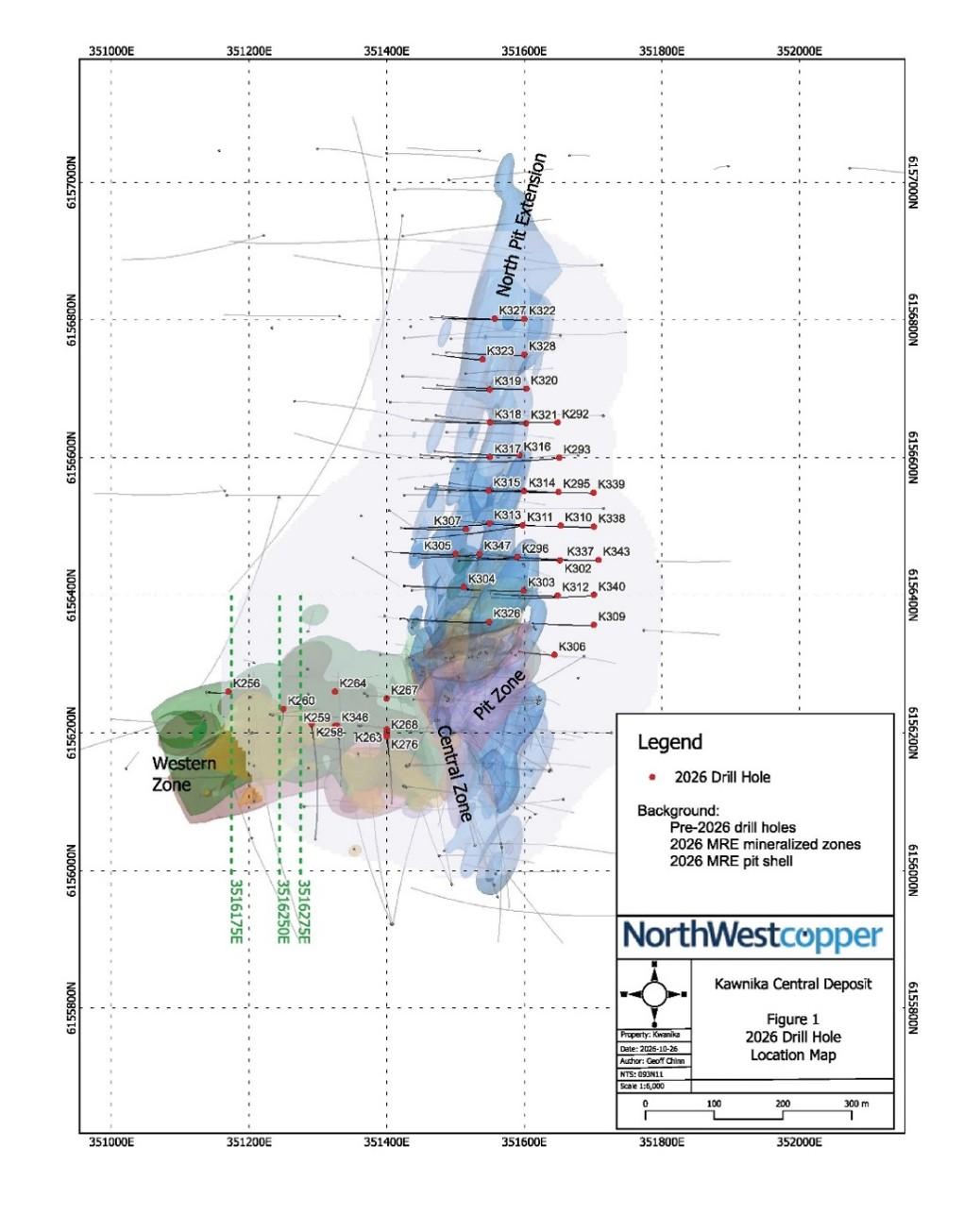
With the three holes reported in this release, the Company has now reported results from 17 of the 43 holes completed during the 2026 Kwanika drill program, which totaled 12,291 metres. Planned collar locations for the holes of the 2026 drill program are presented in Figure 1, along with the location of the cross sections 351275 E, 351250 E, and 351175 E (Figures 2, 3, and 4) containing the holes reported in this release.
Figure 1: Kwanika Central 2026 drill hole location map
Geoff Chinn, VP Business Development and Exploration added: “The results from K-26-258 and K-26-260 demonstrate that as drilling progresses to the West holes there is more opportunity to expand mineralization. K-26-258 extended Unit 1 mineralization up-dip and confirmed the presence and orientation of a parallel mineralized structure at depth below the known mineralization. Hole K-26-260 closed a key gap in Unit 2 and intersected a wide interval of primary copper-gold porphyry mineralization enriched in palladium that may warrant expanding last year’s palladium re-sampling program from old holes. In sum, it’s encouraging to see mineralized expansions as we drill to the west and at depth. With our Western Zone results now fully reported, we look forward to receiving the remaining assay results from twenty-six holes in the North Pit Extension Zone.”
Kwanika Exploration Drill Hole Summaries
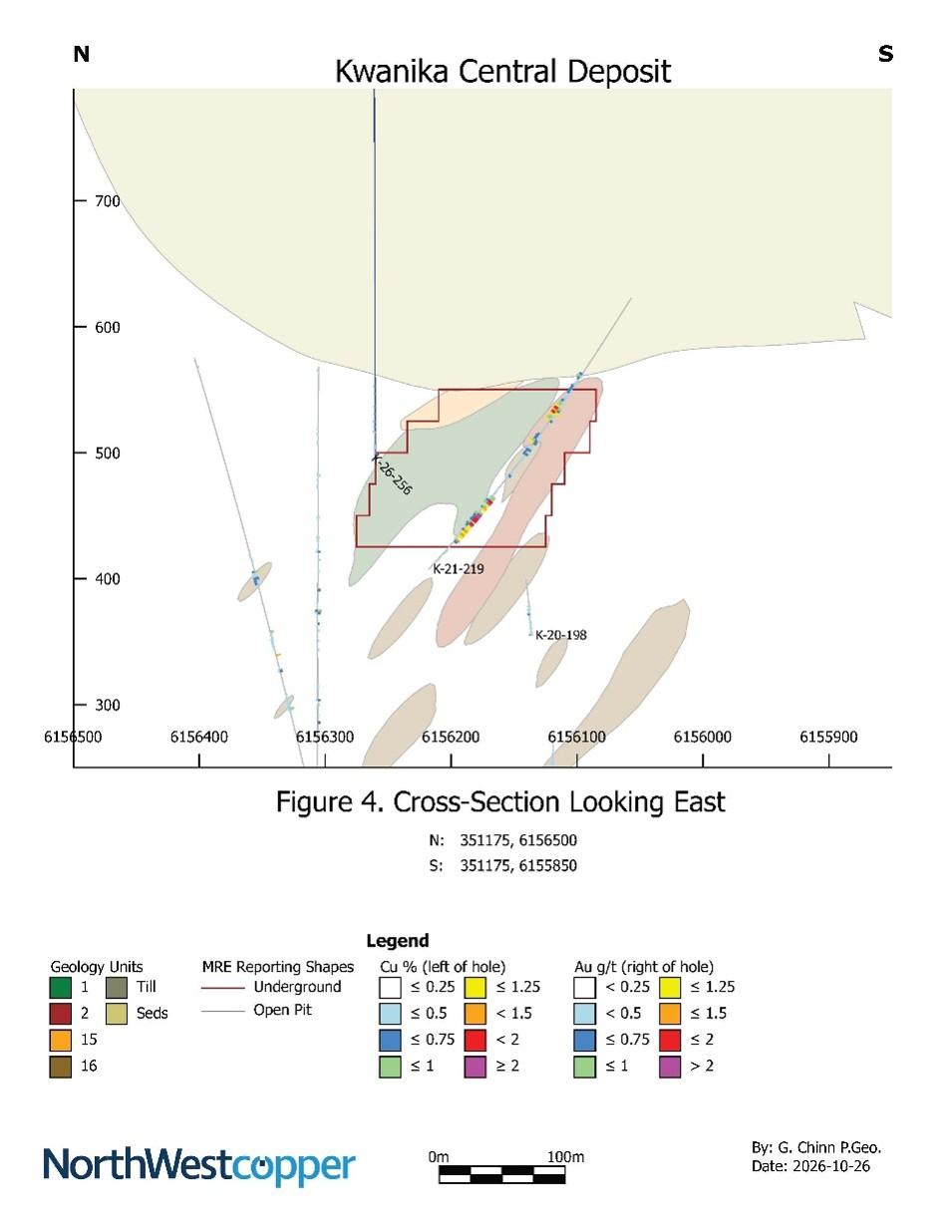
Results of three drill holes are presented on cross sections 351275 E, 351250 E, and 351175 E (Figures 2, 3, and 4) with composited mineralized intersections listed in Table 1 and collar locations provided in Table 2. All cross sections are in the Western Zone. The holes were designed to extend mineralization up-dip, close a gap in mineralization, confirm presence and orientation of a deep mineralized structure, test for primary Cu-Au porphyry mineralization under the known fractured mineralized structures, and reduce drill hole spacing to approximately 50 metres to support upgraded mineral resources in the Indicated category. A summary of the geological aspects of holes is presented below.
Figure 2: Cross-Section 351275 E showing 2026 drill results with blue hole traces
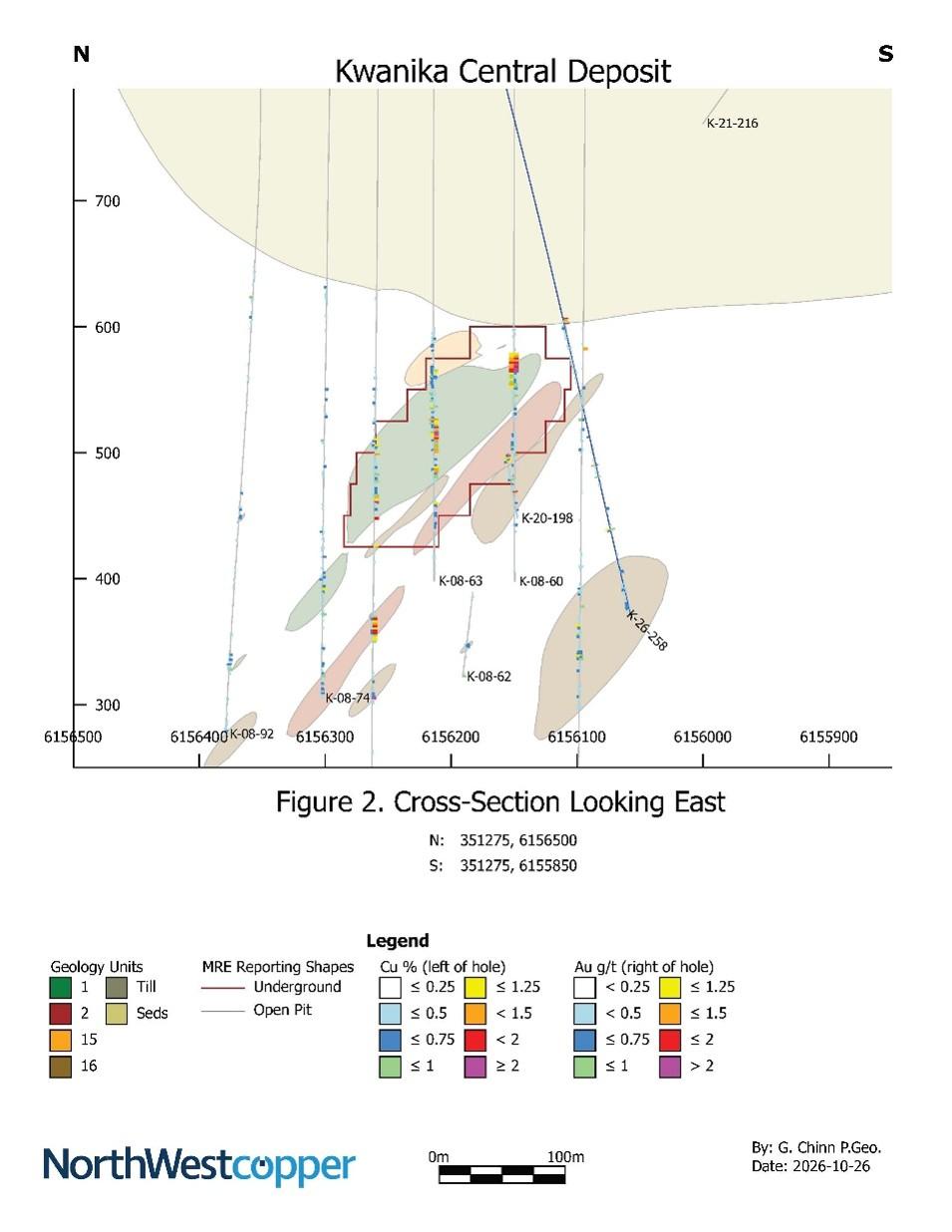
Figure 3: Cross-Section 351250 E showing 2026 drill results with blue hole traces
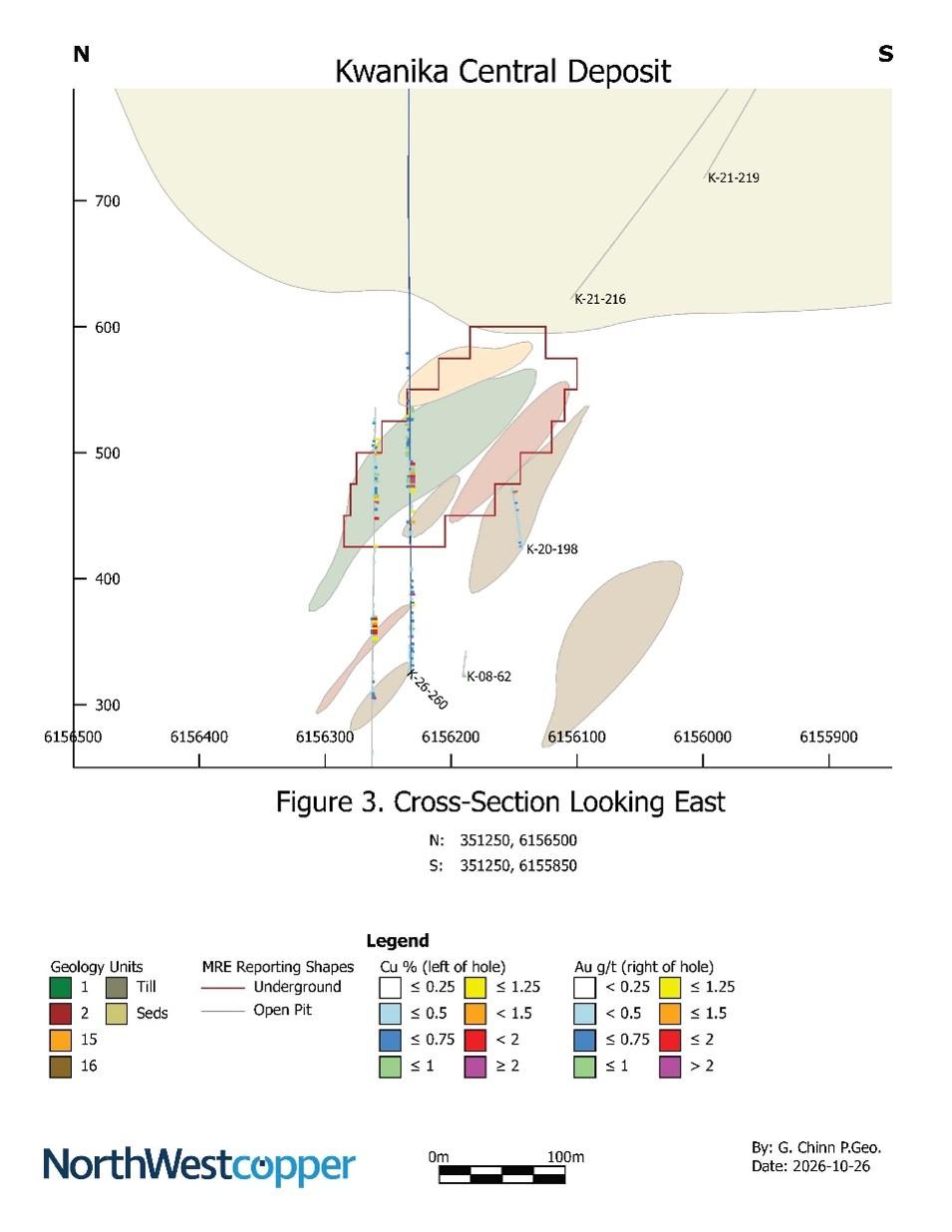
Figure 4: Cross-Section 351175 E showing 2026 drill results with blue hole traces
Western Zone:
Hole K-26-256 on 351175E (Fig. 4) was drilled with HQ to 117 metres and NQ sized core to the end of hole and sampled on about 2 metre intervals from half sawn core and drilled on 260° azimuth at a -88° dip to a depth of 513 metres.
After 35 metres of overburden the hole intersected post-mineralization Cretaceous sediments to 451 metres then maroon-green hematite altered tectonic breccia to 452 metres, and a hematite-chlorite altered maroon and green porphyritic monzonite to 513 metres. The hole was abandoned due to difficult ground condition and poor drilling performance before intersecting targeted mineralized depths.
Hole K-26-258 on 351275E (Fig. 2) was drilled with NQ2 sized core and sampled on about 2 metre intervals from half sawn core and drilled on 170° azimuth at a -75° dip to a depth of 648 metres.
After 33 metres of overburden the hole intersected post-mineralization Cretaceous sediments to 406 metres then mineralized maroon-green hematite altered tectonic breccia hosting native copper and localized clasts of stockwork to 412 metres as per Table 1, Composite 2 (Comp. 2) and a weakly mineralized light tan potassic altered fractured porphyritic monzonite with early quartz-sulphide stockwork veins to 455 metres followed by a weakly mineralized light orange to tan potassic-sericite altered monzodiorite hosting localized quartz-sulphide stockwork and planar anhydrite veinlets to 471 metres (Comp. 3). A sequence of propylitic altered andesite porphyry to 474 metres, grey-green to orange monzondiorite to 487 metres, grey-green to light orange quartz monzonite to 493 metres, andesite porphyry to 497 metres, grey-green monzodiorite to 503 metres, grey-green to light orange quartz monzonite to 509 metres, grey-green propylitic altered andesite to 522 metres, weakly propylitic altered dark green diorite to 528 metres, moderately propylitic altered light green to grey-green monzodiorite to 533 metres. These intervals are followed by a weakly propylitic and potassic altered medium grey to light green-grey diorite to 648 metres, crosscut by fault zones at 576 and 591metres, mineralized between 604 and 630 metres (Comp. 4), and crosscut by late porphyritic dykes between 630 and 633 metres and between 645 and 647 metres.
Hole K-26-260 on 351250E (Fig. 3) was drilled with NQ2 sized core and sampled on about 2 metre intervals from half sawn core and drilled on 177° azimuth at a -88° dip to a depth of 675 metres.
After 33 metres of overburden the hole intersected post-mineralization Cretaceous sediments to 404 metres then propylitic altered dark green tectonic breccia to 420 metres and an oxidized mineralized hematite altered maroon porphyritic diorite to 472 metres (Comp. 5). This is followed by a mineralized fractured light tan potassic altered porphyritic monzonite with early dismembered quartz-sulphide veins and veinlets to 575 metres (Comp. 7, 8, and 9) crosscut by late maroon porphyritic dyke between 575 and 590 metres followed by coherent mineralized orange mottled potassic altered porphyritic monzonite to 675 metres with dominantly dismembered quartz stockwork to 610 metres (Comp. 11) and planar early quartz-sulphide veins (Comp 12) correlated to primary Porphyry Cu-Au Unit 16. Curiously, Composites 11 and 12 both have elevated palladium values, more typical of Unit 2, demonstrating the potential of primary porphyry mineralization to host elevated palladium metal. The hole ended in mineralization at 675 metres.
Hole Summary: Hole K-26-256 on section 351175E (Fig. 4) was abandoned before intersecting anticipated mineralized structures. Hole K-26-258 on section 351275E (Fig. 2) successfully extended Copper Oxide Unit 15 and/or Unit 1 up-dip about 50 metres to the Cretaceous sediment contact (Comp. 2) with Unit 2 and Unit 16 up-dip extensions manifesting as a wide low-grade copper dominant intercept (Comp. 3) typical of distal mineralized extensions. As follow up to hole K-07-56, K-26-258 pushed deeper through weakly altered rocks to confirm the presence and orientation of an altered deep wide parallel mineralized structure under known mineralization of a style typical of distal mineralized extensions and suggesting potential for higher grade mineralization down-dip. Hole K-26-260 on section 351250E (Fig. 3) filled a key gap in Unit 2 that will improve geological and grade continuity and incrementally expand mineral resources in this area. Primary Cu-Au porphyry was encountered deep in K-26-260 that had elevated palladium, demonstrating potential for a small palladium credit in that style of mineralization.
Table 1: Drill Results in this News Release1 2
| Comp | Hole | From | To | Length | Area | Cu | Au | Ag | Pd | CuEq | True Width |
Mineralized |
| # | (m) | (m) | (m) | (%) | (g/t) | (g/t) | (g/t) | (%) | Est. (m) | Unit | ||
| 1 | K-26-256 | – | – | – | Western | – | – | – | – | – | – | Abandoned at 513m |
| 2 | K-26-258 | 406.2 | 417.0 | 10.9 | Western | 0.33 | 0.62 | 0.54 | 0.02 | 1.01 | 8.9 | Copper Oxide 15/HG Au 1 |
| 3 | K-26-258 | 417.0 | 470.6 | 53.6 | Western | 0.28 | 0.13 | 0.37 | 0.00 | 0.43 | 51.8 | Up-dip ext. Units 2, 16 |
| 4 | K-26-258 | 604.2 | 645.2 | 41.0 | Western | 0.34 | 0.23 | 0.32 | 0.01 | 0.60 | 33.6 | Deep Mineralized Structure |
| 5 | K-26-260 | 419.2 | 433.0 | 13.8 | Western | 0.40 | 0.15 | 1.56 | 0.01 | 0.59 | 9.3 | Copper Oxide 15 |
| 6 | K-26-260 | 457.0 | 530.9 | 73.9 | Western | 0.51 | 0.79 | 2.37 | 0.02 | 1.39 | 49.4 | |
| 7 | Including | 457.0 | 505.0 | 48.0 | Western | 0.53 | 0.37 | 2.57 | 0.00 | 0.95 | 32.1 | Higher-Grade Au 1 |
| 8 | And | 505.0 | 530.9 | 25.9 | Western | 0.48 | 1.58 | 2.00 | 0.05 | 2.19 | 17.3 | Higher-Grade Au 1 |
| 9 | K-26-260 | 545.0 | 565.0 | 20.0 | Western | 0.25 | 0.79 | 1.19 | 0.02 | 1.11 | 13.4 | Higher-Grade Au 1 |
| 10 | K-26-260 | 600.2 | 675.0 | 74.8 | Western | 0.23 | 0.49 | 1.34 | 0.07 | 0.78 | 50.1 | |
| 11 | Including | 604.7 | 621.0 | 16.3 | Western | 0.19 | 0.74 | 1.42 | 0.08 | 1.00 | 10.9 | Higher-Grade Au 2 |
| 12 | And | 632.0 | 671.0 | 39.0 | Western | 0.29 | 0.46 | 1.55 | 0.08 | 0.80 | 26.1 | Porphyry Cu-Au 16 |
Table 2: Drill Collar Information3
| Hole | Collar X | Collar Y | Collar Z | Collar Azimuth |
Collar Dip | Final Length | Core Size |
| K-26-256 | 351167 | 6156262 | 1014 | 260 | -88 | 513 | HQ, NQ |
| K-26-258 | 351290 | 6156210 | 1003 | 170 | -75 | 648 | NQ2 |
| K-26-260 | 351247 | 6156236 | 999 | 177 | -88 | 675 | NQ2 |
Quality Assurance / Quality Control
Drilling at Kwanika in 2026 was designed and supervised by NorthWest and implemented by InData Geoscience with assay QA/QC checks by Explore Geosolutions. Samples were collected, tracked and an external QA/QC program was implemented using coarse blanks and certified prepared blanks and standards to monitor analytical accuracy and precision. The samples were sealed on site and shipped to Activation Laboratories Ltd. in Kamloops, BC. The laboratory’s internal quality control system complies with global certifications for quality ISO 17025. Drill core samples were analyzed using a combination of Actlabs multi-element 1F2 analysis for low level concentrations (4-Acid Digestion, ICP-OES) and the 8-4 Acid ICP-OES analysis for higher level concentrations (4-Acid Digestion, ICP-OES with automatic over limits for base metals and silver). Gold, platinum and palladium assaying was completed with 1C-OES method, using a 30-gram fire assay with ICP finish analysis. In addition, about 5% of the sample pulps are re-assayed at a secondary laboratory to confirm reproducibility and check for bias.
Technical aspects of this news release have been reviewed, verified, and approved by Geoff Chinn, P.Geo., VP Business Development and Exploration for NorthWest, who is a qualified person as defined by National Instrument 43-101 – Standards of Disclosure for Mineral Projects.
About NorthWest:
NorthWest is a copper-gold exploration and development company with a pipeline of advanced and early-stage projects in British Columbia, including Kwanika-Stardust, Lorraine-Top Cat and East Niv. With a robust portfolio in an established mining jurisdiction, NorthWest is well positioned to participate fully in strengthening global copper and gold markets. The Company is committed to responsible mineral exploration, working collaboratively with First Nations to help ensure future development incorporates stewardship best practices and respects traditional land use. Additional information can be found on the Company’s website at www.northwestcopper.ca.
On Behalf of NorthWest
“Paul Olmsted”
CEO, NorthWest Copper
For further information, please contact:
416-457-3333
info@northwestcopper.ca
First Quantum Minerals Ltd. (TSX: FM) today reports results for the three and nine months ended Sept... READ MORE
Eldorado Gold Corporation (TSX: ELD) (NYSE: EGO) today reports the Company’s financial and operati... READ MORE
Alamos Gold Inc. (TSX:AGI) (NYSE:AGI) today reported its financial results for the quarter e... READ MORE
Kinross Gold Corporation (TSX: K) (NYSE: KGC) today announced its results for the third quarter ende... READ MORE
Imperial Metals Corporation (TSX:III) reports assay results from its spring 2026 diamond drilling pr... READ MORE