








HIGHLIGHTS:
Montage Gold Corp. (TSX: MAU) (OTCQX: MAUTF) is pleased to report an updated Mineral Resource Estimate for its Koné and Gbongogo Main deposits, at the Company’s flagship Koné project, located in Côte d’Ivoire, where construction continues to rapidly advance on-budget and ahead of schedule with first gold pour anticipated through the oxide circuit in late Q4-2026.
A total of 174,000 meters of exploration, advance grade control and grade control drilling were conducted in 2025, with 36% directed towards the Koné and Gbongogo Main deposits, in addition to delineating new higher-grade satellit e deposits. A total of 59,873 meters of grade control and exploration drilling was completed on the Koné deposit in 2025, increasing the cumulative drilling to 171,050 meters, compared to 100,249 meters prior to the 2024 Updated Feasibility Study (“UFS”). At the Gbongogo Main deposit, 7,292 meters of grade control and exploration drilling have been completed since the beginning of 2025, bringing total drilling to 32,002 meters, compared to 18,276 prior to the 2024 UFS. In-fill and step-out drilling at the Koné and Gbongogo Main deposits, and application of Ordinary Kriging methodology, have enabled better definition of higher-grade zones, improved mineralization continuity, and extended the overall mineralized envelopes.
As shown in Table 1 below, the Koné deposit Measured and Indicated (“M&I”) Resources increased by 142koz to 4.63Moz, with grade increasing by 21% to 0.69 g/t Au, while Inferred Resources increased by 749koz to 1.26Moz, with gra de increasing by 21% to 0.52 g/t Au, compared to last year. Furthermore, the Koné deposit maiden Measured Resource of 229koz at 0.83 g/t Au demonstrates a higher level of resource confidence. At the Gbongogo Main deposit, Indicated Resources increased by 223koz to 783koz, with grade increasing by 3% to 1.51 g/t Au, while Inferred Resources increased by 39koz to 41koz, with grade increasing by 21% to 1.08 g/t Au, compared to last year.
The updated MRE for the Koné project’s overall M&I Resources increased by 671koz to 5.88Moz, with grade increasing by 24% to 0.77 g/t Au, while Inferred Resources increased by 782koz to 1.56Moz, with grade increasing by 7% to 0.58 g/t Au, compared to last year, inclusive of resources for additional satellite deposits published last year. Moreover, Indicated and Inferred Resources for higher-grade satellite deposits now stand at 1.25Moz at 1.34 g/t Au and 303koz at 1.07 g/t Au, respectively, highlighti ng the effectiveness of the exploration programme.
Updated resources for satellite deposits, including Gbongogo South, Koban North, ANV, Yere North, Lokolo Main, Sena and Diouma North, are expected to be published in the coming weeks, while maiden resources for new discoveries such as Petit Yao and Soman 1 & 2 are expected to be released throughout the year, following the completion of phased exploration programmes. Exploration remains a strong focus at the Koné project, with a 90,000-meter drill programme launched in early 2026, supporting the continued expansion of the resource base.
| Table 1: Koné project Mineral Resource Estimate variance year-over-year | ||||||||||
| PREVIOUS MRE1 (Published April 2025) |
UPDATED MRE2 (Published March 2026) |
YoY | ||||||||
| Resources shown on a 100% basis | Tonnage | Grade | Content | Tonnage | Grade | Content | Variance | |||
| (Mt) | (Au g/t) | (Au koz) | (Mt) | (Au g/t) | (Au koz) | (Au koz) | ||||
| Koné deposit | ||||||||||
| Measured | – | – | – | 8.6 | 0.83< /td> | 229 | +229 | |||
| Indicated | 245 | 0.57 | 4,490 | 200 | 0.68 | 4,404 | (86 | ) | ||
| Measured & Indicated | 245 | 0.57 | 4,490 | 209 | 0.69 | 4,632 | +142 | |||
| Inferred | 37 | 0.43 | 510 | 75 | 0.52 | 1,259 | +749 | |||
| Satellite deposits (incl. Gbongogo Main) | ||||||||||
| Measured | – | – | – | – | – | – | – | |||
| Indicated | 16 | 1.38 | 720 | 29 | 1.34 | 1,249 | +529 | |||
| Measured & Indicated | 16 | 1.38 | 720 | 29 | 1.34 | 1,249 | +529 | |||
| Inferred | 8.4 | 1.00 | 270 | 8.8 | 1.07 | 303 | +33 | |||
| Total Koné project | ||||||||||
| Measured | – | – | – | 8.6 | 0.83 | 229 | +229 | |||
| Indicated | 261 | 0.62 | 5,210 | 229 | 0.77 | 5,652 | +442 | |||
| Measured & Indicated | 261 | 0.62 | 5,210 | 238 | 0.77 | 5,881 | +671 | |||
| Inferred | 45 | 0.54 | 780 | 84 | 0.58 | 1,562 | +782 | |||
| 1) Previous MRE as disclosed in the Company’s press r elease dated April 8, 2025, available on Montage’s website and on SEDAR+. 2) Updated MRE is reported in accordance with National Instrument 43-101 Standards of Disclosure for Mineral Projects (“NI 43-101”) and follows the Canadian Institute of Mining, Metallurgy and Petroleum (“CIM”) Definition Standards for Mineral Resources. The Updated MRE for the Koné deposit (“Updated Koné MRE”) has an effective date of December 31, 2025, and is reported at a gold cut-off grade of 0.20 g/t Au and the updated MRE for the Gbongogo Main deposit (“Updated Gbongogo Main MRE”) has an effective date of March 3, 2026, and is reported at a gold cut-off grade of 0.50 g/t Au. The Updated Koné MRE and Updated Gbongogo Main MRE was prepared by Mr. Rolly Wasonga, Qualified Person and employee of Montage, and reviewed and approved by Dr. Gregory Zhang, employee of Snowden Optiro, Australia, who is independent from Montage and a Qualified Person as defined by NI 43-101. The Updated Koné M RE and the Updated Gbongogo Main MRE are constrained within an optimized open-pit shell generated using a gold price of US$2,500 per ounce. The Updated MRE accounts for a change in the constrained optimized open-pit shell generated using a gold price of US$2,500 per ounce on the Gbongogo South and Koban North deposits (as previously published on July 21, 2025) and the ANV deposit (as previously published on November 6, 2025). All other deposits are unchanged from the previous mineral resource estimate disclosed on April 8, 2025, and all previous estimates are available on Montage’s website and on SEDAR+. The Updated Koné MRE is reported on a 100% basis. Rounding errors are apparent. Mineral Resources that are not Mineral Reserves do not have demonstrated economic viability. See Table A1 in Appendix A and “Technical Disclosure” below for details. | ||||||||||
The Company expects to publish an updated life of mine plan (“LOM”) later this year to incorporate the updated MRE for the Koné and Gbongogo Main deposits, along with the addition of several higher-grade satellite deposits. In addition, the LOM is expected to reflect other value enhancement initiatives such as the addition of the oxide circuit, the process plant design enhancements previously announced, and the previously announced shift to an owner-operated mining model.
Martino De Ciccio, Chief Executive Officer of Montage, commented: “We are pleased with our continued progress to unlock exploration value at the Koné project, where construction remains on-budget and ahead of schedule with the first gold pour expected in late Q4-2026 through the oxide circuit.
The updated Mineral Resource Estimate published today for the Koné and Gbongogo Main deposits further enhances the quality of the project. Moreover, the extensive 56,000-meter grade control programme, which represents approximately the first 18 months of production from the Koné deposit and covers a significant portion of oxide mineralisation, further derisks our production start-up.
We are also pleased to be executing against our goal of discovering high grade satellites with the aim of supplementing production from the onset. Over the coming weeks, we expect to publish updated resource estimates for other satellite deposits, including Gbongogo South, Koban North, ANV, Yere North, Lokolo Main, Sena and Diouma North, while we also expect the ongoing 90,000-meter drill programme to yield maiden resources for new targets such as Petit Yao and Soman 1 & 2. This exploration success builds on the momentum generated thus far as we continue on our journey of creating a premier multi-asset African gold producer and unlocking value for all stakeholders.”
Silvia Bottero, EVP Exploration of Montage commented: “We continue to be very excited about the exploration potential at our Koné project, in Côte d’Ivoire, driven by the ongoing success of our exploration programme. Our 2025 programme focused on three parallel tracks: infill and step-out drilling of previously delineated deposits, advancing targets toward maiden resource status, and testing new targets through regional scout drilling. As a result, we have improved the quality, grade, and size of the Koné and Gbongogo Main deposits while increasing its confidence, expanded the other higher-grade satellite deposits, and generated new targets for which we expect to publish maiden resources this year.
The grade control programme, with tighter drill spacing, has delivered significant improvements in the definition of higher-grade shoots, including structures not evident in the broader resource drilling dataset. This has enhanced our understanding of grade continuity and will support more accurate production forecasting with improved contr ol over mining dilution. In addition, mineralized extensions continue to highlight the upside potential of both deposits.
We have also made strong progress in expanding resources for the other higher-grade satellites and look forward to publishing updated resources in the coming weeks. Exploration remains a key focus, with a 90,000-meter programme underway in 2026, aimed at further growing known deposits and delineating maiden resources across new targets.
I would like to thank our exploration teams for their continued dedication and commitment. Their efforts reflect the strength of our team, and we look forward to unlocking further value together for all our stakeholders.”
KONÉ PROJECT MINERAL RESOURCE UPDATE
Table 2 below presents the evolution of the MRE for the Koné project, following the publication of the 2024 Updated Feasibility Study.
|
Table 2: Koné project Mineral Resource Estimate variance since publicatio n of the UFS |
|||||||
| Measured & Indicated | Inferred | ||||||
| Resources shown on | Tonnage | Grade | Content | Tonnage | Grade | Content | |
| a 100% basis | (Mt) | (Au g/t) | (Au koz) | (Mt) | (Au g/t) | (Au koz) | |
| 2024 UFS MRE as published on January 16, 20241 | |||||||
| Koné deposit | 229 | 0.59 | 4,340 | 25 | 0.50 | 400 | |
| Gbongogo Main deposit | 11 | 1.47 | 520 | – | – | – | |
| Other satellite deposits | – | – | – | – | – | – | |
| Total | 240 | 0.63 | 4,860 | 25 | 0.50 | 400 | |
| MRE as published on April 8, 20252 | |||||||
| Koné deposit | 245 | 0.57 | 4,490 | 37 | 0.43 | 510 | |
| Gbongogo Main deposit | 12 | 1.46 | 560 | 0.1 | 0.89 | 2.0 | |
| Other satellite deposits | 4.2 | 1.17 | 160 | 8.4 | 1.00 | 270 | |
| Total | 261 | 0.62 | 5,210 | 45< /strong> | 0.54 | 780 | |
| MRE as published on July 21, 20253 | |||||||
| Koné deposit | 245 | 0.57 | 4,490 | 37 | 0.43 | 510 | |
| Gbongogo Main deposit | 12 | 1.46 | 560 | 0.1 | 0.89 | 2.0 | |
| Other satellite deposits | 9.8 | 1.15 | 364 | 4.0 | 1.07 | 138 | |
| Total | 267 | 0.63 | 5,414 | 41 | 0.49 | 650 | |
| MRE as published on November 6, 20264 | |||||||
| Koné deposit | 245 | 0.57 | 4,490 | 37 | 0.43 | 510 | |
| Gbongogo Main deposit | 12 | 1.46< /td> | 560 | 0.1 | 0.89 | 2.0 | |
| Other satellite deposits | 12 | 1.13 | 436 | 5.4 | 1.10 | 192 | |
| Total | 269 | 0.63 | 5,486 | 43 | 0.51 | 704 | |
| MRE as published March 30, 20265 | |||||||
| Koné deposit | 209 | 0.69 | 4,632 | 75 | 0.52 | 1,259 | |
| Gbongogo Main deposit | 16 | 1.51 | 783 | 1.2 | 1.08 | 41 | |
| Other satellite deposits | 13 | 1.12 | 466 | 7.6 | 1.07 | 262 | |
| Total | 238 | 0.77 | 5,881 | 84 | 0.58 | 1,562 | |
| 1) Updated Feasibility Study available on Montage’s website and on SEDAR+. 2) 2024 MRE as disclosed in the Company’s press release dated April 8, 2025. 3) MRE update as disclosed in the Company’s press releases dated July 21, 2025, which includes MRE updates to the Gbongogo South and Koban North deposits. 4) MR E update for the ANV deposit as disclosed in the Company’s press releases dated November 6, 2025. 5) See Note 2 on Table 1 and “Technical Disclosure” below for details. | |||||||
Table 3 below presents the year-over-year evolution of the MRE for the Koné project. The Koné project’s overall M&I Resources increased by 671koz to 5.88Moz, with grade increasing by 24% to 0.77 g/t Au, while the Inferred Resource increased by 782koz to 1.56Moz, with grade increasing by 7% to 0.58 g/t Au, compared to last year, inclusive of resources for additional satellite deposits published last year. Moreover, Indicated and Inferred Resources for higher-grade satellite deposits now stand at 1.25Moz at 1.34 g/t Au and 303koz at 1.07 g/t Au, respectively, highlighting the effectiveness of the exploration programme.
The grade control and advanced grade control drilling programmes have significantly enhanced grade distribution resolution relative to the Previous MRE whilst providing greater definition of the continuity of mineralised envelopes across the Koné and Gbongogo Main deposits. Additionally, the transition from a Multiple Indicator Kriging (“MIK”) estimation model to Ordinary Kriging for the Koné and Gbongogo Main deposits enabled improved resolution in the modelling of individual mineralisation packages and vein sets. As a result, the Company has defined higher-grade zones within both deposits and expects improved controls on mine dilution, and stronger predictability for production planning, with significant coverage of oxide mineralisation. The tighter drill spacing has also led to an inaugural Measured Resource for the Koné deposit, demonstrating a higher level of resource confidence. The significant increase in Inferred Resources at the Koné deposit reflects the delineation of mineralised extensions identified towards the southeast and southwest extents of the Koné deposit, which remain open.
|
Table 3: Koné project Mineral Resource Estimate variance year-over-year |
||||||||||
| PREVIOUS MRE1 (Published April 2025) |
UPDATED MRE2 (Published March 2026) |
YOY VARIANCE |
||||||||
| Resources shown | Tonnage | Grade | Content | Tonnage | Grade | Content | ||||
| on a 100% basis | (Mt) | (Au g/t) | (Au koz) | (Mt) | (Au g/t) | (Au koz) | (Au koz) | |||
| Koné deposit | ||||||||||
| Measured | – | – | – | 8.6 | 0.83 | 229 | +229 | |||
| Indicated | 245 | 0.57 | 4,490 | 200 | 0.68 | 4,404 | (86 | ) | ||
| Measured & Indicated | 245 | 0.57 | 4,490 | 209 | 0.69 | 4,632 | +142 | |||
| Inferred | 37 | 0.43 | 510 | 75 | 0.52 | 1,259 | +749 | |||
| Gbongogo Main deposit | ||||||||||
| Measured | – | – | – | – | – | – | – | |||
| Indicated | 12 | 1.46 | 560 | 16 | 1.51 | 783 | +223 | |||
| Measured & Indicated | 12 | 1.46 | 560 | 16 | 1.51 | 783 | +223 | |||
| Inferred | 0.1 | 0.89 | 2.0 | 1.2 | 1.08 | 41 | +39 | |||
| Other satellite deposits | ||||||||||
| Measured | – | – | – | – | – | – | – | |||
| Indicated | 4.2 | 1.17 | 160 | 13 | 1.12 | 466 | +306 | |||
| Measured & Indicated | 4.2 | 1.17 | 160 | 13 | 1.12 | 466 | +306 | |||
| Inferred | 8.4 | 1.00 | 269 | 7.6 | 1.07 | 262 | (7 | ) | ||
| Sub-total satellite deposits | ||||||||||
| Measured | – | – | – | – | – | – | – | |||
| Indicated | 16 | 1.38 | 720 | 29 | 1.34 | 1,249 | +529 | |||
| Measured & Indicated | 16 | 1.38 | 720 | 29 | 1.34 | 1,249 | +529 | |||
| Inferred | 8.4 | 1.00 | 270 | 8.8 | 1.07 | 303 | +33 | |||
| Total | ||||||||||
| Measured | – | – | – | 8.6 | 0.83 | 229 | +229 | |||
| Indicated | 261 | 0.62 | 5,210 | 229 | 0.77 | 5,652 | +445 | |||
| Measured & Indicated | 261 | 0.62 | 5,210 | 238 | 0.77 | 5,881 | +671 | |||
| Inferred | 45 | 0.54 | 780 | 84 | 0.58 | 1,562 | +782 | |||
| 1) Previous MRE as disclosed in the Company’s press release dated April 8, 2025, available on Montage’s website and on SEDAR+. 2) See Note 2 on Table 1, Table A1 in Appendix A and “Technical Disclosure” below for details. | ||||||||||
Table 4 below presents the evolution of the MRE for the Koné project since the UFS published on January 16, 2024. M&I Resources for the Koné project have increased by 1.02Moz to 5.88Moz at 0.77 g/t Au, representing a 22% increase in grade and 21% increase in ounces. Inferred Resources have increased by 1.16Moz to 1.56Moz at 0.58 g/t, representing a 16% increase in grade and 290% increase in ounces.
|
Table 4: Koné project Mineral Resource Estimate variance as compared to the U FS |
|||||||||
| 2024 UPDATED FEASIBILITY STUDY1 (Published January 2024) |
UPDATED MRE2 (Published March 2026) |
||||||||
| Resources shown | Tonnage | Grade | Content | Tonnage | Grade | Content | Variance | ||
| on a 100% basis | (Mt) | (Au g/t) | (Au koz) | (Mt) | (Au g/t) | (Au koz) | (Au koz) | ||
| Koné deposit | |||||||||
| Measured | – | – | – | 8.6 | 0.83 | 229 | +229 | ||
| Indicated | 229 | 0.59 | 4,340 | 200 | 0.68 | 4,404 | +64 | ||
| Measured & In dicated | 229 | 0.59 | 4,340 | 209 | 0.69 | 4,632 | +292 | ||
| Inferred | 25 | 0.50 | 400 | 75 | 0.52 | 1,259 | +859 | ||
| Gbongogo Main deposit | |||||||||
| Measured | – | – | – | – | – | – | – | ||
| Indicated | 11 | 1.47 | 520 | 16 | 1.51 | 783 | +263 | ||
| Measured & Indicated | 11 | 1.47 | 520 | 16 | 1.51 | 783 | +263 | ||
| Inferred | – | – | – | 1.2 | 1.08 | 41 | +41 | ||
| Other satellite deposits | |||||||||
| Measured | – | – | – | – | – | – | – | ||
| Indicated | – | – | – | 13 | 1.12 | < td style=”width:9.98775%;;border-bottom: solid black 1pt ; text-align: right ; vertical-align: middle; vertical-align: bottom ; “>466
|
+466 | ||
| Measured & Indicated | – | – | – | 13 | 1.12 | 466 | +466 | ||
| Inferred | – | – | – | 7.6 | 1.07 | 262 | +262 | ||
| Total | |||||||||
| Measured | – | – | – | 8.6 | 0.83 | 229 | +229
< tr> |
||
| Indicated | 240 | 0.63 | 4,860 | 229 | 0.77 | 5,652 | +792 | ||
| Measured & Indicated | 240 | 0.63 | 4,860 | 238 | 0.77 | 5,881 | +1,021 | ||
| Inferred | 25 | 0.50 | 400 | 84 | 0.58 | 1,562 | +1,162 | ||
| 1) Updated Feasibility Study available on Montage’s website and on SEDAR+. 2) See Note 2 on Table 1, Table A2 in Appendix A and “Technical Disclosure” below for details. | |||||||||
KONÉ DEPOSIT DRILLING PROGRAMME
Advanced Grade Control, Grade Control and Resource Drilling Programmes
As shown in Table 5, a total of 59,873 meters were drilled in 2025, incorporating 56,487 meters of GC and AGC drilling data covering approximately the first 18 months of production from the Koné deposit, and a further 3,386 meters of resource drilling. Following the 2025 programme, the total amount of meters drilled at the Koné deposit now stands at 171,050 meters, incorporating 114,563 meters of resource drilling and 56,487 meters of GC and AGC drilling compared to 100,249 meters of resource drilling supporting the 2024 UFS.
|
Table 5: Koné deposit drill statistics |
||||||
| 2025 PROGRAMME | CUMULATIVE TOTAL DRILLING | |||||
| Holes | Meterage | Holes | Meterage | |||
| (#) | (m) | (#) | (m) | |||
| Programme | Drill Type | |||||
| AGC │ 50m/25m | RC | 92 | 10,587 | 92 | 10,587 | |
| AGC │ 25m/25m | RC | 97 | 6,710 | 97 | 6,710 | |
| AGC Total | 189 | 17,297 | 189 | 17,297 | ||
| GC │ 12.5m/12.5m | RC | 1,177 | 39,190 | 1,177 | 39,190 | |
| Programme Sub-Total | 1,366 | 56,487 | 1,366 | 56,487 | ||
| Resource Drilling | AC | – | – | 97 | 4,053 | |
| RC | 15 | 1,399 | 354 | 47,898 | ||
| RD | – | – | 7 | 2,530 | ||
| DD | 4
1,987 |
153 | 60,082 | |||
| Programme Sub-Total | 19 | 3,386 | 611 | 114,563 | ||
| Programme Total | 1,385 | 59,873 | 1,977 | 171,050 | ||
All the assays from the 2025 programme have now been successfully obtained and integrated into the geological and resource models, as follows:
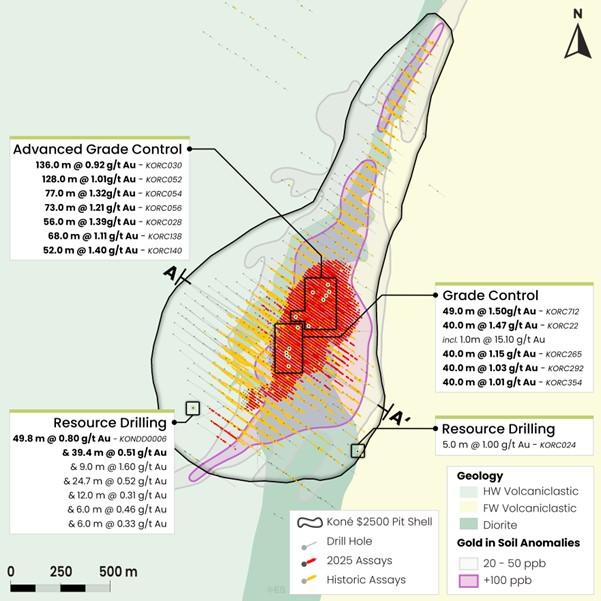
The assayed results have significantly increased confidence in the grade distribution and structural controls of the Koné deposit. The gold mineralisation continuity informs an improved understanding of the mineralisation to support mining activities, whilst also demonstrating the extension potential of the deposit to the southwest, southeast and at depth. Best intercepts across the 2025 resource drilling, AGC and GC programmes are shown in Figure 1 below.
Figure 1: Koné deposit drilling highlighting resource drilling, Grade Control and Advanced Grade Control best intercepts
Koné deposit geology and structural interpretation
The Koné deposit is hosted within a north-south trending package of diorite intrusions which have been emplaced by multiple intrusive pulses during the later stages of the Eburnean orogeny (2,200 to 2,100 Ma). The diorite package at the Koné deposit has been identified up to 330 meters in true thickness, whilst extending over a 2.5 km strike length and currently defined to a depth > 500 meters. The diorite package has intruded into the contact zone between two different sequences of mafic volcaniclastic rocks which form the hanging wall and footwall of the deposit, as demonstrated in Figure 2 below.
Gold mineralisation is associated with quartz, quartz-carbonate and sulphide veins of various thicknesses, as well as fi nely disseminated pyrite and biotite alteration within the diorite intrusions.
Figure 2: Koné deposit structural analysis with schematic interpretation of strain controls
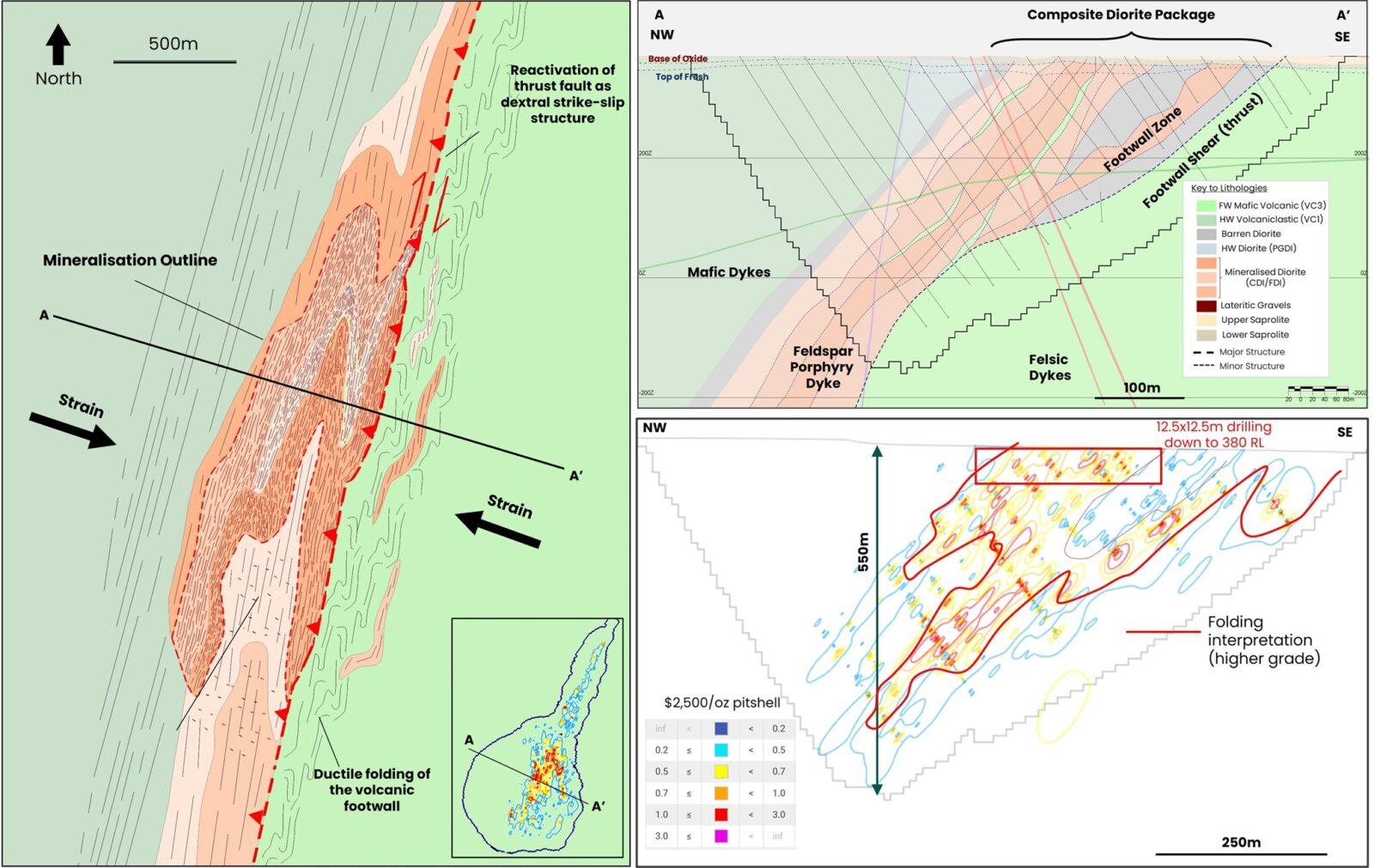
Mineralisation is interpreted to have primarily been controlled by a thrust-shear at the footwall of the diorite package. All the lithologies and primary mineralised veins have latterly been affected by high strain and fold-related deformations events, which consequently thickened the diorite sequence and redistributed the gold mineralisation. At a deposit scale the geometry of the orebody is that of an asymmetric synform yielding a steeply west-dipping axial plane and a pronounced plunge to the southwest.
Early observations of the Koné deposit highlight tight, isoclinal folding and high strain deformation features. The GC and AGC programmes have successfully validated these geological observations on a deposit-wide scale and have demonstrated that the structural complexity plays a vital role in controlling higher-grade mineralisation, enabling a robust understanding of spatial gold grade distribution.
Resource drilling programme results
Building on the successful GC and AGC drilling results, the Company continues to identify mineralisation extensions to the Koné deposit. Downdip and along strike extensions of the Koné deposit to the southwest, as well as recently identified at-surface oxide mineralisation extensions to the southeast were a focus of further evaluation in 2025.
Four DD holes totalling 1,987 meters were drilled in 2025 at a 100-meter spaced grid down to an approximate vertical depth of 300 meters. The purpose was to confirm the downdip continuity of the mineralization to the southwest of the Koné deposit within the diorite. All four diamond drill holes reveal high mineralization potential associated with increased deformation intensity through refolded veins within footwall volcanoclastic units and folded veinlets in diorite. Pervasive hydrothermal breccia zones, characterized by broken textures and strong feldspar and silica alteration, was consistently logged across all holes, indicating robust hydrothermal fluid flows. Observed zones demonstrating higher gold intercepts plot in the continuity of known higher-grade ore shoots controlled by folding axial planes, as earlier described in Figure 2, which are associated with ductile deformation and fluid pathways. Visible gold was identified in both diorite and volcanoclastic rocks in KONDD007A. Assay results in KONDD006 yield wider and higher-grade intervals, near mafic dykes associated with chalcopyrite, as shown in Figure 3. These results confirm the robust continuity of mineralization within the Koné system, with mineralization remaining open along strike and at depth, supporting further exploration and resource expansion potential.
Concurrently, 1,399 meters were drilled across 15 RC holes towards the southeastern extent of the Koné deposit. Drilling was undertaken on a wide grid spacing to test shallow mineralisation along strike. Drill results showed typical diorite-bearing mineralization with intercepts consistent with grades recorded across the Koné deposit at shallow depths. Further drilling in 2026 intends to confirm the continuity of the mineralisation which is currently outside of the Updated Koné MRE pit shell.
Remodelling and drilling programme results
The results of the GC and AGC programmes have signif icantly enhanced the grade distribution resolution compared to the UFS resource data as shown in Figure 3 below.
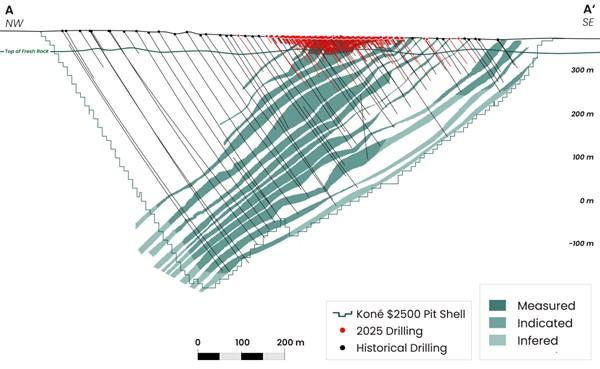
The updated MRE is based on a revised geology-driven modelling approach, integrating structural controls, lithology and grade distribution to define explicit, stationary estimation domains as shown in Figure 4 below. Mineral Resources were estimated using Ordinary Kriging (OK) with dynamic anisotropy, improving the representation of grade continuity and reducing grade smearing relative to the previous modelling methodology Multi Indicator Kriging (MIK).
Figure 3: Koné deposit – 370m RL level plan view of block models
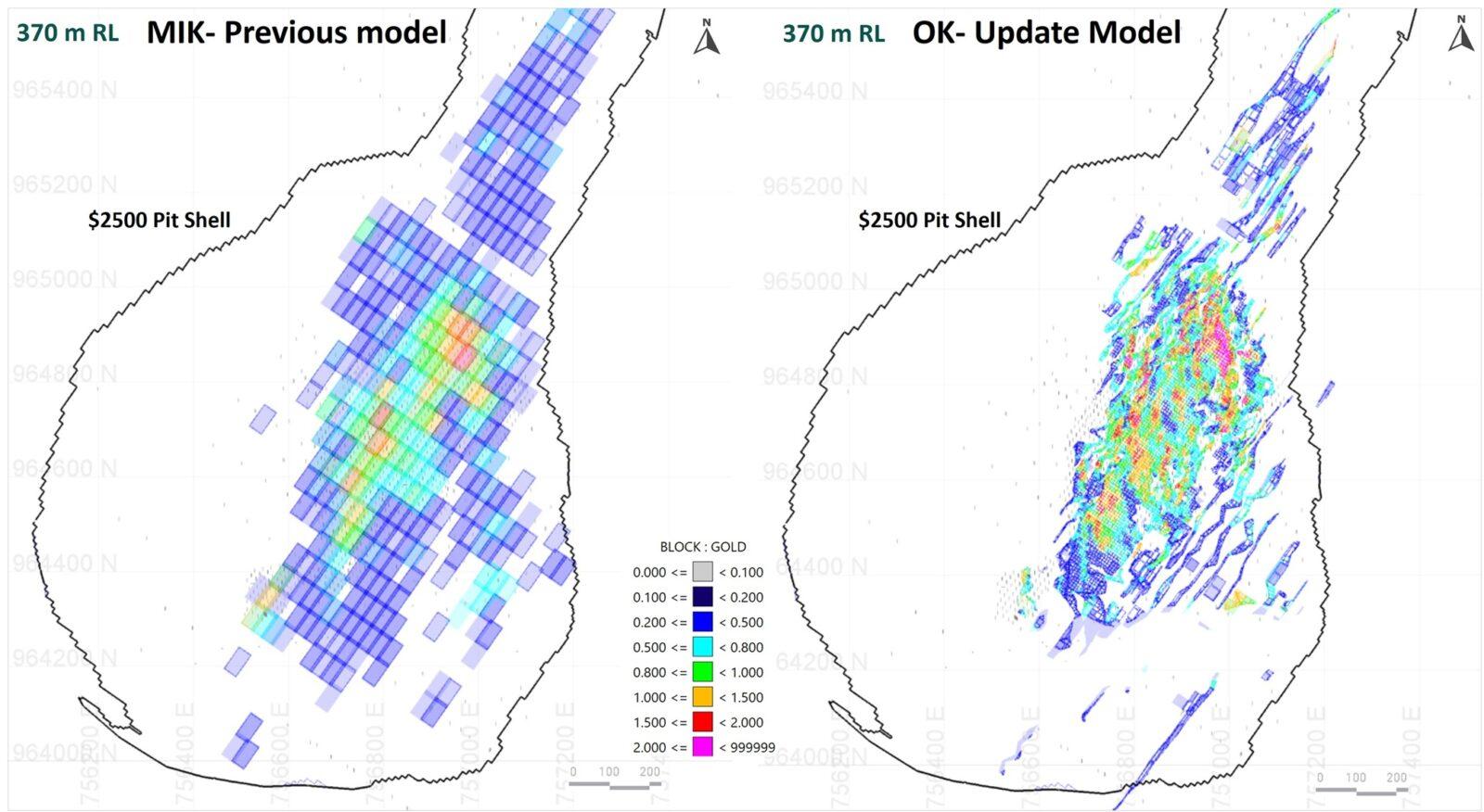
Figure 4: Koné deposit cross section looking northeast
GBONGOGO MAIN DRILLING PROGRAMMES
Advanced Grade Control and Resource Drilling Programmes
As shown in Table 6, the total amount of meters drilled at the Gbongogo Main deposit now stands at 32,002 meters, as compared to the 18,276 meters of drilling prior to the UFS. All of the assays from the recent Gbongogo Main drilling programme have now been successfully obtained and integrated into the geological and resource models, as follows:
|
Table 6: Gbongogo Main deposit drill statistics |
||||||
| 2025 AND JANUARY 2026 PROGRAMMES | CUMULATIVE TOTAL DRILLING | |||||
| Holes | Meterage | Holes | Meterage | |||
| (#) | (m) | (#) | (m) | |||
| Programme | Drill Type | |||||
| AGC │ 25m/ 25m | RC | 30 | 2,961 | 43 | 4,181 | |
| Programme Sub-Total | 30 | 2,961 | 43 | 4,181 | ||
| Resource Drilling | AC | – | – | 19 | 741 | |
| RC | 47 | 4,331 | 112 | 11162 | ||
| DD | – | – | 61 | 15,918 | ||
| Programme Sub-Total | 47 | 4,331 | 192 | 27,821 | ||
| Programme Total | 77 | 7,292 | 235 | 32,002 | ||
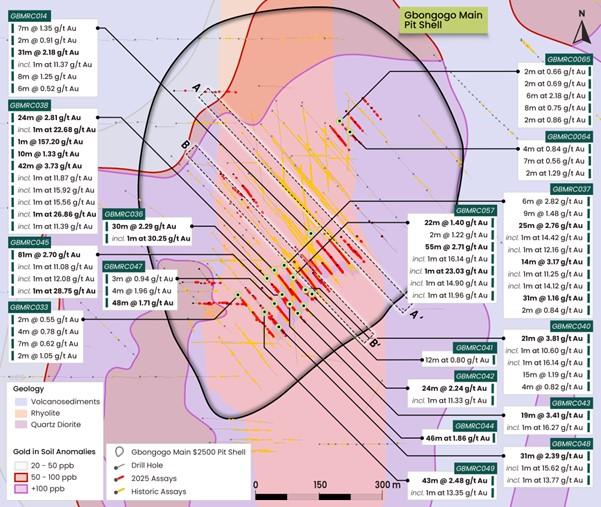
The Gbongogo Main drill programme has improved the understanding of grade continuity, structural controls and domain geometry, and supported increased confidence in the resource. Best intercepts across the 2025 resource drilling and AGC programmes are shown in Figure 5 below.
Figure 5: Gbongogo Main deposit drilling highlighting resource drilling and advanced grade control best intercepts
Gbongogo Main deposit geology and structural interpretation
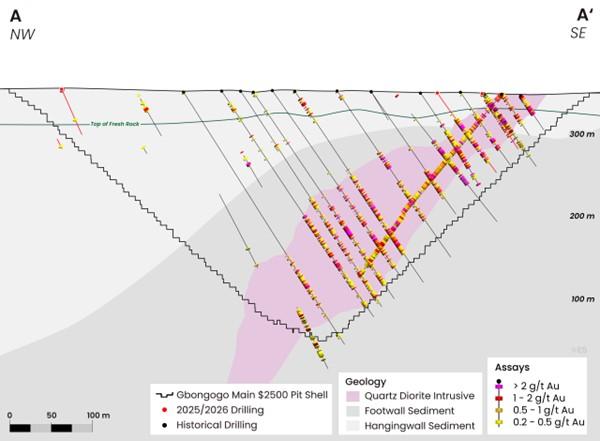
The Gbongogo Main deposit is a mesothermal, lithologically constrained gold system, hosted within an approximately 50° north-plunging quartz diorite intrusion. Mineralization is predominantly confined within this intrusive unit, with volcaniclastic sequences forming the hanging wall and footwall. Gold mineralization is associated with quartz veining, shearing and disseminated sulphide (pyrite) alteration, with strong lithological and structural control on grade distribution. The mineralized corridor exhibits a consistent north-plunging geometry, aligned with the regional structural framework of the Senoufo Greenstone Belt, reinforcing geological continuity and predictability of the system.
Figure 6: Gbongogo Main deposit highlighting mineralised diorite body and open extensions at depth
Remodelling and drilling programme results
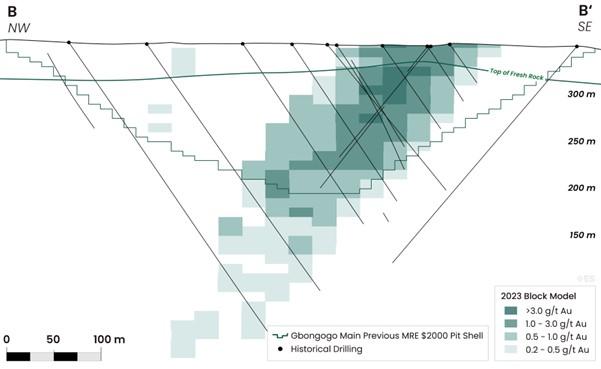
The results of the Gbongogo Main Drill Programme have significantly enhanced the grade distribution resolution compared to the UFS resource data. The transition from a Multiple Indicator Kriging resource estimation model to Ordinary Kriging modelling has improved local estimation accuracy, ensuring accurate geological continuity of individually modelled veins sets. It is expected that the enhanced geological and resource model will improve controls on mine dilution whilst supporting stronger predictability for production planning.
When comparing Figure 7 to Figure 8 below, the updated model incorporates a refined interpretation of the ore body geometry, resulting in a resource model that better defines higher grade mineralised zones expecting to improve mine planning, ore selectivity and dilution controls.
Figure 7: Gbongogo Main deposit – cross section looking north showing UFS MIK resource block model
UPCOMING CATALYSTS
ABOUT MONTAGE GOLD
Montage Gold Corp. is a Canadian-listed company focused on becoming a premier African gold producer, with its flagship Koné project, located in Côte d’Ivoire, at the forefront. Based on the Updated Feasibility Study published in 2024, the Koné project has an estimated 16-year mine life and sizeable annual production of +300koz of gold over the first 8 years and is expected to enter production in Q2-2027.
Brutus Mining Inc. (CSE: BRU) (FSE: ZI3) is pleased to announce that it has closed its non-brokered ... READ MORE
Jaguar Uranium Corp. (NYSE American: JAGU) is pleased to announce an independent Mineral Resource E... READ MORE
Auro Metals Inc. (TSX-V: AURO) (OTCQB: AURFF), is pleased to announce the assay results of the fina... READ MORE
Endeavour Silver Corp. (NYSE: EXK) (TSX: EDR) is pleased to announce that repairs to the primary bal... READ MORE
Scorpio Gold Corp. (NASDAQ: SGLD) (TSX-V: SGLD) (OTCQB: SRCRF) (FSE: RY9) is pleased to announce re... READ MORE