







Lundin Gold Inc. (TSX: LUG) (Nasdaq Stockholm: LUG) (OTCQX: LUGDF) is pleased to announce positive results from near-mine porphyry exploration drilling programs at its 100% owned Fruta del Norte gold mine in southeast Ecuador.
Recent drilling continues to advance the understanding of the emerging porphyry belt adjacent to the Fruta del Norte mine. Results confirm a large intrusive complex hosting several shallow copper gold porphyry systems within a short distance of each other. Together, Sandia, Trancaloma, Trancaloma West, and Castillo define a multi-kilometre trend of clustered mineralization, while the new Chontas discovery extends the broader porphyry corridor to at least 10 km.
Program Highlights
Highlights from drilling programs at Sandia, Trancaloma, Trancaloma West, Castillo and Chontas are outlined below, with detailed results provided in Appendix 1.
Jamie Beck, President and CEO, commented, “These results continue to highlight the remarkable copper-gold porphyry potential around Fruta del Norte. The discovery of a fifth system, and the extension of the corridor to 10 kilometres underscore the scale of this emerging copper‑gold district. Sandia’s record intercept speaks to the strength of potential at‑surface mineralization, while ongoing drilling at Trancaloma, Trancaloma West, Castillo, and now Chontas, further defines the continuity of mineralization along the corridor. With multiple rigs turning, we are advancing what is increasingly looking to be a large porphyry district adjacent to FDN.”
Drilling Highlights (not true widths)
Sandia
Trancaloma
Trancaloma West
Castillo
Chontas (Discovery)
10 KM SANDIA-CHONTAS COPPER-GOLD PORPHYRY CORRIDOR
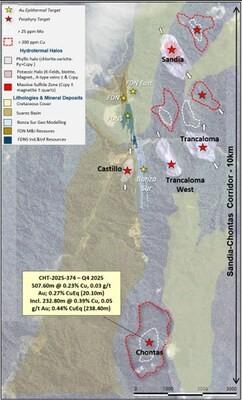
Recent drilling continues to advance the understanding of the emerging porphyry belt adjacent to FDN. Results confirm a large intrusive complex hosting multiple shallow copper gold porphyry systems in close proximity to one another. Collectively, Sandia, Trancaloma, Trancaloma West, and Castillo form a near-mine cluster of deposits located immediately beside FDN, while the new Chontas discovery extends the broader north-south porphyry corridor to at least 10 kilometres.
SANDIA
Located less than two kilometres northeast of FDN, Sandia is the most significant porphyry system discovered to date and sits on the northern edge of currently defined corridor. Drilling outlines wide, continuous copper-gold mineralization beginning at surface. The system is currently defined over 1,300 m along a northwest trend, 700 m in width, and 1,000 m vertically, and remains open along strike to the northwest, to the east, and at depth (see Figures 1 and 2).
Mineralization is predominantly associated with A-type quartz (chalcopyrite) ± magnetite veinlets hosted mainly by quartz monzonite porphyry with well-developed Kfeldspar–magnetite potassic alteration. The standout interval in SND-2025-383 (603.25 m at 0.79% CuEq, including 322.30 m at 1.08% CuEq) represents the highest grade porphyry intercept returned to date in the program and highlights exploration potential toward the northwest and east. In the central portion of the system, SND-2025-378 (694.20 m at 0.60% CuEq) successfully enlarged and extended higher grade mineralization. Four surface drill rigs are currently active at Sandia.
TRANCALOMA
At Trancaloma, drilling continues to expand a broad zone of copper‑gold mineralization from surface, now extending approximately 1,300 m along a northwest trend, 650 m in width, and 1,000 m in depth, and remains open along strike and at depth (see Figures 1, 2, and 3).
Mineralization is associated with well zoned porphyry related alteration, with copper-gold hosted in a phallic to sericite assemblage that transitions at depth into higher grade potassic alteration characterized by Kfeldspar, biotite, and magnetite with A-type quartz ± magnetite veining. Recent holes, TRL-2025-340 (945.05 m at 0.43% CuEq) and TRL-2025-362 (681.60 m at 0.44% CuEq), expanded the system and indicate that the potassic core is shallowing along the southeastern extension. One surface rig is currently active at Trancaloma.
TRANCALOMA WEST
On the western side of Trancaloma, drilling continues to define the Trancaloma West porphyry system (see Figures 1 and 3). Since its discovery last quarter, the program has delineated a continuous mineralized envelope over approximately 1,100 m of strike, 200 m of width, and 500 m of depth. Mineralization and alteration styles are consistent with the main Trancaloma system. Hole TRL-2025-365 (303.50 m at 0.43% CuEq) confirmed shallow mineralization to the north, indicating further room for expansion in that direction. One surface rig is currently active at Trancaloma West.
CASTILLO
At Castillo, located two kilometres south of FDN along the western border of Bonza Sur, drilling has confirmed the southern continuity of higher grade copper gold mineralization beneath the Suarez Basin conglomerates (see Figures 1 and 3). Hole CAS-2025-376 (100.80 m at 0.80% CuEq, including 47.80 m at 1.26% CuEq) intercepted a semi-massive chalcopyrite–pyrite zone associated with quartz–magnetite veining, similar to discovery hole CAS-2025-329 (35.55 m at 2.79% CuEq). This higher grade zone remains open to the south, where one rig is actively exploring.
CHONTAS – NEW PORPHYRY DISCOVERY
At Chontas, located seven kilometres south of Trancaloma and FDN, a systematic exploration program has led to the discovery of another shallow copper‑gold porphyry system (see Figure 4). Testing a large surface Cu–Mo geochemical anomaly, hole CHT‑2025‑374 (232.80 m at 0.44% CuEq) intersected wide, shallow copper‑gold mineralization associated with typical porphyry alteration, including well‑developed potassic (K‑feldspar–biotite) and chlorite–magnetite assemblages and A‑type quartz veining. The discovery confirms a 10 kilometre porphyry corridor and remains open for further exploration.
Figure 1: Map showing Trancaloma-Sandia corridor adjacent to FDN
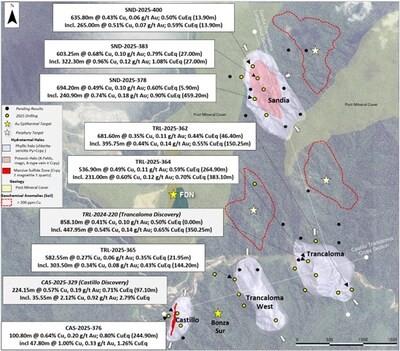
Figure 2: Sandia Trancaloma cross section showing recent drilling results at Trancaloma
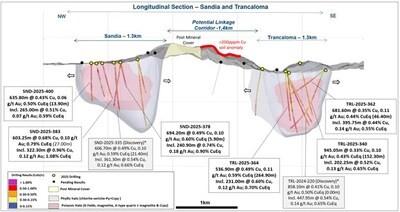
Figure 3: Castillo Trancaloma cross section showing reported drilling results
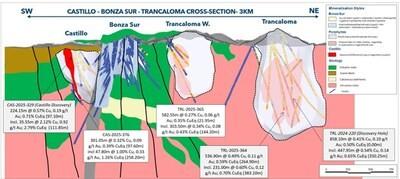
Figure 4: 10 km Porphyry corridor highlighting Chontas discovery and the main deposits under delineation stage
Qualified Persons and Technical Notes
The technical information contained in this News Release has been reviewed and approved by Andre Oliveira, P. Geo, Vice President, Exploration of the Company, who is a Qualified Person in accordance with the requirements of National Instrument 43-101 – Standards of Disclosure for Mineral Projects.
Samples consist of half HQ and NQ-size diamond core that are split by diamond saw on site, prepared at the ALS laboratory in Quito, and analyzed by 50g fire assay and multi-element (ICP-AES/ICP-MS) at the ALS Laboratory in Lima, Peru. The quality assurance-quality control (QA-QC) program of Lundin Gold includes the insertion of certified standards of known gold content, blank and duplicate samples. The remaining half core is retained for verification and reference purposes. For further information on the assay, QA-QC, and data verification procedures, please see Lundin Gold’s AIF.
Copper equivalent calculation for reporting purposes only: US$4.00/lb Cu, US$1,800/oz Au, US$30/oz Ag, and US$25/oz Mo with 80% metallurgical recoveries assumed for all metals. The formula is: CuEq % = Cu % + (0.6562 * Au g/t) + (0.0109 * Ag g/t) + (0.0006 * Mo ppm).
About Lundin Gold
Lundin Gold, headquartered in Vancouver, Canada, owns the Fruta del Norte gold mine in southeast Ecuador. Fruta del Norte is among the highest-grade operating gold mines in the world.
The Company’s board and management team have extensive expertise and are dedicated to operating Fruta del Norte responsibly. The Company operates with transparency and in accordance with international best practices. Lundin Gold is committed to delivering value to its shareholders through operational excellence and growth, while simultaneously providing economic and social benefits to impacted communities, fostering a healthy and safe workplace and minimizing the environmental impact. Furthermore, Lundin Gold is focused on continued exploration on its extensive and highly prospective land package to identify and develop new resource opportunities to ensure long-term sustainability and growth for the Company and its stakeholders.
Brutus Mining Inc. (CSE: BRU) (FSE: ZI3) is pleased to announce that it has closed its non-brokered ... READ MORE
Jaguar Uranium Corp. (NYSE American: JAGU) is pleased to announce an independent Mineral Resource E... READ MORE
Auro Metals Inc. (TSX-V: AURO) (OTCQB: AURFF), is pleased to announce the assay results of the fina... READ MORE
Endeavour Silver Corp. (NYSE: EXK) (TSX: EDR) is pleased to announce that repairs to the primary bal... READ MORE
Scorpio Gold Corp. (NASDAQ: SGLD) (TSX-V: SGLD) (OTCQB: SRCRF) (FSE: RY9) is pleased to announce re... READ MORE