






LaFleur Minerals Inc. (CSE: LFLR) (OTCQB: LFLRF) (FSE: 3WK0) is pleased to report additional assay results from its regional drilling program on the Swanson Gold Project, led by a near-surface intersection of 6.05 g/t Au over 8.00 metres, including 14.96 g/t Au over 3.00 metres, in hole SW-26-124 at the historical Bartec showing. At Jackson, drilling has extended gold mineralization approximately 1,200 metres west-northwest along strike from the historical showing, and at Jolin, drilling returned multiple mineralized intervals within individual holes. Bartec is now a new priority target, located approximately 5 km from the main Swanson Gold Deposit for follow-up diamond drilling.
BARTEC DRILL HOLE: 6.05 g/t Au over 8.00 metres, including 14.96 g/t Au over 3.00 metres, from 38.00 metres downhole (SW-26-124)
Bartec Target
The Bartec showing is a gold-silver occurrence and associated with the northwest-trending Bartec shear zone, near the contact between felsic volcanic rocks (rhyolite, dacite and felsic tuff) and porphyritic andesite. Mineralization consists of pyrite, native gold, chalcopyrite and native silver, with disseminated mariposite, hosted in quartz-carbonate-sericite veins and veinlets. The host rocks are carbonate-, sericite- and silica-altered, and the showing is interpreted as a shear-hosted, orogenic quartz-carbonate vein system. SIGÉOM records 20 historical diamond drill holes totalling 1,356 metres, completed in 1957, 1959 and 1987. These holes tested approximately 700 metres of strike along the structure. Reported historical intersections include 3.4 g/t Au over 1.5 metres and 2.4 g/t Au over 0.7 metres (GM 05974), and 11.66 g/t Au with 6.86 g/t Ag over 0.2 metres at 110.2 metres downhole in hole 86-1 (GM 45030). These historical results are taken from government assessment files. They have not been verified by the Company’s Qualified Person and are presented for context only.
LaFleur Minerals drill hole SW-26-124 is the first modern-day drill hole to be completed at Bartec since 1987 and was designed to validate and characterize the style of mineralization at the Bartec showing, located approximately 1.3 kilometres northeast of the Jackson showing and 5 kilometres from the main Swanson Gold Deposit. The mineralized interval lies approximately 30 metres below surface.
Given the shallow depth, width and grade of this intersection and the limited modern drilling at Bartec, the showing is now a new priority target within the district-scale Swanson Gold Project for follow-up drilling to test the continuity of the mineralization along strike and down-dip.
REGIONAL DRILLING HIGHLIGHTS AT JOLIN AND JACKSON TARGETS
The regional drilling program forms part of LaFleur Minerals’ broader 25,570.5 metre, 93-hole drilling program at the Swanson Gold Project. The regional drilling program is comprised of 64 holes totalling 16,331 metres. The Company reported results from 29 of those holes on February 4, 2026, and this news release reports results from the remaining 35 holes (9,429 metres) (Figure 1). The regional drilling program tested high-priority targets outside the Swanson Gold Deposit, generated from geological interpretation, airborne magnetic and VLF-EM surveys, ground IP, soil surveys and prospecting. These included the historical Bartec, Jackson, and Jolin showings and several newly identified prospects. Several holes intersected multiple mineralized intervals, indicating that gold mineralization extends beyond the known showings.
Significant assay results from the regional drilling program are presented in Table 1 and Figure 1. Drill collar coordinates and details are presented in Table 2.
Jackson Target
The Jackson area has emerged as an important regional target for follow-up exploration. Thanks to the recent high resolution airborne magnetic and VLF-EM surveys along with recent diamond drilling, the Jackson showing can be traced for 1,500m along strike.
Hole SW-25-40 (disclosed in the Company’s February 4, 2026 news release) was completed in the area of the historical Jackson showing discovered in 1932 and intersected 2.88 g/t Au over 3.65 m. This intersection was followed up with hole SW-25-042 at depth, which intersected 5.78 g/t Au over 2.05 metres.
Hole SW-25-067 (disclosed in the Company’s February 4, 2026 news release) was drilled 1,200 metres west and along strike of the Jackson showing and intersected 51.1 g/t Au over 1.0 metre, demonstrating the potential high-grade nature of the mineralization.
Hole SW-26-111, located approximately 660 metres along strike to the northwest of the historical Jackson showing, and halfway between the high-grade intersection of hole SW-25-067 intersected 1.45 g/t Au over 7.70 metres, including, 3.17 g/t Au over 1.15 metres and 3.30 g/t Au over 1.20 metres.
Hole SW-26-113, located approximately 200 metres southeast of SW-26-111 and 700 metres southeast of SW-25-067, intersected a higher-grade interval of 27.8 g/t Au over 1.0 metre, similar in context to SW-25-067.
Further drilling in the area returned a broad mineralized interval in SW-26-117, located approximately 75 metres northwest of the Jackson showing, which intersected 0.60 g/t Au over 44.0 metres, including 3.41 g/t Au over 2.95 metres.
These results extend gold mineralization well beyond the historical Jackson showing and provide several priority targets for follow-up drilling, including both high-grade and broad zones of mineralization. Additional work will be required to establish the geometry and continuity of the mineralized zones both along strike and at depth.
Jolin Target
LaFleur’s drilling at Jolin has identified multiple mineralized zones within individual drill holes.
Hole SW-26-103 intersected nine separate mineralized zones, including 0.58 g/t Au over 19.6 metres; and approximately 77 metres farther downhole a second significant interval with 1.77 g/t Au over 6.45 metres.
Hole SW-26-104, also located in the Jolin area, intersected seven separate mineralized intervals, including a broad zone of 0.53 g/t Au over 11.2 metres.
The presence of multiple mineralized zones in these holes provides targets for additional drilling to determine the continuity, orientation and extent of the mineralization.
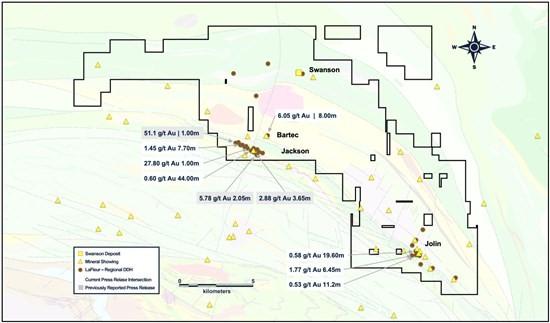
Figure 1: Regional Drill Holes with Significant Assay Results
Table 1: Significant assay results table from regional drilling program at Swanson
| Hole ID | From (m) | To (m) | Length (m) | Au (g/t) | Target | ||
| SW-26-099 | 190.00 | 191.00 | 1.00 | 9.78 | Regional | ||
| SW-26-103 | 176.50 | 196.10 | 19.60 | 0.58 | Jolin | ||
| Incl. | 186.50 | 188.10 | 1.60 | 4.90 | Jolin | ||
| SW-26-103 | 273.35 | 279.80 | 6.45 | 1.77 | Jolin | ||
| SW-26-104 | 334.80 | 335.50 | 0.70 | 8.49 | Jolin | ||
| SW-26-104 | 353.00 | 364.20 | 11.20 | 0.53 | Jolin | ||
| SW-26-105 | 268.20 | 273.00 | 4.80 | 1.31 | Jolin | ||
| SW-26-106 | 214.80 | 218.00 | 3.20 | 1.66 | Jolin | ||
| SW-26-110 | 71.50 | 80.75 | 9. | .61 | Jackson | ||
| SW-26-111 | 30.85 | 38.55 | 7.70 | 1.45 | Jackson | ||
| SW-26-113 | 145.00 | 146.00 | 1.00 | 27.80 | Jackson | ||
| SW-26-117 | 55.00 | 99.00 | 44.00 | 0.60 | Jackson | ||
| Incl. | 68.00 | 70.95 | 2.95 | 3.41 | Jackson | ||
| SW-26-124 | 38.00 | 46.00 | 8.00 | 6.05 | Bartec | ||
| Incl. | 41.00 | 44.00 | 3.00 | 14.96 | Bartec |
Note: Reported intervals are drilled core lengths; true widths have not yet been determined. Composite intervals were calculated using a lower cut-off grade of 0.50 g/t Au and may include internal intervals of material below the cut-off grade. No top cut (capping) was applied to high-grade assays.
Table 2: Regional Drill Collar Locations
| Hole ID |
UTM Easting (m) |
UTM Northing (m) |
Azimuth (deg) |
Dip (deg) |
Length (m) |
| SW-26-088 | 310899 | 5381023 | 180 | -50 | 250 |
| SW-26-091 | 306138 | 5381183 | 180 | -50 | 202 |
| SW-26-092 | 308551 | 5381803 | 180 | -50 | 238 |
| SW-26-093 | 307665 | 5379590 | 180 | -50 | 265 |
| SW-26-094 | 320951 | 5366605 | 230 | -50 | 214 |
| SW-26-095 | 319401 | 5367312 | 230 | -50 | 202 |
| SW-26-096 | 318013 | 5368209 | 230 | -50 | 220 |
| SW-26-097 | 318332 | 5369281 | 225 | -50 | 235 |
| SW-26-098 | 318048 | 5368935 | 225 | -50 | 244 |
| SW-26-099 | 318585 | 5367620 | 230 | -50 | 244 |
| SW-26-100 | 318815 | 5370005 | 230 | -50 | 247 |
| SW-26-101 | 318504 | 5368240 | 75 | -50 | 336 |
| SW-26-102 | 318415 | 5368252 | 75 | -50 | 355 |
| SW-26-103 | 318376 | 5368283 | 75 | -50 | 439 |
| SW-26-104 | 318292 | 5368255 | 75 | -50 | 550 |
| SW-26-105 | 318357 | 5368370 | 75 | -50 | 343 |
| SW-26-106 | 318278 | 5368525 | 75 | -50 | 466 |
| SW-26-107 | 306328 | 5376404 | 200 | -50 | 262 |
| SW-26-108 | 306172 | 5376384 | 200 | -50 | 214 |
| SW-26-109 | 306445 | 5376266 | 200 | -50 | 256 |
| SW-26-110 | 306617 | 5376206 | 200 | -50 | 268 |
| SW-26-111 | 306774 | 5376114 | 200 | -50 | 253 |
| SW-26-112 | 306863 | 5376102 | 200 | -50 | 325 |
| SW-26-113 | 306925 | 5375995 | 200 | -50 | 223 |
| SW-26-114 | 307396 | 5375986 | 200 | -50 | 250 |
| SW-26-115 | 307530 | 5375882 | 200 | -50 | 265 |
| SW-26-116 | 307575 | 5375865 | 200 | -50 | 250 |
| SW-26-117 | 307385 | 5375929 | 200 | -50 | 241 |
| SW-26-118 | 307211 | 5375800 | 200 | -50 | 214 |
| SW-26-119 | 307341 | 5375951 | 200 | -50 | 223 |
| SW-26-120 | 307384 | 5375683 | 200 | -50 | 200 |
| SW-26-121 | 307556 | 5375533 | 200 | -50 | 247 |
| SW-26-122 | 307728 | 5375729 | 200 | -50 | 253 |
| SW-26-123 | 307943 | 5375632 | 200 | -50 | 200 |
| SW-26-124 | 308360 | 5376828 | 210 | -50 | 235 |
Note: Drill Collar Coordinates are in UTM NAD83 Zone 18
Andrew Elinesky, CEO of LaFleur Minerals, commented: “We are very pleased with these regional drilling results, and Bartec is the standout. Hole SW-26-124 intersected 6.05 g/t Au over 8.00 metres, including 14.96 g/t Au over 3.00 metres, just 30 metres below surface, on a showing that had not seen modern drilling. At Jackson, we have now intersected gold over a 1,200-metre corridor west-northwest of the historical showing, and at Jolin, several holes returned multiple mineralized intervals. Bartec moves straight to the top of our follow-up drilling list. ”
Marc Ducharme, VP Exploration, commented: “We are very encouraged with these latest regional drilling results with several high-grade mineralized gold intervals with significant widths identified across the relatively underexplored regional trends at the Jolin, Bartec, and Jackson targets. Our objective is to explore and expand the potential for large-scale gold mineralized systems through focused exploration drilling programs at the district scale. We are convinced that the Swanson Gold Project has the potential to host several large-scale, gold deposits and our current drilling program is aligned on significantly expanding the existing mineral resource at the main Swanson Gold Deposit.”
Sampling, QAQC, and Laboratory Analysis Summary
All core logging and sampling completed by LaFleur Minerals as part of its diamond drilling program is subject to a strict standard for Quality Control and Quality Assurance (QAQC), which include the insertion of certified reference materials (standards), blank materials, and field duplicate analysis. NQ-diameter sawed half-core samples from the drilling program at Swanson were securely sent by Company geologists to AGAT Laboratories Ltd. (AGAT), with sample preparation in Val-d’Or, Québec and analysis in Thunder Bay, Ontario, where samples were processed for gold analysis by 50-gram fire assay with an atomic absorption finish. Samples from selected holes were securely sent to AGAT in Calgary, Alberta, for multi-element analysis (including silver) by inductively coupled plasma (ICP) method with a four-acid digestion. AGAT sample preparation and laboratory analysis procedures conform to the requirements of ISO/IEC Standard 17025 guidelines and meet the requirements under NI 43-101 and CIM best practice guidelines. AGAT is independent of LaFleur Minerals.
The Qualified Person notes no drilling, sampling or recovery factors that could materially affect the accuracy or reliability of the data.
Trafigura Update
LaFleur Minerals continues to advance discussions with Trafigura regarding the previously announced proposed prepayment and gold doré offtake financing. Following Trafigura’s site visit to the Swanson Gold Project and Beacon Gold Mill in August 2026, the parties are negotiating the terms of a definitive agreement. There can be no assurance that a definitive agreement will be entered into, or as to its final terms or timing. The Company will provide an update when appropriate.
Qualified Person Statement and Data Verification
All scientific and technical information in this news release has been prepared and approved by Marc Ducharme, P.Geo. (OGQ), Vice President of Exploration for the Company and considered a Qualified Person (QP) for the purposes of NI 43-101. Mr. Ducharme is not independent of the Company. The QP has verified the analytical data underlying the drilling assay results disclosed in this release by reviewing the Company’s QAQC protocols, core and sample logs, original assay certificates and assay database, and notes no drilling, sampling or recovery factors that could materially affect the accuracy or reliability of the data.
About LaFleur Minerals Inc.
LaFleur Minerals Inc. is focused on the development of district-scale gold projects in the Abitibi Gold Belt near Val-d’Or, Québec. The Company’s mission is to advance mining projects with a laser focus on our PEA-stage Swanson Gold Project and the Beacon Gold Mill, which have significant potential to deliver long-term value. The Swanson Gold Project is approximately 20,642 hectares (206 km2) in size and includes several prospects rich in gold and critical metals previously held by Monarch Mining, Abcourt Mines, and Globex Mining. LaFleur Minerals has consolidated a large land package along a major structural break that hosts the Swanson, Bartec, and Jolin gold targets and several others that make up the Swanson Gold Project. LaFleur Minerals’ recently refurbished Beacon Gold Mill is capable of processing over 750 tonnes per day and is being considered for processing mineralized material from Swanson and for custom milling operations for other nearby gold projects. The Swanson Gold Project is located approximately 55 kilometres north of Val-d’Or in the Abitibi Greenstone Belt, one of the world’s most prolific gold-producing regions. The Val-d’Or-Malartic mining district, 50 to 75 kilometres south and southwest of Swanson, hosts several operating mines and advanced projects, including Agnico Eagle’s Canadian Malartic, Goldex and LaRonde mines, Eldorado Gold’s Lamaque Complex, Fresnillo’s Novador project, and Cartier Resources’ Chimo Mine project. Further northeast, Gold Fields is advancing the Windfall deposit, while Bonterra Resources is advancing the Barry and Gladiator deposits in the Urban-Barry gold camp. Mineralization at these properties is not necessarily indicative of mineralization at the Swanson Gold Project. LaFleur Minerals recently released the results of a positive Preliminary Economic Assessment results for the Company’s Swanson Gold Project and the planned restart of the Beacon Gold Mill (refer to press release dated March 3, 2026).
In this presentation, Jeffrey Christian of CPM Group looks at the gold p... READ MORE
In this week’s Weekly Perspective, David Morgan examines a growing con... READ MORE
Michael Allen, CEO & Director of StrikePoint Gold (TSX-V: SKP) (OTCX... READ MORE
SUR-26-58: 118.0 m of 0.081% Ni and 62 ppm Co from 161.0 m, inclu... READ MORE
Mineral Road Discovery Inc. (CSE: ROAD) is pleased to announce th... READ MORE