







Kirkland Lake Discoveries Corp. (TSX-V: KLDC) (OTCQB: KLKLF) is pleased to announce new diamond drill assay results from the ongoing 25,000 m drill program at the Company’s 100%-owned, district-scale KL South property 18 km south of Kirkland Lake, Ontario.
Results released today include two step-out holes from the Mirado North Zone (KLM26-060 and KLM26-062), three drill holes from the Mirado West Zone (KLM26-054, KLM26-056, and KLM26-058) drilled from a single pad in multiple orientations to test three-dimensional structural geometry, alongside two western step-out holes from the Mirado South Zone (KLM26-053 and KLM26-057) designed to bridge the gap toward Mirado West. In addition, recent geological logging and structural modeling from ongoing northern regional drilling (KLM26-070, KLM26-072, and KLM26-074) have identified a significant mineralized Banded Iron Formation horizon that provides a compelling new physical and chemical vector for high-grade gold targeting across the Project.
Highlights
“Every batch of results from Mirado sharpens our 3D model and reinforces the scale of this gold system. The step-outs at Mirado North Zone have confirmed the more steeply dipping mineralization towards the northwest with a robust hit of 2.78 g/t Au over 21.50 m. At Mirado West, drilling three different directions from the same pad in holes 54, 56, and 58 confirmed the geometry of both our broad, near-surface mineralized zones and the higher-grade structures that feed them. Meanwhile, hole 53 continues to push the Mirado South Zone westward with stacked intervals from near surface to depth, steadily closing the gap between the South and West zones,” said Stefan Sklepowicz, Chief Executive Officer. “Equally exciting is what our team is seeing in the northern regional drilling. Intersecting a continuous Banded Iron Formation gives us an additional high-grade gold target. Iron formations are brittle and iron-rich, meaning they fracture easily to create pathways for gold-bearing fluids and can chemically trigger gold to drop out of solution. By mapping the structural breaks along this iron formation, we have a clear roadmap for targeting high-grade shoots as assays from our ongoing drill program continue to come in.”
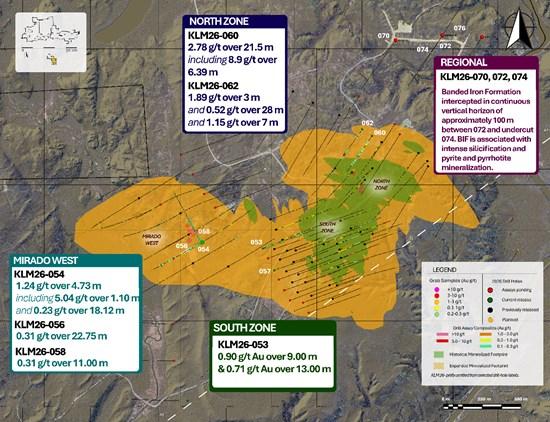
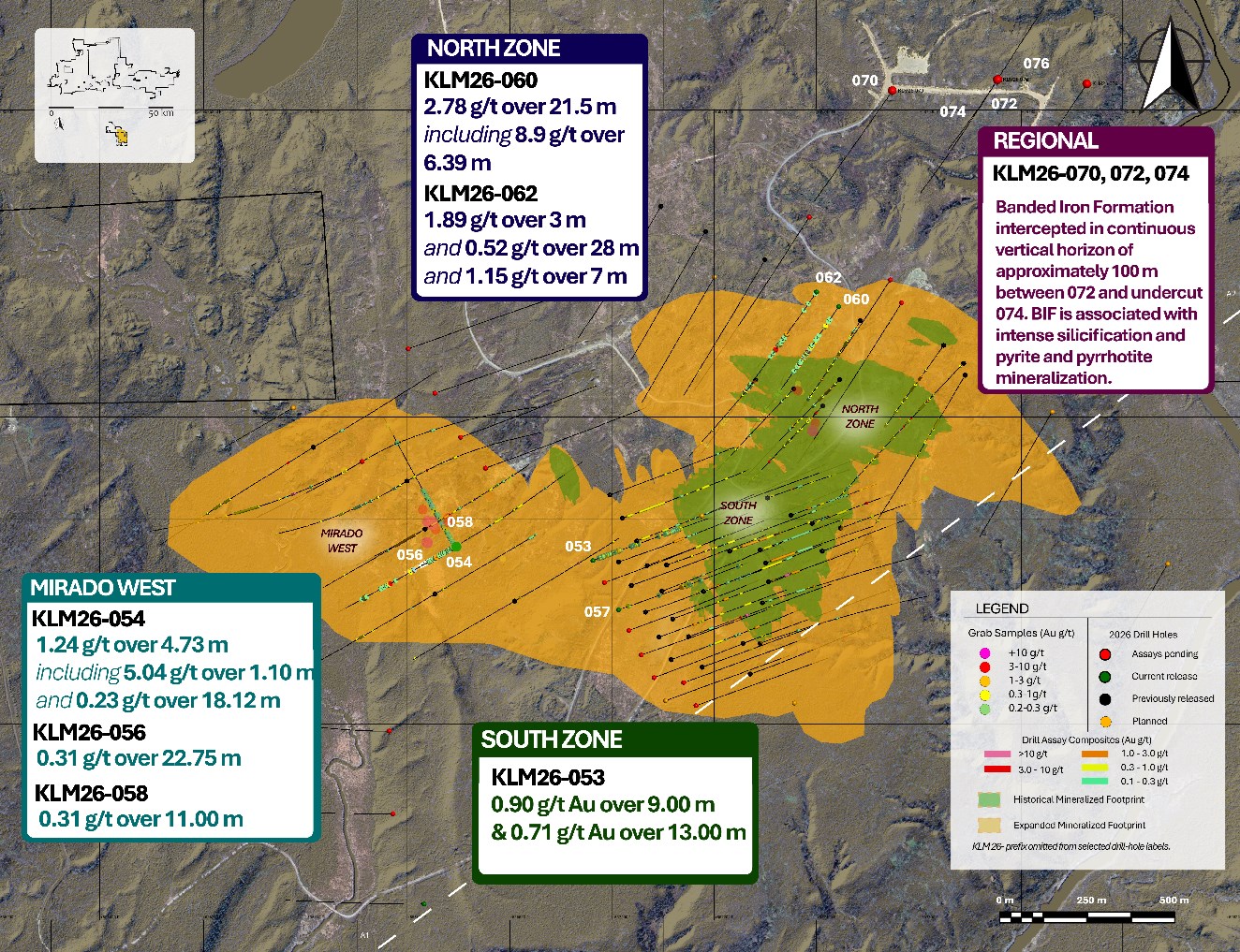
Figure 1: Plan view of Mirado showing 2026 drill-hole locations and assay composites, the historical mineralized envelope, and KLDC’s preliminary interpreted footprint. Interpreted areas are not established mineral resource boundaries.
To view an enhanced version of this graphic, please visit:
https://images.newsfilecorp.com/files/5701/325493_f5fb8d2754e8da3d_001full.jpg
North Zone Extension
At the Mirado North Zone, drillholes KLM26-060 and KLM26-062 were targeted to test the orientation of the stacked gold zones and their extension down-plunge to the northwest. KLM26-060 intersected 2.78 g/t Au over 21.50 m from 187.20 m downhole, including 8.90 g/t Au over 6.39 m. KLM26-062 intersected multiple gold-bearing intervals, including 0.50 g/t Au over 10.00 m from 209.00 m and 1.89 g/t Au over 3.00 m from 230.00 m. Together, these results extend the known North Zone mineralization by approximately 125 m laterally and 125 m verticallyfrom previously released hole KLM26-030 and support the interpreted 20° to 30° northwest plunge of the stacked zones, which remain open down-plunge. Guided by this geometry, the Company plans to step east of previously reported holes KLM26-040, KLM26-043 and KLM26-044, which passed above the projected mineralization, to trace the stacked zones at greater depth.
Mirado West and South Zone Continuity
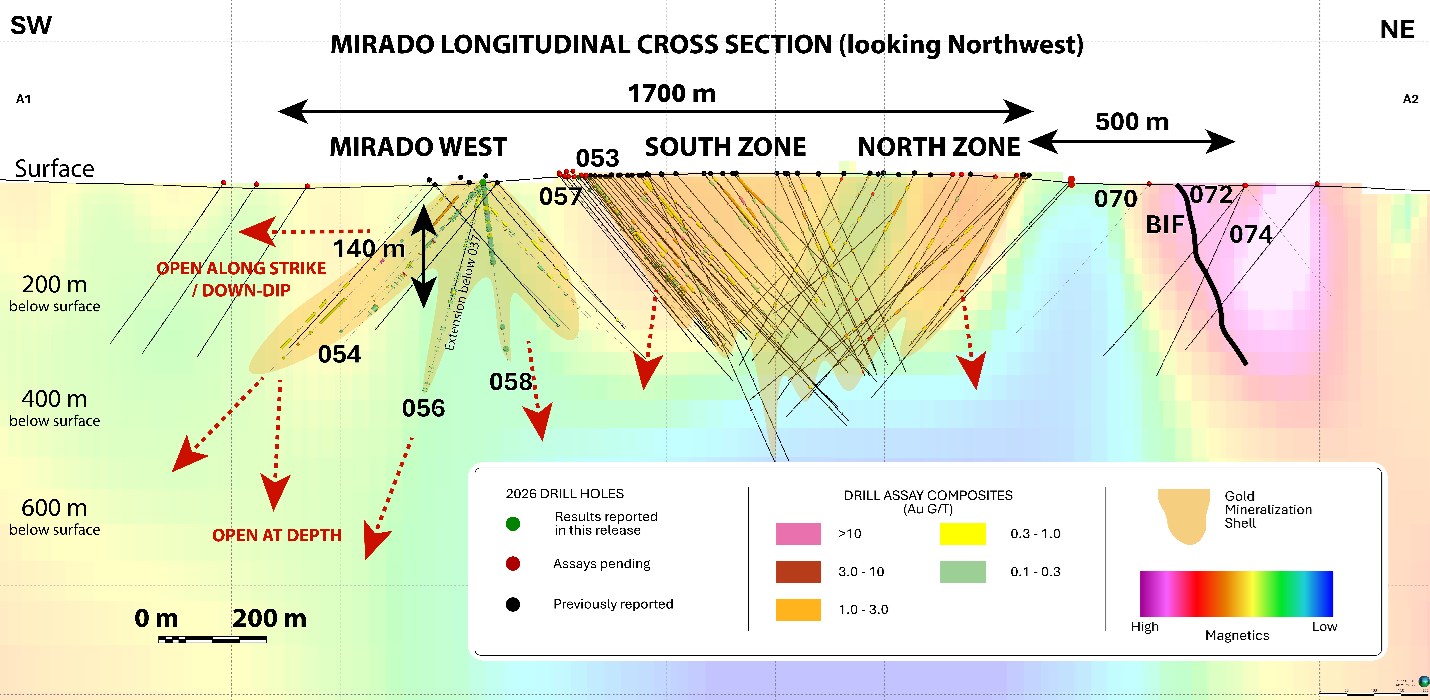
At the Mirado West Zone, holes KLM26-054, KLM26-056, and KLM26-058 were drilled from the same pad as previously released hole KLM26-052 (0.34 g/t Au over 26.58 m and 0.35 g/t Au over 16.00 m). By drilling outward in multiple directions and angles from a single location, the team confirmed the true orientation of the mineralized system: wide, bulk-tonnage halos near surface (0.31 g/t Au over 22.75 m in KLM26-056 and 0.23 g/t Au over 18.12 m in KLM26-054) sitting directly above and around narrower, higher-grade feeder structures (1.18 g/t Au over 3.15 m and 1.24 g/t Au over 4.73 m in KLM26-054) (see Figure 2).
At the Mirado South Zone, western step-out hole KLM26-053 intersected multiple stacked gold zones from 18.00 m to 403.00 m downhole, highlighted by 0.90 g/t Au over 9.00 m and 0.71 g/t Au over 13.00 m. These results confirm that the main South Zone structures continue westward toward Mirado West.
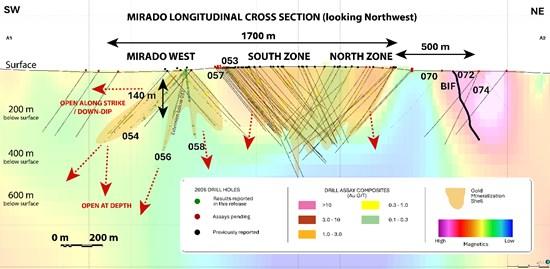
Figure 2: Longitudinal Cross Section (Looking Northwest) across the Mirado Gold Project. The section illustrates the 1,700-m main mineralized corridor alongside new western down-dip extensions and eastern regional step-out targets over a 3D magnetic susceptibility inversion backdrop. Note resolution decreases below 300 m depth. Recent drilling in the western zone (holes KLM26-054, 056, and 058) has extended gold mineralization 140 m vertically below hole KLM26-037, demonstrating strong down-plunge continuity to depths exceeding 400 m below surface. To the east, a 500-m step-out fence (holes KLM26-070, 072, and 074, assays pending) tests a prominent magnetic high and structural contact along a BIF. Mineralization remains open along strike to the west and at depth across multiple sub-parallel shoots.
To view an enhanced version of this graphic, please visit:
https://images.newsfilecorp.com/files/5701/325493_f5fb8d2754e8da3d_002full.jpg
The Northern BIF Target
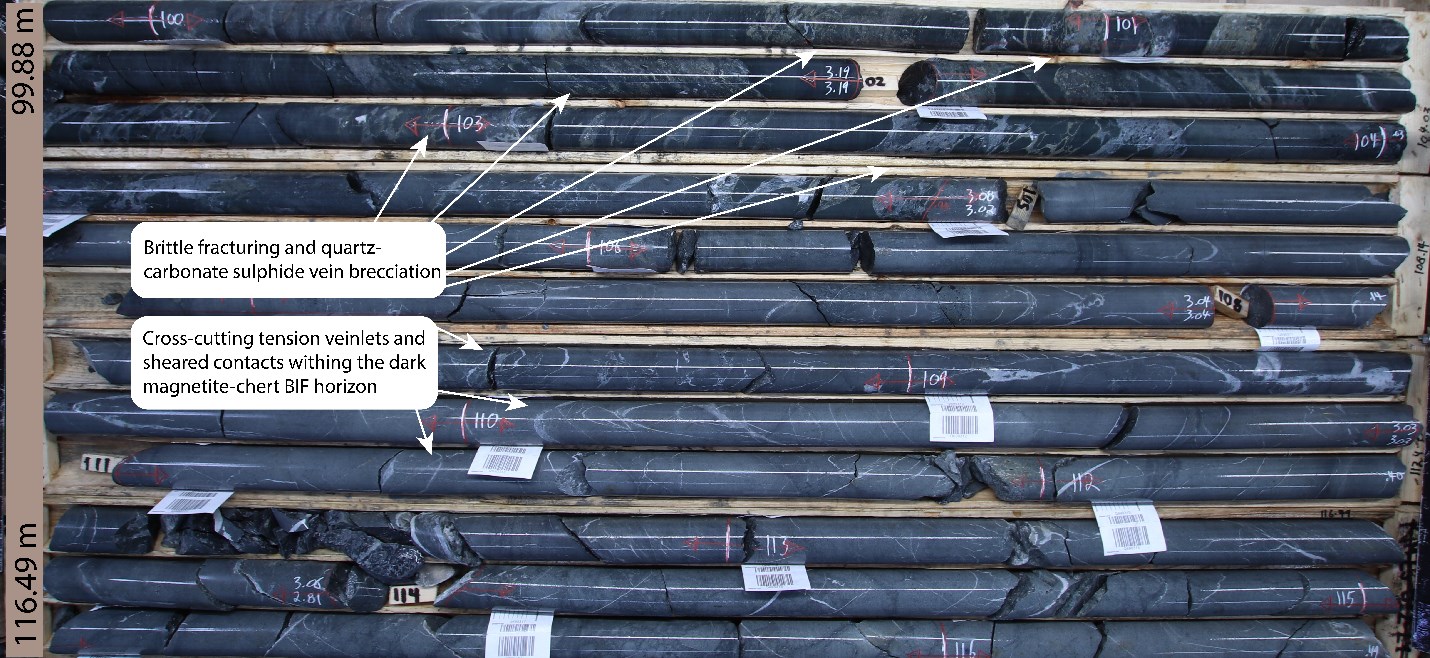
Recent drilling along the northern boundary of the Mirado Gold Project intersected a prominent, northwest-southeast trending BIF running parallel to the regional Lincoln-Nipissing Shear Zone (see Figure 3). Across the Abitibi Greenstone Belt, iron formations are well known as premier hosts for high-grade gold deposits for two simple reasons:
The exploration team is now using magnetic surveys and 3D structural modeling to target the exact points where cross-cutting faults break and offset this northern iron formation. An additional 34 holes have been completed. Multiple drill holes testing the North Zone extension and regional targets currently have assays pending at the laboratory.
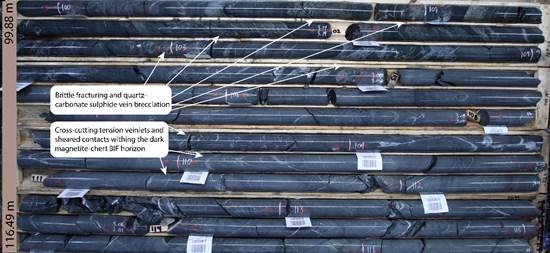
Figure 3: Wet NQ drill core from northern drill hole KLM26-072 (Boxes 21 to 24, from 99.88 m to 116.49 m downhole) illustrating the dark, magnetite-rich BIF horizon. Note the zones of brittle shattering, brecciation, and cross-cutting quartz-carbonate-sulphide veining (e.g., 101.00 m, 103.80 m, 109.00 m, and 112.50 m to 115.00 m) where fracture networks intersect the competent iron formation. Assays for KLM26-072 are currently pending; visual observations of veining, alteration, and sulphide mineralization are not necessarily indicative of gold grade.
To view an enhanced version of this graphic, please visit:
https://images.newsfilecorp.com/files/5701/325493_f5fb8d2754e8da3d_003full.jpg
Table 1 – Mirado drill assay results
| Hole ID | FROM (m) | TO (m) | INTERVAL (m) | Au (g/t) | ZONE |
| KLM26-053 | 18.00 | 36.00 | 18.00 | 0.28 | Mirado South Zone |
| 52.00 | 62.00 | 10.00 | 0.36 | ||
| 77.00 | 86.00 | 9.00 | 0.90 | ||
| including | 77.00 | 81.00 | 4.00 | 1.30 | |
| 212.00 | 214.00 | 2.00 | 1.21 | ||
| 234.00 | 247.00 | 13.00 | 0.71 | ||
| including | 241.00 | 245.00 | 4.00 | 1.58 | |
| KLM26-054 | 66.18 | 84.30 | 18.12 | 0.23 | Mirado West Zone |
| 141.85 | 145.00 | 3.15 | 1.18 | ||
| including | 141.85 | 142.39 | 0.54 | 6.36 | |
| 221.27 | 226.00 | 4.73 | 1.24 | ||
| including | 221.27 | 222.37 | 1.10 | 5.04 | |
| KLM26-056 | 26.60 | 49.35 | 22.75 | 0.31 | Mirado West Zone |
| including | 34.00 | 36.28 | 2.28 | 1.30 | |
| 71.49 | 72.00 | 0.51 | 1.99 | ||
| 109.00 | 109.90 | 0.90 | 1.41 | ||
| 158.38 | 159.00 | 0.62 | 2.43 | ||
| 205.28 | 210.00 | 4.72 | 0.60 | ||
| KLM26-057 | 195.00 | 197.00 | 2.00 | 1.26 | Mirado South Zone |
| KLM26-058 | 60.00 | 71.00 | 11.00 | 0.31 | Mirado West Zone |
| including | 69.50 | 71.00 | 1.50 | 1.32 | |
| 111.00 | 114.00 | 3.00 | 0.24 | ||
| 160.00 | 168.00 | 8.00 | 0.26 | ||
| 183.00 | 191.00 | 8.00 | 0.25 | ||
| KLM26-060 | 187.20 | 208.70 | 21.50 | 2.78 | Mirado North Zone |
| including | 191.23 | 197.62 | 6.39 | 8.90 | |
| 217.64 | 226.80 | 9.16 | 0.35 | ||
| KLM26-062 | 173.00 | 177.00 | 4.00 | 0.62 | Mirado North Zone |
| 209.00 | 219.00 | 10.00 | 0.50 | ||
| including | 209.00 | 211.00 | 2.00 | 1.08 | |
| 230.00 | 233.00 | 3.00 | 1.89 | ||
| including | 230.00 | 232.00 | 2.00 | 2.71 | |
| 372.00 | 400.00 | 28.00 | 0.52 | ||
| 482.00 | 489.00 | 7.00 | 1.15 |
Note: Reported intervals are downhole core lengths. True widths are currently unknown as the geometry of the mineralized zones is still being defined. Gold grades are length-weighted uncut averages.
Digital Resources
Stakeholders can explore KLDC’s drilling through:
Data Verification & Quality Assurance/Quality Control
Gold analyses were completed on half-core NQ samples at Paragon Geochemical Laboratory (independent of KLDC) using Chrysos PhotonAssay technology. PhotonAssay is a non-destructive method that uses high-energy X-rays to measure gold in large samples of approximately 500 g, reducing sampling variability associated with coarse gold mineralization and allowing the retained material to remain available for additional analysis.
Table 2 – Paragon Sample Preparation and Analytical Methods
| Analysis | Code | Location |
| Preparation | PREP-PKG | Timmins, Ontario, Canada |
| Photon and Fire Assay | PA-AU01, Au-SCR1K | Surrey, British Columbia | Hamilton, Ontario, Canada |
| Multi-Element | 33MA-OES | Sparks, Nevada, USA |
Samples returning gold values above the 350 g/t upper detection limit of the PhotonAssay method are reanalyzed using a 1 kg screen fire assay. The sample is sieved at 110 microns, the coarse fraction is analyzed gravimetrically, and the fine fraction is analyzed in duplicate by AAS; the combined result provides a representative total gold value for samples that may contain coarse gold.
Drill program design, QA/QC and interpretation of results are conducted by qualified persons consistent with National Instrument 43-101 and industry best practices. Certified reference standards and blanks are inserted into the sample stream at regular intervals, approximately one control sample per twenty samples, to monitor analytical accuracy and precision.
Reported intervals are calculated using length-weighted average grades with a nominal 0.20 g/t Au cutoff. To reflect continuity within the broader mineralized system, up to 6.90 m of consecutive internal dilution below cutoff is included within selected composites. Reported assays are uncut and no top cut has been applied. All intervals are reported as downhole core lengths. True widths are currently unknown as the geometry of the mineralized zones is still being defined.
Qualified Person
The technical information contained in this news release has been reviewed and approved by Benjamin Cleland, P.Geo., Vice-President, Exploration, who is a Qualified Person as defined by National Instrument 43-101 – Standards of Disclosure for Mineral Projects.
About Kirkland Lake Discoveries Corp.
Kirkland Lake Discoveries Corp. (TSX-V: KLDC) (OTCQB: KLKLF) is a mineral exploration company focused on district-scale discovery in Ontario’s world-renowned Kirkland Lake Gold Camp. Through strategic consolidation, the Company has assembled a 42,000+ ha land package across its KL South, KL West and KL East properties, capturing key structural splays and fault intersections around the Larder Lake-Cadillac deformation zone. By pairing boots-on-the-ground geological expertise with modern data analytics, geophysics, and hyperspectral core scanning, Kirkland Lake Discoveries is systematically expanding the Mirado Gold Project while advancing a deep portfolio of regional gold and polymetallic targets.
For additional information, please contact:
Stefan Sklepowicz
Chief Executive Officer
Phone: +1 226 979 3515
Email: stefan@kirklandlakediscoveries.com
Website: kirklandlakediscoveries.com
Neither TSX Venture Exchange nor its Regulation Services Provider (as that term is defined in policies of the TSX Venture Exchange) accepts responsibility for the adequacy or accuracy of this release.
Table 3 – Mirado drill coordinates and assay status
| Drill Hole | UTM Easting |
UTM Northing |
Azimuth | Inclination | Final Length (m) |
Target/Showing | Assay Result Status |
| KLM26-050 | 586417 | 5318541 | 60 | -50 | 408 | Mirado West Zone | Released |
| KLM26-051 | 586417 | 5318541 | 240 | -50 | 414 | Mirado West Zone | Released |
| KLM26-052 | 586694 | 5318347 | 60 | -50 | 441 | Mirado West Zone | Released |
| KLM26-053 | 586963 | 5318320 | 70 | -50 | 429 | Mirado South Zone | This Release |
| KLM26-054 | 586694 | 5318347 | 240 | -50 | 396 | Mirado West Zone | This Release |
| KLM26-055 | 586985 | 5318277 | 70 | -50 | 405 | Mirado South Zone | Pending |
| KLM26-056 | 586694 | 5318347 | 240 | -75 | 402 | Mirado West Zone | This Release |
| KLM26-057 | 587013 | 5318223 | 70 | -50 | 402 | Mirado South Zone | This Release |
| KLM26-058 | 586694 | 5318347 | 330 | -50 | 435 | Mirado West Zone | This Release |
| KLM26-059 | 587033 | 5318183 | 70 | -50 | 414 | Mirado South Zone | Pending |
| KLM26-060 | 587443 | 5318816 | 213 | -60 | 507 | Mirado North Zone | This Release |
| KLM26-061 | 587057 | 5318135 | 70 | -50 | 411 | Mirado South Zone | Pending |
| KLM26-062 | 587400 | 5318845 | 213 | -60 | 573 | Mirado North Zone | This Release |
| KLM26-063 | 587083 | 5318091 | 70 | -50 | 405 | Mirado South Zone | Pending |
| KLM26-064 | 587544 | 5318868 | 213 | -60 | 501 | Mirado North Zone | Pending |
| KLM26-065 | 587140 | 5318081 | 70 | -50 | 403 | Mirado South Zone | Pending |
| KLM26-066 | 587566 | 5318823 | 213 | -45 | 501 | Mirado North Zone | Pending |
| KLM26-067 | 587164 | 5318036 | 70 | -50 | 426 | Mirado South Zone | Pending |
| KLM26-068 | 587385 | 5318991 | 213 | -50 | 600 | Regional | Pending |
| KLM26-069 | 586753 | 5318500 | 70 | -50 | 504 | Mirado West Zone | Pending |
| KLM26-070 | 587549 | 5319242 | 213 | -50 | 400 | Regional | Pending |
| KLM26-071 | 586705 | 5318561 | 70 | -50 | 400 | Mirado West Zone | Pending |
| KLM26-072 | 587756 | 5319264 | 213 | -50 | 400 | Regional | Pending |
| KLM26-073 | 586654 | 5318646 | 70 | -50 | 400 | Mirado West Zone | Pending |
| KLM26-074 | 587755 | 5319263 | 213 | -65 | 400 | Regional | Pending |
| KLM26-075 | 586602 | 5318733 | 70 | -50 | 400 | Mirado West Zone | Pending |
| KLM26-076 | 587755 | 5319263 | 33 | -50 | 400 | Regional | Pending |
| KLM26-077 | 586635 | 5318381 | 240 | -70 | 400 | Mirado West Zone | Pending |
| KLM26-078 | 587930 | 5319255 | 213 | -50 | 400 | Regional | Pending |
| KLM26-079 | 586512 | 5318513 | 240 | -70 | 400 | Mirado West Zone | Pending |
| KLM26-080 | 586377 | 5318618 | 240 | -50 | 450 | Mirado West Zone | Pending |
| KLM26-081 | 586377 | 5318618 | 240 | -70 | 450 | Mirado West Zone | Pending |
| KLM26-082 | 587566 | 5318823 | 213 | -60 | 400 | Mirado North Zone | Pending |
| KLR26-001 | 586633 | 5317648 | 270 | -50 | 399 | Regional | Pending |
| KLR26-002 | 586572 | 5317825 | 270 | -50 | 400 | Regional | Pending |
| KLR26-003 | 586565 | 5317986 | 270 | -50 | 400 | Regional | Pending |
| KLR26-004 | 585905 | 5317473 | 270 | -50 | 400 | Regional | Pending |
| KLR26-005 | 585717 | 5317480 | 270 | -50 | 399 | Regional | Pending |
| KLR26-006 | 585716 | 5317479 | 90 | -50 | 400 | Regional | Pending |
| KLR26-007 | 585575 | 5317456 | 270 | -50 | 400 | Regional | Pending |
| KLR26-008 | 585590 | 5316490 | 213 | -50 | 400 | Regional | Pending |
| KLR26-009 | 585825 | 5316570 | 213 | -50 | 400 | Regional | Pending |
| KLR26-010 | 585595 | 5316395 | 213 | -60 | 300 | Regional | Pending |
| KLR26-011 | 585735 | 5316235 | 213 | -50 | 400 | Regional | Pending |
Forte Minerals Corp. (CSE: CUAU) (OTCQX: FOMNF) (Frankfurt: 2OA) is pleased to announce that it has ... READ MORE
Dakota Gold Corp. (NYSE American: DC) is pleased to report the results of its S-K 1300 Pre-Feasibili... READ MORE
Fury Gold Mines Limited (TSX: FURY) (NYSE American: FURY) is pleased to announce results from five ... READ MORE
CanAlaska Uranium Ltd. (TSX-V: CVV) (OTCQX: CVVUF) (FSE: DH7) is pleased to report that it has comp... READ MORE
Onyx Gold Corp. (TSX-V: ONYX) (OTCQX: ONXGF) is pleased to report assay results from 36 drill holes ... READ MORE