








Drilling and IP Surveying Also Underway at Hook Target, Investigating the Strongest Near Surface Chargeability Anomaly on the Property
Hercules Metals Corp. (TSXV: BIG) (OTCQB: BADEF) (FSE: C0X) is pleased to announce further results from its 2026 drilling campaign at the Leviathan Porphyry on its Hercules project in western Idaho. HER-25-21 was completed from a 2025 RC pre-collar, and extended Leviathans footwall zone to the southwest with an intercept of:
HER-25-18 was also further extended downhole, following a brief winter drilling pause at the end of 2025. The final composite assay result for HER-25-18 is:
Chris Paul, CEO for Hercules Metals, “We’re pleased to further extend mineralization to the southwest as the Leviathan porphyry copper system continues to demonstrate its continuity and growth potential. We look forward to completing further ongoing step-outs to the southwest as the 2026 season progresses.
We’re also very encouraged by the ongoing IP results at the new Hook target. What initially began as a subtle MT anomaly has quickly evolved into a high priority target, and the first to exhibit a near identical IP response to Leviathan. We look forward to receiving the final survey results once the remaining lines are completed, after which the crew will return to the Pegasus anomaly to investigate the potential for additional near-surface mineralization.”
Table 1: Highlight Intervals
| Hole ID | From (m) | To (m) | Interval (m)1 | Cu (%) | Mo (ppm) | Ag (g/t) | Au (g/t) | CuEq (%)2 |
| HER-25-18 | 172.21 | 960.12 | 787.91 | 0.43 | 91 | 3.5 | 0.027 | 0.54 |
| Including3 | 188.00 | 400.81 | 212.81 | 0.67 | 128 | 10.2 | 0.047 | 0.89 |
| Including3 | 188.00 | 245.36 | 57.36 | 1.06 | 112 | 3.6 | 0.036 | 1.18 |
| HER-25-21 | 224.03 | 1025.65 | 801.62 | 0.30 | 82 | 5.3 | 0.010 | 0.40 |
| Including | 224.03 | 245.36 | 21.33 | 0.22 | 33 | 165.7 | 0.005 | 2.00 |
| Including | 427.09 | 534.92 | 107.83 | 0.43 | 104 | 1.8 | 0.023 | 0.52 |
| Including | 661.42 | 867.70 | 206.28 | 0.39 | 98 | 0.7 | 0.009 | 0.45 |
| HER-25-24 | 236.52 | 254.36 | 17.84 | 1.28 | 20 | 19.7 | 0.039 | 1.54 |
| And | 283.46 | 495.30 | 211.84 | 0.22 | 83 | 1.9 | 0.005 | 0.29 |
| Including | 283.46 | 362.86 | 79.40 | 0.30 | 32 | 3.9 | 0.004 | 0.36 |
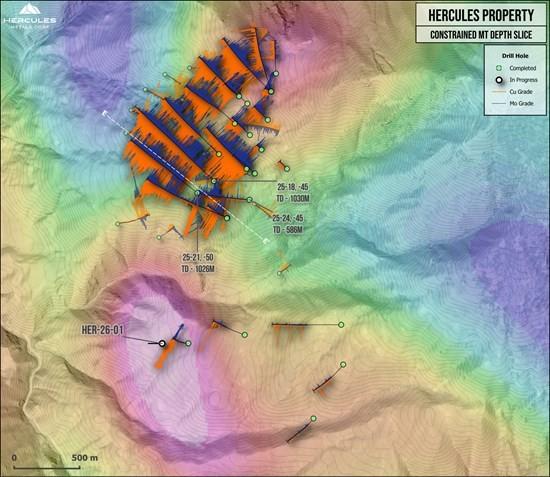
Figure 1: Drill results to date at Hercules relative to a geologically constrained MT conductivity depth slice.
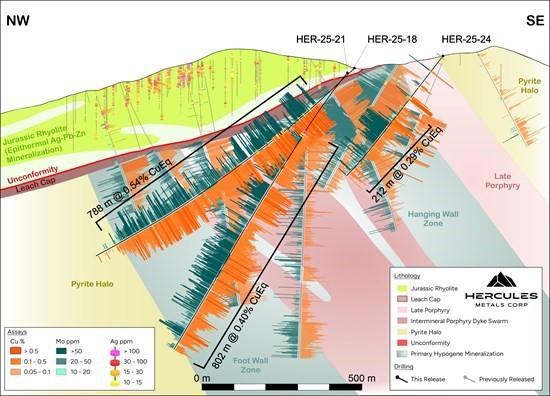
Figure 2: Cross-section E-E’, showing drill hole HER-25-18, HER-25-21, and HER-25-24.
Hook IP Anomaly
A new 2026 IP survey at the Hook target has identified a strong, continuous, near-surface chargeability anomaly exhibiting a geophysical response strongly analogous to the Leviathan porphyry copper system in terms of scale, strength, geometry, and orientation. The anomaly is located approximately 3 kilometers east of, and subparallel to, the Leviathan porphyry system and its associated chargeability signature (Figure 8).
To validate the comparison, IP lines 4 and 5 were extended to also cross over the Leviathan system as a calibration check, where they returned a highly comparable response, with both zones showing chargeability values ranging from 16-19 mV/V (Figures 6 and 7). Upcoming IP lines 6 and 7 will look to extend both the Hook and Leviathan anomalies further north.
IP lines 1 through 3 were run exclusively across the Hook target, where the strongest chargeability anomaly on the Property has been returned, with values of up to 40 mV/V (Figures 3-5).
Drilling has now commenced in hole HER-26-03, to test the area of strongest chargeability between IP lines 1 and 2 (Figures 3, 4, and 8). The anomaly begins within 100 m of surface on these lines; however, the first hole is collared from the nearest existing access road which requires an estimated 350-400 m drilled length to reach the target zone. If initial drilling is successful, the Company will evaluate options for permitting and constructing new temporary roads directly across the anomaly, to test where it comes closest to surface.
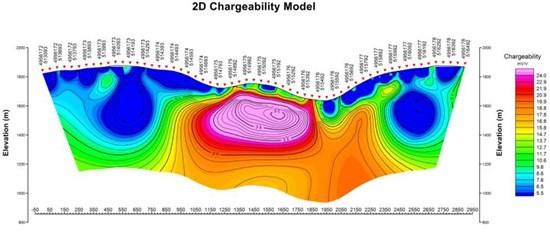
Figure 3: IP line 1N (looking north) at the Hook target. The >20 mV/V anomaly comes within 100 m of surface, where recent landslide cover conceals the target. The initial drill test in HER-26-03 is collared from an existing access road to the west of the anomaly, requiring an estimated 350-400 m drilled length to reach the target zone.
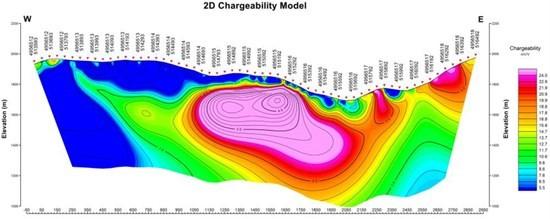
Figure 4: IP line 2N (looking north) at the Hook target, with the strongest values of the survey, up to 40 mV/V.
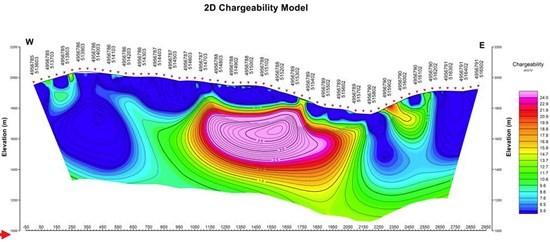
Figure 5: IP line 3N (looking north) at the Hook target.
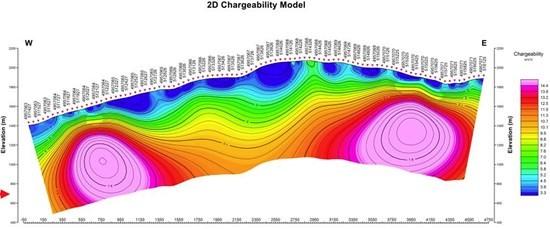
Figure 6: IP line 4N (looking north), which was extended west to cover both the known Leviathan porphyry system (left side) as a calibration check, and the new Hook target (right side) for direct comparison.
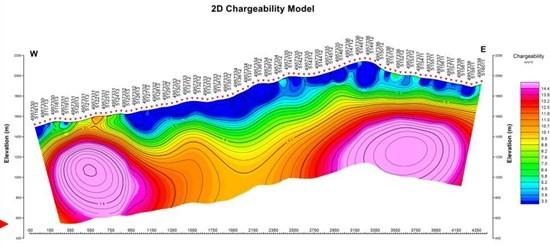
Figure 7: IP line 5N (looking north), which was extended west to cover both the known Leviathan porphyry system (left side) as a calibration check, and the new Hook target (right side) for direct comparison.
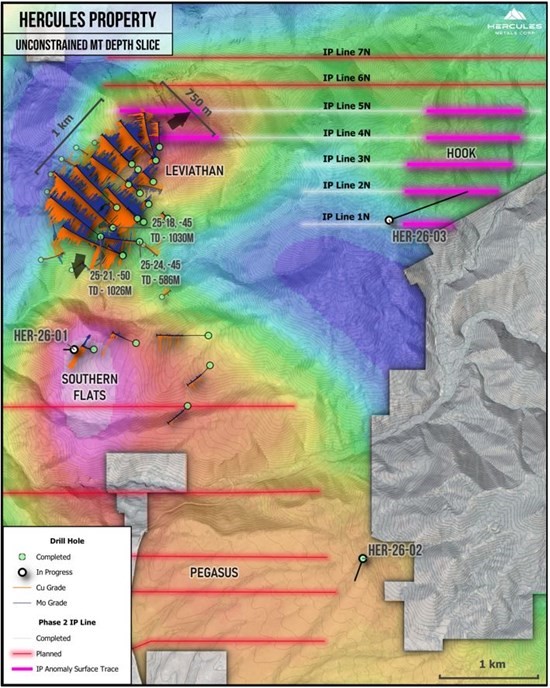
Figure 8: Compilation map showing all four targets on the Hercules Property, including the Leviathan Porphyry Copper System, the new Southern Flats discovery, and the new Hook and Pegasus targets. The unconstrained MT conductivity model in the background indicates the broad structural corridor (warm colours) within which porphyry copper intrusions are interpreted to have been emplaced. The ongoing IP survey will investigate the potential for near surface porphyry centers within this broad conductive corridor.
Pegasus Reconnaissance Drilling
HER-26-02 was collared within an approximately 3 kilometer wide structural corridor, distinguished by strongly elevated MT conductivity, which is host to both the Leviathan and the Southern Flats porphyry copper centers. The hole was collared on the eastern side of the corridor, where it intersected distal alteration and minor quartz-magnetite-pyrite veining, with weak to anomalous copper and molybdenum, consistent with similar results returned from early drilling on the same side of the corridor at the Southern Flats zone.
Drawing on geological insights gained from the discovery of Southern Flats; the western portion of the corridor is interpreted to have certain key structural controls indicative of higher porphyry copper potential. Upon completion of the final two IP lines at Hook, the western side of the structural corridor will be surveyed next, to investigate the potential for associated near-surface chargeability.
Surveyed Drill Collar Locations
Table 2: Surveyed collar data for drill holes reported in this release
| Hole ID | Easting | Northing | Elevation | Depth (m) | Azimuth | Dip |
| HER-25-18 | 511656.9 | 4956141.17 | 1363.04 | 1030.22 | 315.00 | -45.25 |
| HER-25-21 | 511530.94 | 4956050.07 | 1331.93 | 1025.65 | 308.39 | -50.62 |
| HER-25-24 | 511928.12 | 4955997.78 | 1432.74 | 586.13 | 275.07 | -44.77 |
Sample Analysis and QAQC
All drill core samples were prepped at MSA Labs in Elko, Nevada and analyzed at MSA Labs in Langley, British Columbia, an ISO 17025 and ISO 9001 certified laboratory. Samples were dried and crushed to 2 mm, from which a 250 g sub-sample split was then pulverized to 85% passing a 75 micron sieve. Following preparation, assays were determined by the IMS-230 method. A 0.25 g aliquot of the prepared pulp was digested in a 4-acid solution consisting of hydrochloric, nitric, perchloric and hydrofluoric acids. 4-acid is a near total digest and only the most highly resistant minerals are not dissolved. The resulting solution was analyzed via ICP-MS and ICP-ES for 48 elements and was corrected for inter-element spectral interferences. Lower detection limits for this procedure are 0.01 ppm for silver, 0.5 ppm for lead, 2 ppm for zinc, and 0.2 ppm for copper. Mercury is not reported due to volatilization in reaction with hydrofluoric acid and gold is not reported due to the small, 0.25 g aliquot size being insufficient to overcome the nugget effect.
Samples with initial results beyond the upper detection limit of the IMS-230 method were analyzed by procedures ICF-6Ag, ICF-6Cu, ICF-6Pb and ICF-6Zn. The thresholds are 100 ppm for silver, and >1% for copper, lead and zinc.
A 50 g split from the crushed and pulverized samples are composited into larger 500 g composite samples (consisting of ten continuous samples) and analyzed for gold utilizing CPA-Au1 photon assay method. Certain material gold results from the composite samples are then selected for re-analysis, by individual sample, as a 30 g fire assay (FAS-111 Method). Gold assays below detection limit are treated as zero values for composite calculations.
MSA Labs employs internal quality control standards, duplicates and blank samples at set frequencies.
Blind certified reference materials (CRMs) and blank samples were systematically inserted by the Company into the sample stream and analyzed as part of the Company’s quality assurance/quality control protocol.
Qualified Person
The scientific and technical information in this news release has been reviewed and approved for disclosure by Dillon Hume, P.Geo. and Vice President, Exploration for the Company. Mr. Hume is a “Qualified Person” for Hercules Metals within the meaning of National Instrument 43-101 – Standards of Disclosure for Mineral Projects.
About Hercules Metals Corp.
Hercules Metals Corp. is an exploration Company focused on developing America’s newest porphyry copper district, in Idaho.
The 100% owned Hercules Project, located northwest of Cambridge, hosts the newly discovered Leviathan porphyry copper system, one of the most important new discoveries in the country to date. The Company is well positioned for growth through continued drilling, supported by a strategic investment from Barrick Mining Corporation.
With the potential for significant scale, the Company’s management and board of directors aims to deliver value to shareholders through proven discovery success.
Brutus Mining Inc. (CSE: BRU) (FSE: ZI3) is pleased to announce that it has closed its non-brokered ... READ MORE
Jaguar Uranium Corp. (NYSE American: JAGU) is pleased to announce an independent Mineral Resource E... READ MORE
Auro Metals Inc. (TSX-V: AURO) (OTCQB: AURFF), is pleased to announce the assay results of the fina... READ MORE
Endeavour Silver Corp. (NYSE: EXK) (TSX: EDR) is pleased to announce that repairs to the primary bal... READ MORE
Scorpio Gold Corp. (NASDAQ: SGLD) (TSX-V: SGLD) (OTCQB: SRCRF) (FSE: RY9) is pleased to announce re... READ MORE