








GoldQuest Mining Corp. (TSX-V: GQC) (OTCQX: GDQMF) is pleased to report assay results from five metallurgical drill holes completed at the Company’s 100%-owned Romero Gold-Copper Project in San Juan Province, Dominican Republic.
The metallurgical holes, LTP-171 through LTP-175, were drilled to provide fresh representative core for the ongoing geo-metallurgical program and bankable feasibility study work. The assay results confirm multiple high-grade gold-copper intervals within the Romero deposit, while metallurgical test work completed to date continues to support conventional processing assumptions and ongoing process design work.
Highlights:
Luis Santana, CEO of GoldQuest, commented: “These metallurgical drill holes were completed to support ongoing technical studies and provide representative material for geo-metallurgical analysis. In addition to providing fresh information regarding mineralization within the Romero deposit, the results contribute to a broader technical understanding that will be incorporated into ongoing engineering and evaluation work. The localized favorable comparison with the existing block model also provides additional technical information that will be reviewed as part of ongoing studies.”
Drill Results Summary:
Figure 1 shows the location of the drillholes and Table 1 summarizes selected significant assay intervals from the five metallurgical drill holes. Interval grades are calculated using uncapped assays. Intervals may not represent true widths. There is insufficient drilling to determine the exact orientation and thickness of the mineralized zones at this time.
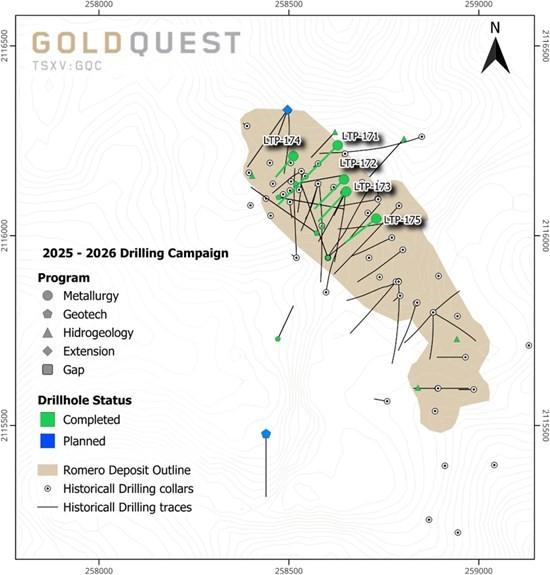
Figure 1: Metallurgical holes location
Table 1: Selected assay results from Romero metallurgical drill holes
| HoleID | Dip (°) | From (m) | To (m) | Interval (m) | Au g/t | Ag g/t | Cu % |
| LTP-171 | -58 | 186.3 | 189.85 | 3.55 | 8.31 | 14.53 | 0.50 |
| 284.15 | 312.5 | 28.35 | 3.20 | 22.58 | 2.07 | ||
| LTP-172 | -75 | 168.65 | 196.2 | 27.55 | 17.61 | 6.07 | 1.40 |
| including | 168.65 | 178.75 | 10.1 | 38.71 | 10.80 | 2.76 | |
| LTP-172 | 245.4 | 260 | 14.6 | 9.16 | 5.03 | 2.32 | |
| including | 248.55 | 256.45 | 7.9 | 15.89 | 6.69 | 3.19 | |
| LTP-172 | 301.4 | 308.6 | 7.2 | 17.17 | 2.70 | 3.76 | |
| including | 306.4 | 308.6 | 2.2 | 47.50 | 4.60 | 9.10 | |
| LTP-172 | 328.6 | 341.4 | 12.8 | 2.48 | 6.06 | 1.40 | |
| LTP-173 | –70 | 135 | 173.6 | 38.6 | 45.01 | 14.31 | 2.44 |
| including | 136.45 | 163.3 | 26.85 | 63.82 | 18.93 | 3.23 | |
| LTP-173 | 215.15 | 231.2 | 16.05 | 12.76 | 79.65 | 4.50 | |
| LTP-174 | -80 | 165 | 176.4 | 11.4 | 3.50 | 3.94 | 0.79 |
| 188.6 | 220 | 31.4 | 9.31 | 7.00 | 1.06 | ||
| including | 205 | 211.4 | 6.4 | 38.00 | 14.81 | 1.21 | |
| LTP-174 | 251.5 | 282 | 30.5 | 16.47 | 2.79 | 1.59 | |
| including | 257 | 268.6 | 11.6 | 34.46 | 4.20 | 2.76 | |
| LTP-175 | -60 | 127.7 | 137 | 9.3 | 2.68 | 8.12 | 0.01 |
| 236.4 | 241.4 | 5 | 3.36 | 1.57 | 1.49 | ||
| 261.4 | 286 | 24.6 | 1.74 | 3.94 | 0.33 |
Local Reconciliation with the Resource Block Model:
GoldQuest completed an initial internal reconciliation exercise using the new drill hole assays, updated collar and survey information, and a simplified comparison against the resource block model within 10 m diameter cylinders around the metallurgical drill holes. The results are preliminary, internal and are not a mineral resource estimate. A fully updated resource model is expected to consider lithology, alteration, structural controls, estimation parameters and classification criteria.
On this preliminary local basis, the new metallurgical holes compare positively with the existing model. The 10 m cylinder exercise indicates a 43% increase in gold grade, with positive changes in copper and silver grades of 9% and 7%, respectively, considering the five metallurgical holes at a 1.0 g/t Au cut-off. The same local comparison indicates increases of 48% in contained gold ounces, 13% in contained copper and 11% in contained silver within the evaluated 10 m cylinders.
Table 2: Preliminary internal model comparison
| Average Value | Material Content | ||||||
| Mass | Au | Cu | Ag | Au | Cu | Ag | |
| t | g/t | % | g/t | t. oz | thousand lb | t. oz | |
| Total | +4% | +43% | +9% | +7% | +48% | +13% | +11% |
Note: Table 2 is based on an internal preliminary comparison within 10 m diameter cylinders around the metallurgical drill holes and is not a mineral resource estimate. The results are intended to illustrate local reconciliation only and do not represent a global update of the Romero block model.
Geo-metallurgical Program Results:
The geo-metallurgical program is a key component of the ongoing bankable feasibility study and has focused on representative samples from defined domains within the Romero deposit. The work completed to date indicates that the tested geo-metallurgical domains are all amenable to conventional comminution and flotation processing methods, supporting the process route contemplated for Romero.
Comminution testing has identified variation in SAG work indices, particularly for softer ores, providing additional information to better align operating cost assumptions with geology. Flotation test work has identified opportunities to evaluate coarser grinding requirements without loss of recovery, while remaining consistent with recovery assumptions applied in the 2016 PFS.
Preliminary test work also suggests that target recoveries may be achievable without the inclusion of a gravity circuit, which could simplify the final flowsheet if confirmed by the remaining work. Mineralogical investigations have been completed to support metallurgical interpretation and address previously identified data gaps, and tailings samples have been generated for ongoing rheological and paste backfill test work.
The results reported remain preliminary and subject to completion of the test program, engineering analysis and integration into the bankable feasibility study. Final metallurgical conclusions and design criteria will be reported as the program advances.
Program Status and Next Steps:
The metallurgical drill holes were completed as part of the Company’s broader geo-metallurgical program for Romero. The program is designed to provide fresh material for comminution, flotation, variability and life-of-mine composite test work, as well as additional geological information to support the feasibility study.
GoldQuest is evaluating the integration of the new metallurgical drilling into the ongoing mineral resource estimate update and related feasibility study workstreams. The Company will provide further updates as metallurgical test work, resource modelling and engineering studies advance.
QA-QC
Core from these holes was partially assayed as part of the metallurgical test program at ALS Metallurgy at Kamloops, Canada, and the remainder of the core was assayed at Bureau Veritas. As part of the Company’s Quality Assurance and Quality Control procedures, the Company reviews results from Certified Standard Reference Materials, which are inserted at a rate of five per 100 samples. Within the results disclosed herein there were no samples with results outside of the recommended tolerances for the Standards. In GoldQuest’s drill programs, composite intervals were chosen using a combination of geological criteria and mineralization, averaging around two metres core length. The drill core is cut in half with one half of the core sample shipped to Bureau Veritas Labs by GoldQuest technicians. The remaining half of the core is kept at the Company core shack for future assay verification, or any other further investigation. Assays within intervals below the 0.005 g/t detection limit for Au were given a 0.0025 g/t value. All drill samples were prepared and screened by ACME Labs (Vancouver); metallic fire assay and multi-element ICP-MS were assayed by Bureau Veritas Laboratories (Vancouver). Gold values are determined by standard fire assay with an AA finish, or, if over 10.0 g/t Au, were re-assayed and completed with a gravimetric finish. Copper and zinc values exceeding 0.2% were re-assayed with a 4-acid digestion and AAS finish. When zinc values exceeded 10% a classic titration was carried out for zinc. QA/QC included the insertion and continual monitoring of numerous standards, blanks and duplicates into the sample stream, at random intervals within each batch.
Qualified Persons
The scientific and technical information contained in this press release has been reviewed and approved by Leandro Sastre, P. Geo., VP of Exploration of GoldQuest, and Franco Martucci, P.E., Senior Metallurgical Engineer. Mr. Sastre is responsible for the exploration and geological information, and Mr. Martucci is responsible for the metallurgical information. Each is a Qualified Person for their respective technical information under NI 43-101 – Standards of Disclosure for Mineral Properties.
About GoldQuest
GoldQuest Mining Corp. is a Canadian exploration and development company with strong participation from Dominican investors, focused on advancing its gold and copper assets in the Dominican Republic. The Company has a Board of Directors and management team with prior experience developing and operating a mine in the country.
Intersected a new mineralized structure above previously defined ... READ MORE
Canoe Mining Ventures Corp. (TSX-V: CLV) is pleased to announce... READ MORE
HIGHLIGHTS 49 holes and 10,018 metres drilled, two and a half tim... READ MORE
High-Grade Oxide Gold Zone Extends Beyond Current Mineral Resourc... READ MORE
Cerro de Pasco Resources Inc. (TSX-V CDPR) (OTCQX CDPMF) (FRA N8H... READ MORE