








Gold X2 Mining Inc. (TSX-V: AUXX) (OTCQB: GSHRF) (FWB: DF8) is pleased to announce the most recent assays from its ongoing infill and resource expansion drilling program targeting the eastern extension of the QES Zone at the Moss Gold Project in Northwest Ontario, Canada.
Michael Henrichsen, CEO and Director of Gold X2 commented, “We are very pleased with the high-grade intersection at the base of the QES pit, which indicates not only the potential to expand the pit to depth, but also demonstrates the potential for underground mineralization that we are currently targeting underneath the RPEEE pit. In addition, three of the four reported drill holes intersected wider and higher grades than predicted in the resource model demonstrating the potential for significant upside to the current resource.”
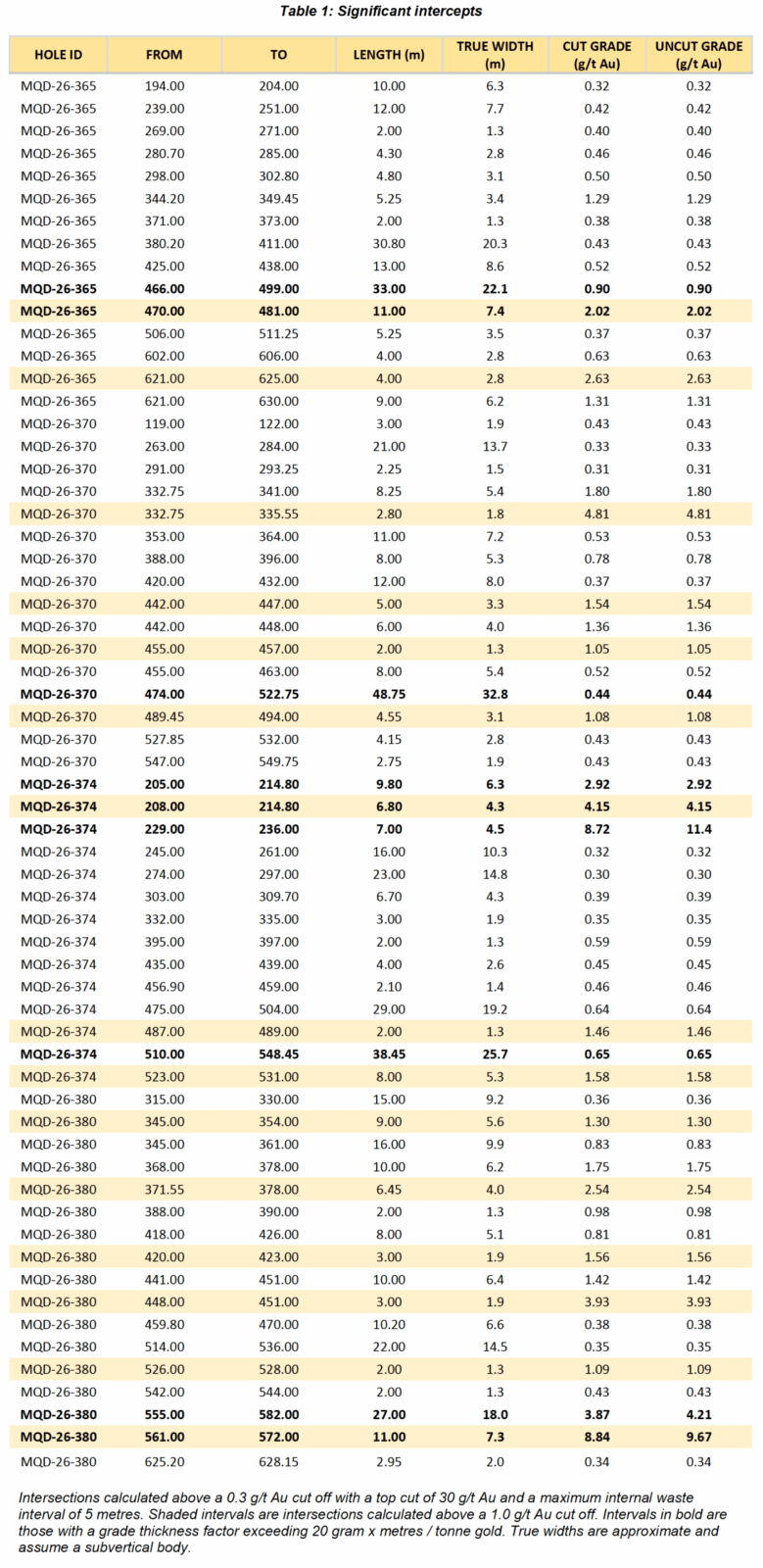
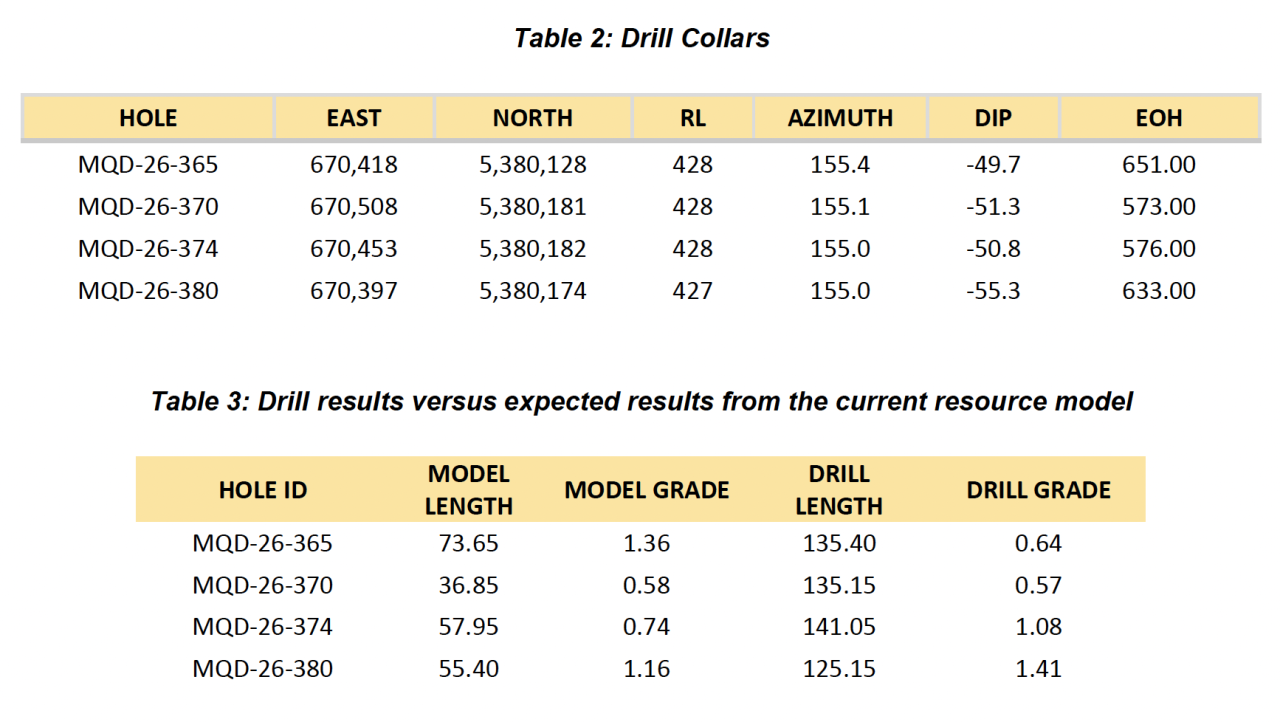
The results of the four holes drilled into the eastern end of the QES Zone are illustrated in the following figures and tables. Figure 1 shows the location map of the drill holes reported in this release. Figure 2 provides a typical cross-section through drill holes MQD-26-365 and MQD-26-380. The results are summarized in Tables 1 to 3, which include significant intercepts (Table 1), drill hole locations (Table 2) and the reconciliation between actual drill intercepts and those predicted by the current resource model (Table 3).
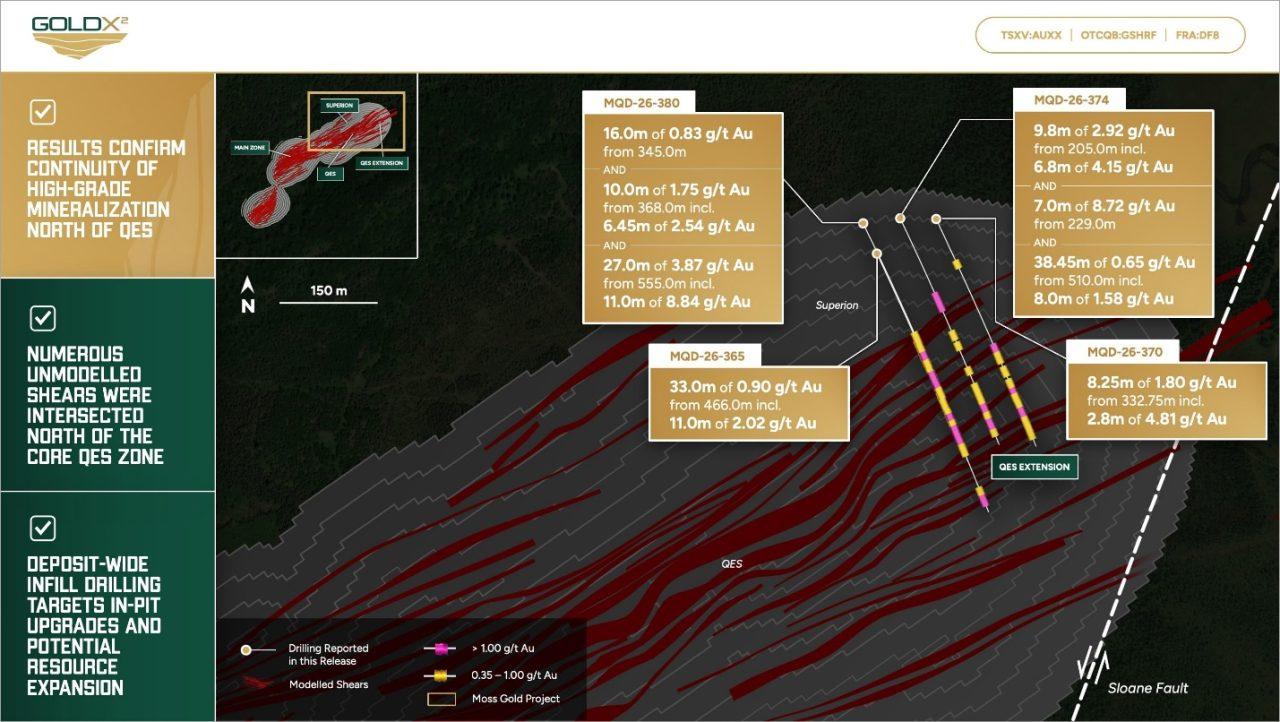
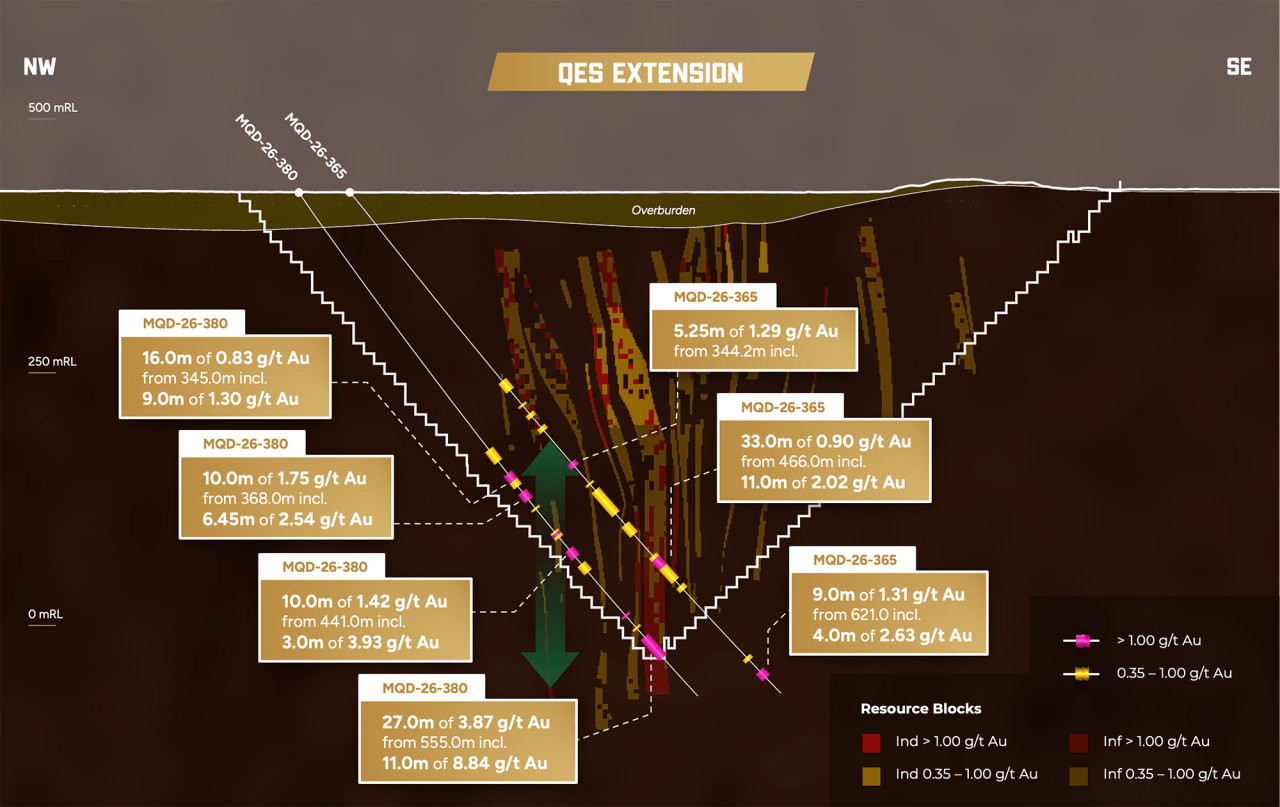
Gold X2 continues its deposit-wide infill drilling program designed to upgrade in-pit Inferred resource blocks to Indicated and further de-risk the Moss Gold Project. Where applicable, holes are positioned to test shallow exploration targets near or within the current RPEEE open pit shell aimed to delineate additional mineralization and expand the mineral resource. Four holes were planned to test the eastern end of the QES Zone, drilling from the north through a large untested area before intersecting the core shears at the base of the RPEEE pit.
The high-grade mineralization intersected at the base of the eastern end of the pit – 27.0m of 3.87 g/t Au from 555.0m, including 11.0m of 8.84 g/t Au from 561.0m in MQD-26-380 – lends credibility to the idea of shallowly dipping high-grade shoots that the Company are starting to define. This provides optionality to expand the current open pit mineral resource at depth by defining additional mineralization beneath the open pit; and to delineate the high-grade primary structures, which remain open and untested at depth, and may develop a robust underground-mineable resource.
The four holes collared through 40-60m of overburden and encountered the expected wide epidote-chlorite altered diorite body north of the QES Zone with localized sericite-silica altered shearing, which increased in intensity and width downhole. Each hole intersected a ~150-200m wide sericite-silica-hematite and sericite-chlorite altered sheared granodiorite, which hosts the core shears of the QES Zone before transitioning into the southern dacitic volcanic package south of the QES Zone. The granodiorite exhibited the expected blend of moderate-strong sericite-hematite-silica alteration and sericite-chlorite alteration with pervasive moderate to strong shearing throughout the granodiorite body. The holes were pushed through the core shears but terminated within the granodiorite as they began to intersect mineralization previously drilled from the south side of the QES Zone.
As the four holes drilled a previously poorly drilled volume, they intersected significantly wider zones of mineralization than has been modelled, which will likely allow for an expansion of the MRE in this area (Table 3).
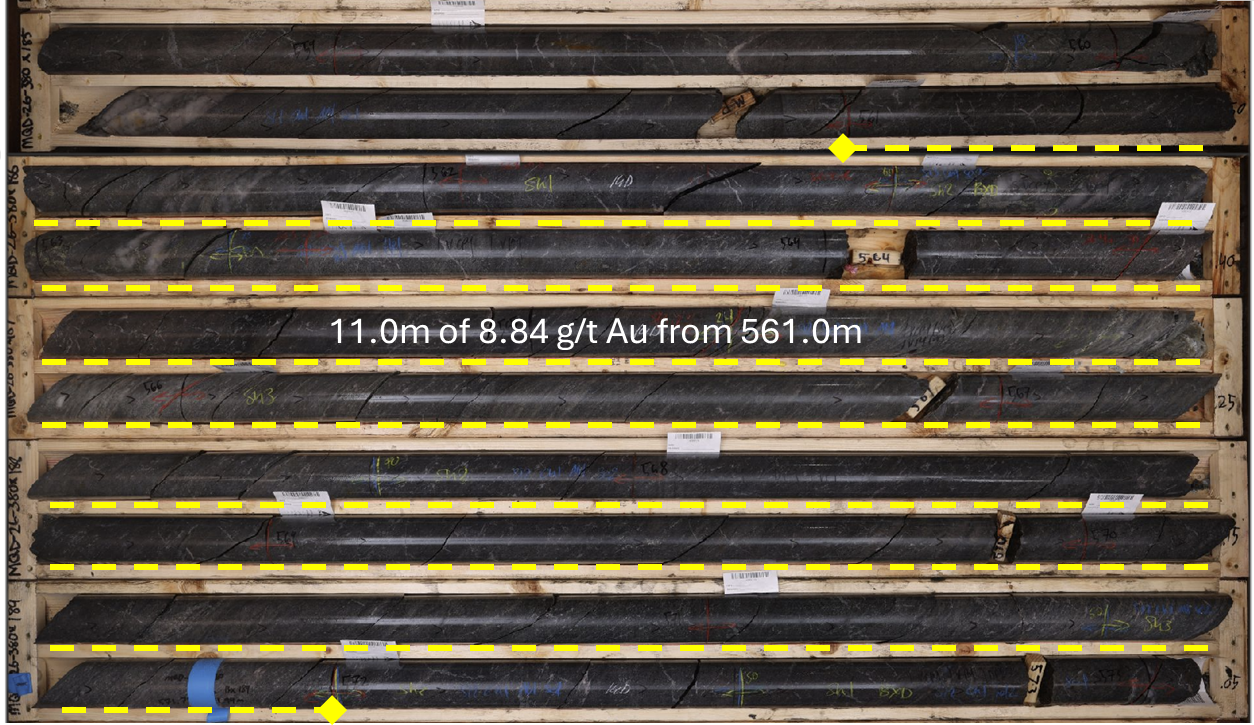
All drill core is HQ diameter drill core has been visually validated in the core shack, rotated, and reconnected. Structural orientation data was captured by acoustical and optical televiewer operated by DGI Geosciences. All core has been sawed in half cut just off a geologist established cutline aligned 90° from the apex of the foliation, with the right half (looking down hole) of the core bagged and sent a third-party analytical laboratory. The left half of the core was returned to core boxes and is stored at Gold X2’s Kashabowie core yard facility.
All samples were sent to Paragon Geochemical in Timmins for sample preparation. Samples were analysed for gold via PhotonAssay™ (“PA-AU02”) by Paragon’s laboratory in Hamilton and then shipped to Activation Laboratories Ancaster for 60 pathfinder elements via ICP-MS after four-acid digestion (“UT-6”). Paragon and ActLabs are accredited by the Standards Council of Canada (SCC) for the Accreditation of Mineral Analysis Testing Laboratories and CAN-P-4E ISO/IEC 17025.
In addition to Paragon quality assurance / quality control protocols, Gold X2 has implemented a quality control program for all samples collected through the drilling program. The quality control program was designed by a qualified and independent third party, with a focus on the quality of analytical results for gold. Analytical results are received, imported to our secure on-line database and evaluated to meet our established guidelines to ensure that all sample batches pass industry best practice for analytical quality control. Certified reference materials are considered acceptable if values returned are within three standard deviations of the certified value reported by the manufacture of the material. In addition to the certified reference material, certified blank material is included in the sample stream to monitor contamination during sample preparation. Blank material results are assessed based on the returned gold result being less than ten times the quoted lower detection limit of the analytical method. The results of the on-going analytical quality control program are evaluated and reported to Gold X2 by Orix Geoscience Inc.
Peter Flindell, PGeo, MAusIMM, MAIG, Chief Operating Officer, of the Company, and a qualified person under National Instrument 43-101 – Standards of Disclosure for Mineral Projects, has approved the scientific and technical information contained in this news release.
Mr. Flindell has verified the data disclosed. To verify the information related to the winter drill program at the Moss Gold Project, Mr. Flindell has visited the property several times; discussed and reviewed logging, sampling, bulk density, core cutting and sample shipping processes with responsible site staff; discussed and reviewed assay and QA/QC results with responsible personnel; and reviewed supporting documentation, including drill hole location and orientation and significant assay interval calculations. He has also overseen the Company’s health and safety policies in the field to ensure full compliance, and consulted with the Project’s host indigenous communities on the planning and implementation of the drill program, particularly with respect to its impact on the environment and the Company’s remediation protocols.
Gold X2 is a growth-oriented gold company focused on delivering long-term shareholder and stakeholder value through the acquisition and advancement of primary gold assets in tier-one jurisdictions. It is led by the ex-global head of structural geology for the world’s largest gold company and backed by one of Canada’s pre-eminent private equity firms. The Company’s current focus is the advanced stage 100% owned Moss Gold Project which is positioned in Ontario, Canada, with direct access from the Trans-Canada Highway, hydroelectric power near site, supportive local communities and skilled workforce. The Company has invested over $150 million of new capital and completed approximately 100,000 meters of drilling on the Moss Gold Project, which, in aggregate, has had over 300,000 meters of drilling. The 2026 updated NI 43-101 mineral resource estimate for the Moss and East Coldstream Deposits has expanded to 2.458 million ounces of Indicated gold resources at 1.04 g/t Au, contained within 73.8 million tonnes and 4.209 million ounces of Inferred gold resources at 0.97 g/t Au contained within 134.7 million tonnes. The Moss Deposit also has a silver MRE of 3.160 million ounces of indicated silver resources at 1.53 g/t Ag contained within 64.3 Mt and 6.273 million ounces of inferred silver resources at 1.55 g/t Ag contained within 125.9 Mt. Results of a preliminary economic assessment of the Moss Gold Project suggest the potential for the deposit to support a long-life mining operation with a strong production profile and low production costs. The MRE and PEA are supported by a NI 43-101 technical report for the Moss Gold Project available on the Company’s website and under the Company’s issuer profile on SEDAR+. For more information, please visit SEDAR+ (www.sedarplus.ca) and the Company’s website (www.goldx2.com).
For More Information – Please Contact:
Michael Henrichsen
President, Chief Executive Officer and Director
Gold X2 Mining Inc.
E: mhenrichsen@goldx2.com
W: www.goldx2.com
T: 1-604-404-4335
Hosted within 12.16 m (10.67 m estimated true width) intersection... READ MORE
Brutus Mining Inc. (CSE: BRU) (FSE: ZI3) is pleased to announce that it has closed its non-brokered ... READ MORE
Jaguar Uranium Corp. (NYSE American: JAGU) is pleased to announce an independent Mineral Resource E... READ MORE
Auro Metals Inc. (TSX-V: AURO) (OTCQB: AURFF), is pleased to announce the assay results of the fina... READ MORE
Endeavour Silver Corp. (NYSE: EXK) (TSX: EDR) is pleased to announce that repairs to the primary bal... READ MORE