








Gold X2 Mining Inc. (NYSE American: AUXX) (TSX-V: AUXX) (FSE: DF80) is pleased to announce the most recent assays from its ongoing resource expansion drilling program targeting the depth extensions of the QES Zone at the Moss Gold Project in Northwest Ontario, Canada.
Michael Henrichsen, CEO of Gold X2 commented, “These results reinforce the potential to expand the open pit to depth and represent a meaningful opportunity to grow the current mineral resource at the Moss Gold Project. With 12 of the 21 planned holes in the QES resource expansion program now complete, we are continuing to define the scale and continuity of mineralization beneath the existing pit. Additional assay results are expected over the coming weeks as we advance this important resource expansion program.”
Highlights
The current QES Drill Program is designed to both extend mineralization to depth and increase drill density beneath the existing RPEEE pit shell, with the objective of supporting a potential expansion of the open pit to depth. The additional drilling is intended to reduce the current constraint imposed by limited drill data at depth and provide a more complete basis for evaluating the potentially economically extractable mineralization in this area.
Technical Overview
The results of the first two holes of a twenty-one-hole campaign drilled into QES Deeps is illustrated in the following figures and tables. Figure 1 shows the location map of the drill hole reported in this release. Figure 2 provides a cross-section through drill hole MQD-26-465, while Figure 3 shows the position of the hole on a long section. The results are summarized in Tables 1 to 2, which include significant intercepts (Table 1) and drill hole locations (Table 2).
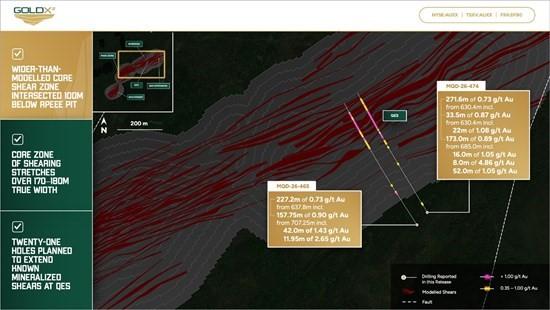
Figure 1: Shows the location of the drill holes in the QES Deeps campaign
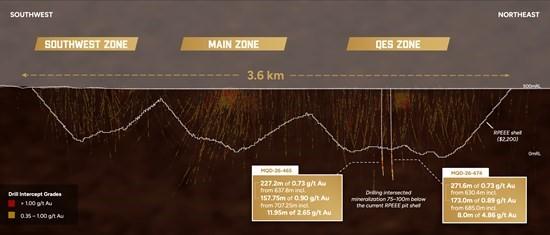
Figure 2: Shows a long section, highlighting the reported drill holes relative to the drill data and the RPEEE pit shell
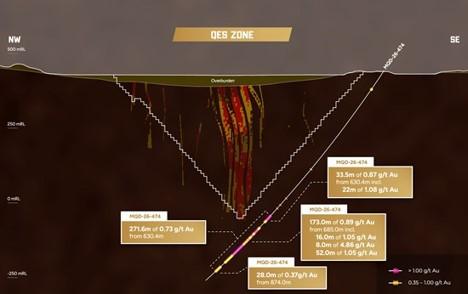
Figure 3: Shows a section through drill hole MQD-26-474 with reported intersections relative to the current resource block model and RPEEE pit shell
Gold X2 continues its deposit-wide infill and resource expansion drill programs designed to upgrade in-pit Inferred resource blocks to Indicated and expand the overall Mineral Resource at the Moss Gold Project.
Twenty-one holes have been planned across the QES Zone targeting a depth of 75 to 100 meters below the current RPEEE pit shell to extend the depth of the known mineralized shears. The aim of this campaign is to ensure that the deeper sections of the Mineral Resource are informed solely by new drilling and that the scale of the RPEEE pit is fully defined by economic parameters and not restricted by limited drill data as is currently the case.
MQD-26-465 and MQD-26-474 were collared from the southern flank of the QES Zone and intersected mineralization between 75-100m below the RPEEE pit shell, which is within the parameters currently applied for the definition of Inferred Mineral Resources. Despite the deeper level of drilling in this campaign, they remain 180 meters above the deepest hole — MQD-25-326, which intersected 117m of 1.21 g/t Au (press release dated March 3, 2026) — suggesting the mineralized shears extend to a much greater depth.
Both holes largely encountered expected geological sequences beneath a thin veneer of glacial till overburden. The upper approximately 600 meters of core is dominated by the southern dacitic volcanic package intersected by various 1-3m wide, late-stage, mafic and intermediate dykes. Localized shearing is seen throughout the volcanic package associated with strong sericite-chlorite alteration and zones of gold mineralization, including 13.0m of 0.77 g/t Au from 273.0m in MQD-26-466.
The holes then intersected the expected sheared QES diorite and granodiorite complex, which continued until each hole was terminated. Mineralization is primarily hosted in sheared, sericite-silica-hematite altered granodiorite with more localized sericite-chlorite altered sections associated with increased shear intensity and strongly deformed cm-scale quartz-carbonate veins with 2-3% pyrite-chalcopyrite. These zones are associated with higher-grade shears, including 11.95m of 2.65 g/t Au from 790.05m in MQD-26-465 and 8.0m of 4.86 g/t Au from 721.0m in MQD-26-474.
Importantly, the core zone of shearing stretches over 170-180 meters true width. The calculated significant intercepts (Table 1) are part of the core shear zone, which when taken as a whole, returned 227.2m of 0.73 g/t Au from 637.8m in MQD-26-465 and 271.6m of 0.73 g/t Au from 630.4m in MQD-26-474.
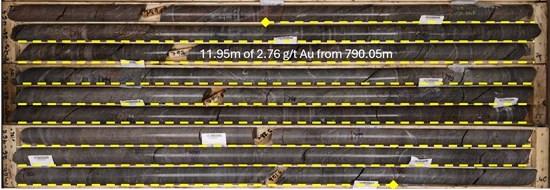
Figure 4: Hole MQD-26-465: Strongly sheared granodiorite with intense sericite-silica-hematite with an intercept of 11.95m of 2.76 g/t Au from 790.05m, part of the greater interval of 157.75m of 0.9m from 707.25m.
Table 1: Significant intercepts
| HOLE ID | FROM | TO | LENGTH (m) | TRUE WIDTH (m) | CUT GRADE (g/t Au) |
UNCUT GRADE (g/t Au) |
| MQD-26-465 | 273.00 | 286.00 | 13.00 | 8.3 | 0.77 | 0.77 |
| MQD-26-465 | 273.00 | 275.00 | 2.00 | 1.3 | 3.51 | 3.51 |
| MQD-26-465 | 338.00 | 340.00 | 2.00 | 1.3 | 0.43 | 0.43 |
| MQD-26-465 | 550.00 | 552.00 | 2.00 | 1.4 | 0.30 | 0.30 |
| MQD-26-465 | 623.00 | 625.00 | 2.00 | 1.4 | 0.62 | 0.62 |
| MQD-26-465 | 637.80 | 688.80 | 51.00 | 36.2 | 0.45 | 0.45 |
| MQD-26-465 | 685.00 | 688.80 | 3.80 | 2.7 | 1.47 | 1.47 |
| MQD-26-465 | 707.25 | 865.00 | 157.75 | 117.0 | 0.90 | 0.90 |
| MQD-26-465 | 751.00 | 766.60 | 15.60 | 11.4 | 1.22 | 1.22 |
| MQD-26-465 | 774.00 | 816.00 | 42.00 | 31.3 | 1.43 | 1.43 |
| MQD-26-465 | 846.00 | 860.10 | 14.10 | 10.8 | 1.03 | 1.03 |
| MQD-26-474 | 73.00 | 82.00 | 9.00 | 5.2 | 0.40 | 0.40 |
| MQD-26-474 | 266.05 | 281.85 | 15.80 | 9.6 | 0.30 | 0.30 |
| MQD-26-474 | 419.00 | 422.00 | 3.00 | 1.9 | 0.39 | 0.39 |
| MQD-26-474 | 551.00 | 553.00 | 2.00 | 1.3 | 0.42 | 0.42 |
| MQD-26-474 | 581.00 | 583.00 | 2.00 | 1.3 | 0.36 | 0.36 |
| MQD-26-474 | 597.00 | 599.10 | 2.10 | 1.4 | 0.51 | 0.51 |
| MQD-26-474 | 630.40 | 663.90 | 33.50 | 22.6 | 0.87 | 0.87 |
| MQD-26-474 | 631.00 | 653.00 | 22.00 | 14.8 | 1.08 | 1.08 |
| MQD-26-474 | 685.00 | 858.00 | 173.00 | 121.8 | 0.89 | 1.02 |
| MQD-26-474 | 696.00 | 712.00 | 16.00 | 11.0 | 1.05 | 1.05 |
| MQD-26-474 | 721.00 | 729.00 | 8.00 | 5.5 | 4.86 | 7.70 |
| MQD-26-474 | 740.00 | 743.00 | 3.00 | 2.1 | 1.45 | 1.45 |
| MQD-26-474 | 749.00 | 752.00 | 3.00 | 2.1 | 1.66 | 1.66 |
| MQD-26-474 | 757.00 | 760.00 | 3.00 | 2.1 | 1.03 | 1.03 |
| MQD-26-474 | 767.00 | 819.00 | 52.00 | 36.9 | 1.05 | 1.05 |
| MQD-26-474 | 874.00 | 902.00 | 28.00 | 20.4 | 0.37 | 0.37 |
|
Intersections calculated above a 0.3 g/t Au cut off with a top cut of 30 g/t Au and a maximum internal waste interval of 10 metres. Shaded intervals are intersections calculated above a 1.0 g/t Au cut off. Intervals in bold are those with a grade thickness factor exceeding 20 gram x metres / tonne gold. True widths are approximate and assume a subvertical body. |
||||||
Table 2: Drill Collars
| HOLE | EAST | NORTH | RL | AZIMUTH | DIP | EOH |
| MQD-26-465 | 670,280 | 5,379,113 | 440 | 328.0 | -56.1 | 930.60 |
| MQD-26-474 | 670,326 | 5,379,168 | 440 | 330.2 | -57.3 | 945.30 |
Analytical and QA/QC Procedures
All drill core is NQ diameter drill core has been visually validated in the core shack, rotated, and reconnected. Structural orientation data was captured by acoustical and optical televiewer operated by DGI Geosciences. All core has been sawed in half cut just off a geologist established cutline aligned 90° from the apex of the foliation, with the right half (looking down hole) of the core bagged and sent a third-party analytical laboratory. The left half of the core was returned to core boxes and is stored at Gold X2’s Kashabowie core yard facility.
All samples were sent to ALS Geochemistry in Thunder Bay for sample preparation. Samples were analysed for gold via PhotonAssayTM (“Au-PA02“) in Thunder Bay and 48 pathfinder elements via ICP-MS after four-acid digestion (“ME-MS61“) in Vancouver. ALS is accredited by the Standards Council of Canada (SCC) for the Accreditation of Mineral Analysis Testing Laboratories and CAN-P-4E ISO/IEC 17025.
In addition to ALS quality assurance / quality control protocols, Gold X2 has implemented a quality control program for all samples collected through the drilling program. The quality control program was designed by a qualified and independent third party, with a focus on the quality of analytical results for gold. Analytical results are received, imported to our secure on-line database and evaluated to meet our established guidelines to ensure that all sample batches pass industry best practice for analytical quality control. Certified reference materials are considered acceptable if values returned are within three standard deviations of the certified value reported by the manufacture of the material. In addition to the certified reference material, certified blank material is included in the sample stream to monitor contamination during sample preparation. Blank material results are assessed based on the returned gold result being less than ten times the quoted lower detection limit of the analytical method. The results of the on-going analytical quality control program are evaluated and reported to Gold X2 by Orix Geoscience Inc.
Qualified Person
Peter Flindell, PGeo, MAusIMM, MAIG, Chief Operating Officer, of the Company, and a qualified person under National Instrument 43-101 – Standards of Disclosure for Mineral Projects, has approved the scientific and technical information contained in this news release.
Mr. Flindell has verified the data disclosed. To verify the information related to the winter drill program at the Moss Gold Project, Mr. Flindell has visited the property several times; discussed and reviewed logging, sampling, bulk density, core cutting and sample shipping processes with responsible site staff; discussed and reviewed assay and QA/QC results with responsible personnel; and reviewed supporting documentation, including drill hole location and orientation and significant assay interval calculations. He has also overseen the Company’s health and safety policies in the field to ensure full compliance and consulted with the Project’s host indigenous communities on the planning and implementation of the drill program, particularly with respect to its impact on the environment and the Company’s remediation protocols.
About Gold X2 Mining
Gold X2 is a growth-oriented gold company focused on delivering long-term shareholder and stakeholder value through the acquisition and advancement of primary gold assets in tier-one jurisdictions. It is led by the ex-global head of structural geology for the world’s largest gold company and backed by one of Canada’s pre-eminent private equity firms. The Company’s current focus is the advanced stage 100% owned Moss Gold Project which is positioned in Ontario, Canada, with direct access from the Trans-Canada Highway, hydroelectric power near site, supportive local communities and skilled workforce. The 2026 updated NI 43-101 mineral resource estimate for the Moss and East Coldstream Deposits has expanded to 2.458 million ounces of Indicated gold resources at 1.04 g/t Au, contained within 73.8 million tonnes and 4.209 million ounces of Inferred gold resources at 0.97 g/t Au contained within 134.7 million tonnes. The Moss Deposit also has a silver MRE of 3.160 million ounces of indicated silver resources at 1.53 g/t Ag contained within 64.3 Mt and 6.273 million ounces of inferred silver resources at 1.55 g/t Ag contained within 125.9 Mt. Results of a preliminary economic assessment of the Moss Gold Project suggest the potential for the deposit to support a long-life mining operation with a strong production profile and low production costs. The MRE and PEA are supported by a NI 43-101 technical report for the Moss Gold Project available on the Company’s website and under the Company’s issuer profile on SEDAR+.
Brutus Mining Inc. (CSE: BRU) (FSE: ZI3) is pleased to announce that it has closed its non-brokered ... READ MORE
Jaguar Uranium Corp. (NYSE American: JAGU) is pleased to announce an independent Mineral Resource E... READ MORE
Auro Metals Inc. (TSX-V: AURO) (OTCQB: AURFF), is pleased to announce the assay results of the fina... READ MORE
Endeavour Silver Corp. (NYSE: EXK) (TSX: EDR) is pleased to announce that repairs to the primary bal... READ MORE
Scorpio Gold Corp. (NASDAQ: SGLD) (TSX-V: SGLD) (OTCQB: SRCRF) (FSE: RY9) is pleased to announce re... READ MORE