








First Atlantic Nickel & Cobalt Corp. (TSX-V: FAN) (OTCQB: FANCF) (FSE: P21) is pleased to announce the visual results of the first drill hole at the Alloy Max Zone, the Company’s second large-scale awaruite (Ni₃Fe) nickel-cobalt alloy discovery. The Alloy Max Zone is located approximately 7 km north of the discovery at the RPM Zone within the 30 km Pipestone Ophiolite Complex at the Company’s Pipestone XL Nickel-Cobalt Alloy Project in central Newfoundland.
The first hole at Alloy Max North, XL-26-15, intersected visibly disseminated awaruite over its entire 414-meter length and ended in mineralization, with visual abundance and grain size increasing down hole toward the east. The visual identification of disseminated awaruite indicates the potential for a second large area of mineralization within the Pipestone XL project in addition to the RPM Zone.
Drilling is ongoing at Alloy Max North and South, with additional drill holes underway from additional drill pads. At each location, Company’s geologists identified visible awaruite in exposed bedrock prior to drilling, providing further support for the surface expression of awaruite mineralization across the zone.
KEY HIGHLIGHTS
The Company’s new white paper, Onshoring the Nickel-Cobalt Supply Chain. Without a Smelter, released on June 9, 2026, is available now at www.fanickel.com.
DISCOVERY HOLE XL-26-15: 414 METERS OF VISIBLE AWARUITE AT ALLOY MAX NORTH
XL-26-15 is the first drill hole completed at Alloy Max North and the discovery hole for the Alloy Max Zone, a new large-scale awaruite zone located approximately 5.2 km north of the Company’s RPM Zone discovery hole, AN-24-02. Drilled at a 60-degree dip to the east, XL-26-15 intersected visibly disseminated awaruite over its entire 414-meter length and ended in open mineralization. Visual abundance and grain size increased down hole toward the east, indicating that the system strengthens in that direction and remains open for expansion.
The hole tested only a narrow slice of the zone, covering approximately 200 meters of width against a mapped width of roughly 1.5 km and leaving the large majority of the approximately 4 km strike length undrilled. Drilling is now continuing in the Alloy Max Zone across additional drill pads, where minimal overburden has allowed Company geologists to expose and sample bedrock directly and identify visible awaruite prior to drilling, consistent with the surface sampling results reported on March 18, 2026.
Much of this ground had seen little historical exploration, with prior operators not testing specifically for awaruite or conducting DTR analysis. Improved road access and drier ground conditions have allowed the Company to access the Alloy Max area where drilling is ongoing.
Alloy Max North has the potential to be represent a new, larger area of disseminated awaruite mineralization in addition to the RPM Zone, in line with the Company’s mission to develop a multi-deposit nickel-cobalt alloy mining district with centralized onshore processing feeding directly into downstream industries, bypassing midstream smelting constraints in North America.
THE ALLOY MAX ZONE: A SECOND LARGE-SCALE AWARUITE DISCOVERY
The Alloy Max Zone was first announced on March 18, 2026, following district-wide surface sampling that integrates field geological mapping, surface rock sampling with DTR analysis, and geophysics. This work outlined a major new area of magnetically recoverable awaruite mineralization up to approximately 7 km north of the RPM Zone. The initial target area measures approximately 4 km in length and 1.5 km in width, with geophysical processing indicating the potential for a mineralized area larger than the RPM Zone.
Surface DTR sampling at Alloy Max has returned magnetically recoverable nickel grades comparable to surface values at the RPM Zone, where drill core has consistently returned significantly higher DTR grades than weathered surface samples. This established relationship between surface and drill-core grades forms the basis for the Company’s expectation of higher grades at depth, and was a factor in Alloy Max being selected as a priority drill target for 2026.
The Pipestone Ophiolite Complex is a major belt of ultramafic rocks emplaced along a continental-scale fault system. The Company believes Alloy Max is related to this major tectonic event, which would have supplied the large volumes of heat and fluid required to form awaruite. Awaruite forms during serpentinization, when ultramafic rock reacts with water, interpreted here to have been sourced from ocean water, generating the large volumes of molecular hydrogen (H₂) needed to reduce nickel to its native metallic alloy state. A regional, crustal-scale fault structure cuts the 30 km Pipestone XL Ophiolite Complex, providing the pathway for fluids to interact with the host rock, generate hydrogen, and reduce nickel to metal across the trend.
AWARUITE CONFIRMED AT THE RPM ZONE: 77.62% NICKEL, 1.69% COBALT
On May 21, 2026, the Company confirmed awaruite at the RPM Zone through electron microprobe analysis by SGS Canada Inc., which averaged 77.62% nickel and 1.69% cobalt.
These results confirm the high-grade, naturally magnetic nickel-iron-cobalt (Ni-Fe-Co) alloy at Pipestone XL, a metallic mineralogy that can be concentrated through magnetic separation and flotation and processed onshore directly into downstream nickel and cobalt products, bypassing conventional smelting, roasting and high-pressure acid leaching.
GEOLOGIC HYDROGEN AND THE VEMA HYDROGEN JOINT VENTURE
The same serpentinization process associated with awaruite formation at Pipestone XL also generates hydrogen, and the Company is advancing a parallel geologic hydrogen initiative alongside its nickel-cobalt program. As announced on June 9, 2026, First Atlantic and Vema Hydrogen signed a letter of intent to jointly develop low-carbon Engineered Mineral Hydrogen (EMH) at Pipestone XL through a proposed 50/50 joint venture. The presence of awaruite, which forms only when hydrogen reduces nickel and iron during serpentinization, is a direct geological signature of a hydrogen-generating system.
Samples from the Alloy Max Zone, including drill core from XL-26-15 and subsequent holes, will be used in the Company’s Engineered Mineral Hydrogen (EMH) evaluation work at Pipestone XL.
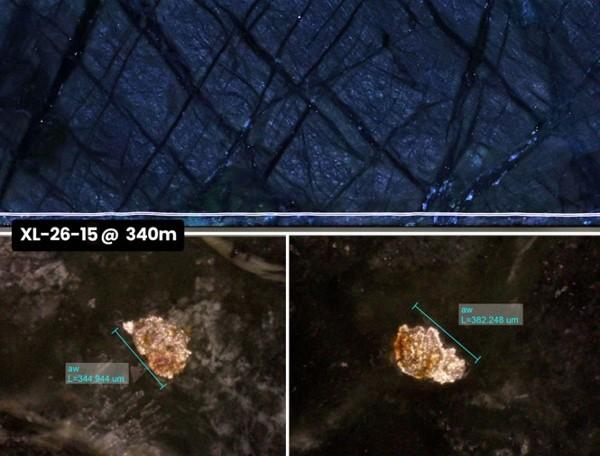
Figure 1. Visible Awaruite Grains up to 382 microns in drill hole XL-26-15 at 340 Meters, Alloy Max North.
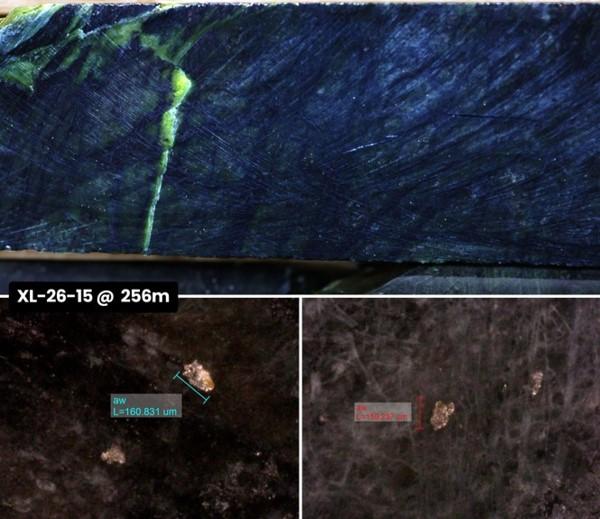
Figure 2. Visible Awaruite Grains up to 160 microns in drill hole XL-26-15 at 256 Meters, Alloy Max North.
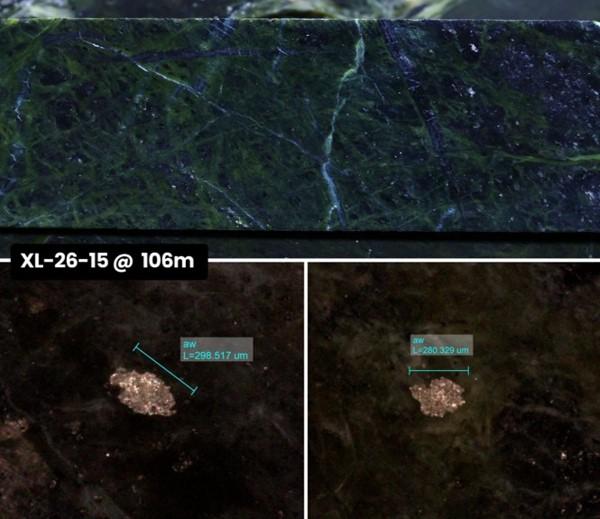
Figure 3. Visible Awaruite Grains up to 298 microns in drill hole XL-26-15 at 106 Meters, Alloy Max North.
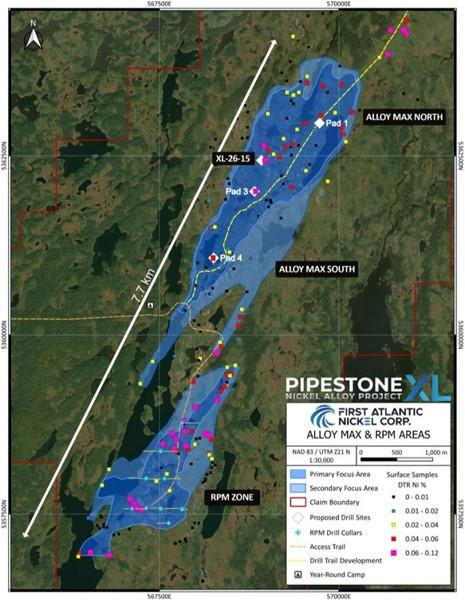
Figure 4. Map of the Alloy Max and RPM Zone areas showing DTR nickel (%) in surface rock samples, including 2026 Alloy Max drill pad locations and the RPM 2025 drill holes.
AWARUITE: A SMELTER-FREE NICKEL-COBALT ALLOY (Ni₃Fe)
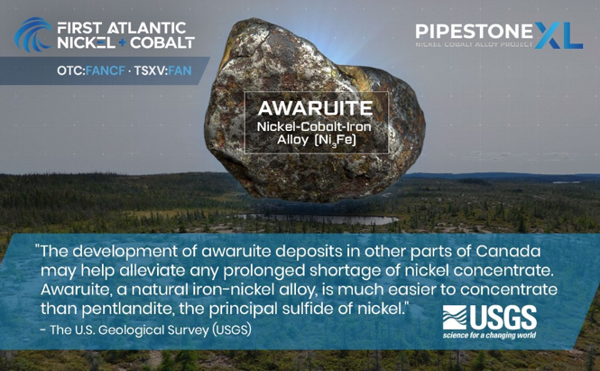
Figure 5: USGS quote on awaruite nickel-iron-cobalt alloy.
Awaruite is a naturally occurring, sulfur-free nickel-iron-cobalt alloy with nickel content of approximately 77%. Because it already exists in a metallic state, awaruite can be processed into a high-grade concentrate of approximately 60% nickel through magnetic separation and flotation, without smelting, roasting, or high-pressure acid leaching. This concentrate can be sent directly for downstream battery chemical refining or for the manufacture of specialty alloys and stainless steel.
As stated in the August 2025 report From Rocks to Power: Strategies to Unlock Canada’s Critical Minerals for Global Leadership in Energy Storage, EVs, & Beyond from the Battery Metals Association of Canada:
“Awaruite is not a sulfide nor an oxide nickel ore but a high-content native nickel-iron ore. Simple beneficiation processes after mining could provide 60% Ni concentrate, ready for leaching for battery cathode purposes and would yield MHP as a by-product. This process would bypass pyrometallurgy or early hydrometallurgy stages and be among the lowest carbon-intensive nickel production sites in the global nickel market.”1
The U.S. Geological Survey highlighted awaruite’s potential in its Mineral Commodity Summaries 2012, stating:
“The development of awaruite deposits in other parts of Canada may help alleviate any prolonged shortage of nickel concentrate. Awaruite, a natural iron-nickel alloy, is much easier to concentrate than pentlandite, the principal sulfide of nickel.”2
The absence of sulfur reduces the risk of acid mine drainage and certain permitting challenges commonly associated with sulfide mineralization, positioning awaruite to supply North American industries including stainless steel, electric vehicles, aerospace, and defence.
Qualified Person
Adrian Smith, P.Geo., a director and the Chief Executive Officer of the Company is a qualified person as defined by NI 43-101. The qualified person is a member in good standing of the Professional Engineers and Geoscientists Newfoundland and Labrador (PEGNL) and is a registered professional geoscientist (P.Geo.). Mr. Smith has reviewed and approved the technical information disclosed herein.
About First Atlantic Nickel & Cobalt Corp.
First Atlantic Nickel & Cobalt Corp. is a critical mineral exploration company in Newfoundland & Labrador developing the Pipestone XL Nickel-Cobalt Alloy Project. The project spans the entire 30-kilometer Pipestone Ophiolite Complex, where multiple zones, including RPM, Alloy Max, Super Gulp, Atlantic Lake, and Chrome Pond, contain awaruite (Ni₃Fe), a naturally occurring magnetic nickel-iron-cobalt alloy of approximately ~77% nickel with no sulfur and no sulfides, along with secondary chromium mineralization. Awaruite’s sulfur-free composition removes acid mine drainage (AMD) risks, while its unique magnetic properties enable processing through magnetic separation, eliminating the electricity requirements, emissions, and environmental impacts of conventional smelting, roasting, or high-pressure acid leaching while reducing dependence on overseas nickel processing infrastructure.
The U.S. Geological Survey recognized awaruite’s strategic importance in its 2012 Annual Report on Nickel, noting that these deposits may help alleviate prolonged nickel concentrate shortages since the natural alloy is much easier to concentrate than typical nickel sulfides. The Pipestone XL Nickel-Cobalt Alloy Project is located near existing infrastructure with year-round road access and proximity to hydroelectric power. These features provide favorable logistics for exploration and future development, strengthening First Atlantic’s role to establish a secure and reliable source of North American nickel production for the stainless steel, electric vehicle, aerospace, and defense industries. This mission gained importance when the U.S. added nickel to its critical minerals list in 2022, recognizing it as a non-fuel mineral essential to economic and national security with a supply chain vulnerable to disruption.
Brutus Mining Inc. (CSE: BRU) (FSE: ZI3) is pleased to announce that it has closed its non-brokered ... READ MORE
Jaguar Uranium Corp. (NYSE American: JAGU) is pleased to announce an independent Mineral Resource E... READ MORE
Auro Metals Inc. (TSX-V: AURO) (OTCQB: AURFF), is pleased to announce the assay results of the fina... READ MORE
Endeavour Silver Corp. (NYSE: EXK) (TSX: EDR) is pleased to announce that repairs to the primary bal... READ MORE
Scorpio Gold Corp. (NASDAQ: SGLD) (TSX-V: SGLD) (OTCQB: SRCRF) (FSE: RY9) is pleased to announce re... READ MORE