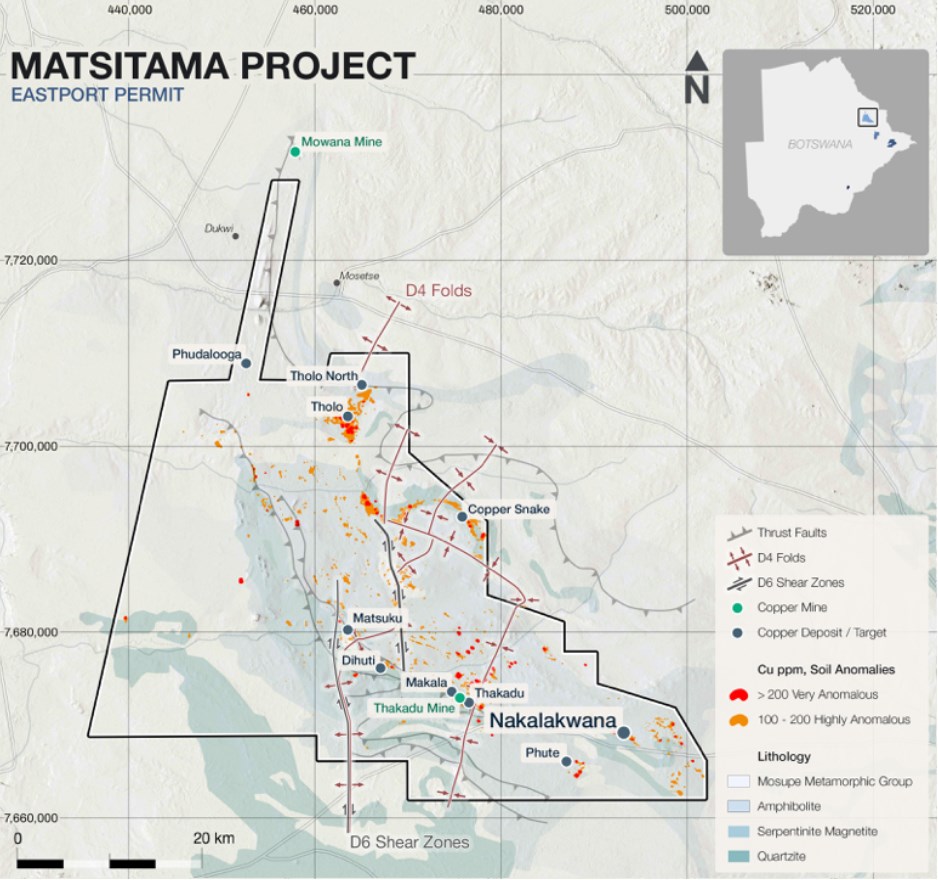







Eastport Critical Metals Corp. (TSX-V: EVI) (OTCQB: EVIIF) is pleased to announce the Company the commencement of a large scale gravity geophysical survey to cover the 30 km trend from Thole to Copper Snake (Figure 1), and the final assay results from Nakalakwana drilling at the Matsitama Copper Project.
Daniel Major, CEO, commented;
“The final assay results at Nakalakwana, have generated key deliverables that include; enabling the company to qualify the existing resource and any future MREs under NI 43-101 compliance, prove thick continuous zones of copper mineraliation with multiple holes of >100m of copper mineralisation and almost 10x the strike length relative to the Nak-Main at ~1.3km in length.
The above represents a footprint of less than 1% of our total license area at Matsitama, this is to say that over an area of less than 1% we have a district scale copper target with an existing resource, grade and considerable exploration potential to scale Nak-Main.
This is exactly why today we are announcing the commencement of the Gravity survey at Thole to Copper Snake. As an explorer we are in the privileged position to have multiple district scale targets throughout the Matsitama project and now we have to use our resources to continue to define this emerging region that we believe holds multiple district scale opportunities.
The 30km zone from Thole to Copper Snake includes some of the highest soil anomalies throughout our licenses. These are associated with major geological structures and evidence of ancient small-scale mining, but the zone remains almost unexplored.”
The Company’s flagship Matsitama Copper Project, located in northeast Botswana, encompasses a contiguous block of six Prospecting Licences covering approximately 1,845 km2, near the village of Matsitama, approximately 85 km west of Francistown.
Historical exploration at Matsitama, including soil sampling programs, has highlighted the widespread occurrence of copper mineralisation across the PLs. Combined with the presence of two adjacent copper mines (one operating, one historical) and the 2013 historical Mineral Resource at Nakalkwana, this supports the Company’s view that further exploration at the Matsitama Copper Project is likely to identify additional mineralised zones.
The NI 43-101 Technical Report on the Matsitama Copper Project, Central District, Botswana, dated March 19, 2025 identifies over 20 copper prospects across the Property, including Nakalakwana Hill, Lepashe Copper Snake (Lepashe, Palamela, Tau) and Tholo and Tholo North.
Gravity Survey
Gravity geophysical surveys are widely used in copper exploration because they detect variations in rock density, which can be associated with copper mineralisation and identify the geological structures that control ore deposition.
Exploration to date at Thakadu and Nakalakwana has identified copper mineralisation associated with dense minerals such as chalcopyrite, bornite, pyrite, pyrrhotite, and magnetite. These mineralised zones are often denser than the surrounding host rocks and can produce gravity anomalies. Copper mineralisation appears to be structurally controlled by localised faulting and folding, with these structures acting as important pathways for copper-bearing hydrothermal fluids. A major density boundary visible in gravity data may indicate a deep fault or crustal structure that helped focus mineralising fluids.
The Thole to Copper Snake zone is defined by high-grade copper soil anomalies extending over 30 kilometres in length, associated with major folds and faults. Historical exploration has been limited to shallow drilling focused on near-surface oxide mineralisation.
A regional gravity survey is proposed for the Thole to Copper Snake zone given the large area of potential, which covers 291 km2. This gravity survey will complement the existing magnetic geophysics survey to help identify the high potential areas. These will be followed by a magnetotelluric survey, which measures natural electrical and magnetic field variations on the Earth’s surface to map subsurface electrical conductivity and resistivity, providing a three-dimensional view to several hundred metres depth and improving exploration targeting. MT surveys are a critical tool for locating deep-seated and concealed copper systems, particularly porphyry, iron oxide-copper-gold, volcanic-associated massive sulphide, and sediment-hosted copper deposits.
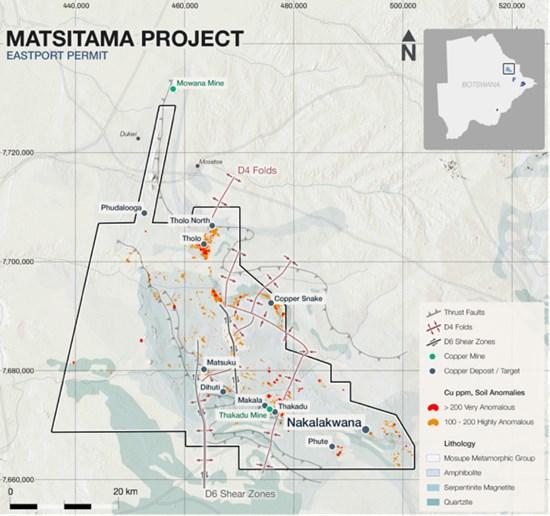
Figure 1: Matsitama Copper Project Licence Area Showing Copper Soil Anomalies and Geological Structures
To view an enhanced version of this graphic, please visit:
https://images.newsfilecorp.com/files/8324/316204_fbc88a5704703b29_001full.jpg
Drill Assay Results
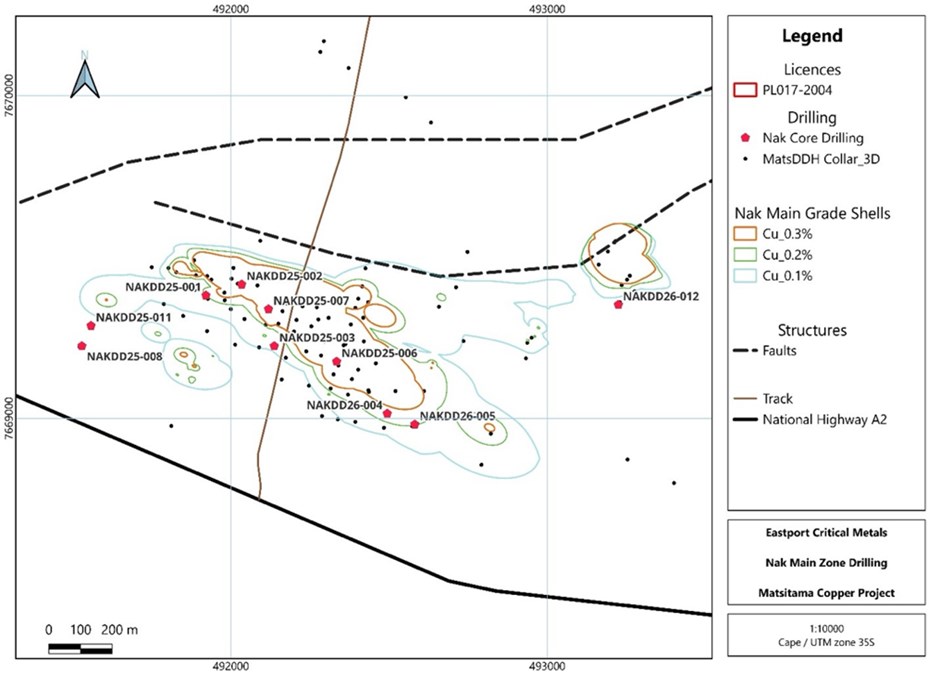
Final assay results have been received from the drilling program completed at Nakalakwana (see Figure 2.0). The results returned are consistent with the previous intersections from Nak-Main, with hole NAKDD25-006 reporting 110.8m at 0.43% copper. Holes NAKDD25-001 and NAKDD26-005 tested the boundaries of the Nakalakwana Deposit. Hole NAKDD26-012 tested a separate geological structure and returned high grades over a intersection with 16.0 m @ 0.52% Cu. As noted above, the Phase 1 exploration program has confirmed widespread, continuous occurrence of copper mineralisation throughout the permits, with drilling at Nak-East and Nak-Main reporting multiple copper intersections exceeding 100m, and structurally controlled copper mineralistion across a strike distances of over 10km – providing clear evidence of a strong correlation between copper mineralisation and the localised structures.
Significant intersections from final the Phase 1 Nak-Main drilling results are provided below.
Drill Hole NAKDD25-006
1 includes 8 overlimit samples capped at 1% Cu and 2.37m unsampled section at 0% Cu (dilution)
Drill Hole NAKDD26-012
2 includes 3 overlimit samples capped at 1% Cu.
Drill Hole NAKDD25-001
Drill Hole NAKDD26-005 has anomalous copper assays from 137.7m with nine samples exceeding 0.15% Cu.
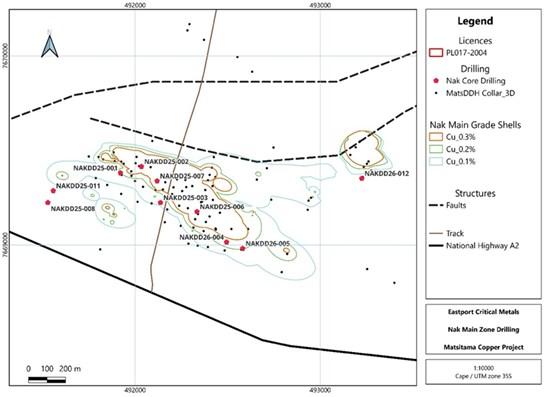
Figure 2 : Nak Main Diamond Drill Holes
To view an enhanced version of this graphic, please visit:
https://images.newsfilecorp.com/files/8324/316204_fbc88a5704703b29_002full.jpg
QA/QC
Eastport staff transport the core trays to the secure core yard at the end of each drilling shift. The core yard is under constant surveillance by 24/7 security personnel. Throughout the core processing workflow, Eastport staff remain solely responsible for handling the core, with the Eastport geological and field technician team performs logging and sampling tasks.
After collection, core will be sent as one metre interval of half core samples are transported to the designated storage area and subsequently dispatched to the ALS Global laboratory in Johannesburg for further preparation and analysis. ALS-Johannesburg is an accredited laboratory in accordance with ISO/IEC 17025 and the South African National Accreditation System (SANAS). ALS Global Johannesburg is independent of the Issuer. Upon completion of the analysis, the ALS pulps are returned to Lobatse or Matsitama to replace the archived sample splits.
ALS-Johannesburg processed the DDH core samples following the standard preparation code PREP-31. The samples were crushed to a size where 70% of the material was less than 2 mm and then underwent riffle splitting to obtain a 250 g representative sample. This split sample was further pulverized to a size where 85% of the material was less than 75 μm.
ALS-Johannesburg performed the analysis, with samples undergoing multi-element analysis as well as a gold fire assay. The gold fire assay uses analytical code Au-GRA21, an Au fire assay and Atomic Absorption Spectroscopy (AAS) finish on a 30 g aliquot.
The multi-element analysis used analytical code ME-ICP61, a four-acid digestion with Inductively Coupled Plasma Atomic Emission Spectroscopy (ICP-AES) finish. A total of 34 elements are reported, including copper, to a detection limit of 1 ppm to 10,000 ppm.
Nakalakwana Historical Mineral Resource
Eastport does not consider the 2013 SRK Consulting (South Africa) Pty Limited mineral resource as current. SRK was contracted by Matsitama Minerals (Pty) Ltd to undertake the update of the Mineral Resources for the Nakalakwana Hill copper deposit on the basis of data from 30 drillholes completed during 2012. Mineral Resources classified as Indicated and Inferred in accordance with the definitions and guidelines of the SAMREC Code 2007 edition were reported from the optimistic pit as shown in Table 2.
Table 1: Historical Mineral Resources for Nakalakwana based on the optimistic pit and a cut-off grade of 3000 ppm, SRK 2013
| Resource Class | Tonnage (Mt) | Copper Grade (ppm) |
| Indicated | 6.8 | 4,800 |
| Inferred | 3.1 | 4,294 |
| Total | 9.9 | 4,640 |
Table Note: Historical Resource stated in compliance with SAMREC 2007
In classifying the Mineral resources for Nakalakwana, SRK reviewed the drillhole data distribution, the consistency in the grade distributions, the QA/QC, the spatial continuity observed in the variograms and the quality of the estimates concomitant with the quantity of composites informing the estimates. SRK considered the relatively well informed areas with drillhole intersections within 50 m spacing and with demonstrated consistency in the grade distribution as Indicated Mineral Resources. The block estimates informed by data spaced more than 50m apart were classified as Inferred Mineral Resources. The classification was consistent with the guidelines and definitions of The SAMREC Code (2007 edition), which has since been superseded.
For Cut-off grade optimisation SRK obtained realistic costs based on the Mowana pit operations from African Copper PLC and applied an escalation factor of 30% to the revenue factors and reduced the mining costs by 30 % for the optimistic scenario for reporting resources. The pit optimisation run based on this scenario indicated a cut-off grade of about 3 000 ppm Cu and a pit shell within which total mineral resources of 9.9 Mt at 4,640 ppm Cu were reported at the 3,000 ppm cut-off grade (Table 2).
The Qualified Person considers the historical estimate to be relevant as an indication of the potential scale and grade of mineralization at Nakalakwana and as a basis for guiding future exploration and resource delineation programs. The estimate was prepared by a reputable independent consulting firm using industry-standard methodologies applicable at the time. However, its reliability is limited by the age of the data (2012 drilling), the relatively wide drill spacing in portions of the deposit, and the absence of verification work by the current QP. In addition, key economic and technical assumptions, including costs, recoveries, and metallurgical performance, have not been independently validated by the Company.
The Indicated and Inferred Mineral Resource categories reported under the SAMREC Code (2007) are broadly comparable to the Indicated and Inferred Mineral Resource categories as defined in the Canadian Institute of Mining, Metallurgy and Petroleum Definition Standards adopted under NI 43-101, in that both classification systems are based on geological confidence and data quality. However, the historical estimate has not been prepared in accordance with CIM Definition Standards, including the explicit requirement to demonstrate reasonable prospects for eventual economic extraction, and therefore should not be relied upon as a current mineral resource.
Significant work is required to verify and upgrade the historical estimate to a current mineral resource compliant with NI 43-101. The Company would need to validate historical data and QA/QC, complete additional drilling, update geological modelling, undertake metallurgical work, and establish economic parameters supporting RPEEE.
The SRK 2013 Mineral Resource estimate is considered to be historical as it was reported in line with the 2007 Edition of the SAMREC Code which has subsequently been superseded by the 2016 Edion of the SAMREC Code. The SAMREC Code (2016) adopted the CRIRSCO (Committee for Mineral Reserves International Reporting Standards) standard definitions, bringing SAMREC 2016 into full alignment with the International Reporting Code Template and as an acceptable foreign code under NI 43-101. The Company intends to complete a CIM-compliant mineral resource estimate incorporating additional drilling and updated technical and economic assumptions. Neither the QP, the Company, nor its consultants have undertaken sufficient work to classify the historical estimate as current, and the Company is not treating the historical estimate as a current mineral resource.
Qualified Person
The technical information in this news release has been reviewed and approved by Nicholas O’Reilly MIMMM (QMR) MAusIMM MSc DIC, an independent consultant and Qualified Person under National Instrument 43-101 – Standards of Disclosure for Mineral Projects.
About Eastport Critical Metals Corp. (TSXV: EVI) (OTCQB: EVIIF)
Eastport is a critical minerals development company advancing five projects in Botswana, with cumulative historical and current expenditures approaching CAD$20 million. The Company’s most advanced asset is the Matsitama Copper Project, which hosts multiple sizeable targets across the Matsitama copper district.
The Company’s additional projects include Selebi East, a nickel-copper-cobalt project located seven kilometres east of the historic Selebi Mines; the Semarule Rare Earth Elements Project, positioned within the Gaborone-Molepolole corridor; the Foley Uranium Project, adjoining the Letlhakane uranium deposit; and the Keng Project, which targets nickel, copper and PGEs on the northern margin of the Molopo Farms Complex.
Botswana is widely regarded as one of Africa’s strongest mining jurisdictions, combining the continent’s highest GDP per capita with a 50-year track record of large-scale mineral development since the Orapa diamond discovery in 1967. The country ranks among the top performers globally on the Fraser Institute’s Investment Attractiveness Index and is the highest-rated jurisdiction in Africa on the Policy Perception Index. These rankings reflect Botswana’s stable regulatory environment, consistent rule of law, and long-standing support for responsible mineral development – factors that have underpinned significant investment and major M&A activity in the natural resources sector in recent years.
On behalf of the Board of Directors
“Daniel Major”
Daniel Major, Chief Executive Officer
Eastport Critical Metals Corp.
For further information about Eastport, please contact:
Daniel Major, Chief Executive Officer
info@eastportcmc.com
New assays support higher grades and substantially greater minera... READ MORE
Antimony Resources Corp. (CSE: ATMY) (OTCQB: ATMYF) (FSE: K8J0) i... READ MORE
Adyton Resources Corporation (TSX-V: ADY) (OTCQB: ADYRF) (FSE: 70... READ MORE
Scottie Resources Corp. (TSX-V: SCOT) (OTCQB: SCTSF) (FSE: SR80)... READ MORE
Silver Pony Resources Corp. (CSE: PONY) (FSE: BJ40) (OTCID: PONIF... READ MORE