








Canamera Energy Metals Corp. (CSE: EMET) (OTCQB: EMETF) (FSE: 4LF0) announced assay results from auger drill hole TUV-AUG-0043 at the Turvolândia Ionic Clay Rare Earth Project in Minas Gerais, Brazil. The hole was drilled in a previously untested area of the Project, situated 3.3 kilometres north of the Marita target and 3.7 kilometres northwest of the Cordis target, and returned rare earth mineralisation from surface through 14 metres of depth, with the hole terminating in mineralised material and remaining open at depth.
Highlights
“The Linda result provides promising new data for evaluating Turvolândia,” commented Brad Brodeur, Chief Executive Officer of Canamera Energy Metals Corp. “We drilled a 14M auger hole into a completely untested area and hit REE mineralisation from the first metre to the bottom of the hole, averaging over 2,200 ppm TREO and a healthy Magnetic REO + heavy REE Yttrium averaging 664.7 PPM — with grades still increasing at the full 14 metres depth and the hole still open. That is the kind of result that may be indicative of a broader mineralized system. Turvolândia now has three geophysically coherent targets defining a corridor, with substantial unexplored ground between them. We are moving quickly to evaluate that ground.”
About Hole TUV-AUG-0043 and the Linda Target
Hole TUV-AUG-0043 was designed as an initial reconnaissance test of a largely unexplored portion of the Project. Prior to this hole, no systematic exploration had been conducted in the northern sector of the property. The Cordis and Marita targets represent the Company’s two principal previously drilled REE exploration targets at the Project, each characterised by broad, near-surface ionic clay rare earth mineralisation extending from surface to end of hole. TUV-AUG-0043 was drilled approximately 3.3 kilometres north of Marita and 3.7 kilometres northwest of Cordis, in an area with no prior systematic exploration.
Previous drilling at the Cordis and Marita targets has confirmed broad ionic clay rare earth mineralisation at Turvolândia. As announced in the Company’s news release dated March 11, 2026, hole TUV-AUG-0007 at Cordis intersected 2 metres (14-16 m) grading 3,823 ppm TREO and 1,851 ppm MREO + Y, including a best 1 metre (15-16 m) grading 5,341 ppm TREO and 2,790 ppm MREO + Y, terminating in mineralisation, while hole TUV-AUG-0014 at Cordis intersected 13 metres grading 3,255 ppm TREO and 1,332 ppm MREO + Y from surface to end of hole. At Marita, hole TUV-AUG-0018 returned 2 metres grading 1,368 ppm TREO and 534 ppm MREO + Y, also terminating in mineralisation.
The Linda target, defined by the results from TUV-AUG-0043 and supported by regional airborne geophysical data, is situated northwest of the Cordis target and north of the Marita target. Together, the three targets form a broadly distributed exploration framework across the Turvolândia Project, with approximately 2.7 kilometres separating the Cordis and Marita targets and meaningful untested ground between all three areas.
Preliminary interpretation of the regional airborne geophysical survey indicates that the Linda target exhibits radiometric characteristics, including potassium channel responses and enhanced ternary radiometric products, comparable to those observed at the Cordis and Marita targets. While these geophysical similarities do not necessarily indicate equivalent mineralisation, they provide an important exploration vector and support the potential for additional ionic clay-hosted rare earth systems elsewhere within the broader Cordis-Marita-Linda target area.
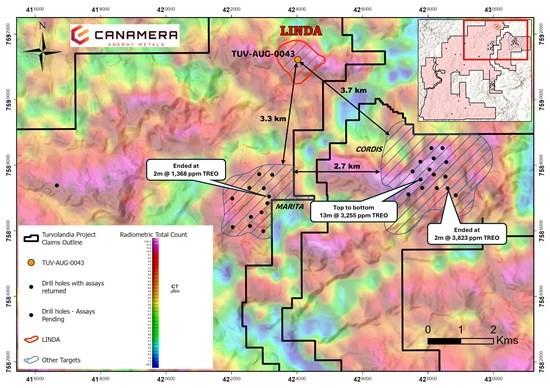
Figure 1: Location map, with Enhanced Total Count Airborne Radiometric Image
Assay Results
Hole TUV-AUG-0043 was drilled vertically to a total depth of 14.0 metres. Three lithological units were encountered: a surface Soil horizon (0-1 m), a Clay Pedolith (1-10 m), and a Mottled Zone (10-14 m). The hole terminated in the Mottled Zone; the base of the weathered profile was not reached.
Rare earth grades increase systematically from surface through the upper Clay Pedolith, with a pronounced step-up at the transition to the deeper Clay Pedolith and Mottled Zone, where values range from 2,545 to 2,958 ppm TREO. Full assay results for TUV-AUG-0043 are presented in Table 1 below.
Table 1: Assay Results – TUV-AUG-0043
| From (m) |
To (m) |
Lithology | TREO (ppm) |
MREO + Y (ppm) |
Nd2O3 + Pr6O₁₁ (ppm) |
Dy₂O₃ + Tb₄O₇ (ppm) |
HREO (ppm) |
Ga (ppm) |
| 0 | 1 | Soil | 1,134.9 | 223.1 | 180.8 | 9.0 | 62.8 | 36.3 |
| 1 | 2 | Clay Pedolith | 914.8 | 175.5 | 143.8 | 6.6 | 47.1 | 32.3 |
| 2 | 3 | Clay Pedolith | 1,191.0 | 269.4 | 222.5 | 10.0 | 70.2 | 33.1 |
| 3 | 4 | Clay Pedolith | 1,573.0 | 436.5 | 369.3 | 14.0 | 100.2 | 33.7 |
| 4 | 5 | Clay Pedolith | 1,991.8 | 594.9 | 510.7 | 17.5 | 126.0 | 33.3 |
| 5 | 6 | Clay Pedolith | 1,994.3 | 602.6 | 517.6 | 17.1 | 128.1 | 32.1 |
| 6 | 7 | Clay Pedolith | 2,958.2 | 892.5 | 779.3 | 25.3 | 176.9 | – |
| 7 | 8 | Clay Pedolith | 2,575.3 | 827.6 | 715.1 | 23.6 | 172.0 | – |
| 8 | 9 | Clay Pedolith | 2,954.5 | 982.9 | 843.3 | 29.0 | 217.9 | – |
| 9 | 10 | Clay Pedolith | 2,545.6 | 833.5 | 717.1 | 23.9 | 178.7 | – |
| 10 | 11 | Mottled Zone | 2,629.5 | 846.8 | 709.6 | 28.1 | 211.3 | – |
| 11 | 12 | Mottled Zone | 2,749.7 | 860.8 | 688.0 | 34.0 | 260.0 | – |
| 12 | 13 | Mottled Zone | 2,754.3 | 832.1 | 635.0 | 38.3 | 289.4 | – |
| 13 | 14 | Mottled Zone | 2,953.9 | 927.8 | 607.1 | 59.6 | 451.3 | – |
| 0 | 14 | Average | 2,208.6 | 664.7 | 545.7 | 24.0 | 178.0 | – |
| 0 | 6 | Average (Ga) | 1,633.3 | 383.7 | 327.5 | 11.2 | 89.2 | 33.5 |
Notes:
Ga: not detected below 6 metres depth. — denotes below detection limit or not reported.
All values expressed as rare earth oxide equivalents. Conversion factors: JCU Advanced Analytical Centre.
TREO = CeO2 + Dy2O3 + Er2O3 + Eu2O3 + Gd2O3 + Ho2O3 + La2O3 + Lu2O3 + Nd2O3 + Pr6O11 + Sm2O3 + Tb4O7 + Tm2O3 + Y2O3 + Yb2O3
MREO = Dy2O3 + Nd2O3 + Pr6O11 + Tb4O7 + Y2O3
HREO = Dy2O3 + Er2O3 + Eu2O3 + Gd2O3 + Ho2O3 + Lu2O3 + Tb4O7 + Tm2O3 + Y2O3 + Yb2O3
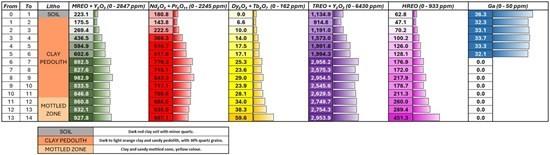
Figure 2 – Hole TUV-AUG-0043 strip log
Favourable Weathering Profile
The Chemical Index of Alteration (“CIA”) is widely used as a proxy for weathering intensity and clay mineral development in ionic adsorption rare earth systems. CIA is defined as Al2O3 / (Al2O3 + CaO + Na2O + K2O) × 100. All 14 samples from TUV-AUG-0043 returned CIA values exceeding 70%, with an average CIA of approximately 83%.
Such values indicate highly developed clay-rich horizons formed under advanced tropical weathering conditions. Advanced weathering is considered a key characteristic of ionic clay rare earth deposits globally, as it creates the clay mineral surface area required to adsorb and concentrate rare earth elements. These results support the prospectivity of the Turvolândia Project for ionic adsorption clay-hosted REE mineralisation.
Next Steps
The Company is currently evaluating follow-up exploration programs to test the continuity of mineralisation between the Cordis, Marita, and Linda targets, as well as the depth extent of the weathered profile at TUV-AUG-0043 and across the Linda area. Future programs may include additional auger drilling to characterise the lateral extent of the Linda target and deeper diamond or RC drilling to evaluate the vertical extent of the weathered profile and potential for grade enhancement below the current drill depth.
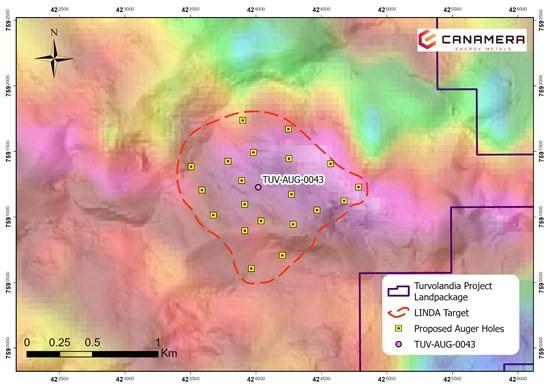
Figure 3: Proposed Follow-Up Drilling at Linda
There can be no assurance that future exploration programs will define economically recoverable mineral resources.
Assay Methodology and QA/QC
Auger drill samples were analyzed by SGS Geosol (ISO 9001, 14001 and 17025 certified), Belo Horizonte, Brazil, using lithium metaborate (LiBO₂) fusion followed by inductively coupled plasma optical emission spectrometry and mass spectrometry (ICP-OES/MS) for 49-element analysis, including all rare earth elements. The QA/QC program includes the regular insertion of certified reference materials (CRMs), blank standards and field duplicates. Elemental values were converted to rare earth oxide equivalents using standard conversion factors.
The scientific and technical information in this news release has been reviewed and approved by Warren Robb, P.Geo. (British Columbia), VP Exploration of Canamera Energy Metals Corp. and a “Qualified Person” as defined by National Instrument 43-101 (“NI 43-101”). Mr. Robb is not independent of the Company within the meaning of NI 43-101.
For a further discussion of the Company’s QA/QC procedures and processes, please see its most recently-filed technical report, a copy of which may be obtained at www.sedarplus.ca.
About Canamera Energy Metals Corp.
Canamera Energy Metals Corp. is a rare earth elements exploration and development company with an expanding project portfolio across Brazil, the United States, and Canada. The Company is focused on advancing ionic clay REE projects in Brazil and critical mineral assets in North America to support Western rare earth supply chain independence.
Brutus Mining Inc. (CSE: BRU) (FSE: ZI3) is pleased to announce that it has closed its non-brokered ... READ MORE
Jaguar Uranium Corp. (NYSE American: JAGU) is pleased to announce an independent Mineral Resource E... READ MORE
Auro Metals Inc. (TSX-V: AURO) (OTCQB: AURFF), is pleased to announce the assay results of the fina... READ MORE
Endeavour Silver Corp. (NYSE: EXK) (TSX: EDR) is pleased to announce that repairs to the primary bal... READ MORE
Scorpio Gold Corp. (NASDAQ: SGLD) (TSX-V: SGLD) (OTCQB: SRCRF) (FSE: RY9) is pleased to announce re... READ MORE