








BP Silver Corp. (TSX-V: BPAG) (OTCQB: BPSCF) announces new assay results from its Phase 2 diamond drilling program at the Cosuño Silver Project, in Bolivia, highlighting a significant new emerging polymetallic discovery at the Jalsuri North Target, where drilling has intersected broad intervals of zinc +/- silver mineralization.
HIGHLIGHTS
Dr. Stewart D. Redwood, Director and Qualifying Person, stated: “The Bolivian Silver-Polymetallic Belt stands out compared to other silver belts globally because the Bolivian deposits contain a diverse array of precious metals and base metals, as well as strategic and critical elements, in addition to silver. These metals have the potential to provide valuable credits as by-products, leading to potentially higher NSRs, IRRs and NPVs. We are increasingly bullish on Cosuño given the discovery of high-grade bismuth, antimony, and now zinc to complement the high-grade silver. There are also significant grades of copper, gold, indium, lead and tin in some holes. The vertical and horizontal distribution of these metals will also give us valuable geological information about the zoning of the mineral deposit as we gather more data. During a recent site visit, I reviewed the core and was very pleased with what I observed. The number of metals identified to date, together with the grades encountered, makes Cosuño a unique system—something I have not seen before.”
SUMMARY
Assay results have been received for three additional drill holes of the Phase 2 Drill Program: Drill-hole CO-0015 was completed at the Jalsuri North Target, while drill-holes CO-0011 and CO-0014 were completed at the Pocañita Chica Target (Figure 1, Table 1).
Polymetallic mineralization encountered by the Phase 1 and 2 drill programs was previously reported in the Company’s news releases dated February 2, 2026, February 27, 2026, and September 29, 2026.
Drill hole CO-0015 intersected a 142 m interval of zinc-dominated mineralization at Jalsuri North, accompanied by additional metals, highlighting the polymetallic nature of this emerging discovery.
It is interpreted as the upper or distal levels of intermediate-sulfidation epithermal mineralized system occurring beneath the large, Cosuño lithocap, suggesting the potential for a large mineralized system at depth (Figure 2 and 3). Mineralization is hosted by andesite lavas forming the base of the volcanic sequence and by underlying conglomerates of the Upper Oligocene to Lower Miocene aged San Vicente Formation (host to Pan American Silver’s San Vicente Mine).
Mineralization is controlled by a northwest-trending structure and occurs as breccia-hosted mineralization, veinlets, fillings within vesicles in the lavas, disseminations, replacement mineralization and within the conglomerate matrix (Figure 5A). Alteration includes silicification and chlorite-calcite alteration in the volcanic rocks, while the conglomerates exhibit clay or illite alteration associated with bleaching. The mineral assemblage consists primarily of sphalerite and pyrite, with minor chalcopyrite and galena, associated with quartz, calcite, barite and white clay minerals (smectite and/or dickite).
Tim Shearcroft, Founder and CEO, stated: “This discovery hole, featuring 59 meters grading 3.72% zinc equivalent, along with six additional elements, including silver and gold, is extremely encouraging. Cosuño continues to impress me, and these results reinforce our confidence in the project’s significant potential.”
Jalsuri North Target
The most significant result came from drill hole CO-0015, which intersected 142 m @ 1.42% zinc (2.14% zinc equivalent) from 5.0 to 147.0 m, including 59 m @ 2.57% zinc (3.72% zinc equivalent) from 5 to 64 m (Figure 2). Within this interval, a higher-grade zone of 22 m @ 5.18% zinc (7.75% zinc equivalent) was intersected from 19 to 41 m (Table 2 and Figure 2).
The hole also returned significant silver mineralization, including 2.0 m @ 249.0 g/t silver (495.4 g/t silver equivalent) from 35.0 to 37.0 m. A further interval of 2.0 m @ 132.0 g/t silver (189.0 g/t silver equivalent) was intersected from 107.0 to 109.0 m (Table 1).
Additional assay results from CO-0015 included zinc grades of up to 15.2% over 1 m, copper grades exceeding 1.0% (over-limit re-assay results pending), silver grades of up to 288 g/t, and gold grades of up to 1.42 g/t. The hole also returned bismuth values of up to 288 ppm, antimony values of up to 1,265 ppm, and lead values of up to 8,960 ppm, highlighting the polymetallic nature of the mineralization.
Interpretation
Drill hole CO-0015 intersected structurally controlled intermediate sulfidation hydrothermal alteration and mineralization (veinlet and disseminated) developed across multiple lithological units (Figure 2 and 3).
The distribution of alteration, veinlets, and sulfides is consistent with structurally focused hydrothermal fluid flow affecting multiple host rocks. The dashed red envelope outlines the interpreted veinlet zone within the underlying volcano-sedimentary and volcaniclastic sequences, where veinlet development appears more dispersed and less continuous than in the upper andesite (Figure 2). The zone remains open laterally and at depth, although its extent and continuity are unconfirmed.
The projected geometry, lateral extent, and continuity of the structures and veinlet zone remain unconfirmed. The dashed red envelope is conceptual only and does not define a confirmed geological contact, assay-defined mineralized volume, or continuous mineralized interval. The Company cautions that additional drilling is required to test the interpretation.
Pocañita Chica Target
Drill holes CO-0011 and CO-0014 tested the mapped hydrothermal breccia corridor at Pocañita Chica (Figure 1). Both holes intersected anomalous but sub-economic silver mineralization (Table 1).
The results suggest that the holes may have intersected narrow feeder-related structures or mineralized splays within the broader Pocañita Chica hydrothermal breccia system, where thicker, higher-grade silver mineralization was intersected during Phase 1 and the current Phase 2 drill program in holes CO-0008, CO-0009 and CO-0013 (see news releases dated February 27, 2026 and September 29, 2026, respectively).
Vein and feeder structures are not uniformly mineralized, and intervals of low-grade or barren material can occur along their length. Accordingly, intersecting a feeder-related structure is an important step in understanding the hydrothermal system, but does not necessarily indicate continuous or economically significant mineralization. Further geological interpretation and drilling will be required to determine the continuity, geometry and significance of these structures and to identify zones of potentially higher-grade silver mineralization within the broader system.
| Hole No | From m | To m | Interval m | Ag g/t | Au g/t | Bi % | Cu % | Pb % | Zn % | Sb % | AgEq g/t | ||||||||||||||
| CO-0011 | 81.5 | 106.5 | 25 | 18.32 | 0.01 | 0.0069 | 0.0042 | 0.0029 | 0.0390 | 0.0062 | 23.17 | ||||||||||||||
| CO-0014 | 74 | 79 | 5 | 14.19 | 0.01 | 0.0050 | 0.0023 | 0.0203 | 0.0023 | 0.0033 | 16.71 | ||||||||||||||
| CO-0015 | 28 | 45 | 17 | 38.95 | 0.23 | 0.0109 | 0.3109 | 0.0492 | 4.9187 | 0.0163 | 192.95 | ||||||||||||||
| Inc | 35 | 37 | 2 | 249.00 | 0.86 | 0.0800 | 0.7770 | 0.1117 | 3.4550 | 0.0983 | 495.40 | ||||||||||||||
| And | 107 | 109 | 2 | 131.95 | 0. | .0577 | 0.1788 | 0.0257 | 0.6585 | 0.0372 | 188.99 |
Table 1. Silver-dominated intersections with associated gold (Au), bismuth (Bi), copper (Cu), lead (Pb), zinc (Zn), antimony (Sb); and silver equivalent (AgEq).
| Hole No | From m | To m | Interval m | Ag g/t | Au g/t | Bi % | Cu % | Pb % | Zn % | Sb % | ZnEq % |
| CO-0015 | 5 | 147 | 142 | 8.89 | 0.04 | 0.0025 | 0.0567 | 0.0722 | 1.4180 | 0.0033 | 2.1392 |
| Inc | 5 | 64 | 59 | 12.25 | 0.07 | 0.0033 | 0.0556 | 0.1485 | 2.5739 | 0.0056 | 3.7191 |
| Inc | 19 | 41 | 22 | 27.75 | 0.16 | 0.0077 | 0.0737 | 0.3251 | 5.1824 | 0.0123 | 7.7519 |
| Inc | 83 | 100 | 17 | 1.74 | 0.01 | 0.0001 | 0.0587 | 0.0041 | 1.5372 | 0.0003 | 1.5602 |
| inc | 87 | 94 | 7 | 1.89 | 0.02 | 0.0002 | 0.0177 | 0.0061 | 3.0079 | 0.0003 | 2.8906 |
| Inc | 106 | 122 | 16 | 21.60 | 0.03 | 0.0081 | 0.0253 | 0.0422 | 0.4914 | 0.0054 | 1.7529 |
Table 2. Zinc-dominated intersections with associated silver (Ag), gold (Au), bismuth (Bi), copper (Cu), lead (Pb), antimony (Sb); and zinc equivalent (ZnEq).
Notes to Table 1:
(1) Silver equivalent and zinc equivalent grades were calculated using 2025 average metal prices reported by the U.S. Geological Survey: US$38.00 per ounce for silver (Ag), US$1.30 per pound for zinc (Zn), US$3,300 per ounce for gold (Au), US$4.80 per pound for copper (Cu), US$20.00 per pound for bismuth (Bi), US$1.06 per pound for lead (Pb), and US$25.00 per pound for antimony (Sb).
(2) Recoveries of 90% have been assumed for all metals for illustrative exploration purposes. The Cosuño Project is at an early exploration stage, and no metallurgical test work has been completed to establish metal recoveries. Metal-equivalent calculations are used solely as an exploration tool to assist in evaluating and reporting drill intercepts. They do not represent an estimate of recoverable metal content; net smelter returns or economic value.
(3) Reported intervals represent core lengths. True widths have not yet been determined.
(4) Silver intersections were calculated using a cutoff grade of 10 g/t silver, with sub-intervals reported at 30, 60 and 90 g/t silver. Reported intervals may include internal dilution.
(5) Intersections calculated at cutoff grades of 0.10% zinc with sub-intervals at 0.50% and 1.00% zinc. The intervals may include some internal dilution.
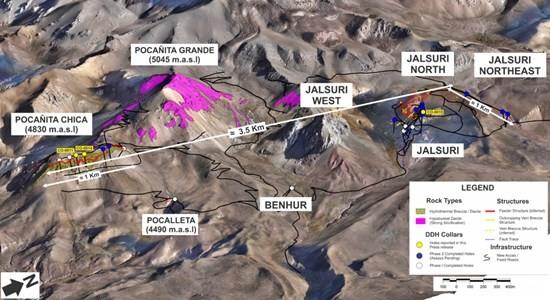
Figure 1. Cosuño Project 3D Plan View Map Showing Drill Collars.
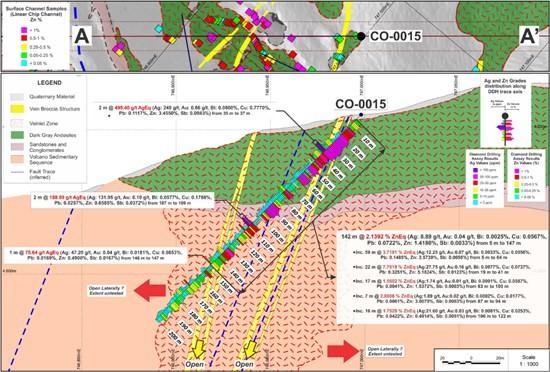
Figure 2. Cross-Section of Drill Hole CO-0015.
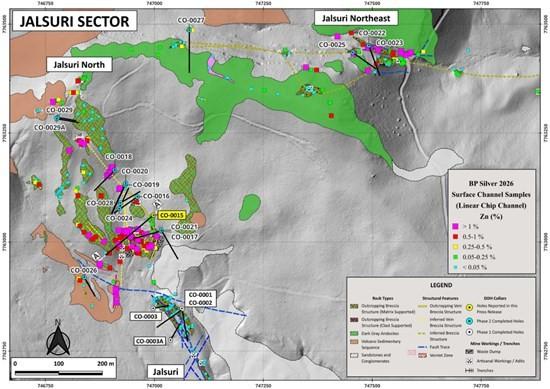
Figure 3. Jalsuri North Plan Map Showing Cross-Section Lines.
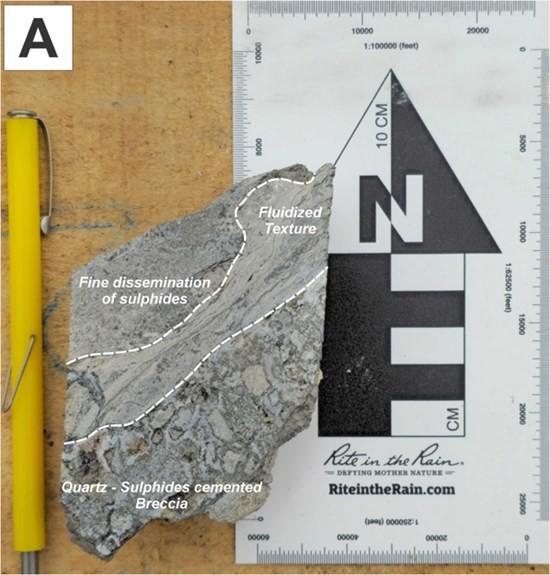
Figure 4A: Strongly silicified Fault Vein Breccia structure exhibiting fluidized textures and locally developed matrix-supported breccia, with sulphides cemented the matrix, Hole CO-0015 from 30 to 31 m, 1 m @ 15.70% zinc equivalent (silver: 13.15 g/t, gold: 0.06 g/t, copper: 0.294%, zinc: 15.2%).
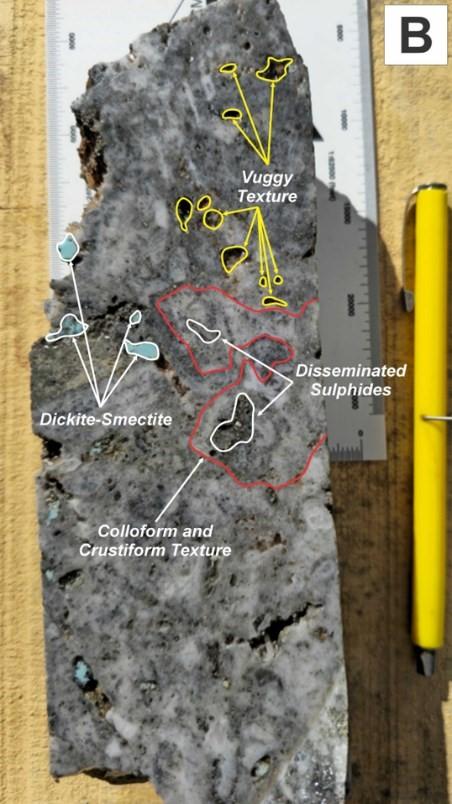
Figure 4B: Strongly silicified structure with open spaces filled by sulphides (honey-coloured sphalerite, silver sulphosalts, and chalcopyrite) and dickite–smectite alteration minerals, exhibiting an incipient vuggy texture, Hole CO-0015 from 35 to 36 m, 1 m @ 620.10 g/t silver equivalent (silver: 288 g/t, gold: 1.42 g/t, copper: > 1%, lead: 0.14%, zinc: 3.93%, antimony: 0.1265%).
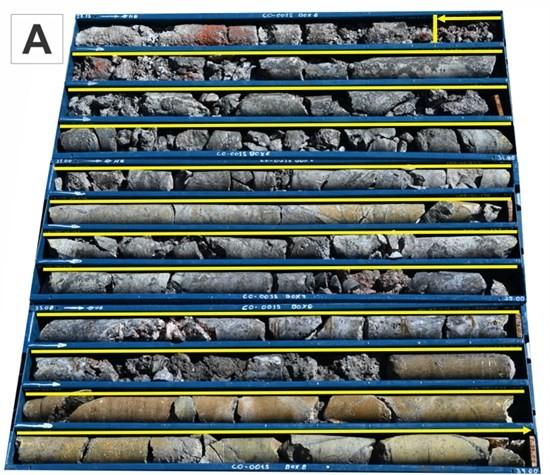
Figure 5A: Hole CO-0015 from 28 to 39 m, 1 m @ 259.90 g/t silver equivalent (silver: 51.43 g/t, gold: 0.29 g/t, bismuth: 0.0150%, copper: 0.3483%, lead: 0.0607%, zinc: 7.011%, antimony: 0.0213%) strongly silicified, fault vein breccia structure hosted in dark greenish andesites, with locally developed sulphide veinlets, disseminated sulphides, and sulphides cementing silicified fragments. Fluidized textures and matrix-supported breccias with sulphides in the matrix are locally developed.
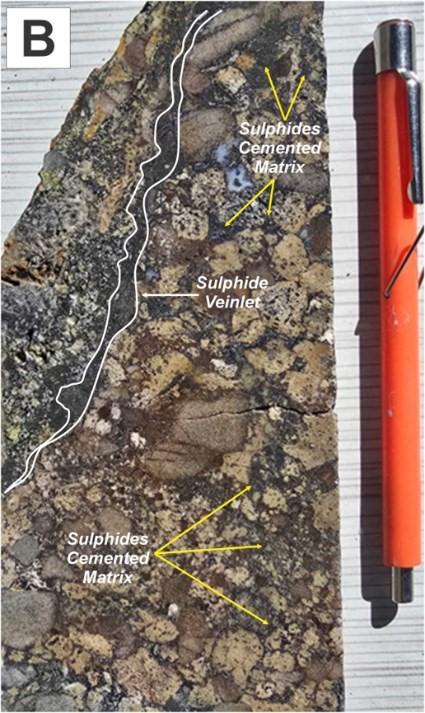
Figure 5B: Hole CO-0015 from 89 to 90 m @ 6.70% zinc equivalent (silver: 3.31 g/t, gold: 0.05 g/t, zinc: 7.10%) conglomerate unit with strong silicified alteration, sulphides cemented matrix, with development of narrow sulphide veinlets.
Qualified Person
The technical information contained in this news release has been reviewed and approved by Dr. Stewart D. Redwood, PhD, FIMMM, a Director of the Company and a Qualified Person as defined under National Instrument 43-101 – Standards of Disclosure for Mineral Projects. As Dr. Redwood is a director of the Company, he is not independent under National Instrument 43-101.
QA/QC
The work program was designed and supervised by Gonzalo Lemuz, P.Geo, the Company’s Chief Operating Officer, who was responsible for all aspects of the work, including the Quality Assurance and Quality Control (QAQC) program. On-site personnel at the Project rigorously collect and track samples which are then security sealed and shipped to ALS laboratory in Oruro for sample preparation. The core samples were prepared by ALS at their laboratory in Oruro, Bolivia and the sample pulps were shipped to their laboratory in El Callao, Peru for analysis. ALS is accredited to ISO/IEC 17025:2017 and ISO9001:2015. ALS is independent of BP Silver. Silver and multi-elements were analysed by aqua regia digestion and ICP-MS finish. Gold was analysed by fire assay and AA finish. BPAG inserted certified standard reference materials (CSRM), blanks and duplicates to monitor QAQC. All diamond drill holes were drilled in HQ-diameter core. The average core recovery was 95% for CO-0012 and 97% for CO-0013.
About BP Silver Corp.
BP Silver Corp. is a Canadian exploration company focused on advancing high-grade silver projects in Bolivia. The Company’s flagship asset, the Cosuño Project, is strategically located in the prolific Bolivian silver belt, a region with a rich mining history and significant untapped discovery potential. With a strong technical team and a disciplined exploration strategy, BP Silver is positioned to unlock value for its shareholders through the discovery and development of major silver deposits.
K2 Gold Corporation (TSX-V: KTO) (OTCQX: KTGDF) (FSE: 23K) announ... READ MORE
Labrador Gold Corp. (TSX-V: LAB) (FNR: 2N6) is pleased to announce the c... READ MORE
White Gold Corp. (TSX-V: WGO) (OTCQX: WHGOF) (FSE: 29W) is please... READ MORE
New results across Mirado West, North and South accompany expande... READ MORE