







Highlights
Samples from the Company’s current 2026 drilling program are being assayed at the SGS laboratory in Mwanza, Tanzania, with results to be reported following receipt, review and completion of the Company’s QA/QC procedures.
Avanti Gold Corp. (CSE: AGC) (FSE: X370) (OTCQB: AVTGF) is pleased to report assay results from eight historical diamond drill holes totaling 1,310.26 meters at the Akyanga Deposit on the Misisi Project in the Democratic Republic of the Congo. The previously unsampled historical core was re-logged, sampled and submitted for analysis as part of the Company’s ongoing review of the Akyanga geological database. The results include several near-surface and higher-grade mineralized intervals that provide additional support for the interpreted continuity of multiple stacked mineralized structures within the Akyanga Deposit, particularly toward its southern portion.
The results include several near-surface and higher-grade mineralized intervals that support the current geological interpretation, dipping towards the southern portion of the deposit across multiple parallel veins.
Notable results from the historical drilling include (See Table 1 full best intercepts):
The eight historical holes are located within the southern strike extension of the Akyanga mineralized system and were not previously supported by assay data. The results provide additional information between previously reported drill holes and support the current interpretation of multiple stacked mineralized structures. The holes do not test the principal areas targeted by the current 2026 drilling program; rather, they add geological and grade information along the southern strike extension that will be evaluated as part of future geological modelling and drill targeting
Mohamed Cisse, Chief Executive Officer of Avanti commented: “The completion of sampling and assaying of this previously unsampled historical core has added useful geological and grade information to the Akyanga dataset. The results include several meaningful near-surface and higher-grade intervals and provide additional support for our interpretation of multiple stacked mineralized structures. The results will be incorporated into our geological modelling and future drill targeting as we continue to advance the 2026 exploration program across the Misisi Project.”
QUALITY CONTROL AND QUALITY ASSURANCE
Drill cores for assaying were taken at a maximum of one-metre intervals and were cut with a diamond saw, with one-half of the core placed in sealed bags by Company geologists and sent to the SGS Laboratory in Mwanza, Tanzania (independent of the Company). The core samples were then crushed down to 80% passing minus 2 mm and split with one half of the sample up to 1.5 kg pulverized down to 90% passing 75 microns. Gold analyses were carried out on 50g aliquots by fire assay. In addition, check assays were also carried out by the screen fire assay method to verify high-grade sample assays obtained initially by fire assay. As part of the Company’s QA/QC procedures, internationally recognized standards, blanks and duplicates were inserted into the sample batches prior to submitting to SGS Laboratory.
ABOUT THE AKYANGA DEPOSIT
The Misisi Project site is located in the Fizi territory of South Kivu province, in the DRC, approximately 250 kilometers south of Bukavu and 180 kilometers north of Kalemie. The Akyanga Deposit, located centrally in the Misisi Project, hosts an NI 43-101 compliant Inferred Mineral Resource of 40.8 million tonnes averaging 2.37 g/t gold containing 3.11 million ounces which was based on 19,956m of historic drilling, including 105 diamond drillholes totalling 19,070 meters and six reverse circulation drillholes totalling 887 meters. The Akyanga resource is determined from surface to a vertical depth of 350 meters over a strike length of 2,100 metres, using a US$1,500/oz pit shell. The mineralisation remains open at depth and along strike. Mineral Resources that are not Mineral Reserves do not have demonstrated economic viability. The assay results reported herein are not included in the current Mineral Resource Estimate.
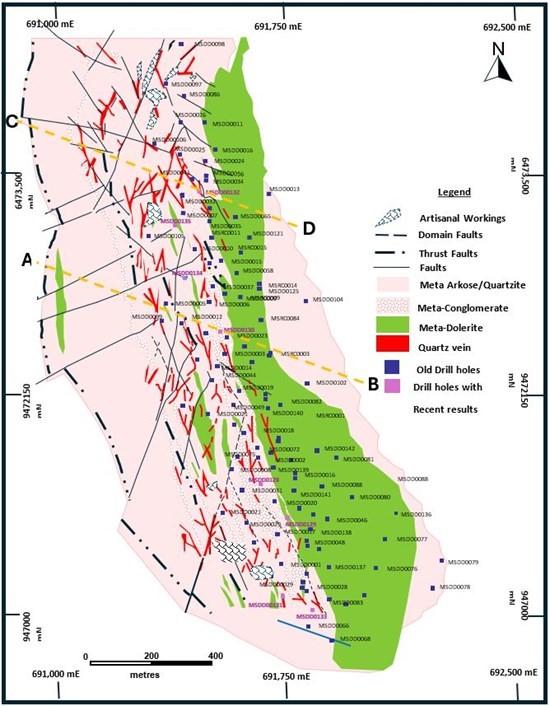
Figure 1: Akyanga Deposit Plan View with New Historical Drill hole locations
As shown in Figure 1 above, eight diamond drill holes totalling 1,310.26 meters (MSDD0128 to MSDD0135) produced 1284 samples which have now been successfully assayed by the SGS Analytical Laboratory in Mwanza, Tanzania. As shown in Table 1 below, the assayed samples demonstrate the strong continuity of near-surface, high-grade gold mineralisation towards the southern portions of the Akyanga deposit, proving the potential for a significant resource expansion at the Misisi Project.
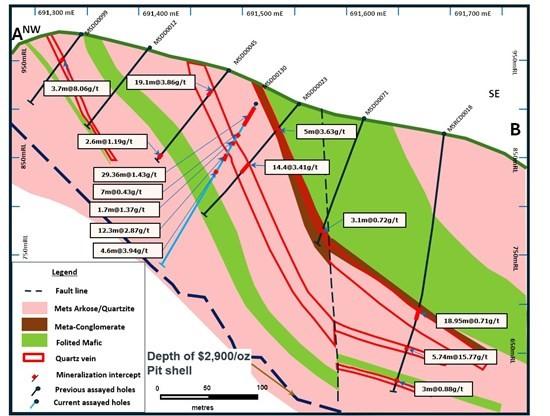
Figure 2: Cross section through hole MSDD0130
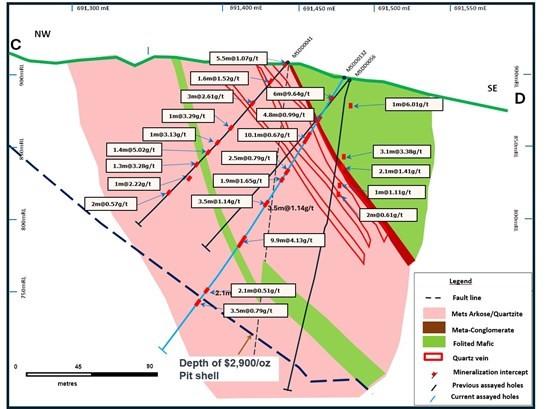
Figure 3: Cross section through hole MSDD0132
Figures 2 and 3 above, show the cross sections through holes MSDD0130 and MSSDD0132 with stacked mineralised domains of 29.36 meters at 1.43 g/t Au from 0 meters, 12.3 meters at 2.87 g/t Au (incl. 0.6m @ 17.59 g/t from 60m and 0.5m @ 37.53 g/t from 67m) from 55.2 meters, and 4.6 meters at 3.94 g/t Au from 74.59 meters for hole MSDD0130, and stacked mineralised zones of 1.6 meters at 9.64 g/t Au from 17.4 meters, 4.8 meters at 0.99 g/t Au from 33.8 meters, 10.1 meters at 0.67 g/t Au from 48 meters, 9.9 meters at 4.13 g/t Au from 133.6 meters for hole MSDD032.
Table 1: Significant intercepts1
| Hole ID | Drill | Collar Location | Azimuth | Incl | From | To | Intercept | Grade | Comments | ||
| Type | m E | m N | m E | degrees | (meters) | (g/t Au) | |||||
| MSDD0128 | DD | 691675 | 9472446 | 851 | 290 | 60 | 73.4 | 74.7 | 1.3 | 2.28 | |
| MSDD0128 | 82 | 83 | 1 | 1.7 | |||||||
| MSDD0128 | 89 | 92 | 3 | 0.46 | |||||||
| MSDD0128 | 120.9 | 128.5 | 7.6 | 0.54 | |||||||
| MSDD0128 | 153.5 | 154.5 | 1 | 2.78 | |||||||
| MSDD0129 | DD | 691755 | 9472333 | 846 | 290 | 60 | 20.3 | 24.2 | 3.9 | 1.54 | |
| MSDD0129 | 29.4 | 33.27 | 3.87 | 1.27 | |||||||
| MSDD0129 | 38.5 | 41 | 2.5 | 1.59 | |||||||
| MSDD0129 | 44 | 48.5 | 4.5 | 0.77 | |||||||
| MSDD0129 | 50.5 | 54.9 | 4.4 | 0.93 | |||||||
| MSDD0129 | 71.5 | 75.5 | 4 | 0.51 | |||||||
| MSDD0129 | 83.6 | 86.4 | 2.8 | 1.4 | |||||||
| MSDD0129 | 94.5 | 97.6 | 3.1 | 1.04 | |||||||
| MSDD0130 | DD | 691533 | 9472992 | 904 | 290 | 60 | 0 | 29.36 | 29.36 | 1.43 | |
| MSDD0130 | 31.4 | 38.4 | 7 | 0.43 | |||||||
| MSDD0130 | 42.5 | 44.2 | 1.7 | 1.37 | |||||||
| MSDD0130 | 55.2 | 67.5 | 12.3 | 2.87 | Incl. 0.6m @ 17.59 g/t from 60m, | ||||||
| 0.5m @ 37.53 g/t from 67m | |||||||||||
| MSDD0130 | 74.59 | 79.19 | 4.6 | 3.94 | |||||||
| MSDD0131 | DD | 691741 | 9472063 | 839 | 290 | 50 | 0 | 3.31 | 3.31 | 0.58 | |
| MSDD0132 | DD | 691474 | 9473435 | 906 | 290 | 60 | 17.6 | 19.2 | 1.6 | 9.64 | Incl. 0.88m @ 17.3 g/t from 18.32m |
| MSDD0132 | 33.8 | 38.6 | 4.8 | 0.99 | |||||||
| MSDD0132 | 48 | 53.1 | 10.1 | 0.67 | |||||||
| MSDD0132 | 78.5 | 81 | 2.5 | 0.71 | |||||||
| MSDD0132 | 85.3 | 87.2 | 1.9 | 1.65 | |||||||
| MSDD0132 | 105.3 | 108.8 | 3.5 | 1.14 | |||||||
| MSDD0132 | 133.6 | 143.5 | 9.9 | 4.13 | Incl. 0.8m @ 37.71 g/t from 139.7m | ||||||
| MSDD0132 | 179.6 | 181.7 | 2.1 | 0.51 | |||||||
| MSDD0132 | 189.5 | 193 | 3.5 | 0.79 | |||||||
| MSDD0133 | DD | 691840 | 9472020 | 833 | 290 | 50 | 27.9 | 29.4 | 1.5 | 18.52 | |
| MSDD0134 | DD | 691420 | 9473145 | 935 | 290 | 50 | 70 | 70.5 | 0.5 | 0.74 | |
| MSDD0134 | 75 | 79.7 | 4.7 | 0.59 | |||||||
| MSDD0134 | 100.4 | 100.9 | 0.5 | 2.62 | |||||||
| MSDD0134 | 106 | 107.9 | 1.9 | 3.14 | |||||||
| MSDD0134 | 113.5 | 114.5 | 1 | 0.79 | |||||||
| MSDD0135 | DD | 691394 | 9473318 | 945 | 290 | 50 | 18.8 | 22.3 | 3.5 | 1.73 | |
| MSDD0135 | 27 | 27.8 | 0.8 | 0.67 | |||||||
| MSDD0135 | 32.8 | 35 | 2.2 | 0.97 | |||||||
| MSDD0135 | 40.6 | 48.3 | 7.7 | 0.71 | |||||||
| MSDD0135 | 97.7 | 98.6 | 0.9 | 0.51 | |||||||
| MSDD0135 | 101.9 | 102.5 | 0.6 | 0.62 | |||||||
| MSDD0135 | 105 | 105.8 | 0.8 | 4.79 | |||||||
1 Intercepts are reported as downhole lengths. True widths are estimated to be approximately 85% of reported downhole lengths based on current geological interpretation. Grades are calculated as length-weighted averages of uncut assay results.
GEOLOGY AND MINERALISATION
The geology of the Misisi project area is dominated by Proterozoic meta-sediments comprising interbedded quartz muscovite schists, schistose arkoses, muscovite quartzites, and quartzites; pebble conglomerates and foliated mafic intrusion. Gold mineralisation is associated with numerous zones of stacked quartz veins that occur sub-parallel to bedding. The mineralised zones have strike lengths of up to 2,000 m and are generally less than 10 m thick. At the southern end of the Akyanga deposit the vein zones dip moderate to shallowly to the southeast. In the central and northern part, the deposit steepens at surface, such that at the northern end the mineralisation is near vertical at surface and flattening out down dip. The depth of weathering is estimated to be approximately 30 m. Mineralisation is structurally and lithologically controlled, in association with local deformation zones, and occurs along north-south striking structures. The current interpretation is that the base of a mafic unit provides a contact with hardness contrast along which there has been structural movement.
ABOUT THE MISISI PROJECT
The Misisi Project site is located in the Fizi territory of South Kivu province, in the DRC, approximately 250 kilometres south of Bukavu and 180 kilometres north of Kalemie. The project comprises three contiguous 30-year mining leases covering 133 square kilometres along the 55-kilometre Kibara Gold Belt.
The Akyanga Deposit, located centrally in the Misisi Project, hosts an NI 43-101 compliant Inferred Mineral Resource of 40.8 million tonnes averaging 2.37 g/t gold, containing 3.11 million ounces, which was based on 19,956 meters of historic drilling, including 105 diamond drillholes totaling 19,070 meters and six reverse circulation drillholes totalling 887 meters. The resource extends from surface to a vertical depth of 350 metres over a strike length of approximately 2,100 metres, using a US$1,500/oz pit shell. The mineralisation remains open at depth and along strike.
ACCELERATED EXPLORATION STRATEGY
The Company has adopted a phased exploration strategy designed to maximize drilling productivity while rapidly advancing resource growth.
Phase 1 focuses on approximately 15,000 metres of drilling at the Akyanga and Akyanga East deposits to:
Expand the existing resource footprint;
With four rigs operating simultaneously, the Company expects to significantly accelerate completion of Phase 1.
Phase 2 will commence immediately following the arrival of the additional two drill rigs, increasing the total operational fleet to six rigs by the end of July. The expanded fleet will enable simultaneous drilling across several high-priority regional targets including:
The six-rig fleet will allow Avanti to execute one of the most aggressive exploration campaigns currently underway in Central Africa.
UPCOMING NEWS FLOW
The Company expects a strong pipeline of exploration milestones over the coming months, including:
ABOUT AVANTI GOLD CORP
Avanti Gold Corp. is a gold exploration company with a robust portfolio of projects in Africa. The Company’s flagship asset is the Misisi Project in the Democratic Republic of Congo (DRC), home to the Akyanga gold deposit. The Akyanga deposit has an Inferred Mineral Resource of 40.8 million tonnes (Mt) at an average gold grade of 2.37 grams per tonne (g/t), totaling 3.1 million ounces (Moz) of gold. The Misisi Project spans three contiguous 30-year mining leases covering 133 square kilometers (km²) along the 55-kilometer-long Kibara Gold Belt, a prominent metallogenic province known for hosting significant gold deposits.
¹ QUALIFIED PERSONS STATEMENT
Ephraim Masibhera, B.Sc. Geol (UZ), MSc Cd, MGSSA, Pr.Sci.Nat, Technical Director, at Kweneng Group, an independent Qualified Person as defined by NI 43-101, has reviewed and approved the scientific and technical information contained in this news release. The drill holes were completed historically; however, the available core was re-logged, sampled and submitted for analysis in 2026. The Qualified Person reviewed the available drill collar, down-hole survey, geological logging, sampling, chain-of-custody and QA/QC information and considers the data adequate for the purposes of this disclosure.
¹ As disclosed in the Misisi Project August 1st 2023 Technical Report available on Avanti’s website and on SEDAR+
Brutus Mining Inc. (CSE: BRU) (FSE: ZI3) is pleased to announce that it has closed its non-brokered ... READ MORE
Jaguar Uranium Corp. (NYSE American: JAGU) is pleased to announce an independent Mineral Resource E... READ MORE
Auro Metals Inc. (TSX-V: AURO) (OTCQB: AURFF), is pleased to announce the assay results of the fina... READ MORE
Endeavour Silver Corp. (NYSE: EXK) (TSX: EDR) is pleased to announce that repairs to the primary bal... READ MORE
Scorpio Gold Corp. (NASDAQ: SGLD) (TSX-V: SGLD) (OTCQB: SRCRF) (FSE: RY9) is pleased to announce re... READ MORE