







Auro Metals Inc. (TSXV: AURO) (OTC Pink: AURFF) is pleased to announce the third batch of assay results, of four drillholes, from the 2026 Phase I Drill Program at its 100%-owned Santa Barbara Gold-Copper Project located in the Zamora-Chinchipe Province in southeastern Ecuador. Since the commencement of the program, 19 drill holes have been completed and assay results of ten holes (including the six holes released on June 22 and July 13, 2026) have been received.
SUMMARY OF DRILL RESULTS
These four holes were drilled at the southern part of the known mineralized porphyry system, which is believed to be the core area of the known porphyry mineralization system. These holes were designed to test the continuity of mineralization between historical drill intercepts and the extension of mineralization in up-dip and down-dip directions. All four holes intersected wide mineralization starting from surface or near-surface, with highlights of the drilling are as follows:
These drill results, with intercepts summarized in Table 1 below, continue to demonstrate that mineralization is open in both up-dip and down-dip directions and show good consistency of gold-copper grades. Drillhole specifications of all completed drillholes are provided in Table 2, and a drill plan view is shown in Figure 1.
“These four holes drilled in our Phase I Drill Program at Santa Barbara South builds upon the previous two batches of drill results and continues to highlight the scale and consistency of the Project,” said Victor Feng, CEO of Auro. “DSB-60 intersected 542 metres of continuous gold-copper mineralization with the gold grade from this hole roughly 15% higher than the gold grade of the inferred resource from our Mineral Resource Estimate. DSB-62 intersected almost 150m of gold-copper mineralization with a higher-grade pocket starting near surface. DSB-63 confirmed that mineralization remains open in the up-dip direction towards surface and also remains open at depth. To date, assay results for 10 holes have been published, 9 holes are pending assays and the 4 rigs on site continue turning. We look forward to sharing assay results when they become available.”
|
Table 1: Summary of Drill Intercepts |
|||||||
| Hole_ID | Depth_from | Depth_to | Interval_m | Au_g/t | Cu_% | AuEq_g/t | |
| DSB-60 | 198.00 | 740.00 | 542.00 | 0.60 | 0.12 | 0.63 | |
| DSB-62 | 24.00 | 173.50 | 149.50 | 0.66 | 0.06 | 0.68 | |
| incl. | 34.00 | 63.40 | 29.40 | 1.53 | 0.11 | 1.55 | |
| DSB-63 | 0.00 | 143.00 | 143.00 | 0.74 | 0.10 | 0.76 | |
| incl. | 30.00 | 66.50 | 36.50 | 1.25 | 0.14 | 1.29 | |
| 165.9 | 251.00 | 85.10 | 0.44 | 0.08 | 0.46 | ||
| DSB-64 | 20.5 | 142.15 | 121.65 | 0.44 | 0.07 | 0.46 | |
Notes:
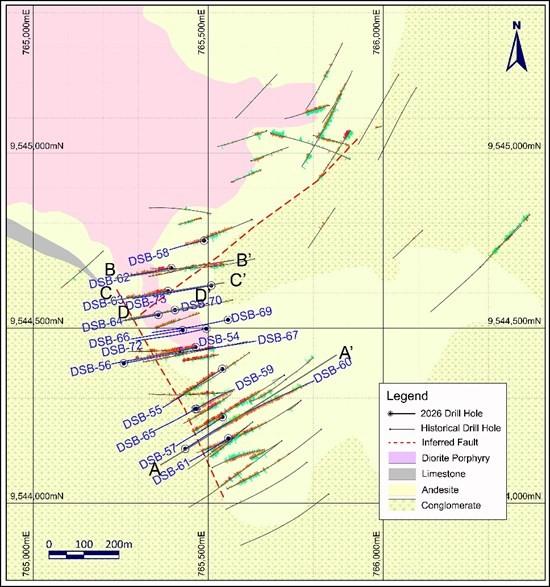
Figure 1: Plan view of drill holes
DESCRIPTION OF HOLES
Hole DSB-60 was drilled to a depth of 802.65m to test the up-dip extension of the mineralized zone intercepted by hole DSB-57 and to test the continuity of mineralization between holes DSB-57, DSB-23, DSB-33A and DSB-36 at the southern portion of Santa Barbara South, and intersected 542m (from 198m to 740m) grading 0.60 g/t Au and 0.12% Cu. To the end of hole, mineralization weakens but continues (Figure 2). Mineralization seems to be offset by faulting and did not extend up-dip to the west.
Drilled from the top of the western hill to the northeast at a dip angle of -60°, the hole is collared in a young conglomerate cover which extends to a depth of 43.4m. Then lithology abruptly changes to oxidized volcano-sediment rocks with disturbed weak beddings locally, which continues to a depth of 61m, gradually transitions to fresh volcano-sediment rocks until a depth of 186m. Apparently between the conglomerate and the oxidized volcano-sediment rocks there is a break or a paleosurface. The conglomerate horizon contains no sulfides, and the fresh volcano-sediment rocks have disseminated primary pyrite, but assay data indicate no gold or copper mineralization in either of them. From 185m to 225m is a fault zone composed of tectonic breccia and fault gauge, with the upper part dominated by clasts of volcano-sediment and the lower half by basaltic andesite. Further down the hole, lithology is dark aphanitic basaltic andesite (Figure 3) cut by a few dykes of porphyritic diorite and the hole ends in diorite intrusion at a depth of 802.6m. Gold-copper mineralization starts from the fault zone and continues until the end of hole, characterized by disseminated and small veinlets of pyrite and chalcopyrite associated with secondary biotite of potassic alteration.
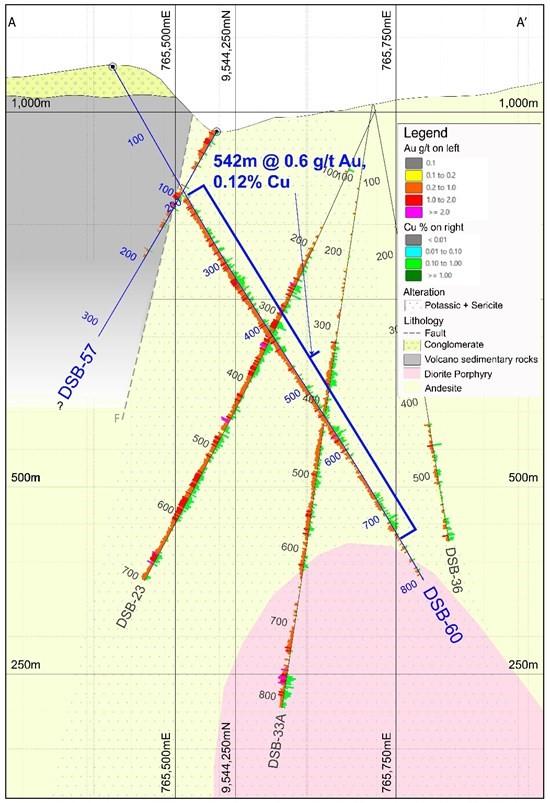
Figure 2: Section A-A’
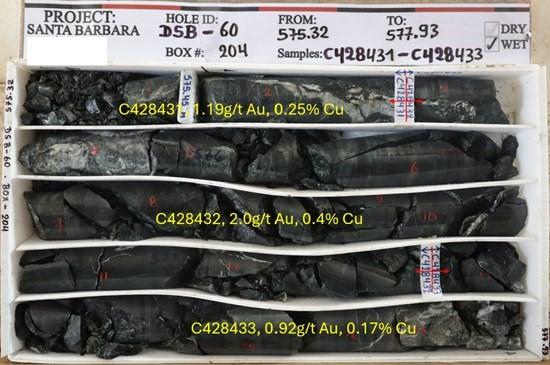
Figure 3: Core photo of DSB-60, Box 204, from 575.32m to 577.93m, mineralized basaltic andesite cut by quartz veining.
Hole DSB-62 was drilled to a depth of 200m to test the gap between the historical holes DSB-06 and DSB-17 at the northern end of Santa Barbara South, and intersected 149.5m (from 24.0m to 173.5m) grading 0.66 g/t Au and 0.06% Cu, including a higher grade sub-interval of 29.4m (from 34.0m to 63.4m) grading 1.53 g/t Au and 0.11% Cu. Drill results from this hole indicate gold-copper mineralization is open in the up-dip direction to surface (Figure 4).
The top 26m from surface is overburden and saprolite of mineralized rock clasts. Further down the hole, lithology is dominated by volcano-sediment rocks cut by porphyritic diorite dykes. The volcano-sediment rocks are pervasively altered (silicification and sericitization), locally cataclastic to semi-brecciated, cut by quartz-calcite veins (Figure 5). Mineralization is characterized by disseminated and small veinlets of pyrite and chalcopyrite associated with secondary biotite, illite, sericite and epidote. The hole terminated in mineralized cataclastic volcanoclastic sediments at a depth of 200m.
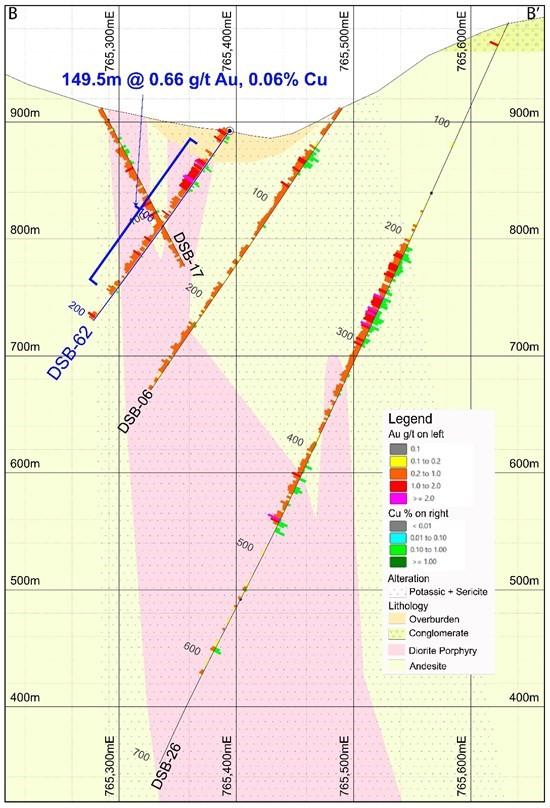
Figure 4: Section B-B’
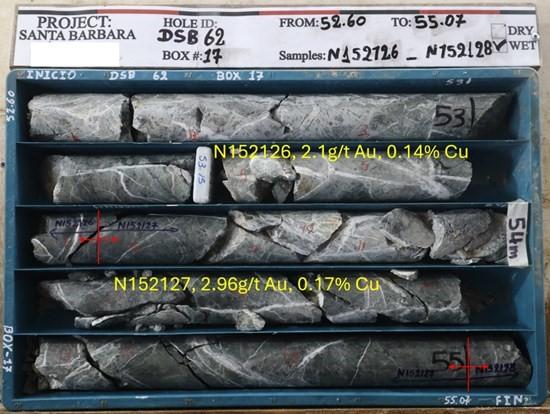
Figure 5: Core photo of DSB-62, Box 17, from 52.6m to 55.07m, mineralized volcano-sediment rock, pervasively altered and cut by quartz and quartz-calcite veining.
Hole DSB-63 was drilled to a depth of 253.9m, approximately 60m south of the hole DSB-62 at the northern part of Santa Barbara South in a westerly dipping direction to test the up-dip extension of the mineralized zone. It intercepted 143m (from 0m to 143m) grading 0.74 g/t Au and 0.1% Cu, including 36.5m (from 30m to 66.5m) grading 1.25 g/t Au and 0.14% Cu, and 85.1m (from 165.9m to 251m) grading 0.44 g/t Au and 0.08% Cu. Mineralization continued at the end of hole (Figure 6).
Lithology in the upper half of the hole is porphyritic diorite cut by veining of quartz and calcite associated with alteration of secondary biotite, chlorite and epidote with strong mineralization characterized by disseminated and small veinlets of pyrite and chalcopyrite (Figure 7). The lower half is cataclastic to brecciated silicified volcano-sediments intruded by diorite dykes, and both rock types are mineralized with disseminated and veining of pyrite and small amount of chalcopyrite.
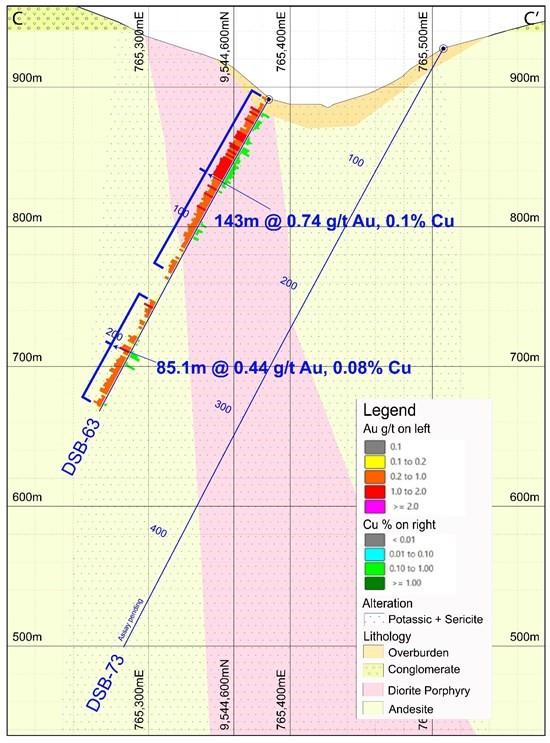
Figure 6: Section C-C’
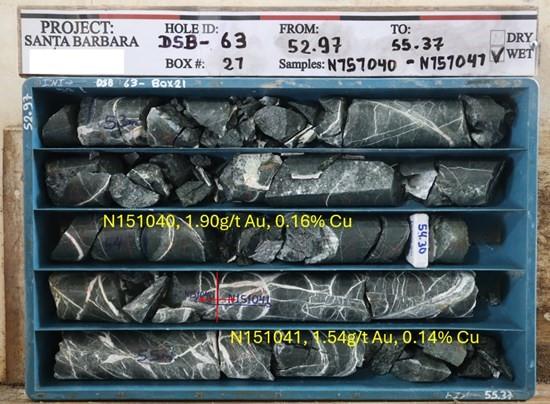
Figure 7: Core photo of DSB-63, Box 27, from 52.97m to 55.37m, mineralized diorite cut by quartz and quartz-calcite veining.
Hole DSB-64 was drilled to a depth of 199.35m approximately 60m south of the hole DSB-63 at the northern part of Santa Barbara South in a westerly dipping direction to test the up-dip extension of the mineralized zone and intersected 121.65m (from 20.5m to 142.15m) grading 0.44 g/t Au and 0.07% Cu, which indicates mineralization is open to the up-dip direction (Figure 8).
Similar to hole DSB-63, lithology in hole DSB-64 is dominated by diorite in the upper part. In the lower part, until the end of hole, volcano-sediment rocks are dominant and cut by diorite porphyry dykes. Mineralization is better developed in the upper diorite. Near the end of hole, mineralization was weaker but continued.
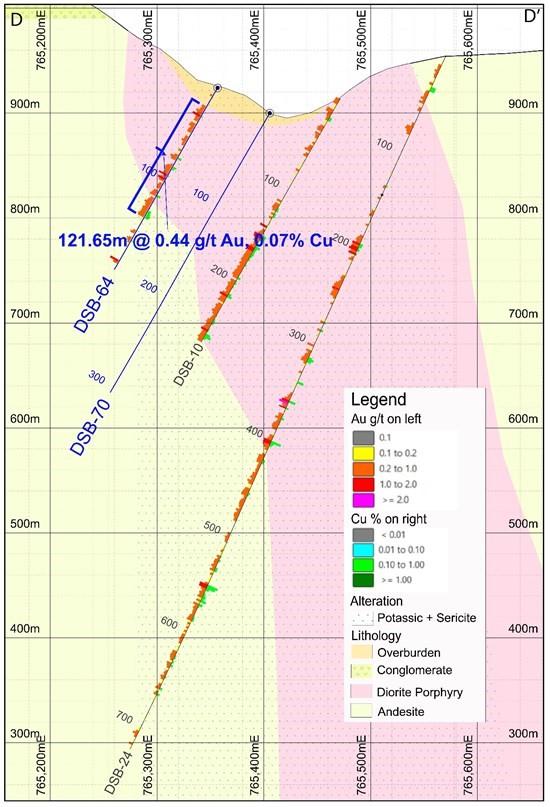
Figure 8: Section D-D’
| Table 2: Summary of Phase I Drill Holes of Santa Barbara Gold-Copper Project | |||||||
| Hole_ID | Easting | Northing | Altitude | Depth_m | Azimuth (°) | Dip (°) | Assay Results |
| DSB-54 | 765463.70 | 9544445.53 | 931.38 | 705.70 | 260 | -82 | complete |
| DSB-55 | 765539.93 | 9544383.21 | 940.76 | 285.50 | 240 | -45 | complete |
| DSB-56 | 765417.68 | 9544434.13 | 960.10 | 274.85 | 260 | -47 | complete |
| DSB-57 | 765541.01 | 9544245.95 | 973.91 | 315.70 | 240 | -60 | complete |
| DSB-58 | 765488.12 | 9544749.44 | 920.64 | 274.80 | 260 | -63 | complete |
| DSB-59 | 765466.41 | 9544269.27 | 1030.67 | 706.55 | 60 | -80 | complete |
| DSB-60 | 765434.27 | 9544155.26 | 1060.67 | 802.65 | 60 | -60 | complete |
| DSB-61 | 765557.28 | 9544184.88 | 990.14 | 720.60 | 236 | -77.5 | pending |
| DSB-62 | 765394.10 | 9544671.12 | 892.48 | 200.00 | 260 | -55 | complete |
| DSB-63 | 765384.50 | 9544605.71 | 891.07 | 253.90 | 260 | -60 | complete |
| DSB-64 | 765356.92 | 9544537.66 | 924.00 | 199.35 | 260 | -60 | complete |
| DSB-65 | 765463.12 | 9544268.74 | 1030.43 | 379.80 | 240 | -70 | pending |
| DSB-66 | 765427.24 | 9544493.67 | 909.15 | 312.15 | 260 | -60 | pending |
| DSB-67 | 765258.71 | 9544399.36 | 1040.33 | 599.00 | 80 | -52 | pending |
| DSB-69 | 765556.17 | 9544523.38 | 922.05 | 490.05 | 260 | -63 | pending |
| DSB-70 | 765404.89 | 9544551.38 | 900.01 | 306.60 | 260 | -60 | pending |
| DSB-71 | 765256.00 | 9544398.00 | 1039.00 | 745.00 | 80 | -63 | pending |
| DSB-72 | 765494.39 | 9544498.07 | 905.17 | 400.90 | 260 | -60 | pending |
| DSB-73 | 765508.60 | 9544621.44 | 927.45 | 485.65 | 260 | -60 | pending |
| Total | 8458.75 | ||||||
Notes:
|
Table 3: Summary of Drill Intercepts for Phase 1 Drill Holes at Santa Barbara |
|||||||
| Hole_ID | Depth_from | Depth_to | Interval_m | Au_g/t | Cu_% | AuEq_g/t | |
| DSB-54 | 0.00 | 705.70 | 705.70 | 0.61 | 0.10 | 0.64 | |
| incl. | 0.00 | 235.00 | 235.00 | 0.97 | 0.11 | 1.00 | |
| DSB-55 | 0.00 | 246.00 | 246.00 | 0.56 | 0.09 | 0.58 | |
| incl. | 31.50 | 187.00 | 155.50 | 0.73 | 0.11 | 0.76 | |
| DSB-56 | 0.00 | 134.00 | 134.00 | 0.67 | 0.09 | 0.69 | |
| 164.50 | 188.50 | 24.00 | 0.89 | 0.07 | 0.90 | ||
| DSB-57 | 0.00 | 59.00 | 59.00 | 0.67 | 0.10 | 0.70 | |
| 92.50 | 130.00 | 37.50 | 0.50 | 0.10 | 0.53 | ||
| DSB-58 | 12.00 | 142.00 | 130.00 | 0.60 | 0.09 | 0.63 | |
| DSB-59 | 81.43 | 706.55 | 625.12 | 0.64 | 0.10 | 0.67 | |
Notes:
QUALITY ASSURANCE AND QUALITY CONTROL
All samples in respect of the exploration program at the Project discussed in this news release were shipped in securely-sealed bags by a chartered commercial truck, directly from the field to the sample preparation facilities of SGS in Guayaquil, Ecuador for preparation, and to SGS in Lima, Peru for geochemical analysis. SGS is a global leader in inspection, verification, testing, and certification. It is an ISO/IEC 17025 accredited laboratory independent from Auro. All samples go through fire assay (SGS code FAA313) for gold and multi-acid digestion ICP-AES multi-element assay (SGS code ICP40B) for other elements. Certified reference materials, various types of blank samples and duplicate samples are inserted into normal drill core sample sequences prior to delivery to laboratory for preparation and analysis. The overall ratio of quality control samples in sample sequences is around twenty percent.
QUALIFIED PERSON
The scientific and technical information contained in this news release has been reviewed and approved by Alex Zhang, P. Geo., a Director of the Company, who is a Qualified Person for the purposes of National Instrument 43-101 – Standards of Disclosure for Mineral Projects. The Qualified Person has verified the information disclosed herein, including the sampling, preparation, security and analytical procedures underlying such information, and is not aware of any significant risks and uncertainties that could be expected to affect reliability or confidence in the information discussed herein.
ABOUT AURO METALS INC.
Auro Metals Inc. is a mineral exploration company which holds a 100% interest in the Santa Barbara Gold-Copper Project in the Zamora Copper-Gold Belt of southeastern Ecuador. The Santa Barbara Project is a large-scale porphyry system comprising Indicated resources of 29.8 million tonnes grading 0.73 grams per tonne gold and 0.10% copper containing 697,000 ounces gold and 68 million pounds copper, and Inferred resources of 205.7 million tonnes grading 0.52 grams per tonne gold and 0.09% copper containing 3,418,000 ounces gold and 426 million pounds copper. For more detail, see the Company’s mineral resource estimate prepared in accordance with NI 43-101 by SRK Consulting, effective March 23, 2026 which can be found on SEDAR+ and the Company’s website.
Brutus Mining Inc. (CSE: BRU) (FSE: ZI3) is pleased to announce that it has closed its non-brokered ... READ MORE
Jaguar Uranium Corp. (NYSE American: JAGU) is pleased to announce an independent Mineral Resource E... READ MORE
Auro Metals Inc. (TSX-V: AURO) (OTCQB: AURFF), is pleased to announce the assay results of the fina... READ MORE
Endeavour Silver Corp. (NYSE: EXK) (TSX: EDR) is pleased to announce that repairs to the primary bal... READ MORE
Scorpio Gold Corp. (NASDAQ: SGLD) (TSX-V: SGLD) (OTCQB: SRCRF) (FSE: RY9) is pleased to announce re... READ MORE