








Asante Gold Corporation (TSX-V: ASE) (GSE: ASG) (OTCQX: ASGOF) is pleased to announce the filing of updated independently coordinated and prepared NI 43-101 technical reports for its Bibiani and Chirano Gold Mines in Ghana (effective 31 December 2025). These reports supersede the respective technical reports for Bibiani and Chirano filed on 30 April 2024 (effective 31 December 2023). Mineral Resources for both operations have been estimated using a gold price assumption of US$2,500/oz, and Mineral Reserves US$2,100/oz.
HIGHLIGHTS
Consolidated Resource Base
Chirano Gold Mine
Bibiani Gold Mine
Malik Easah, Chairman of Asante, commented:
“These updated, independently coordinated and prepared technical reports underscore the inherent quality of Asante’s geological endowment in the Chirano-Bibiani Corridor, and reinforce the thesis for long-term potential at our Chirano and Bibiani operations. Despite mineral inventory depletion from producing over 430,000 ounces across both mines in the past two years, we have maintained our combined Measured and Indicated Resource base. This is a reassuring reflection of the quality of our near-mine exploration pipeline at both Bibiani and Chirano. At Bibiani specifically, exploration activity was constrained over the 2024-2025 period, however, enhanced exploration budget is planned going forward to rebuild that pipeline. Both assets remain open at depth along the more than 80-kilometre Chirano-Bibiani Corridor, which is largely untested by drilling below 300 to 700 metres depth. At Bibiani in particular, the Main Pit is believed to be open to at least 1,400 metres below surface. This represents significant further upside potential for our future underground mine planning at Bibiani. With a 4.6 million ounce Measured and Indicated Resource base as our foundation, Asante’s core focus as a company is to vigorously pursue its ongoing operational improvements at both assets and to thereby translate this geological opportunity into value for shareholders.”
GROUP MINERAL RESOURCES – BIBIANI AND CHIRANO – as at 31 December 20251
| M&I Resources (koz) | Inferred Resources (koz) | Mineral Reserves (koz) | |
| Chirano | 2,531 | 830 | 1,303 |
| Bibiani | 2,064 | 965 | 1,527 |
| Group Total | 4,595 | 1,795 | 2,830 |
UNLOCKING VALUE ACROSS THE CHIRANO-BIBIANI CORRIDOR
Asante controls the CBC across +937km2 of combined Bibiani and Chirano tenure, spanning over 80 kilometres of strike along the Sefwi-Bibiani Belt. The Company considers the CBC, which has produced over 8 million ounces of gold over its mining history, to be one of the most prospective yet historically underexplored structural settings in West Africa’s Birimian gold province. It is interpreted as an ancient crustal-scale structure that provided the geological conduit responsible for district-scale gold endowment encompassing Bibiani and Chirano. The corridor comprises two principal, sub-parallel structures: the BSZ, which extends across both the Bibiani and southern Chirano tenure, and the CSZ, the main structural control at Chirano.
The Sefwi-Bibiani Belt’s structural setting is analogous to other greenstone-hosted gold belts globally, such as the Lefroy-Boulder Fault Zone within Western Australia’s Eastern Goldfields (50+ million ounce endowment) and the Abitibi Greenstone Belt in Canada (180+ million ounce endowment), both of which have sustained several mining centres over long production histories along their structural trends. Yet mineralization within the CBC remains largely untested relative to the scale of its broader structural setting. The CBC offers along strike potential both between and beyond the existing mine areas, and is open at depth along its extent, which is largely untested beyond 300 to 700 metres below surface.
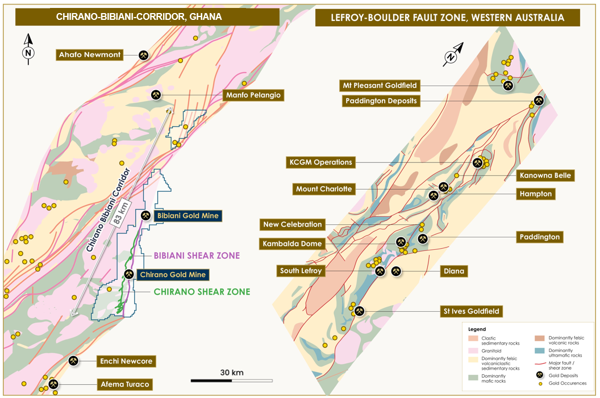
Figure 1. Schematic maps comparing the CBC within the Sefwi Bibiani Gold Belt, Ghana, to the Lefroy-Boulder Fault Zone, showing key gold mines and occurrences.
CHIRANO GOLD MINE – EXPLORATION AND DEVELOPMENT
Chirano comprises thirteen deposits with estimated Mineral Resources across an approximate 15-kilometre strike, associated with the CSZ within the CBC. Since Asante’s acquisition of Chirano in August 2022, over 66,900 metres of drilling and 257 holes have delivered significant Mineral Resource and Reserve growth.
Since December 2023, M&I Mineral Resources have grown by 443,000 ounces to 2.53 million ounces (as at 31 December 2025). Mineral Reserves also saw drilling more than replace production depletion (which was approx. 270,000 ounces), with growth in Proven and Probable Mineral Reserves of 244,000 ounces to 1.30 million ounces. This supports a seven-year current Life of Mine plan.
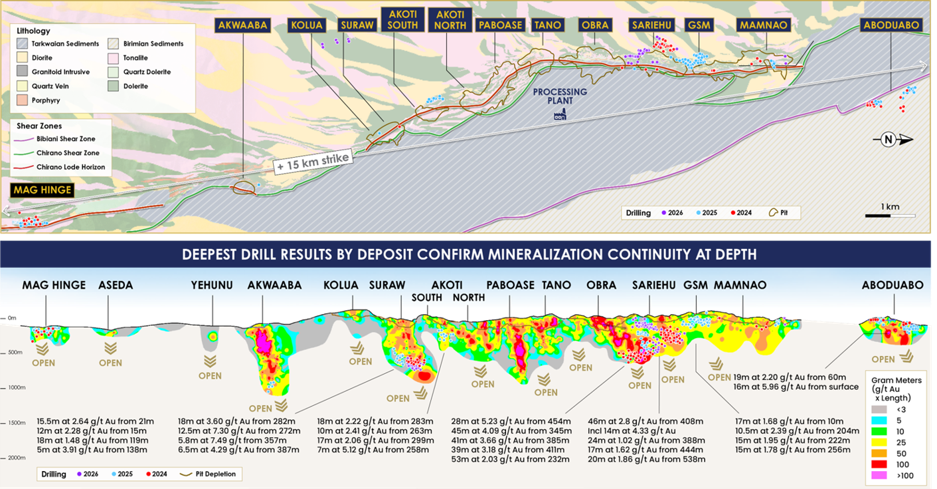
Figure 2. Plan and long section images of the Chirano 2024-25 Mineral Resource and Reserve drilling, highlighting significant Mineralized intercepts and depth potential, along with planned 2026-27 drilling.
Key contributors to the December 2025 Mineral Resource and Reserve additions included:
Together, Obra, Sariehu, and northern Mamnao form the basis of a “North Mine” concept, which is a plan under evaluation to link mining of all three deposits into one operation. In 2024, drilling successfully closed the Sariehu-Mamnao Gap, confirming continuous mineralization over 1 kilometre near surface between the two deposits and added 73,000 ounces at 1.01 g/t Au the open pit Mineral Reserve base. Significant intercepts included 17m at 1.68 g/t Au from 10m (hole CHRC3495) and 15m at 1.95 g/t Au from 204m (hole CHRC3534).
Additional RC infill drilling was completed at Aboduabo, comprising 45 holes for 5,829 metres, aimed at improving resource confidence and supporting metallurgical test work. Significant intercepts including 19m at 2.20 g/t Au from 60m (hole CHRC3553) and 16.5m at 5.96 g/t Au from surface (CHRC3547).
Across the broader Chirano system, the 13 deposits collectively host 265,000 ounces of open pit M&I Mineral Resources at 1.08 g/t Au and over 2.2 million ounces of underground M&I Mineral Resources at 2.17 g/t Au. Mineralization remains open at depth throughout the system. Mineral Resource definition currently extends to approximately 600 metres below surface, however depth potential is readily demonstrated by Akwaaba, which is developed beyond 800 metres below surface, and Paboase, which was previously mined to approximately 950 metres below surface (at a grade of 3.57 g/t Au). This depth potential remains a key focus of exploration in 2026 and beyond.
2026 CHIRANO EXPLORATION PROGRAMME
Near-mine exploration
Drilling during 2026 directly follows up on the success of results returned in 2024-25, with near-mine drilling underway at Obra, Suraw, Sariehu, and the Obra-Sariehu and Sariehu-Mamnao gaps. Initial results from this drilling continue to support the case for a single, consolidated mining operation across Obra to Mamnao. Additional drilling at Akoti South, Tano and Mamnao is scheduled to commence later in the year, with Mag Hinge to follow in Q4 2026.
At the Obra-Sariehu Gap, drilling is testing near-surface mineralization between the two pits to evaluate open pit potential and support possible pit-linkage opportunities. Year-to-date, 26 RC/RCDD holes totaling 6,015 metres have been completed, confirming mineralization and providing encouraging support for an open-pit pushback assessment. Significant intercepts include 4.2m at 21.21 g/t Au from 324m, including 2.88m at 30.76 g/t Au from 324m (hole CHDD3771UG); and 12.6m at 1.59 g/t Au from 308m, including 9.6m at 1.88 g/t Au from 312m (hole CHRC3775D).
At Sariehu itself, drilling in 2026 aims to build on the existing 241,000 ounce underground M&I Mineral Resource, testing the down-dip extensions of mineralization between 1,850 – 1,900 metres RL, aiming to convert additional Inferred Resources to Indicated category ahead of underground development. Year-to-date, 11 diamond holes totaling 3,136 metres have been completed, with assays returning encouraging results that continue to demonstrate consistent mineralization along strike and at depth, including 20.4m at 1.67 g/t Au from 543.7m, including 2.4m at 2.75 g/t Au from 544m (hole CHRC3772D) and 6.2m at 2.15 g/t Au from 558m, including 3.2m at 3.02 g/t Au from 558m (hole CHRC3772DW1).
Suraw depth extension drilling is underway below 1,650 metres RL, aiming to test the strike and depth potential highlighted by the 2024-25 assay results, where intercepts of 18m at 3.60 g/t Au from 282m (hole CHDD3671UG), including 6.56m at 5.72 g/t Au and 12.5m at 7.30 g/t Au from 272m (hole CHDD3691UG), indicate further extension potential.
Mamnao drilling targeting the northern extension of the deposit is in progress, building on the successful infill/closure of the Sariehu-Mamnao Gap in 2024 and in support of further consolidating the North Mine concept.
At Tano, drilling targets a Mineral Resource upgrade below 1,800 metres RL and extension of mineralization in the western splays.
Drilling at Akoti South is scheduled to commence in Q3 2026, targeting further extension of the maiden Mineral Reserve along strike and at depth.
Mag Hinge drilling is scheduled for Q4 2026, targeting further Mineral Resource definition along strike and at depth in order to advance the near-surface oxide target from Pre-Feasibility Study stage toward eventual Mineral Reserve declaration.
BIBIANI GOLD MINE – EXPLORATION AND DEVELOPMENT
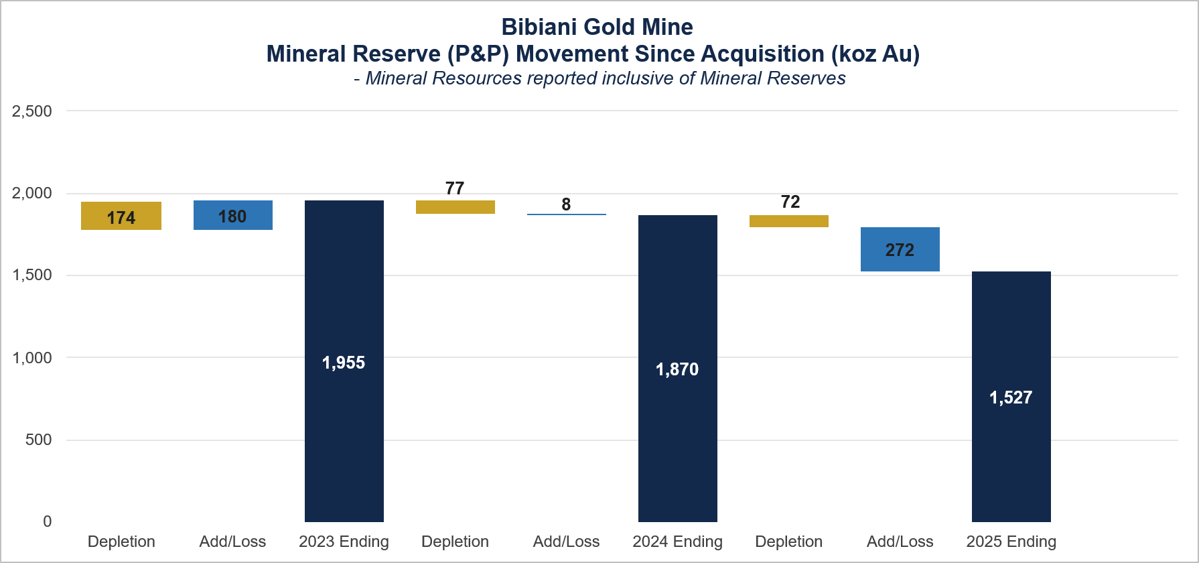
The December 2025 Bibiani Mineral Resource is the result of a systematic near-mine drilling programme during 2024 and 2025 combined with updated geological modelling of the Main Pit. M&I Mineral Resources total 2.06 million ounces, inclusive of Mineral Reserves, with an additional 965,000 ounces of Inferred Mineral Resources. Updated Proven and Probable Mineral Reserves of 1.53 million ounces support a current 9-year Life of Mine plan including both open pit and underground material, with underground development scheduled to commence in late 2026.
The BSZ hosts a continuous and structurally controlled Mineralized corridor extending from Russel in the south through the Main Pit to Little Mug (now “Cut 6” and an extension of the Main Pit) in the north over 3.7 kilometres of strike – providing the geological framework for Bibiani’s near-mine growth strategy. Ongoing Mineral Resource definition and exploration drilling continues to test extensions of this system, both along strike and at depth.
Main Pit
The Main Pit Mineral Resource, incorporating the Big Mug northern extension, now comprises M&I Mineral Resources of approximately 1.93 million ounces (inclusive of Mineral Reserves of 1.53 million ounces) and Inferred Resources of approximately 925,000 ounces. Main Pit has a total Mineralized strike length of approximately 4,000 metres, of which only 1,800 metres has been mined historically, while Mineral Resource definition currently extends to approximately 600 metres below surface. It remains open along strike and at depth, with the NNE-SSW trending and steeply dipping vein system interpreted to continue well below the current base of the defined Mineral Resource.
Approximately 43,000 metres of drilling in 2024-25 were completed at Bibiani, primarily focused on de-risking the Main Pit underground Mineral Resource ahead of underground development. Results supported a revised Mineral Resource evaluation and estimation with enhanced grade distribution, producing a more robust model. Further drilling is warranted ahead of underground mining and is a focus of the 2026 programme.
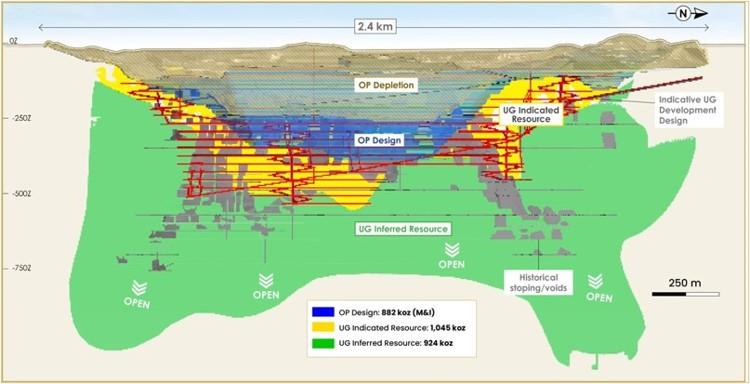
Figure 3. Plan map showing Bibiani operation and drill hole locations from recent 2024 to 2025 Resource drilling programmes and planned 2026 programmes.
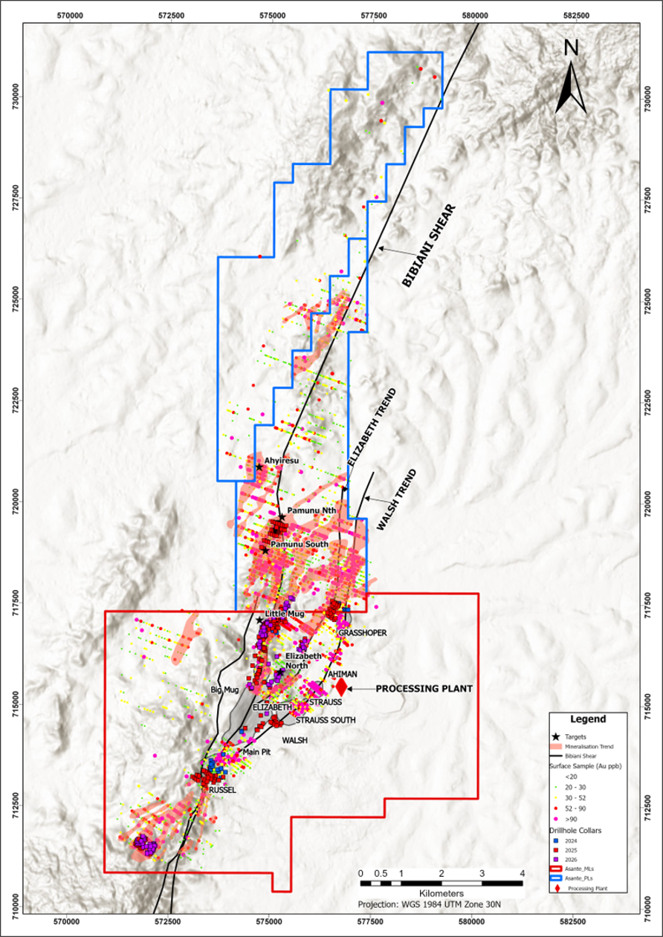
Figure 4. Long-section of Bibiani Main Pit, showing Mineral Resource by category.
At Big Mug, over 7,460 metres of drilling successfully confirmed structural continuity of the Bibiani Main Underground footprint and demonstrated that mineralization remains open at depth. Notable intercepts included:
Below the current Main Pit Mineral Resource, three northerly plunging high-grade shoots (North, Central and South Deeps) have been interpreted as down-dip and down-plunge extensions of the Main Pit Mineralized system. Mineralization was recently confirmed to approximately 650 metres below surface and remains open, while high-grade shoots within North and South Deeps were historically stoped to a vertical depth of 850m in the 1920s – 1950s. Based on historical drilling and the Company’s current geological interpretation, the system is considered open to at least approximately 1,400 metres below surface.
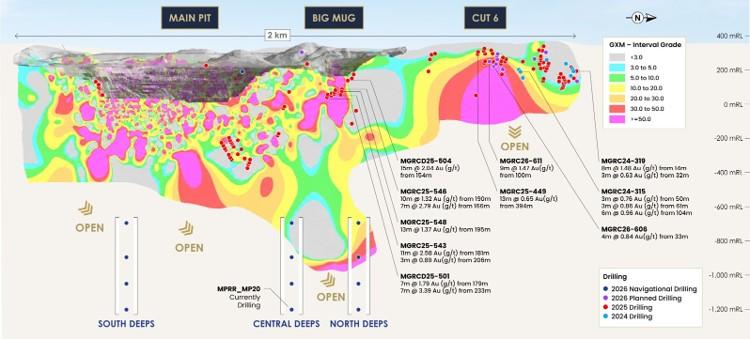
Figure 5. Long-section of the Bibiani Main Pit (now encompassing Big Mug) and Cut 6 extension, showing significant 2024-26 drilling intercepts and interpreted mineralization grade shells (GXM) along the North, Central and South Deeps trends, which remain open at depth.
Russel South and Russel Underground
Exploration continues to investigate the down-dip potential and southern extension of Russel, which commenced producing oxide ore during the period, with 79,000 ounces to date. Approximately 12,500 metres of diamond and RC drilling was completed.
Recent assay results from Russel South, returned discontinuous mineralization along strike at surface, but confirmed an encouraging shallow intercept of 20 metres at 0.94 g/t Au from 145 metres (hole MGRC25-403), located approximately 300 metres south of the existing open pit, supporting potential for a southern open-pit extension.
At depth, drilling also identified a south-plunging zone of mineralization, returning a best intercept of 9 metres at 18.70 g/t Au from 264 metres (hole MGRCD24-308), complementing the previously identified north-plunging “Russel Underground” shoot indicate underground depth potential below the current open pit. This has supported an initial 38,000 ounce Indicated Mineral Resource at “Russel Underground” (2.55 g/t Au), with a further 4,000 ounces classified as Inferred. Significant results include 9.0 metres at 1.68 Au g/t Au from 197metres (hole MGRCD24-307) and 3.0m at 3.49 g/t Au from 237 metres (hole MGRCD24-299) along the south plunging shoot, and 11 metres at 15.81 g/t Au from 260 metres (hole MGRCD24-308), strengthening the north-plunging shoot.
Recent geological interpretation has also suggested that ‘the southern extremities of the Main Pit historical underground workings may be structurally connected to the north-easterly plunge of the mineralization at Russel. This potential link is to be tested as underground development of the Main Pit advances.
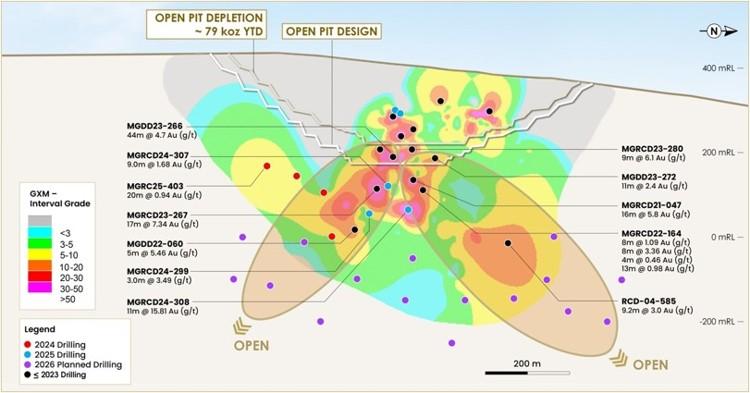
Figure 6. Long-section of Russel Pit showing open pit depletion and design, interpreted GXM grade shells, and pierce points for 2024-25 and planned 2026 drilling, highlighting south and north shoots which remain open at depth.
Advanced exploration was also completed at several near-mine targets with near-surface mineralization, targeting progression towards maiden Mineral Resource status. Further drilling of these targets is planned in 2026 including:
2026 BIBIANI EXPLORATION PROGRAMME
Near-mine exploration:
Asante’s 2026 programme at Bibiani is focused on further conversion drilling of the Main Pit and Big Mug underground Mineral Resources, while advancing several parallel workstreams across near-mine satellite targets and step-out drilling across the BSZ. This work is set to build on the significant results defined in 2025 between the Main Pit and Cut 6 (previously the “Little Mug” prospect) along the BSZ, the Elizabeth North trend, and from the South-West Trend target to Asempaneye.
Approximately 25,685 of 33,250 metres of planned RC and diamond drilling has been completed year-to-date. At the Main Pit, three mother-and-daughter diamond drill holes targeting a central north-plunging shoot beneath the underground Mineral Resource have been completed for a total of 3,307 metres (comprising 298 metres of pre-collared RC drilling and 3,009 metres of diamond drilling). Results were positive, confirming mineralization to approximately 650 metres below surface, which is open at depth. Significant Mineralized intersections include 29.1m at 1.17 g/t Au from 591m (hole MGDD25-550) and 13m at 1.18 g/t Au from 475m (hole MGRCD25-528). Building on this result, a proof-of-concept drilling programme has commenced to test three interpreted Deeps targets – North, Central and South – via 12 navigational diamond drill holes along three drill fences. Drilling along the Central Deeps fence has recently commenced, aiming to test the down plunge extension of mineralization confirmed by the previously mentioned mother-and-daughter holes, with the deepest hole being tested first to a target depth of approximately 1,600 metres.
Additional Mineral Resource definition drilling continues at the Main Pit, aimed at confirming grade continuity, refining geometry, and upgrading Inferred Mineral Resources to Indicated classification. Geological interpretation and 3D modelling remains ongoing, with the new drilling and structural data expected to improve understanding of geometry and continuity, supporting further underground Mineral Resource conversion and growth.
At Russel, infill and depth extension drilling is planned to target underground potential identified below the Russel pit shell, ahead of commencing a formal underground study. At Russel South, follow-up drilling is set to test the down-dip and along-strike near surface mineralization identified approximately 300 metres south of the Russel open pit.
Building on the 2026 programme, Asante plans a revitalised and expanded FY2027 exploration budget at Bibiani, targeting increased near-mine drilling metres to rebuild the resource pipeline following the constrained 2024–2025 exploration period. This will focus on further definition and extension drilling across the Main Pit Deeps targets, Cut 6, and the SWT/Asempaneye trend, alongside continued greenfields testing at the Asuontaa and Donkoto licences.
GREENFIELDS EXPLORATION STRATEGY
Beyond near-mine growth described above, Asante is also advancing greenfields exploration across the broader CBC, holding an extensive and largely untested land package comprising 775 km² of prospecting licences around Chirano and further prospective ground across Bibiani’s Asuontaa and Donkoto licenses. The Company’s greenfields strategy is to systematically screen its tenure through regional surface mapping, geochemistry and geophysics, building a ranked and risked pipeline of first pass drill targets to test, while progressing the highest priority zones toward maiden Mineral Resource status over time.
At Chirano, drill pad preparation is underway at the Anansu Prospecting License following up encouraging near-surface mapping and trenching at the Nyama Yama and DBS targets, with first-pass drilling planned in Q4 2026 at Futa South and, further north, at Aso-Meko, Chine and the Aboduabo extension/Zone 3A. At Bibiani, field mapping and grab sampling completed in 2025 confirmed gold mineralization in granitoids and quartz veins at the Yaro and Bredi targets within the Asuontaa license, with follow-up drill testing planned into 2027.
Given the scale and historically underexplored nature of the CBC, which Asante considers comparable to prolific greenstone belts such as the Lefroy-Boulder Fault Zone of Western Australia and Abitibi Greenstone Belt in North America, the Company views greenfields exploration as a multi-year and corridor-wide opportunity to define new mining operations beyond the existing Bibiani and Chirano operations.
QUALITY ASSURANCE / QUALITY CONTROL
The 2026 drilling program was conducted in accordance with industry best practices and followed drilling, sampling, QA/QC and data management procedures previously implemented at Chirano. These procedures have been reviewed and validated by the Asante Gold Exploration team and various external Qualified Persons and are consistent with accepted industry standards.
Asante employs a QA/QC program consistent with industry best practices. Drilling was conducted by GTS Drilling Services, Deep Rock Drilling and Toomahit Drilling and was supervised by the Asante exploration teams. Selected drill core intervals were cut in half with a diamond blade saw. Half of the sampled core was left in the core box and the remaining half was bagged and sealed. Asante utilizes accredited laboratories, and the samples were transported to either ALS-Kumasi or the Intertek laboratory in Tarkwa, Ghana. Gold was analyzed by 50-gram fire assay with Atomic Absorption-finish. Certified reference material (CRM) standards, duplicates, and coarse blank material are inserted. Results from the QA/QC program indicate that assay quality is within acceptable limits and supports the reliability of the analytical data.
ABOUT THE TECHNICAL REPORTS
The updated technical reports, entitled “NI 43-101 Technical Report and Updated Mineral Resource Estimate, Asante Gold Bibiani Limited, Ghana, West Africa” and “NI 43-101 Technical Report and Updated Mineral Resource Estimate, Asante Gold Chirano Limited, Ghana, West Africa”, each with an effective date of 31 December 2025 and an issue date of 5 August 2026, have been prepared in accordance with National Instrument 43-101, Standards of Disclosure for Mineral Projects (“NI 43-101”), and filed under the Company’s SEDAR+ profile at www.sedarplus.ca. The reports supersede the prior technical reports for Bibiani and Chirano filed on 30 April 2024. Readers are encouraged to read the technical reports in their entirety, including all qualifications, assumptions and risks, available on SEDAR+ and the Company’s website at www.asantegold.com.
QUALIFIED PERSONS STATEMENT
The scientific and technical information in this news release has been reviewed and approved by Dean Bertram, Vice President Geology of Asante Gold Corporation, a Qualified Person as defined by NI 43-101.The updated technical reports were prepared by the following independent Qualified Persons: David Michael Begg of dMb Management Services Pty Ltd; Clive Brown and Galen White of Bara Consulting Limited; and Glenn Bezuidenhout of GB Independent Consulting Pty Ltd. Each Qualified Person has reviewed and approved the portions of the technical reports relevant to their area of responsibility. None of the independent Qualified Persons hold any interest in Asante, its associated parties, or in any of the mineral properties which are the subject of this news release.
ABOUT ASANTE GOLD CORPORATION
Asante is a growing mid-tier gold producer, developer and explorer with a high-quality portfolio of assets located on two of West Africa’s most prolific and prospective gold belts in Ghana. The Company operates the Bibiani and Chirano Gold Mines on the Sefwi-Bibiani Gold Belt in Ghana’s Western North Region, where it holds an extensive and underexplored land position spanning more than 80 kilometres of strike. Asante is also advancing its Kubi Gold Project on the Ashanti Gold Belt, extending the Company’s footprint across Ghana’s most productive gold corridor. Committed to responsible mining and the creation of lasting value for its shareholders, people and host communities,
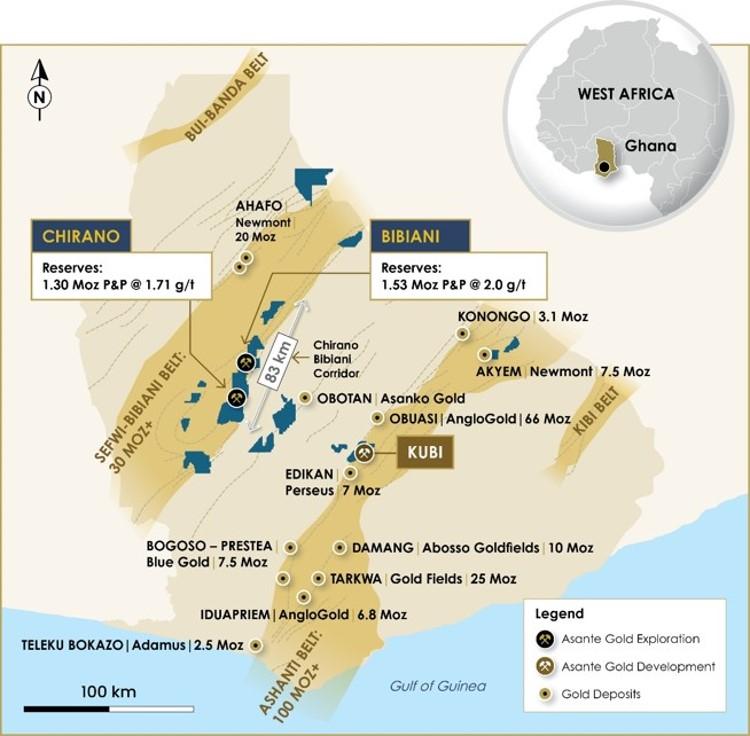
Figure 7. Asante Portfolio, Ghana.
About The Bibiani Gold Mine
Bibiani is an operating open pit gold mine situated in the Western North Region of Ghana, with historical gold production of more than 4.5 million ounces. The mine is fully permitted with mining and processing infrastructure on-site, including a refurbished process plant and associated mining infrastructure. Asante commenced mining at Bibiani in late February 2022, with commercial production announced on 10 November 2022.
About The Chirano Gold Mine
Chirano is an operating open pit and underground mine located in the Western Region of Ghana. The mine was first explored and developed in 1996 and began production in October 2005. Chirano comprises multiple open pit and underground operations and has produced over 3 million ounces of gold. Asante acquired its 90% interest in Chirano in August 2022.
Brutus Mining Inc. (CSE: BRU) (FSE: ZI3) is pleased to announce that it has closed its non-brokered ... READ MORE
Jaguar Uranium Corp. (NYSE American: JAGU) is pleased to announce an independent Mineral Resource E... READ MORE
Auro Metals Inc. (TSX-V: AURO) (OTCQB: AURFF), is pleased to announce the assay results of the fina... READ MORE
Endeavour Silver Corp. (NYSE: EXK) (TSX: EDR) is pleased to announce that repairs to the primary bal... READ MORE
Scorpio Gold Corp. (NASDAQ: SGLD) (TSX-V: SGLD) (OTCQB: SRCRF) (FSE: RY9) is pleased to announce re... READ MORE