






Arras Minerals Corp. (TSX-V: ARK) (OTCQB: ARRKF) is pleased to report additional drill results from the Berezski North target at the Elemes Project in Kazakhstan. Drilling continues to return broad intervals of porphyry-style copper-gold mineralization, highlighted by 568.9m grading 0.33% copper equivalent in EL26036 and 399.7m grading 0.26% CuEq in EL26034, while also expanding the footprint of near-surface tourmaline-breccia and structurally controlled mineralization. The Company also welcomes a new strategic shareholder that now holds approximately 8.3% of the Company’s issued and outstanding shares.
Ongoing geological and mineralogical modelling is also providing vectors towards the interpreted higher-temperature core of the Berezski North porphyry system. Sulphide zonation identifies bornite-rich mineralization at depth in EL26034 and EL26036. When integrated with systematic short-wave infrared alteration data, these results support the interpretation that the two holes may have tested the margins of the principal porphyry system, with the potential core located farther to the southwest.
Key Highlights:
Tim Barry, CEO of Arras Minerals, commented, “The scale of these intercepts is the key takeaway from this round of drilling. EL26036 returned nearly 570 metres of copper-gold mineralization at 0.33% CuEq from 78 metres depth, including 168 metres at 0.51% CuEq. These are substantial mineralized drill intervals and reinforce our view that Berezski North hosts a large porphyry system.”
He added, “Equally important is what the mineralogy and alteration are telling us about where these holes sit within the system. Bornite-bearing to locally bornite-dominant mineralization at depth, together with systematic SWIR alteration zonation, supports our interpretation that EL26034 and EL26036 may have tested the margins of the main porphyry rather than its core. This interpretation is consistent with the broad mineralization previously intersected in EL26032, which returned 935.9m grading 0.51 g/t Au and 0.19% Cu (0.71% CuEq), and points us farther to the southwest. Two rigs are now dedicated to Berezski North, testing this vector while continuing to expand the mineralized footprint.”
Darren Klinck, President of Arras Minerals, commented, “We are pleased to welcome another well-respected, western-based mining company as a strategic shareholder in Arras, holding approximately 8.3% of the Company following its purchase of Teck Resources’ former position. We thank Teck for its partnership since 2022 and look forward to the support of our new shareholder as we continue to advance and expand the Elemes Project.”
Broad Porphyry Copper-Gold Intercepts Expand Berezski North and Strengthen Vectors Towards Potential Porphyry Core
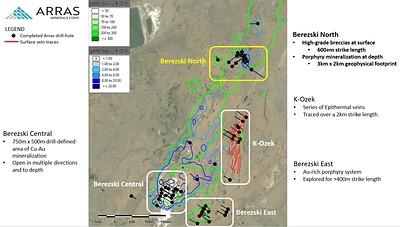
EL26034 and EL26036 returned broad intervals of porphyry-style copper-gold mineralization, while EL26035 and EL26037 tested and expanded the footprint of structurally controlled tourmaline-breccia mineralization. Together with previously reported results, the new drilling supports the interpretation of a large, well-preserved porphyry system at Berezski North that remains open in multiple directions and at depth.
The Company has modelled sulphide mineralogy across the Berezski North drill holes to better understand the architecture of the hydrothermal system. Within the porphyry zone, the model shows a transition from a more pyrite-chalcopyrite-dominant assemblage on the margins to chalcopyrite- and bornite-rich mineralization at depth, providing a vector towards a higher-temperature environment. A separate chalcopyrite-rich zone is associated with the structurally controlled tourmaline breccias.
EL26034 intersected broad zones of bornite-bearing and locally bornite-dominant mineralization within the deeper porphyry-style interval. Bornite is commonly associated with higher-temperature portions of porphyry copper systems and, together with the observed sulphide zonation, provides an important geological vector for follow-up drilling.
The Company has collected systematic SWIR measurements from drill core. The data show systematic variations in alteration mineralogy across Berezski North that broadly mirror the sulphide-mineralogy zonation. These alteration patterns help place individual drill holes within the broader hydrothermal system and provide an additional vector towards the interpreted higher-temperature core.
Taken together, the sulphide and alteration data support the Company’s current interpretation that EL26034 and EL26036 may have tested portions of the margin of the principal porphyry system intersected by EL26032, which returned 935.9m grading 0.51 g/t Au and 0.19% Cu. The potential higher-temperature core may lie farther to the southwest, where additional geophysical responses define a priority target for follow-up drilling.
The latest drilling is therefore serving two purposes: expanding the known mineralized footprint at Berezski North and refining geological vectors towards the interpreted centre of the porphyry system.
Drill-Hole Geological Summaries
EL26034: The upper part of the drill hole is dominated by fine- to medium-grained, grey to dark-grey andesite, locally brecciated and interbedded with volcaniclastics and tuffs. At 339m depth, the hole intersected medium-grained diorite. Alteration within the andesite sequence is characterized by propylitic alteration. From approximately 300m depth, weak potassic alteration increases with depth, with K-feldspar occurring as vein halos and patches.
Mineralization in the upper part of EL26034 consists mainly of pyrite with minor chalcopyrite. Below approximately 500m, the hole intersects porphyry-style quartz-pyrite-chalcopyrite veining with minor bornite. Below approximately 750m, mineralization gradually decreases and occurs mainly as patches of veins.
EL26035: The hole targeted near-surface breccia mineralization and was collared in diorite before intersecting tourmaline breccia from 60.2m depth. The breccia comprises tourmaline-quartz-cemented diorite fragments with minor K-feldspar and pyrite-chalcopyrite patches. At 127.6m, the hole passed into brecciated diorite with tourmaline-quartz patches and veins, before entering weakly propylitic-altered diorite at 160.7m that continues to the end of the hole at 432.0m.
Mineralization within the breccia consists of patchy and disseminated pyrite-chalcopyrite with minor galena and sphalerite. Outside the breccia, mineralization is dominated by pyrite with minor chalcopyrite in early K-feldspar veins, quartz-carbonate-chalcopyrite veins and rare C-type sulphide veins.
EL26036: The hole was drilled to explore deep porphyry mineralization at Berezski North. It was collared in fine-grained, weakly propylitic-altered diorite before passing into andesite at 58.0m. At 94.4m, the hole intersected tourmaline breccia comprising K-feldspar- and quartz-cemented andesite fragments with minor sulphide patches, before returning to andesite. At 494.8m, the hole entered potassic-altered diorite with minor secondary biotite.
In the upper part of the hole, quartz-pyrite-chalcopyrite mineralization with minor galena and sphalerite occurs as patches and disseminations within brecciated andesite and tourmaline breccia. At depth, mineralization occurs in quartz-calcite-pyrite-chalcopyrite veins with minor bornite and molybdenite.
EL26037: The hole was drilled to explore the eastern continuation of the tourmaline breccias. It intersected medium-grained diorite with minor andesite and quartz-diorite intervals, cut by numerous faults and shear zones. Alteration is generally weak; below the weathered zone, weak patchy potassic alteration becomes stronger and more pervasive with depth.
Veining is generally weak and is dominated by K-feldspar-carbonate-quartz veins with minor quartz-pyrite veins. Vein density is highest near the top of the hole and decreases with depth. Mineralization is generally low grade and consists mainly of disseminated pyrite and pyrite in veins, with minor chalcopyrite in veins and patches. Mineralization is strongest near surface, where it appears to be associated with fracture and fault zones.
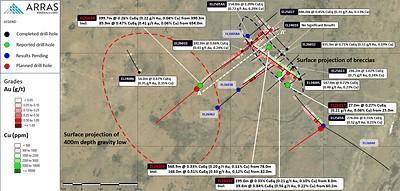
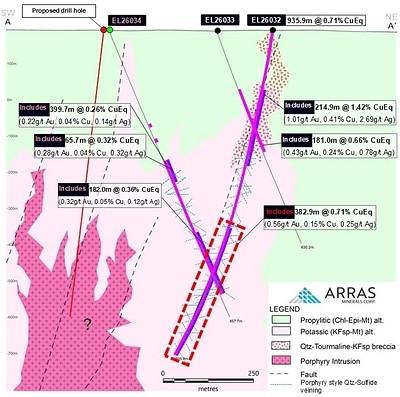
Assay results reported in this news release include:
Table 1. Summary of Berezski North drill-hole assay results
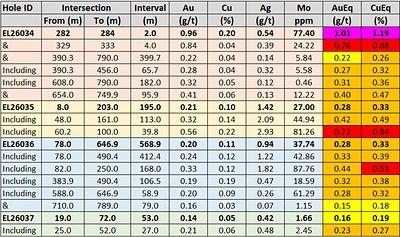
Notes: Copper and gold equivalent calculations use the following metal prices: US$3.75/lb copper, US$3,000/oz gold, US$35/oz silver and US$30/lb molybdenum. Metallurgical recoveries are Cu 90%, Au 85%, Ag 75% and Mo 80%. All intervals are presented as core lengths; true thicknesses of mineralization are currently unknown.
Table 2. Drill-hole collar locations
| Hole ID | Coordinates (UTM) | ||||||
| Easting | Northing | RL | Azimuth | Dip | Hole Depth (m) | ||
| EL26034 | 507834 | 5717323 | 230 | 040 | -70 | 857.7 | |
| EL26035 | 508266 | 5717389 | 229 | 045 | -70 | 432.0 | |
| EL26036 | 508211 | 5717536 | 228 | 230 | -80 | 814.5 | |
| EL26037 | 508312 | 5717329 | 229 | 050 | -70 | 303.6 | |
Integrated Geological Vectoring at Berezski North
The Company is integrating drill results with sulphide mineralogy, SWIR alteration and geophysical data to develop a three-dimensional geological model and guide drilling towards the interpreted centre of the Berezski North porphyry system.
Sulphide mineralogy displays a distinct zonation, with chalcopyrite- and bornite-rich mineralization at depth grading outward into a more pyrite-chalcopyrite-dominant assemblage. A separate chalcopyrite-rich zone is associated with the structurally controlled tourmaline-breccia mineralization.
Bornite-rich mineralization provides a potential vector towards the higher-temperature portion of the system. EL26034 intersected broad zones of bornite-bearing and locally bornite-dominant mineralization, while EL26036 intersected minor bornite and molybdenite within deeper quartz-calcite-pyrite-chalcopyrite veins.
The combined sulphide and alteration zonation supports the Company’s interpretation that EL26034 and EL26036 may have tested portions of the margin of the principal porphyry system. The potential higher-temperature core may occur farther to the southwest, where coincident geophysical responses provide an additional priority target for follow-up drilling.
Systematic SWIR measurements from drill core show zonation in white-mica alteration across Berezski North. The distribution of these alteration minerals is broadly consistent with the sulphide-mineralogy patterns and provides an independent means of vectoring within the hydrothermal system. In the breccia zones, the SWIR data may also help map structures that focused hydrothermal fluid flow. Together, these data support the interpretation that EL26034 and EL26036 may lie on the margin of the principal porphyry system, with priority follow-up targets located farther to the southwest.
To date, ten holes have been completed at Berezski North since drilling recommenced in Q1 2026. Results received to date support the interpretation of a large, preserved porphyry system. Two diamond drill rigs are currently dedicated to the target, testing the emerging vector towards the interpreted porphyry centre while continuing to expand the known mineralized footprint.
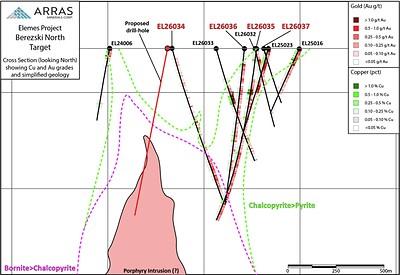
Exploration Program Update: Four diamond drill rigs continue to operate at Elemes. Two rigs are drilling at Berezski North, one at Berezski East and one at Berezski Central. To date in 2026, the Company has completed approximately 24,000m in 35 drill holes at Elemes.
In addition, the Company recently completed a 362-hole KGK program totaling more than 6,000m across the Berezski and Aimandai trends to identify additional targets for follow-up exploration. Final assay results from the KGK program are expected later this month and will be reported as they become available.
Assay turnaround times have increased significantly compared with 2025 amid higher global exploration activity. The Company is working with ALS Chemex in Karaganda to identify ways to reduce turnaround times, including evaluating the installation of an ALS-operated sample-preparation facility in Ekibastuz. The Company has more than 3,000 drill-core samples currently awaiting assay results.
Core photos
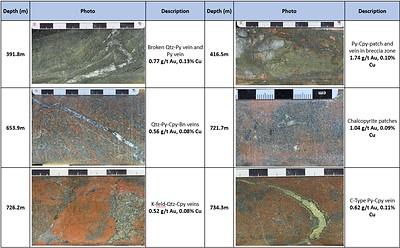
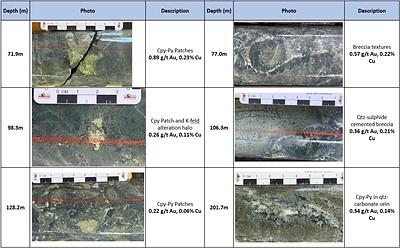
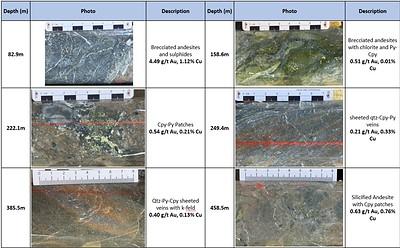
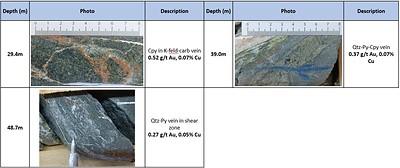
Elemes Phase II Drill Program: Arras Minerals commenced its 20,000m Phase II diamond drill program at Elemes in June 2025. Drilling paused in late December for the scheduled winter break and recommenced in February 2026. Nearly 10,000m were completed in 2025, and continued exploration success prompted the Company to expand the program to a planned 40,000m, targeted for completion by the end of 2026.
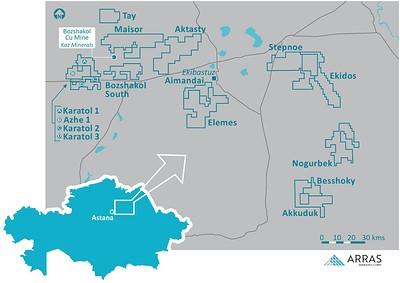
Elemes Project Overview: The Elemes Project comprises two exploration licences covering 531 square kilometres in northeastern Kazakhstan, approximately 13 km southwest of Ekibastuz and 20 km from Arras’ operational base. The project benefits from excellent infrastructure, with a paved highway crossing the licences and power transmission, heavy rail and other utilities within a 15 km radius.
Situated within the prolific Bozshakol-Chingiz metallogenic belt, Elemes lies near significant regional deposits, including the Beskauga porphyry copper-gold-silver deposit (~80 km east) and KAZ Minerals’ Bozshakol copper-gold mine (~60 km northwest), which has reported mined grades of 0.39% copper and 0.19 g/t gold. 1
Geologically, the property is underlain by interbedded intermediate volcanic and sedimentary rocks intruded by multiple phases of diorite and monzodiorite porphyry. Copper-gold mineralization occurs in sheeted and stockwork quartz-chalcopyrite veins associated with these intrusions. In addition, high-grade low-sulphidation epithermal veins have been mapped on the property and represent a secondary exploration target.
Property-wide soil sampling programs defined two extensive Cu-Mo-As geochemical anomalies: the Berezski and Aimandai trends, both considered priority targets for follow-up exploration drilling. A Phase I drill program on the Berezski trend in late 2024 returned high-grade porphyry/epithermal copper-gold mineralization in results announced in Q1 2025. A 20,000m Phase II drill program commenced in May 2025 and has since been expanded, with a current target of 40,000m by the end of 2026.
References
1KAZ Minerals Q4 2025 Production Report.
https://www.kazminerals.com/app/uploads/2026/02/Q4-2025-Production-report_FINAL_ENG.pdf
Bouzari, F; Lee, R; Hart, C; Barker, S; van Straaten, B, “Mineralogical and Geochemical Vectors Within and Around Advanced Argillic-Altered Rocks of British Columbia”, Economic Geology, March, 2026
Halley, S; Dilles, J; Tosdal, R, “Footprints: Hydrothermal Alteration and
Geochemical Dispersion Around Porphyry Copper Deposits”, SEG Newsletter, January 2015
Issuance of DSUs
The Company has granted an aggregate of 24,866 deferred share units (“DSUs”) to certain independent directors at a price of C$1.51 per DSU. The DSUs were granted in consideration for services rendered by the directors for the quarter ended July 31, 2026, in lieu of cash. The DSUs were granted in accordance with the Company’s Equity Incentive Plan and were priced based on the volume-weighted average price of the Company’s common shares on the TSX Venture Exchange for the five trading days immediately preceding the grant date. To date, the Company has issued a total of 231,621 DSUs to its independent directors.
Quality Assurance and Quality Control
The Company adheres to CIM Best Practices Guidelines for exploration-related activities conducted on its property. Quality Assurance and Quality Control (QA/QC) procedures are overseen by the Qualified Person.
Arras Minerals QA/QC protocols include the insertion of certified reference materials (standards), blanks and field duplicates into the sample stream. Drill core is cut by Company personnel at Arras Minerals’ operations base in Ekibastuz, Kazakhstan. Diamond drill core is sawn in half and sampled at intervals of up to 2 metres, with samples terminated at geological boundaries. One half is placed in sealed bags and shipped to the laboratory, while the other half is retained on site.
Each bagged core sample was shipped to the ALS laboratory in Karaganda, Kazakhstan. Samples were dried, crushed and pulverized to greater than 80% passing -200 mesh. Prepared sample splits were sent to ALS Chemex geochemical analysis laboratories in Loughrea, County Galway, Ireland, and Lima, Peru, for multi-element analysis. Multi-element analyses were completed by ICP-MS following a four-acid digestion (method ME-MS61), and samples containing greater than 1.0% copper were analyzed using method Cu-OG62.
Gold analysis was conducted by ALS Chemex at its analytical laboratory in Karaganda, Kazakhstan. Gold was analyzed by 30 g fire assay with an AA (atomic absorption) finish (method Au-AA23), with a detection limit of 0.005 g/t gold. Samples containing greater than 10.0 g/t gold were analyzed by fire assay with a gravimetric finish (method Au-GRA21).
ALS is an accredited laboratory that is independent of the Company. Chain of custody is maintained from the drill site through submission to the laboratory preparation facility.
Qualified Person
The scientific and technical disclosure in this news release has been prepared under the supervision of, and approved by, Matthew Booth, Vice President of Exploration of Arras Minerals Corp., a Qualified Person for the purposes of NI 43-101. Mr. Booth has reviewed and approved this release. Mr. Booth has more than 20 years of mineral exploration experience and is a Certified Professional Geologist with the American Institute of Professional Geologists (CPG 12044).
Metal-equivalent grades are calculated using the metal prices and recoveries set out in this news release. All drill-hole intervals are reported as core lengths because true thicknesses are unknown. Assumed metal prices are US$3.75/lb copper, US$3,000/oz gold, US$35/oz silver and US$30/lb molybdenum.
The Company has updated assumed metal recoveries to 90% for copper, 85% for gold, 75% for silver and 80% for molybdenum. These figures are based on a review of published data from advanced-stage porphyry projects, including Vizcachitas (Los Andes Copper); Copper Creek (Faraday Copper); Valeriano (ATEX Copper); Los Helados (NGEx Resources Inc.); Opemiska (XXIX Metal Corp.); Costa Fuego (Hot Chili Limited); Moonlight-Superior (US Copper Corp.); Warintza (Solaris Resources Inc.); Chita Valley (Minsud Resources Corp.); and Hat (Doubleview Gold Corp.).
Copper equivalent (“CuEq”) grades reported for drill holes at Elemes were calculated using the following formula: CuEq % = ((Copper (%)) x 0.9) + ((Gold (g/t) x 0.8571) x 0.85) + ((Silver (g/t) x 0.0117) x 0.75) + ((Molybdenum (ppm) x 6.8568) x 0.80).
Gold equivalent (“AuEq”) grades reported for drill holes at Elemes were calculated using the following formula: AuEq g/t = (Gold (g/t) x 0.85) + ((Copper (%) x 1.1667) x 0.9) + ((Silver (g/t) x 0.0136) x 0.75) + ((Molybdenum (ppm) x 8.0) x 0.80).
Brutus Mining Inc. (CSE: BRU) (FSE: ZI3) is pleased to announce that it has closed its non-brokered ... READ MORE
Jaguar Uranium Corp. (NYSE American: JAGU) is pleased to announce an independent Mineral Resource E... READ MORE
Auro Metals Inc. (TSX-V: AURO) (OTCQB: AURFF), is pleased to announce the assay results of the fina... READ MORE
Endeavour Silver Corp. (NYSE: EXK) (TSX: EDR) is pleased to announce that repairs to the primary bal... READ MORE
Scorpio Gold Corp. (NASDAQ: SGLD) (TSX-V: SGLD) (OTCQB: SRCRF) (FSE: RY9) is pleased to announce re... READ MORE