







Deeper Drilling Beneath High-Grade Perry Zone Now Underway
Arizona Gold and Silver Inc. (TSX-V: AZS) (OTCQB: AZASF) is pleased to report assay results from four diamond drill holes completed at its Philadelphia Project in Arizona. The results extend both high-grade and broad zones of gold mineralization approximately 150 metres vertically above previously reported high-grade intersections in the Perry Zone. Today’s results further demonstrate the expanding size and large scale of the gold-silver hydrothermal system along Arabian Fault system with enhanced fluid flow and mineralization development in the Perry Zone area.
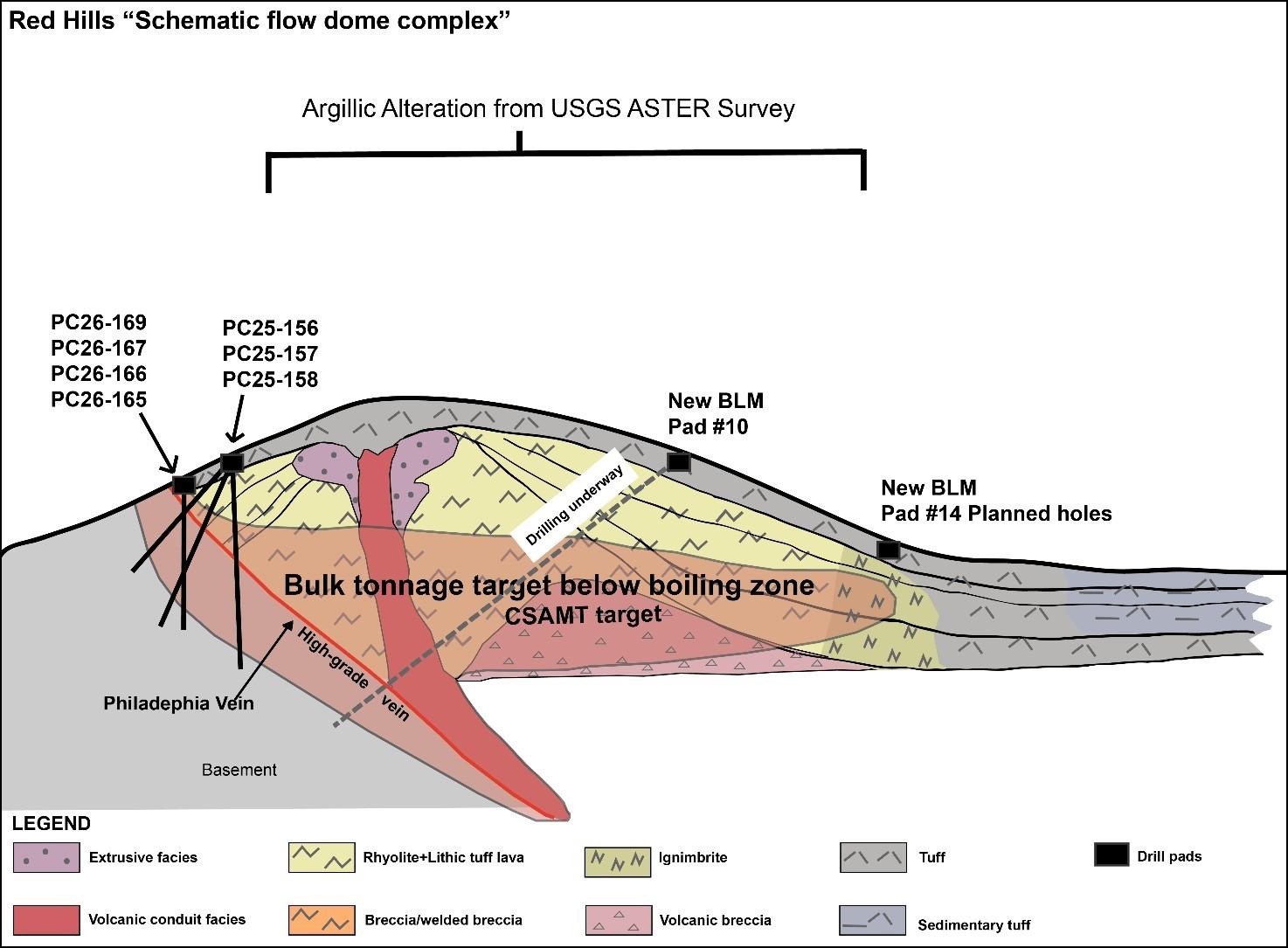
With expanded U.S. Bureau of Land Management permits now in place, drilling has transitioned to testing the projected down-dip continuation of the high-grade intercepts in the Perry Zone beneath the hematite and argillic altered cap to the Red Hills (Figure 1).
Highlights
Dr. Lex Lambeck, Senior Vice President Exploration, commented:
“These results further strengthen our geological model, demonstrating broad gold mineralization within the Perry Zone and increasing our confidence in the geometry and continuity of the system”
“Importantly drilling has now moved below these higher-grade intersections with drilling underway testing the projected down-dip continuation of the Perry Zone together with a CSAMT geophysical target beneath Red Hills. This represents an important next step expanding the high-grade core of the Perry Zone, further proofing our geological model and testing an exciting target beneath the strong alteration seen at surface in the Red Hills” (Figure 1).
Drill Results
The four holes reported in this release: PC26-165, PC26-166, PC26-167 and PC26-169: were designed primarily to test up-dip extensions of mineralization previously intersected in the Perry Zone and further define the broader mineralized envelope above the which occurs around the high-grade core of the system.
PC26-169
Hole PC26-169 was drilled approximately 30 metres north of PC25-154 (22.47m at 3.05 Au gpt) at an azimuth of 330 degrees and an inclination of -80 degrees. The hole tested the up-dip extension of mineralization encountered in PC25-157 (6.28m at 7.02 Au gpt) and intersected mineralized rhyolite and andesite quartz breccia and calcite breccia.
Significant results include:
Mineralization is associated with strong andesite-hosted quartz-calcite veining and brecciation and occurs above the interpreted boiling horizon within the upper portion of the hydrothermal system.
PC26-165
Hole PC26-165 was drilled approximately 90 metres above PC23-111 at an azimuth of 213 degrees and an inclination of -79 degrees. The hole tested the up-dip continuation of mineralization and intersected a broad mineralized corridor hosted by quartz-rich rhyolite breccia and calcite breccia.
Significant results include:
Mineralization occurs stratigraphically above the interpreted boiling horizon and is characterized by quartz-rich brecciation and progressively stronger calcite veining with depth.
PC26-167
Hole PC26-167 drilled approximately 90 metres above PC25-156 (20.43m at 9.04 gpt Au) at an azimuth of 319 degrees and an inclination of -75 degrees. The hole tested the up-dip continuation of the Perry Zone and intersected a broad zone of mineralization within the upper portion of the interpreted hydrothermal upwelling system.
Significant results include:
Alteration, brecciation and vein textures are consistent with drilling remaining within the upper portion of the hydrothermal system above the high-grade portion of the Perry Zone.
PC26-166
Hole PC26-166 was drilled approximately 20 metres below PC25-154 (22.47m at 3.05 gpt Au) at an azimuth of 305 degrees and an inclination of -75 degrees. The hole tested the up-dip continuation of the Perry Zone and intersected broad gold mineralization within the upper hydrothermal system.
Significant results include:
Table 1: Key grade/thickness intervals
| Drill hole | Cut off (g) | From (m) | To (m) | Thick (m) | Au gpt | Ag gpt |
| PC26-169 | 3 | 256.18 | 277.97 | 21.79 | 4.1 | 5.8 |
| within | 1 | 245.36 | 282.70 | 37.34 | 3.1 | 7.1 |
| within | 0.25 | 242.41 | 284.38 | 73.46 | 1.69 | 4.4 |
| PC26-165 | 3 | 142.19 | 143.16 | 0.98 | 10.19 | 8.7 |
| within | 1 | 110.83 | 113.93 | 3.11 | 3.34 | 12.7 |
| 1 | 142.19 | 149.14 | 6.95 | 2.07 | 2.9 | |
| within | 0.25 | 109.42 | 171.69 | 62.27 | 0.70 | 2.0 |
| PC26-167 | 3 | 229.21 | 244.45 | 15.24 | 2.66 | 5.6 |
| within | 1 | 226.77 | 255.12 | 28.35 | 2.19 | 7.9 |
| within | 0.25 | 191.11 | 257.92 | 66.81 | 1.12 | 4.0 |
| PC26-166 | 3 | 247.35 | 248.72 | 1.37 | 3.02 | 6.6 |
| within | 1 | 234.62 | 258.32 | 23.64 | 1.42 | 6.8 |
| within | 0.25 | 227.69 | 260.63 | 32.95 | 1.11 | 6.0 |
Next Phase of Exploration: Testing the Perry Zone at Depth
The drilling reported in this release has defined an additional 150+ metres of vertically continuous gold mineralization above the high-grade intercepts previously reported in the deepest Perry Zone intercepts, further defining a broad mineralized envelope and strengthening the Company’s geological model.
With expanded BLM permitting now in place, drilling has moved to the projected down-dip continuation of the Perry Zone beneath Red Hills (Figure 1). Deeper drilling will test both the Perry Zone and a coincident Controlled-Source Audio-frequency Magnetotellurics (“CSAMT”) geophysical anomaly. Widespread hematite alteration and abundant pseudomorphs after pyrite at Red Hills support the interpretation that the area represents the upper expression of a large hydrothermal system which includes the east-dipping Perry Zone.
The expanded permit provides access to 16 additional drill pads and the flexibility to operate multiple rigs, enabling systematic testing of the Perry Zone at depth and other high-priority targets. Exploration is also advancing over the Eastern and Northeastern hyperspectral anomalies as the Company evaluates the district-scale potential of the Philadelphia low-sulfidation epithermal gold system.
Figure 1: Red Hills Boiling Zone Beneath Rhyolite Flow Dome looking northeast. The surface argillic alteration is approximately 650m wide.
QA/QC Protocols
All core samples were processed at Skyline Labs in Tucson, Arizona, International Standard ISO 9001:2015. Gold was analyzed by fire assay with AA finish, with over-limits re-analyzed gravimetrically. Silver and multi-element analysis were completed using ICP-MS methods. The Company maintains a rigorous QA/QC program including insertion of certified standards and blanks.
Qualified Person
Dr. Lex Lambeck, SVP Exploration for Arizona Gold and Silver and Certified Professional Geologist (11734), is the Qualified Person under NI 43-101 for this release and has reviewed the drill core and assay data for this release and approved the technical content of this release.
About Arizona Gold & Silver Inc.
Arizona Gold & Silver Inc. is a leading exploration company focused on uncovering precious metal resources in Arizona and Nevada. With a commitment to sustainable practices and innovative exploration techniques, the company aims to drive value for stakeholders while prioritizing environmental stewardship. The flagship asset is the Philadelphia gold-silver property where the Company is drilling off an large scale epithermal gold-silver system.
Daura Gold Corp. (TSX-V: DGC) (OTC: DGCOF) is pleased to announce that it has closed its previously ... READ MORE
Trojan Gold Inc. (CSE: TGII) is pleased to announce that, further to its press releases dated March ... READ MORE
Peruvian Metals Corp (TSX-V: PER) (OTCQB: DUVNF) announces third quarter production results a... READ MORE
Osisko Gold Group Inc. (NYSE: OGG) (TSX-V: OGG) is pleased to announce that it has completed its pr... READ MORE
Grande Portage Resources Ltd. (TSX-V: GPG) (OTCQX: GPTRF) (FSE: GPB) is pleased to announce that, fu... READ MORE